
Your regulatory change management checklist runs five stages: Identification, Assessment, Planning, Implementation, and Verification. Your immediate next action is to open your change log right now and create a timestamped entry for any regulatory notice you received in the last 30 days, including the source URL, jurisdiction, and effective date. With 92% of compliance professionals reporting their roles have grown harder due to regulatory volume, the gap between reactive scrambling and a defensible, repeatable process is widening fast. Agencies like the SEC, CFPB, FinCEN, and OFAC issue updates on overlapping timelines, and without a structured intake mechanism, even well-staffed teams miss material changes. Riskinmind's AI-powered compliance monitoring is built specifically for this environment, giving credit unions, community banks, and lenders a single system of record across all five stages.
Next 24–72 hours:
- Log every open regulatory notice in a change log with source URL, jurisdiction, and effective date
- Assign a preliminary owner to each open item
- Flag any change with an effective date within 90 days as high-priority
- Schedule a 30-minute triage call with your senior compliance officer and a business-unit lead
Maintain 100% NCUA & OCC Audit Readiness
Monitor regulatory updates 24/7, check internal credit policies, and generate compliance trails with Erina (AI Regulatory Agent).
Pro Tip: Start with the Federal Register's daily email digest and the CFPB's supervisory highlights. These two sources alone cover the majority of material changes affecting U.S. consumer financial institutions.
Table of Contents
- What does a complete regulatory change management checklist look like?
- How should you assign governance and accountability for RCM?
- Where should you monitor for regulatory changes?
- How do you assess impact and prioritize regulatory changes?
- How do you build an implementation plan that holds up at audit time?
- How do you verify compliance and prepare for an exam?
- What does the research say about RCM program maturity?
- What operational artifacts and tool capabilities does your team need?
- How do you measure RCM program health?
- Templates you can adopt immediately
- Key Takeaways
- Why RCM must be an operating discipline, not a project
- Riskinmind gives financial institutions an audit-ready RCM foundation
- Authoritative sources and further reading
What does a complete regulatory change management checklist look like?
A mature five-stage RCM process requires a specific artifact at each stage, a named owner, and a clear acceptance criterion. The table below maps each stage to what your team must produce and who is accountable.

| Stage | Required Artifact | Owner | Acceptance Criteria |
|---|---|---|---|
| Identification | Change log entry | Regulatory intelligence owner | Timestamped; includes source URL, jurisdiction, effective date, topic tag |
| Assessment | Impact memo | Senior compliance officer | Signed; covers scope, affected systems, effort estimate, legal interpretation |
| Planning | Implementation plan | Business implementer | Milestones, owners, deadlines, and deliverables documented; linked to obligations register |
| Implementation | Evidence package | Business implementer + IT/ops | Policy/control updates, training records, config screenshots, contract amendments |
| Verification | Verification report | Internal audit / second line | Controls tested; sampling documented; attestation signed; remediation tracked |
Identification is where most programs leak. A change that never enters the log cannot be assessed, planned, or verified. Every incoming regulatory notice, whether a final rule, proposed rulemaking, or enforcement action, needs a log entry within 24 hours of receipt.
Assessment is the most frequent failure point: assessors must map regulatory intent across multiple functions, not just read the rule text. The impact memo must capture which systems, processes, contracts, and business lines are affected, along with a preliminary effort estimate and a legal interpretation note.
Planning translates the memo into a tracked project. Every task needs a named owner, a deadline tied to the regulatory effective date, and a link back to the obligations register entry.

Implementation is execution plus evidence. Screenshots, policy version numbers, training attendance logs, and signed attestations must be captured in real time, not reconstructed before an exam.
Verification closes the loop. Testing must confirm that the spirit of the regulation is met, not just that a policy document was updated.
How should you assign governance and accountability for RCM?
Clear ownership is the structural backbone of any RCM program. Without it, the five-stage checklist becomes a shared responsibility that belongs to no one.
Sample RACI for core RCM activities
| Activity | Regulatory Intelligence Owner | Senior Compliance Officer | Business Implementer | Internal Audit / Second Line | Executive Sponsor |
|---|---|---|---|---|---|
| Identification / log entry | R | A | C | I | I |
| Impact assessment | C | R/A | C | I | I |
| Implementation planning | I | A | R | C | C |
| Execution / evidence capture | I | C | R | I | I |
| Verification / controls testing | I | C | C | R/A | I |
| Board / exec reporting | C | R | I | C | A |
R = Responsible, A = Accountable, C = Consulted, I = Informed
Escalation triggers should be defined in writing. A high-urgency item, defined as any change with an effective date within 60 days or a penalty exposure above your institution's materiality threshold, should escalate to the executive sponsor within 48 hours of identification. Items requiring system changes or contract amendments should trigger an immediate cross-functional meeting.
Staffing RCM by function size:
- Small compliance function (1–3 staff): The compliance officer serves as both regulatory intelligence owner and assessor; a designated business-unit lead handles implementation; internal audit verifies.
- Medium function (4–10 staff): Separate the intelligence owner from the assessor; assign a dedicated implementer per business line; second-line risk handles verification.
- Large function (10+ staff): A regulatory intelligence team feeds a formal assessment committee; business-unit compliance leads own implementation; independent internal audit verifies with formal sampling.
Pro Tip: Even in a small institution, the person who identifies a change should never be the sole verifier. That independence is what makes your evidence defensible in an exam.
Where should you monitor for regulatory changes?
Horizon scanning works only when you know which sources are authoritative, how often to check them, and how to triage what comes in. Scanning frequency should be tied to enforcement risk: critical enforcement pages every 6–12 hours, important guidance sources daily, and tertiary or watch-list sources weekly.
Priority sources for U.S. financial institutions
| Source | Criticality | Recommended Frequency | What to Watch |
|---|---|---|---|
| Federal Register | Critical | Daily | Final rules, proposed rules, effective dates |
| CFPB | Critical | 6–12 hours | Supervisory highlights, enforcement actions, circulars |
| SEC | Critical | 6–12 hours | Releases, no-action letters, exam priorities |
| FinCEN | Critical | Daily | BSA/AML advisories, SAR guidance |
| OFAC | Critical | 6–12 hours | Sanctions updates, SDN list changes |
| Federal Reserve / OCC / FDIC | Important | Daily | SR letters, guidance, examination manuals |
| State banking regulators | Important | Daily | State-specific licensing, consumer protection |
| FATF / BIS (international) | Watch | Weekly | Cross-border obligations, correspondent banking |
| Industry bodies (ABA, CUNA, MBA) | Watch | Weekly | Advocacy positions, comment letters, summaries |
Triage process: When a new item enters the queue, tag it immediately with jurisdiction, topic area (e.g., BSA/AML, fair lending, capital), and a preliminary priority score. Route it to the relevant regulatory intelligence owner within 24 hours. Items that do not clear your materiality threshold, meaning they affect no current product, process, or customer population, go to a "monitor only" file with a 90-day review trigger.
Pro Tip: Set up a shared inbox or a dedicated channel in your workflow tool for regulatory alerts. Routing everything through one person's email is a single point of failure that creates backlogs during high-volume periods.
How do you assess impact and prioritize regulatory changes?
Not every regulatory change demands the same response. A scoring matrix that combines impact and urgency lets you allocate limited compliance resources to the changes that matter most.
Impact × urgency scoring matrix
| Score | Impact (1–3) | Urgency (1–3) | Priority | Suggested Response Time |
|---|---|---|---|---|
| — | High (3) | High (3) | Critical | Immediate escalation; implementation plan within 5 business days |
| 4–6 | Medium (2) | Medium (2) | Elevated | Assessment within 10 business days; plan within 30 days |
| 1–3 | Low (1) | Low (1) | Standard | Assessment within 30 days; plan within 60 days |
Impact covers financial exposure, customer harm potential, operational disruption, and reputational risk. Urgency reflects time to effective date, enforcement signals, and exam cycle proximity.
Every high-priority change requires a formal impact memo. That memo must capture: scope of the change, affected systems and processes, affected legal entities or business lines, estimated effort in person-hours or project weeks, a plain-language legal interpretation, and the name of the assessor with a sign-off date. For a detailed framework on documenting these assessments, the step-by-step risk assessment guide covers the full methodology.
Multi-jurisdictional changes require an additional column in the impact memo: a jurisdiction-by-jurisdiction comparison of requirements, noting where federal and state obligations diverge. When a federal rule sets a floor and a state rule adds requirements, the more restrictive standard governs your implementation plan.
Effort bands by change category:
- Policy-only change: 1–5 business days (drafting, review, approval, distribution)
- Process or control change: 2–6 weeks (design, testing, training, sign-off)
- System or technology change: 4–16 weeks (requirements, development, UAT, deployment)
- Contract amendments: 3–12 weeks (legal review, counterparty negotiation, execution)
How do you build an implementation plan that holds up at audit time?
An implementation plan is not a project plan in the general sense. It is a compliance artifact, and every milestone must be traceable back to the regulatory source that triggered it.
Implementation plan template structure
| Milestone | Owner | Deadline | Deliverable | Linked Obligation |
|---|---|---|---|---|
| Policy update drafted | Compliance officer | [Date] | Revised policy document, version-controlled | [Obligation ID] |
| Policy approved | Executive sponsor | [Date] | Signed approval memo | [Obligation ID] |
| System configuration updated | IT/operations | [Date] | Config export / screenshot | [Obligation ID] |
| Training delivered | HR / L&D | [Date] | Attendance log with timestamps | [Obligation ID] |
| Contract amendments executed | Legal | [Date] | Executed amendment copies | [Obligation ID] |
| Controls testing initiated | Internal audit | [Date] | Testing plan | [Obligation ID] |
Communication is a milestone, not an afterthought. Business units need to know what is changing, why, and by when, before the effective date, not after. Executive leadership needs a status summary at each major milestone. Vendors and counterparties affected by contract changes need lead time to negotiate and execute.
Link every task in the implementation plan to its entry in the obligations register. That linkage is what creates traceability from the original regulatory source through to the completed control. Automation in regulatory reporting can maintain this traceability automatically, reducing the manual effort of keeping the register synchronized with implementation status.
Pro Tip: Version-control every policy document with a date stamp and an approver name in the document footer. An undated policy is nearly impossible to defend in an exam when the examiner asks which version was in effect on a specific date.
How do you verify compliance and prepare for an exam?
Verification is where many programs stop short. Checking that a policy was updated is not verification. Testing must confirm that the control actually operates as the regulation requires, which means sampling transactions, reviewing system outputs, and confirming that staff behavior has changed.
Controls testing checklist
- Identify the specific control(s) that implement the regulatory requirement
- Define the testing objective: what does "compliant" look like operationally?
- Select a sample (random or risk-based) of transactions, records, or outputs
- Test each sample item against the regulatory requirement, not just the internal policy
- Document results: pass/fail, exception details, root cause for failures
- Track remediation for any exceptions with owner and deadline
- Obtain verifier sign-off with timestamp
- File the completed testing workpaper in the evidence repository
Evidence examples and retention guidance:
| Evidence Type | Format | Minimum Retention |
|---|---|---|
| Policy documents | PDF, version-controlled | — |
| Training attendance logs | Timestamped roster or LMS export | 5 years |
| System configuration exports | Screenshots or config files with date | 5 years |
| Signed attestations | PDF with digital or wet signature | — |
| Testing workpapers | Structured workpaper with sampling detail | — |
| Change log entries | Immutable system record or locked spreadsheet | — |
Maintaining audit-grade evidence in real time, rather than reconstructing it before an exam, is the single most effective way to reduce examination findings. Examiners can tell the difference between documentation that was built as the work happened and documentation assembled the week before their arrival.
Pro Tip: For compliance testing programs, independence matters as much as thoroughness. The person who implemented a control should not be the person who tests it. Even in small institutions, a second reviewer adds credibility to the evidence file.
What does the research say about RCM program maturity?
The data on regulatory change volume is unambiguous. Ninety-two percent of compliance professionals report that their roles have become harder due to the pace and volume of regulatory change, a finding that reflects the lived experience of every compliance officer managing overlapping federal and state obligations.
The five-stage RCM model, Identification, Assessment, Planning, Implementation, and Verification, is the practitioner consensus for a defensible, auditable process. Each stage requires a timestamped artifact and a named owner. Without both, the stage does not exist from an examiner's perspective.
The distinction between proactive RCM and reactive compliance management is not semantic. Reactive compliance discovers new obligations through enforcement actions. Proactive RCM monitors proposed rules, guidance documents, and enforcement signals before effective dates, compressing the time available for implementation and reducing the risk of a gap. A structured five-stage workflow with a single system of record compresses the time between regulatory publication and full implementation and reduces audit findings tied to non-implementation.
The artifact requirement at each stage is not bureaucratic overhead. It is the mechanism that makes the process defensible. An examiner who asks "how did you identify this change, who assessed it, and when was it implemented?" needs a timestamped answer at each step.
What operational artifacts and tool capabilities does your team need?
The artifacts your team must preserve are the physical evidence of a functioning RCM program. Without them, the process exists only in people's memories, which is not a defensible position.
Required operational artifacts:
- Change log (immutable, timestamped, with source URL and jurisdiction per entry)
- Impact memos (signed, dated, with scope and effort estimates)
- Implementation plans (version-controlled, with milestone completion dates)
- System configuration exports or screenshots (dated, linked to the relevant change)
- Training records (attendance logs with timestamps, course version, and completion status)
- Verification reports (testing workpapers with sampling methodology and sign-off)
A centralized obligations register integrated with downstream controls is the operational backbone. Many teams build the register but fail to connect it to active control logic, such as underwriting rules, fraud detection parameters, or contract clause libraries. A change is only fully managed when it reaches that active control layer. For documentation standards that support this integration, the risk management documentation standards guide covers the full requirements.
Tool capabilities checklist for evaluating RCM platforms
| Capability | What to Look For |
|---|---|
| Regulatory monitoring feeds | Multi-source, multi-jurisdiction, configurable alert thresholds |
| Obligation mapping | Automated linkage from regulatory source to internal control |
| Workflow automation | Assignable tasks, deadline tracking, escalation routing |
| Immutable audit trail | Timestamped, user-attributed, tamper-evident record of every action |
| Evidence repository | Structured storage with retention rules and access controls |
| Reporting dashboards | Real-time status, aging reports, board-ready exports |
| Integrations | CLM, HR/LMS, ITSM, core banking systems |
When a lightweight tool is sufficient: A small institution with fewer than five active regulatory changes per quarter and a two-person compliance function can manage with a structured spreadsheet and a shared document repository, provided the change log is locked after each entry and evidence is stored with consistent naming conventions.
When an enterprise GRC platform or AI-assisted feed is warranted: Multi-charter institutions, those operating across five or more state jurisdictions, or any organization tracking more than 20 active changes simultaneously will find manual tools create more risk than they eliminate. Automated monitoring and workflow tools materially reduce time-to-complete and improve audit readiness at that scale.
Pro Tip: Treat the obligations register as a live operational system, not a compliance archive. Connect it to your underwriting rules engine, your fraud detection parameters, and your contract management system. A register that sits in a GRC tool but never touches active operations is a documentation exercise, not a control.
How do you measure RCM program health?
KPIs give you a factual basis for reporting to the board and for identifying where the program is breaking down before an examiner does.
Core KPIs and KRIs for RCM
| Metric | Definition | Target / Escalation Trigger |
|---|---|---|
| Time-to-identification | Days from regulatory publication to change log entry | Less than 2 business days for critical sources |
| Time-to-assessment | Days from log entry to signed impact memo | Less than 10 business days for elevated/critical items |
| Time-to-complete | Days from log entry to verified implementation | Before regulatory effective date |
| % changes verified before effective date | Verified items / total items due in period | a large majority |
| Open-gap aging | Number of items past their target completion date | Zero tolerance for critical items; escalate at 30 days for elevated |
| Exam findings tied to RCM | Findings attributable to missed or late implementation | Target: zero |
For monthly or quarterly board reporting, present these metrics as a dashboard with three views: current-period status (green/yellow/red by item), trend over the last four quarters, and an aging report for open items. Escalation triggers should be defined in the reporting template itself, not left to judgment at the time of the meeting.
Post-implementation reviews are the mechanism for continuous improvement. After each significant change cycle, ask three questions: Did we identify the change early enough? Did the assessment capture all affected systems? Did verification confirm the regulatory intent, not just the paperwork? The answers drive adjustments to monitoring coverage, scoring thresholds, and artifact requirements.
Templates you can adopt immediately
The templates below are designed to be copied directly into a ticketing system, GRC platform, or spreadsheet. Each row or field maps to an artifact required at a specific RCM stage.
Change log row template
| Field | Value |
|---|---|
| Change ID | [Auto-generated or sequential] |
| Date identified | [YYYY-MM-DD HH:MM] |
| Source | [e.g., Federal Register, CFPB.gov] |
| Source URL | [Direct link to the notice] |
| Jurisdiction | [Federal / State / Multi-jurisdictional] |
| Topic tag | [e.g., BSA/AML, Fair Lending, Capital] |
| Effective date | [YYYY-MM-DD] |
| Priority score | [Critical / Elevated / Standard] |
| Assigned owner | [Name, title] |
| Status | [Identified / In Assessment / In Planning / In Implementation / Verified] |
Impact memo header template
Change ID: [ID] Regulatory source: [Agency, rule title, citation] Effective date: [Date] Assessor: [Name, title, date signed] Scope: [Which products, processes, systems, and legal entities are affected] Affected functions: [Compliance, IT, Legal, Operations, HR, etc.] Estimated effort: [Person-hours or project weeks by function] Legal interpretation: [Plain-language summary of the obligation] Recommended priority: [Critical / Elevated / Standard]
Verification report template
Change ID: [ID] Verification date: [Date] Verifier: [Name, title, independence confirmation] Controls tested: [List of specific controls] Sampling methodology: [Random / Risk-based; sample size and selection criteria] Results summary: [Pass / Fail counts; exception details] Remediation items: [Owner, deadline, status for each exception] Attestation: [Verifier sign-off with timestamp]
Pro Tip: Lock the change log row and impact memo as PDF or system record immediately after sign-off. Editable documents are not audit-grade evidence. An examiner who sees a Word document with a recent "last modified" date will ask why it was changed.
Key Takeaways
A structured regulatory change management checklist, with timestamped artifacts and named owners at every stage, is the only defensible approach for U.S. financial institutions facing accelerating regulatory volume.
| Point | Details |
|---|---|
| Five-stage checklist | Every RCM program requires Identification, Assessment, Planning, Implementation, and Verification, each with a signed, timestamped artifact. |
| 92% of compliance professionals report rising difficulty | Rising regulatory volume makes a repeatable, documented process non-optional for audit defense. |
| Verification tests intent, not paperwork | Controls testing must confirm the regulation's operational intent is met, not just that a policy document exists. |
| Obligations register must connect to active controls | A register disconnected from underwriting rules, fraud engines, or contract systems is a documentation exercise, not a control. |
| Riskinmind automates the full RCM cycle | Continuous monitoring, obligation mapping, workflow automation, and immutable evidence trails are built into the Riskinmind platform for financial institutions. |
Why RCM must be an operating discipline, not a project
The most consequential mistake compliance teams make is treating regulatory change management as a project with a start and end date. Regulations do not follow a fiscal year. The SEC, CFPB, FinCEN, and state banking regulators issue updates on a continuous, overlapping basis, and the enforcement environment does not pause while your institution catches up.
What actually separates mature programs from reactive ones is not the sophistication of their tools. It is the discipline of maintaining timestamped artifacts at every stage, in real time, before an exam is announced. Teams that reconstruct documentation under examination pressure produce evidence that examiners recognize immediately as retrospective, and that recognition shapes the tone of the entire examination.
The governance model matters more than most compliance officers acknowledge. A RACI that assigns accountability to a committee rather than a named individual is a RACI that will not hold under pressure. When a critical change arrives with a 45-day effective date, the question "who owns this?" needs a one-word answer, not a meeting.
Technology does not replace judgment in RCM, but it does eliminate the manual overhead that causes teams to miss changes, delay assessments, and lose evidence. AI-assisted monitoring feeds, automated obligation mapping, and immutable audit trails compress the time between identification and verified implementation. That compression is what reduces exam findings, not the volume of documentation produced.
Riskinmind gives financial institutions an audit-ready RCM foundation
Compliance officers at credit unions, community banks, and lenders face a specific challenge: the same regulatory obligations as larger institutions, with a fraction of the compliance staff. Manual tracking creates gaps that show up as exam findings. Riskinmind addresses that gap directly, with continuous regulatory monitoring, an AI-powered obligation mapping engine, automated workflow routing, and an immutable evidence trail that satisfies examiner expectations without requiring your team to rebuild documentation from scratch.
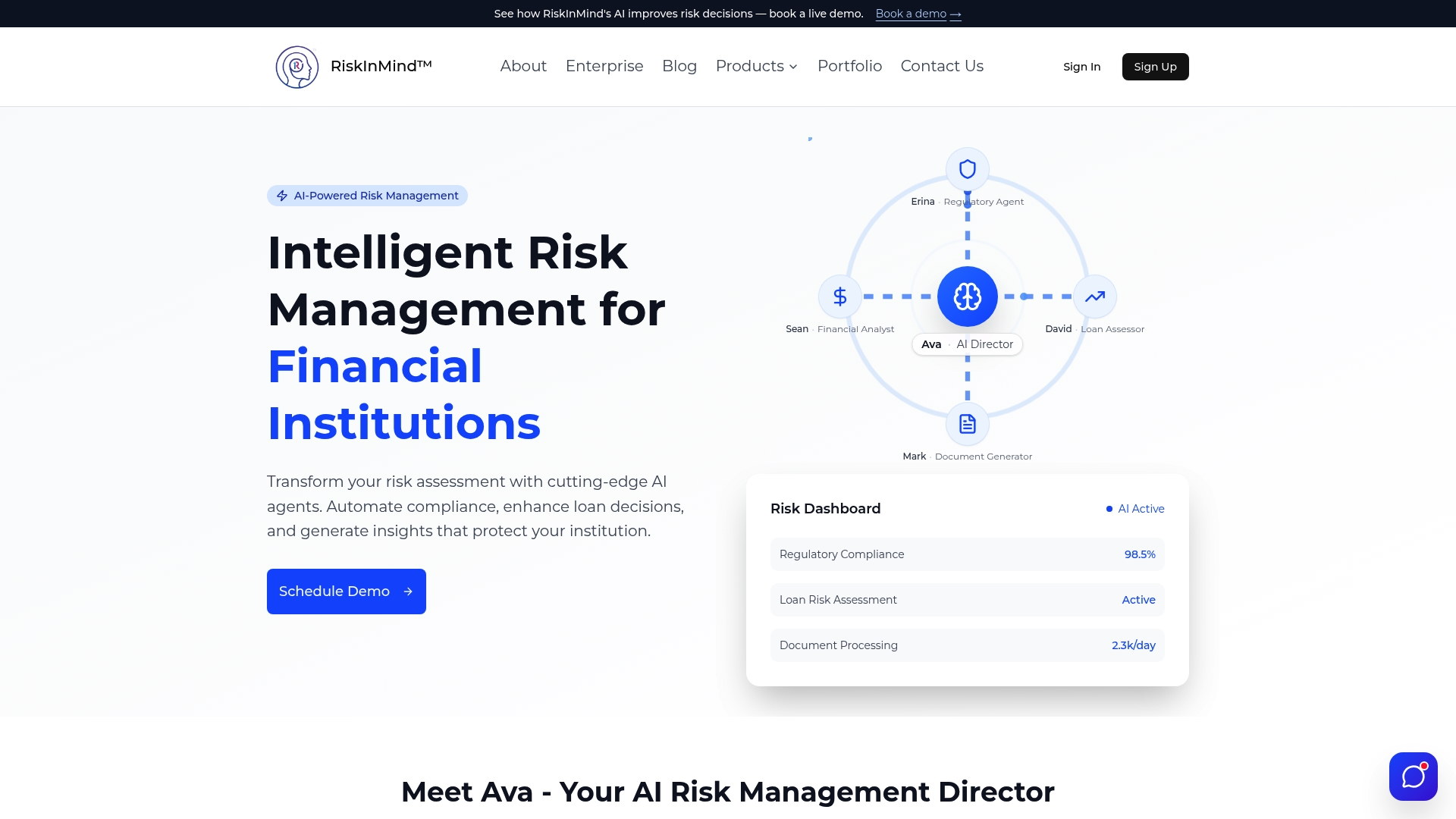
Ava, Riskinmind's central AI director, coordinates specialized compliance agents that monitor SEC, CFPB, FinCEN, OFAC, and state regulator feeds in real time, flag material changes, and route them to the appropriate owner with a pre-populated impact assessment template. The platform's SOC 2® certification and bank-grade security mean the evidence it captures meets the same standards your examiners apply. Every change log entry, impact memo, and verification report is timestamped and tamper-evident from the moment it is created.
Schedule a platform demo to see how Riskinmind maps your regulatory obligations to active controls and generates board-ready compliance dashboards. If you want to explore the loan application workflow specifically, the loan application product page shows how the platform handles underwriting compliance in a regulated lending environment.
Authoritative sources and further reading
The claims and frameworks in this article draw from the following primary sources. Each contributes a distinct element of the RCM methodology.
- MetricStream / Regology — Source of the 92% compliance professional survey finding on rising regulatory difficulty. What is Regulatory Change Management
- eQomply — Primary source for the five-stage RCM model, artifact requirements, and verification guidance. Regulatory Change Management Process
- Archer IRM — Source for the proactive vs. reactive RCM distinction and the future-to-present monitoring mindset. What is Regulatory Change Management? The Definitive Guide
- Changeflow — Source for monitoring cadence thresholds and tool capability guidance. Regulatory Change Management: The Complete Guide
- SureCloud GRC Practitioner Guide — Source for real-time, audit-grade evidence capture requirements. GRC Practitioner Guide, Chapter 5
- Dilitrust — Practitioner framework covering the six-step RCM lifecycle and obligations register design. Regulatory Change Management: A Guide for Legal Leaders
- Riskinmind blog — Related guides on automated compliance for financial institutions and the financial institution compliance process.
The core principle across all these sources is consistent: a regulatory change is only managed when it reaches active control logic, and only defensible when every stage has a timestamped artifact and a named owner. The checklist in this article operationalizes that principle for U.S. financial institutions.