
An AI-driven compliance checklist is a structured, automated framework that maps regulatory controls to AI tools, evidence sources, and risk tiers across a financial institution's operations. Platforms like Compyl and Whistic now integrate with 125+ proprietary data sources to automate evidence collection in real time, while AI-enhanced assessments achieve 97% accuracy compared to 81% with manual methods. That 16-point accuracy gap is not a marginal improvement. It is the difference between a clean audit and a regulatory finding. For compliance officers and risk managers at credit unions, community banks, and lenders, this checklist approach compresses audit-readiness cycles from 12–18 months down to 4–6 months, enabling continuous compliance rather than reactive scrambling before each exam.
What prerequisites does an ai-driven compliance checklist require?
Before you execute any automated compliance program, the foundation must be solid. Three elements determine whether your AI compliance solution produces reliable outputs or simply automates existing gaps.
Automate Regulatory Model Risk Governance
Examine models against 32 qualitative criteria and resolve risk Tiers with pre-deployment checklists per OCC 2011-12 guidelines.
AI Inventory and Tool Approval Documentation

The most overlooked step in any AI compliance review is a complete inventory of every AI tool in use, including tool name, vendor, data types processed, and formal approval status. Shadow AI tools, those adopted without IT or compliance sign-off, create untracked data exposure and regulatory blind spots. Your inventory must distinguish sanctioned tools from unsanctioned ones before any control mapping begins.
Data Governance and Vendor Management Policies
Updated data governance policies must cover AI-specific use cases, data loss prevention rules, data residency requirements, and vendor data processing agreements. Vendor DPAs need explicit clauses on data retention limits and opt-out rights. Without these, automated evidence collection captures activity but cannot confirm that activity meets your regulatory obligations.
Identity, Access, and Integration Controls
Multi-factor authentication and single sign-on are non-negotiable prerequisites. They create the access control layer that your compliance platform monitors and reports against. Enterprise-grade platforms also require pre-built integrations with your cloud infrastructure, CI/CD pipelines, and security tooling to automate evidence at deployment.
| Prerequisite | Compliance Impact |
|---|---|
| AI Inventory with approval status | Eliminates shadow AI risk and maps data exposure |
| Data governance and vendor DPAs | Confirms regulatory obligations are contractually enforced |
| MFA and SSO controls | Provides auditable access records for identity-based controls |
| Platform integrations (125+ sources) | Enables continuous, real-time evidence collection |
| Framework cross-mapping capability | Reduces duplicate controls across SOC 2, ISO 27001, and others |
Pro Tip: Before selecting a compliance management system, confirm it supports your specific regulatory frameworks, such as SOC 2, ISO 42001, FFIEC guidelines, and BSA/AML requirements. A platform that cannot map to your exact frameworks will require manual workarounds that defeat the purpose of automation.
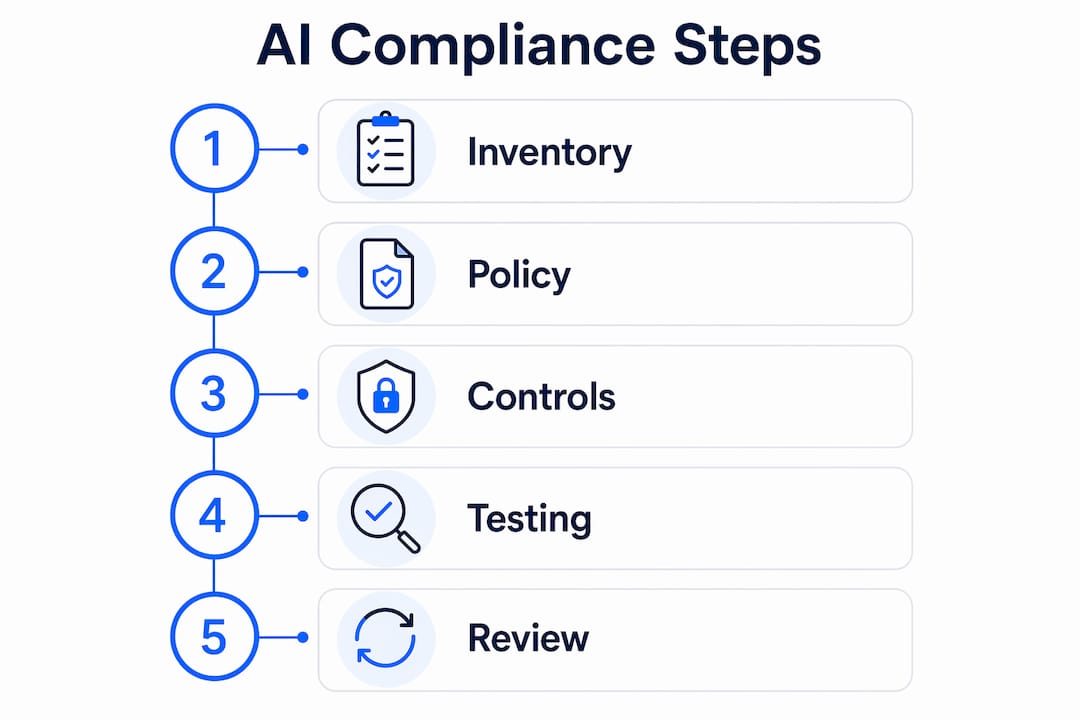
How to execute the core steps of an AI compliance program
The checklist below reflects the operational sequence that compliance teams at financial institutions follow when deploying intelligent checklist automation. Each step builds on the last.
-
Capture all AI tools and use cases in a centralized inventory. Record vendor name, model type, data inputs and outputs, business unit owner, and approval status. This is your compliance baseline. Without it, every subsequent step operates on incomplete information.
-
Map each AI tool and its data exposure surfaces to your compliance frameworks and risk tiers. Tools that process personally identifiable information or credit data carry higher inherent risk and require more rigorous controls. Framework mapping at this stage prevents duplicate control work later.
-
Implement controls across identity access, data handling, and vendor management. This includes enforcing MFA, reviewing vendor contracts for DPA compliance, and confirming data residency settings. The AegisAI model risk management checklist structures this as a 20-item evidence requirement set covering inventory, validation, ongoing monitoring, and documentation control.
-
Automate evidence collection through platform integrations. Modern GRC platforms pull evidence from cloud infrastructure, security tools, and application logs continuously. This replaces point-in-time screenshots with live control data. The result is a compliance posture that reflects your actual environment, not last quarter's audit prep.
-
Establish audit-ready evidence trails with timestamped, immutable records. Structured audit trails with clear pass/fail criteria allow auditors to verify controls without requesting additional documentation. Status indicators alone are insufficient. Auditors require the underlying proof.
Pro Tip: Schedule recurring automated control tests on a daily to monthly cadence depending on control criticality. Tests that run continuously generate permanent timestamped records, which means your audit file builds itself rather than requiring a manual sprint in the weeks before an exam.
The role of AI in regulatory compliance for banks extends beyond task automation. It creates a compliance architecture that is always current, always documented, and always defensible.
What challenges should you anticipate during implementation?
Deploying an AI-driven compliance program surfaces predictable friction points. Knowing them in advance lets you design around them rather than troubleshoot after the fact.
Shadow AI and Inventory Gaps
The most common failure mode is an incomplete AI inventory. Employees adopt AI writing tools, data analysis platforms, and vendor-provided models without formal approval. These tools touch sensitive data and create regulatory exposure that your compliance platform cannot monitor if it does not know they exist. Conduct a network-level discovery scan alongside your self-reported inventory to close this gap.
Siloed Evidence and Static Audit Prep
Many compliance teams still collect evidence in spreadsheets or shared drives, separated by business unit or framework. Continuous control visibility requires that all evidence feeds into a single platform with cross-framework correlation. Siloed collections produce duplicate work and create inconsistencies that auditors flag immediately.
Vendor Data Retention and Opt-Out Failures
Vendor DPAs frequently contain default data retention settings that conflict with your institution's regulatory obligations. Review each vendor agreement for retention periods, data deletion timelines, and opt-out mechanisms. Automate reminders for annual DPA reviews so these settings do not drift out of compliance between audits.
Incomplete or Outdated Evidence Records
Automation enforces timeliness, but only if your platform is configured to flag stale evidence. Set evidence expiration thresholds for each control type. A firewall configuration screenshot from eight months ago does not satisfy an auditor reviewing current-state controls.
"The real differentiator for successful AI-driven compliance is continuous control visibility combined with structured audit trails, not just automation of tasks." — Whistic
Balancing AI-assisted verification with human review is the final challenge. Automated tests confirm whether a control is technically present. Human reviewers confirm whether it is operating as intended and whether the rationale is documented clearly enough to withstand regulatory scrutiny. Neither replaces the other.
How do AI compliance tools integrate with risk management frameworks?
Compliance automation produces its highest value when its outputs feed directly into your institution's broader risk management architecture. Isolated compliance data is useful. Compliance data mapped to credit risk, operational risk, and market risk frameworks is transformative.
AI-driven risk assessment models process structured and unstructured data in real time, offering dynamic risk views that adjust as regulatory and market conditions shift. Traditional static models produce a risk snapshot. AI-native models produce a continuous risk signal. That distinction matters when examiners ask whether your institution identified an emerging control gap before or after it became a finding.
Cross-framework correlation is where modern compliance management systems create measurable efficiency gains. A single control, such as access logging, may satisfy requirements under SOC 2, FFIEC IT examination guidelines, and your internal model risk management policy simultaneously. Platforms that map controls across frameworks automatically eliminate the redundant evidence collection that consumes compliance team capacity.
| Approach | Audit-Readiness Timeline | Evidence Quality | Framework Coverage |
|---|---|---|---|
| Manual compliance workflows | 12–18 months | Point-in-time, inconsistent | Single framework per cycle |
| Automated GRC platform | 4–6 months | Continuous, timestamped | Multi-framework simultaneously |
Real-time risk monitoring supports early gap detection by surfacing control failures as they occur rather than during scheduled reviews. A credit union that identifies a failed access control test on Tuesday can remediate it by Thursday. The same institution relying on quarterly manual reviews discovers the gap during exam preparation, when remediation options are limited and examiner scrutiny is highest.
The operational efficiency case is direct. Compressing audit-readiness from 12–18 months to 4–6 months frees compliance staff to focus on higher-order risk analysis rather than evidence assembly. That reallocation of capacity is where AI-driven risk assessment creates lasting institutional value beyond the compliance function itself.
Key takeaways
An AI-driven compliance checklist works because it replaces reactive, point-in-time audit preparation with continuous, automated control visibility backed by immutable evidence trails.
| Point | Details |
|---|---|
| Start with a complete AI inventory | Document every tool, vendor, data type, and approval status before any control mapping begins. |
| Automate evidence collection continuously | Platform integrations with 125+ sources replace manual screenshots with live, timestamped control data. |
| Map controls across frameworks | Cross-framework correlation eliminates duplicate evidence work and closes multi-regulatory gaps simultaneously. |
| Combine automation with human review | Automated tests confirm technical presence; human reviewers confirm operational intent and documentation quality. |
| Treat audit readiness as a permanent state | Continuous control testing compresses compliance cycles from 12–18 months to 4–6 months. |
Why the inventory step decides everything else
After working through AI compliance implementations at financial institutions of varying sizes, one pattern repeats without exception: teams that invest heavily in the AI inventory step produce cleaner audits, faster. Teams that treat it as a checkbox produce gaps that surface at the worst possible moment.
The non-obvious insight is that your AI inventory is not a compliance document. It is a risk map. Every tool on that list represents a data exposure surface, a vendor dependency, and a potential regulatory obligation. When you treat the inventory that way, the subsequent control mapping and evidence collection steps become logical rather than procedural.
Static audits are a structural problem, not a resource problem. I have seen well-staffed compliance teams fail examinations because their evidence was accurate as of six months ago but did not reflect current-state controls. Continuous monitoring is not a luxury for large institutions. It is the minimum viable posture for any institution operating under active regulatory supervision.
The evolving regulatory environment around AI, including emerging guidance on model risk management and algorithmic fairness, makes flexibility in your compliance tooling a genuine strategic requirement. Platforms that lock you into fixed frameworks will require expensive reconfiguration as guidance evolves. Build for adaptability from the start.
Audit readiness is not a project with a completion date. It is a continuous operational state that AI-driven checklists make achievable without proportional increases in compliance headcount.
— Raj
How Riskinmind supports ai-powered compliance for financial institutions
Riskinmind's platform is built specifically for credit unions, community banks, and lenders that need AI-driven compliance and risk management without the implementation complexity of enterprise GRC tools.
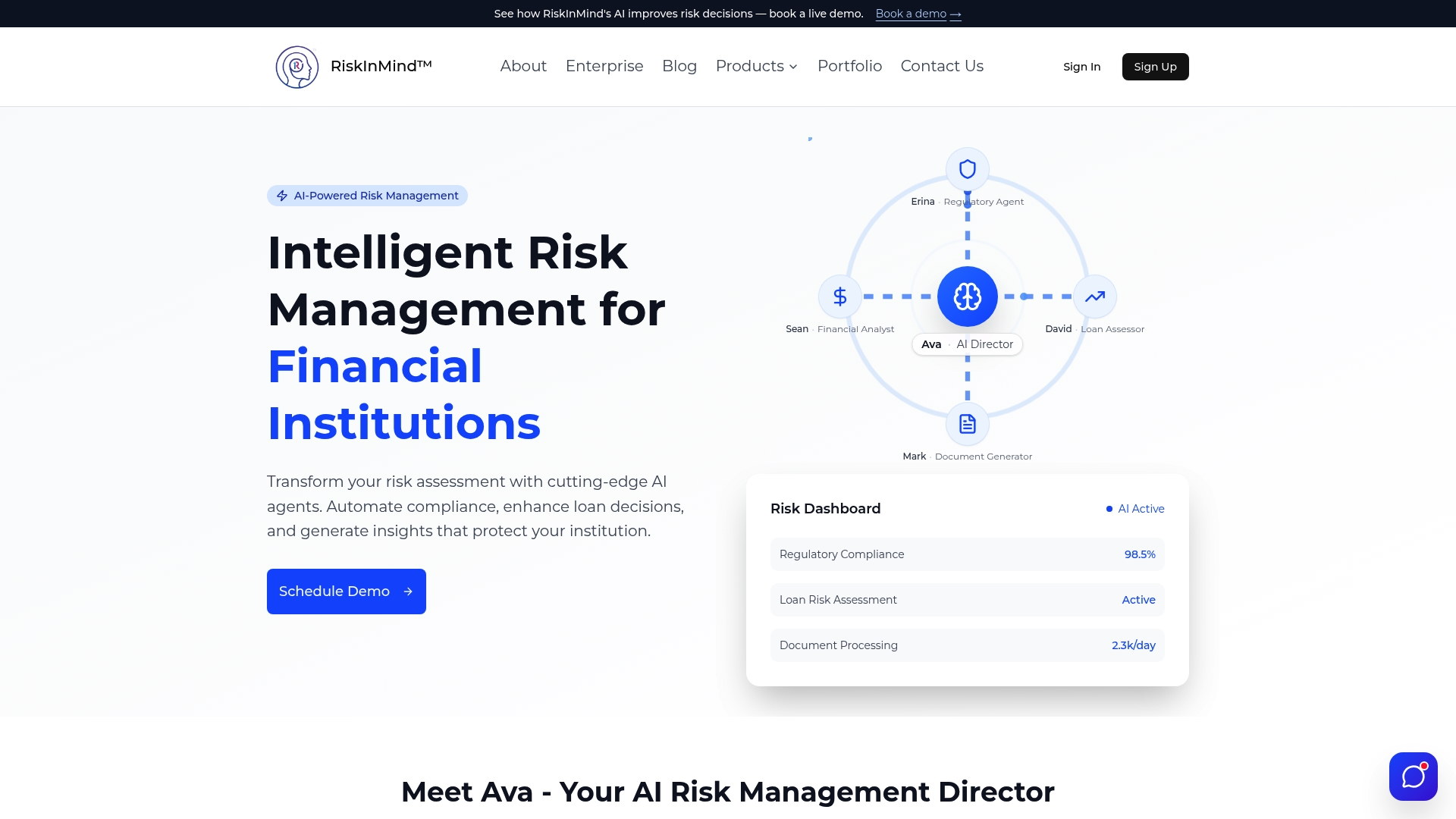
The platform's specialized AI agents automate evidence collection, risk profiling, and compliance documentation across loan underwriting, portfolio monitoring, and regulatory reporting. Ava, Riskinmind's central AI director, coordinates these agents to deliver real-time risk signals with response times under half a second. For institutions ready to see the platform in action, the AI loan application tool demonstrates how automated risk profiling and compliance documentation work in a live lending workflow. You can also explore the CRE loan risk predictor for commercial real estate compliance and risk analysis. Riskinmind holds SOC 2® certification, which means the platform meets the security and availability standards your institution already requires.
FAQ
What is an ai-driven compliance checklist?
An AI-driven compliance checklist is a structured framework that uses machine learning and automation to map regulatory controls, collect evidence, and monitor compliance status continuously. It replaces manual, point-in-time audit preparation with real-time control visibility.
How much faster does AI make compliance audit preparation?
AI-powered GRC platforms compress audit-readiness timelines from 12–18 months to 4–6 months, a reduction of up to 66%. This is achieved through automated evidence collection and cross-framework control mapping.
What is shadow AI and why does it matter for compliance?
Shadow AI refers to tools adopted by employees without formal IT or compliance approval. These tools create untracked data exposure and regulatory risk that compliance platforms cannot monitor unless the tools are formally inventoried and assessed.
How does AI improve accuracy in compliance assessments?
AI-enhanced compliance guidance achieves 97% accuracy in complex framework assessments compared to 81% with manual methods. The 16-point improvement reflects AI's ability to process large volumes of regulatory requirements consistently without human error.
Can AI compliance tools work across multiple regulatory frameworks simultaneously?
Yes. Modern compliance management systems map a single control to multiple frameworks, such as SOC 2, ISO 42001, and FFIEC guidelines, at the same time. This eliminates duplicate evidence collection and reduces total compliance workload significantly.