
The financial institution compliance process is a structured, risk-profile-driven program that integrates regulatory requirements with internal controls to ensure lawful operation and effective risk management. Compliance professionals at credit unions, community banks, and lenders face mounting pressure from regulators including the CFPB, Federal Reserve, and FinCEN, each with distinct supervisory expectations. The core challenge is not just meeting minimum standards but building a program that holds up under exam scrutiny, adapts to business changes, and closes the loop between monitoring and corrective action. This guide walks through every layer of that program, from foundational design to audit readiness.
What are the core components of the financial institution compliance process?
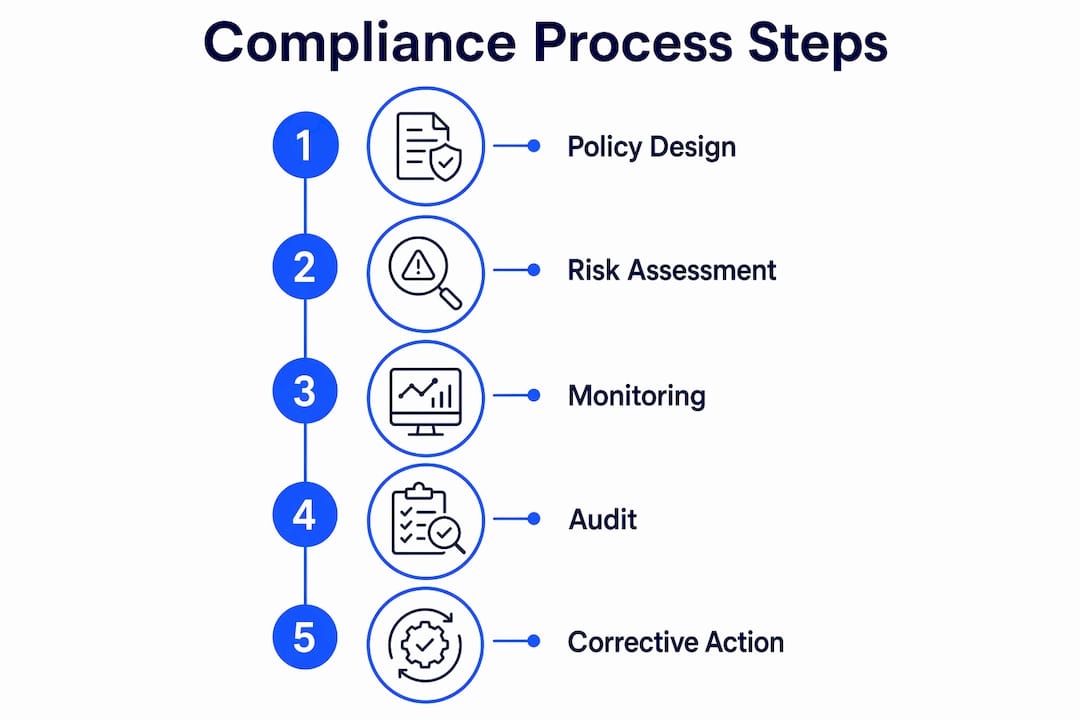
The financial institution compliance process is built on five distinct operational layers: policy and procedure design, risk assessment, ongoing monitoring, independent audit and testing, and corrective action management. Each layer serves a different function, and collapsing them into a single undifferentiated program is one of the most common structural mistakes compliance officers make.
Maintain 100% NCUA & OCC Audit Readiness
Monitor regulatory updates 24/7, check internal credit policies, and generate compliance trails with Erina (AI Regulatory Agent).
Policy and procedure design is the starting point. Policies must reflect the institution's actual risk profile, not a generic template borrowed from a larger bank. A community bank with a narrow product set and a single-state footprint needs far less procedural complexity than a multi-state lender with commercial real estate, consumer lending, and trust services running simultaneously.

Risk assessment is the engine that drives everything else. The CFPB's Compliance Management Review evaluates four components: board oversight, compliance program, consumer complaint response, and compliance audit. That framework makes clear that strong board and senior management oversight is not optional. It is the foundation on which every other element rests.
Monitoring vs. audit: why the distinction matters
Compliance monitoring is ongoing and less formal, while compliance audits are discrete, independent evaluations that verify adherence and report findings to the board. Treating them as interchangeable creates blind spots. Monitoring catches issues in real time. Audits confirm whether the monitoring itself is working.
| Characteristic | Compliance Monitoring | Compliance Audit |
|---|---|---|
| Frequency | Ongoing, continuous | Periodic, scheduled |
| Formality | Informal, operational | Formal, documented |
| Ownership | Compliance staff | Independent function |
| Output | Issue logs, exception reports | Formal audit report |
| Audience | Compliance management | Board, senior management |
| Purpose | Detect and correct issues | Verify program effectiveness |
Control matrices are the connective tissue between these layers. A well-built matrix maps each regulatory requirement to a specific control, assigns an owner, and records the monitoring frequency. Without that structure, compliance workflows become reactive rather than systematic.
Pro Tip: Build your control matrix in a format that can be exported directly to examiners. Regulators increasingly expect to see the matrix, not just hear about it.
How do you implement continuous compliance monitoring and risk assessment?
Continuous monitoring is not a technology problem. It is a process design problem. The goal is to detect compliance failures at the point of execution, not weeks later during a file review. That requires a monitoring cadence calibrated to risk level, not to staff availability.
FinCEN's April 2026 proposed rules mandate regular updates and scope coverage for AML/CFT risk assessments, including evaluation of products, services, customers, and geographic reach. The practical implication is that your risk assessment cannot be a static annual document. It must update when the business changes, whether that means a new loan product, a new branch, or a shift in customer demographics.
Here is a step-by-step framework for operationalizing continuous monitoring:
- Map your regulatory universe. List every applicable regulation, from BSA/AML to TILA to fair lending, and assign each to a business line or process owner.
- Set monitoring frequency by risk tier. High-risk areas such as AML transaction monitoring and fair lending pricing reviews warrant monthly or quarterly reviews. Lower-risk areas may be reviewed semi-annually.
- Define what evidence looks like. For each monitoring activity, specify what a passing result looks like and what documentation proves it. Automated logs and timestamps provide stronger evidence than manual notes written after the fact.
- Trigger risk assessment updates on business events. New products, acquisitions, and regulatory changes should each trigger a formal reassessment of the affected risk area. AML/CFT risk assessments are now operationalized with triggers tied to business events to ensure programs update promptly upon money laundering and terrorist financing risk changes.
- Connect monitoring outputs to your issues register. Every exception identified during monitoring should generate a logged issue with an owner, a root cause, and a remediation deadline.
- Report monitoring results upward. Compliance management should receive a regular summary of monitoring results, with escalation protocols for high-severity findings.
Data governance is a critical and often underestimated part of this process. Only 2 of 31 G-SIBs were fully compliant with BCBS 239 risk data aggregation and reporting principles as of the 2023 update. That figure reflects how difficult it is to maintain data quality at scale, and it applies to community institutions too, just with fewer zeros. Poor data governance means monitoring outputs are unreliable, which means your entire compliance process rests on a weak foundation.
Pro Tip: Collect evidence at the point of execution. A screenshot taken during a transaction review is worth ten times more to an examiner than a summary written the following week.
For a detailed walkthrough of building a risk assessment from the ground up, the step-by-step risk assessment guide from Riskinmind covers the full methodology.
What are best practices for compliance audits and corrective action?
Independent testing is often required by specific regulations such as BSA/AML and must be completely separate from control ownership. That separation is not bureaucratic formality. It is what gives the audit finding credibility when an examiner reviews it.
Audit scope setting is where most programs go wrong. Scope that is too narrow misses systemic issues. Scope that is too broad produces findings so numerous that remediation becomes unmanageable. The right approach is to scope each audit cycle based on the prior year's monitoring results and the current risk assessment. High-risk areas with recent monitoring exceptions get deeper audit coverage. Stable, low-risk areas get lighter treatment.
Corrective action management is the part of the compliance process that examiners scrutinize most closely. A finding without a documented owner, a root cause analysis, and a realistic remediation deadline is not a finding. It is a liability. The closed-loop compliance process that ties monitoring outputs to corrective action is what examiners focus on to assess program effectiveness.
Best practices for corrective action management include:
- Assign a single accountable owner to every finding, not a team or a department.
- Document root cause analysis before setting the remediation approach. Treating symptoms without understanding causes produces repeat findings.
- Set remediation deadlines that are realistic but not open-ended. Ninety days is a reasonable default for most findings. Critical regulatory violations warrant thirty days or less.
- Track all open findings in a centralized issues register that compliance management reviews monthly.
- Validate remediation before closing a finding. Closure requires evidence that the control is now operating effectively, not just a statement that the fix was implemented.
- Report open and overdue findings to senior management and the board on a defined schedule.
Pro Tip: Prepare a one-page audit evidence package for each major compliance area before your next exam. Include the monitoring log, the issues register, and the most recent corrective action summary. Examiners who can find what they need quickly tend to spend less time looking for what they cannot.
Riskinmind's compliance monitoring best practices resource provides additional detail on building exam-ready documentation workflows.
How does tailoring your program to your risk profile build regulator confidence?
The Federal Reserve emphasizes that compliance programs should vary substantially depending on risk profile and complexity. That guidance is not a suggestion. It is the basis on which examiners evaluate whether your program is fit for purpose.
A program that is over-engineered for a small institution wastes resources and creates procedural complexity that staff cannot sustain. A program that is under-built for a complex institution leaves material risks uncontrolled. Neither outcome serves the institution or its regulators.
The table below summarizes how key risk factors should shape your compliance program design:
| Risk Factor | Effect on Compliance Program |
|---|---|
| Product complexity | Broader policy scope, more granular control matrices |
| Geographic reach | Multi-jurisdiction regulatory mapping, state law overlays |
| Customer risk profile | Enhanced due diligence procedures, tiered monitoring frequency |
| Transaction volume | Automated monitoring tools, higher sampling rates in audits |
| Regulatory history | More frequent independent testing, enhanced board reporting |
| Institutional size | Proportionate staffing, scalable documentation standards |
Tailoring also affects how you document your program. Examiners in 2026 expect to see risk-based documentation standards that explain why the program is designed the way it is, not just what the program does. That means your compliance risk profile should be a living document that justifies your monitoring frequencies, your audit scope, and your policy choices.
Institutions that build their programs around their actual risk profile consistently perform better in exams than those that copy peer programs without adaptation. The reason is straightforward: a program designed around your risks produces evidence that speaks directly to your risks, which is exactly what examiners want to see.
Key takeaways
An effective financial institution compliance process requires risk-profile-driven design, continuous monitoring with documented evidence, independent audit functions, and closed-loop corrective action management to satisfy regulatory expectations.
| Point | Details |
|---|---|
| Risk-profile-driven design | Tailor policy scope, monitoring frequency, and audit depth to your institution's actual risk factors. |
| Monitoring and audit are distinct | Monitoring detects issues in real time; audits independently verify whether the program works. |
| Evidence collected at execution | Contemporaneous logs and timestamps carry far more weight with examiners than after-the-fact summaries. |
| Closed-loop corrective action | Every finding needs an owner, a root cause, a deadline, and documented validation before closure. |
| AML/CFT assessments must be dynamic | FinCEN's 2026 proposed rules require risk assessments to update when business conditions or risk factors change. |
What i've learned after years inside compliance programs
The compliance programs that consistently pass exams are not the most elaborate ones. They are the most honest ones. The institutions that struggle are usually those that built their programs to look comprehensive rather than to actually manage risk.
The closed-loop process is where I see the most consistent failure. Monitoring identifies an issue, a fix gets implemented, and then nobody checks whether the fix worked. Six months later, the same issue surfaces in an audit. Examiners notice that pattern immediately, and it signals a program that is reactive rather than controlled.
The AML/CFT regulatory shift underway in 2026 is the most significant change to the compliance framework in years. The move toward standardized, trigger-based risk assessments is going to expose institutions that have been treating their AML risk assessment as an annual checkbox exercise. If your risk assessment does not update when you launch a new product or onboard a new customer segment, it is already out of compliance with where regulation is heading.
Technology matters, but not in the way most vendors describe it. The value of automation in compliance is not speed. It is evidence quality. Automated logs do not forget. They do not get rewritten after the fact. They create a defensible record that manual processes simply cannot match. The role of AI in regulatory compliance is shifting from novelty to necessity for institutions that want to sustain quality at scale.
Build your program around your risks, document your reasoning, and close every loop. That is what exam-ready compliance looks like in practice.
— Raj
How Riskinmind supports your compliance process
Compliance professionals managing complex regulatory requirements need tools that keep pace with their workload. Riskinmind's AI-powered platform is built specifically for credit unions, community banks, and lenders that need to manage compliance, credit risk, and portfolio monitoring without adding headcount.
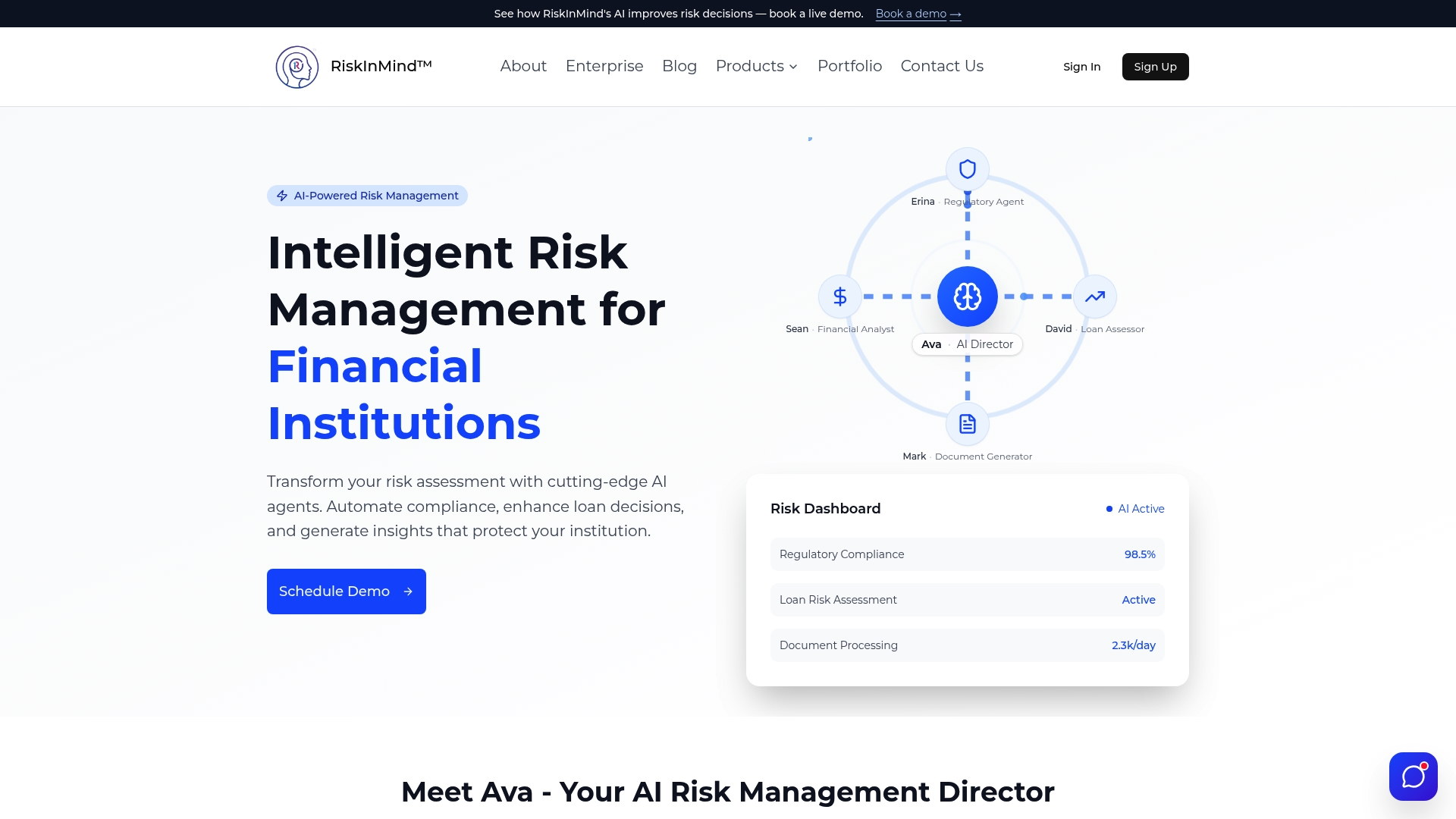
The platform's compliance management capabilities support control matrix design, risk assessment updates, and monitoring workflow automation. Riskinmind's peer benchmarking and risk analysis tool lets compliance officers compare their institution's risk metrics against peer institutions, which is particularly useful when calibrating monitoring frequency and audit scope to your actual risk position. For institutions managing loan portfolio compliance, the loan application platform integrates compliance checks directly into the underwriting workflow, reducing the gap between operational decisions and regulatory requirements.
FAQ
What is the financial institution compliance process?
The financial institution compliance process is a risk-based program that integrates policy design, ongoing monitoring, independent auditing, and corrective action management to meet regulatory requirements. The Federal Reserve requires that these programs be tailored to each institution's risk profile, size, and complexity.
How does compliance monitoring differ from a compliance audit?
Compliance monitoring is ongoing and operational, designed to detect issues in real time, while a compliance audit is a formal, independent evaluation that verifies whether the program is working effectively. Audits typically report findings directly to the board, while monitoring results feed into the compliance management function.
What do aml/cft rules require for risk assessments in 2026?
FinCEN's 2026 proposed rules require AML/CFT risk assessments to cover products, services, customers, and geographic reach, and to update promptly when significant risk changes occur. Static annual assessments no longer satisfy the regulatory standard under the proposed framework.
What makes a compliance program audit-ready?
Audit-ready programs collect evidence at the point of execution, maintain a centralized issues register with documented owners and deadlines, and produce formal corrective action summaries that examiners can review. Automated logs and exception reports provide stronger evidence than manually prepared documentation.
How should institutions tailor their compliance programs?
Institutions should design their compliance programs around their specific risk factors, including product complexity, customer risk profile, transaction volume, and regulatory history. The Federal Reserve's supervisory guidance makes clear that a program appropriate for a large multi-state bank is not appropriate for a single-branch credit union.