
Streamlined compliance checks are defined as automation-driven workflows that replace manual evidence collection with continuous, integrated controls mapped to regulatory frameworks. For compliance officers and risk managers at credit unions, community banks, and lenders, knowing how to streamline compliance checks is the difference between audit readiness and costly remediation. Automated compliance controls can eliminate 40–60% of manual evidence collection effort while providing continuous visibility. That reduction translates directly into fewer staff hours lost to spreadsheet-based tracking and more time spent on judgment-intensive risk work. Frameworks like SOC 2, ISO 27001, HIPAA, PCI DSS, and NIST each demand structured evidence, and automation is the only practical way to satisfy all of them without duplicating effort.
How to streamline compliance checks: prerequisites and tools
Automation fails without a solid foundation. Before deploying any technology, you must map every compliance obligation your institution carries, including controls tied to OFAC screening, BSA/AML requirements, and applicable state regulations. Skipping this step produces automated workflows built on incomplete control libraries, which creates gaps that surface during audits at the worst possible time.
Maintain 100% NCUA & OCC Audit Readiness
Monitor regulatory updates 24/7, check internal credit policies, and generate compliance trails with Erina (AI Regulatory Agent).
The most critical infrastructure decision is building a single source of truth for your control library. When controls are mapped to multiple frameworks simultaneously, a single piece of evidence can satisfy SOC 2, ISO 27001, and HIPAA requirements at once. This "test once, satisfy many" approach eliminates the redundant evidence submissions that consume compliance teams during multi-framework audit cycles.

Native API integrations are the engine behind reliable automated evidence collection. Connections to platforms like AWS, Okta, and GitHub allow your compliance program to pull access logs, configuration states, and change records automatically. Manual evidence collection for 20 or more cloud integrations can consume an entire fiscal quarter. Automating those same integrations reclaims that time for analysis and remediation work.
Policy management and deadline tracking also require automation. Compliance calendars with automated reminders, version-controlled policy documents, and owner assignments prevent the silent failures that occur when renewal dates slip past overworked teams.
| Metric | Manual process | Automated process |
|---|---|---|
| Evidence collection time | Weeks to months per audit cycle | Hours to days with API pulls |
| Control accuracy | Prone to human error and version gaps | Consistent, timestamped, and auditable |
| Multi-framework coverage | Separate evidence packages per framework | Single control mapped to all frameworks |
| Audit readiness | Point-in-time snapshots only | Continuous, real-time control state |
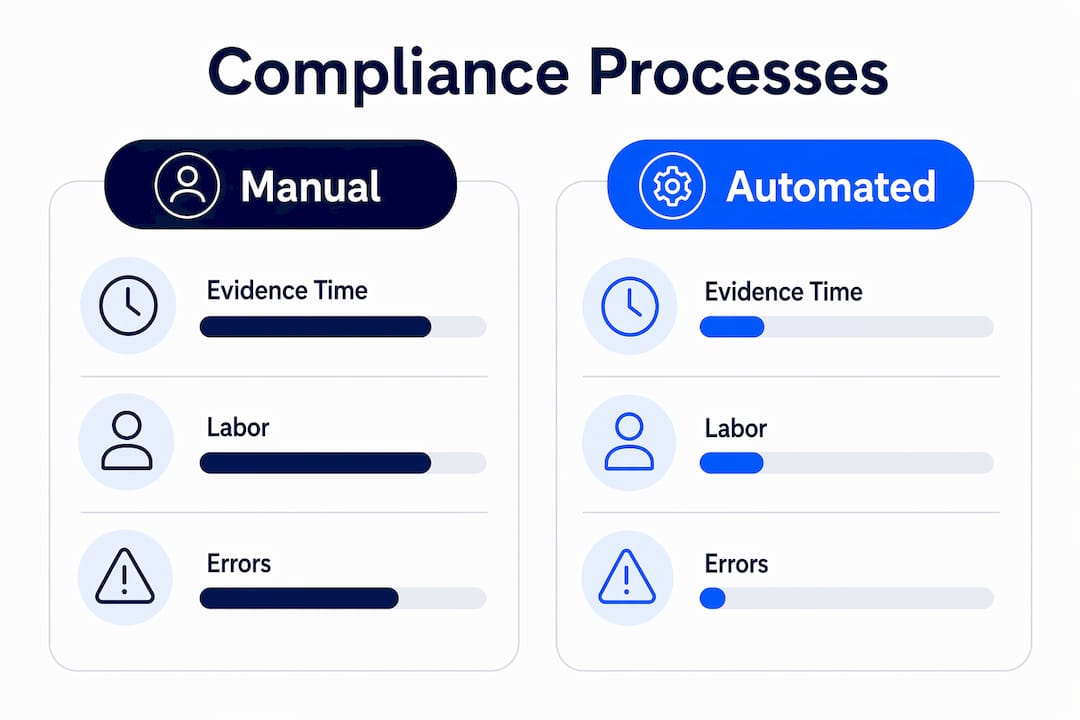
Pro Tip: Before selecting any compliance platform, audit your existing integrations. A tool that connects natively to your core banking system, identity provider, and cloud infrastructure will deliver far more value than one requiring custom middleware.
How does continuous automated monitoring work in practice?
Continuous monitoring is the shift from annual or quarterly audit snapshots to daily or weekly automated control tests. The practical difference is significant. Point-in-time snapshots create what practitioners call "audit theater," a false sense of security that evaporates the moment a configuration drifts between review cycles. Continuous automated controls running daily or weekly produce a genuine, defensible compliance state.
Implementing continuous monitoring follows a clear sequence:
- Inventory your controls. List every technical and administrative control required by your applicable frameworks. Assign an owner, a testing frequency, and a pass/fail criterion to each one.
- Build or configure integrations. Connect your compliance platform to the systems that generate evidence, such as your identity management tool, cloud environment, and endpoint management system.
- Schedule automated tests. Set each control to run on a defined cadence. High-risk controls like privileged access reviews warrant daily testing. Lower-risk administrative controls may run weekly or monthly.
- Configure failure alerts. When a control test fails, the system should immediately notify the control owner and open a remediation task. Delays between failure and notification are where regulatory exposure grows.
- Automate documentation. Every test result, with its timestamp, evidence artifact, and pass/fail status, should write automatically to your audit log. Manual documentation at this stage reintroduces the errors you automated away.
- Manage remediation in the same platform. Tracking findings and remediation plans outside your compliance system creates version control problems. Keep the full lifecycle, from detection to closure, in one place.
- Review dashboards on a set schedule. Automated systems still require human review. Weekly dashboard reviews catch systemic issues that individual alert notifications may obscure.
Pro Tip: Map your automated control tests directly to the specific control clauses in your frameworks. When an auditor asks for evidence of SOC 2 CC6.1 compliance, you want to pull a filtered report instantly rather than searching across disconnected systems.
What should stay human in an automated compliance program?
Not all compliance tasks should be automated. Risk analysis, regulatory interpretation, and incident response require human judgment that no current automation can reliably replicate. The practical rule is straightforward: automate the collection and testing of evidence, and keep humans accountable for evaluating what that evidence means.
A human-in-the-loop approach uses AI to rank and recommend controls while preserving auditor oversight for final decisions. This model reduces workload without removing accountability. It also builds auditor confidence, since examiners from the OCC, FDIC, and state regulators increasingly expect to see documented human review behind automated outputs.
The tasks best suited to automation include:
- Routine evidence collection from integrated systems
- Control test scheduling and execution
- Policy acknowledgment tracking and deadline reminders
- Regulatory reporting templates and pre-population
- Access certification campaigns with automated provisioning flags
The tasks that require human judgment include:
- Interpreting ambiguous regulatory guidance from bodies like the CFPB or FinCEN
- Conducting enterprise-wide risk assessments and scenario analysis
- Responding to regulatory inquiries and examination requests
- Evaluating the materiality of control failures
- Approving exceptions and documenting the rationale
Modern compliance governance replaces reactive gatekeeping with proactive, structured oversight using deep logic and governed AI. That shift only holds when skilled compliance professionals remain engaged with the outputs rather than treating automation as a substitute for judgment.
What are the most common compliance workflow challenges?
Integration complexity is the most frequent obstacle when financial institutions begin automating compliance checks. Legacy core banking systems often lack modern API support, forcing teams to rely on file exports and manual uploads that undercut the efficiency gains automation promises.
Staff resistance is the second major challenge. Compliance professionals who built their expertise around manual processes sometimes view automation as a threat rather than a tool. Phased rollouts address this directly. Starting with one framework or one control domain, such as access management, lets teams build confidence before expanding scope.
Incomplete policy documentation creates a third category of failure. Automated workflows can only enforce policies that are written, approved, and version-controlled. Institutions that begin automation projects often discover undocumented practices that have never been formalized.
| Challenge | Recommended mitigation |
|---|---|
| Legacy system integration gaps | Use file-based connectors as interim bridges; prioritize API upgrades in IT roadmap |
| Staff resistance to new workflows | Phased rollout by control domain; involve compliance staff in platform configuration |
| Incomplete policy documentation | Conduct a policy inventory before automation; assign owners and approval deadlines |
| Measuring ROI | Track manual hours saved, audit findings reduced, and cost avoidance from regulatory actions |
| Governance gaps in AI outputs | Establish a review protocol requiring human sign-off on AI-generated recommendations |
Measuring return on investment grounds the business case for continued investment. Track the hours your team previously spent on manual evidence collection, the number of audit findings that required remediation, and the cost of any regulatory actions. A single OCR corrective action plan can cost between $50,000 and $500,000, which makes the cost of a well-configured compliance platform look modest by comparison.
Pro Tip: Run a time-in-motion study before your automation project begins. Have team members log the hours spent on evidence collection, policy tracking, and audit prep for one full month. That baseline becomes your ROI benchmark and your most persuasive internal business case.
Key Takeaways
Efficient compliance processes require continuous automated monitoring, a unified control library, and skilled human oversight working together to produce defensible audit evidence at scale.
| Point | Details |
|---|---|
| Automate evidence collection first | API-based integrations eliminate the manual effort that consumes entire audit quarters. |
| Build one control library | Mapping controls to multiple frameworks lets a single test satisfy SOC 2, ISO 27001, and HIPAA simultaneously. |
| Run continuous tests, not snapshots | Daily or weekly automated control tests replace point-in-time audits and eliminate audit theater. |
| Keep humans in the loop | Risk analysis, regulatory interpretation, and incident response require human judgment that automation cannot replace. |
| Measure ROI from the start | Track hours saved and cost avoidance from regulatory actions to sustain investment in compliance automation. |
Continuous compliance is a cultural shift, not a technology project
I have watched compliance teams at community banks and credit unions invest in capable platforms and still struggle to improve their audit outcomes. The technology was sound. The problem was that leadership treated automation as a one-time implementation rather than an ongoing operating model.
Effective compliance management requires a culture where misconduct reporting is safe and leadership sets the tone from the top. That principle applies equally to compliance automation. When executives treat the compliance dashboard as a real-time management tool rather than an annual audit artifact, the entire organization's behavior shifts. Control owners take remediation alerts seriously. Policy owners meet their deadlines. The compliance function gains credibility with examiners because the evidence trail is continuous and consistent.
My practical advice is to start with the controls that cause the most pain during audits. Access reviews, vendor management documentation, and change management logs are common culprits at financial institutions. Automate those first, demonstrate the time savings, and use that credibility to expand the program. Trying to automate everything simultaneously produces a project that stalls under its own weight.
The institutions that will lead on AI-driven compliance are not the ones with the largest technology budgets. They are the ones where compliance officers understand both the regulatory substance and the automation mechanics well enough to configure systems that actually reflect their risk environment. That combination of technical fluency and regulatory expertise is the real competitive advantage.
— Raj
Riskinmind's risk analysis tools for compliance teams
Compliance officers who have built continuous monitoring programs quickly discover that evidence collection is only half the challenge. Benchmarking your institution's risk posture against peers and translating that data into defensible decisions is where the real analytical work begins.
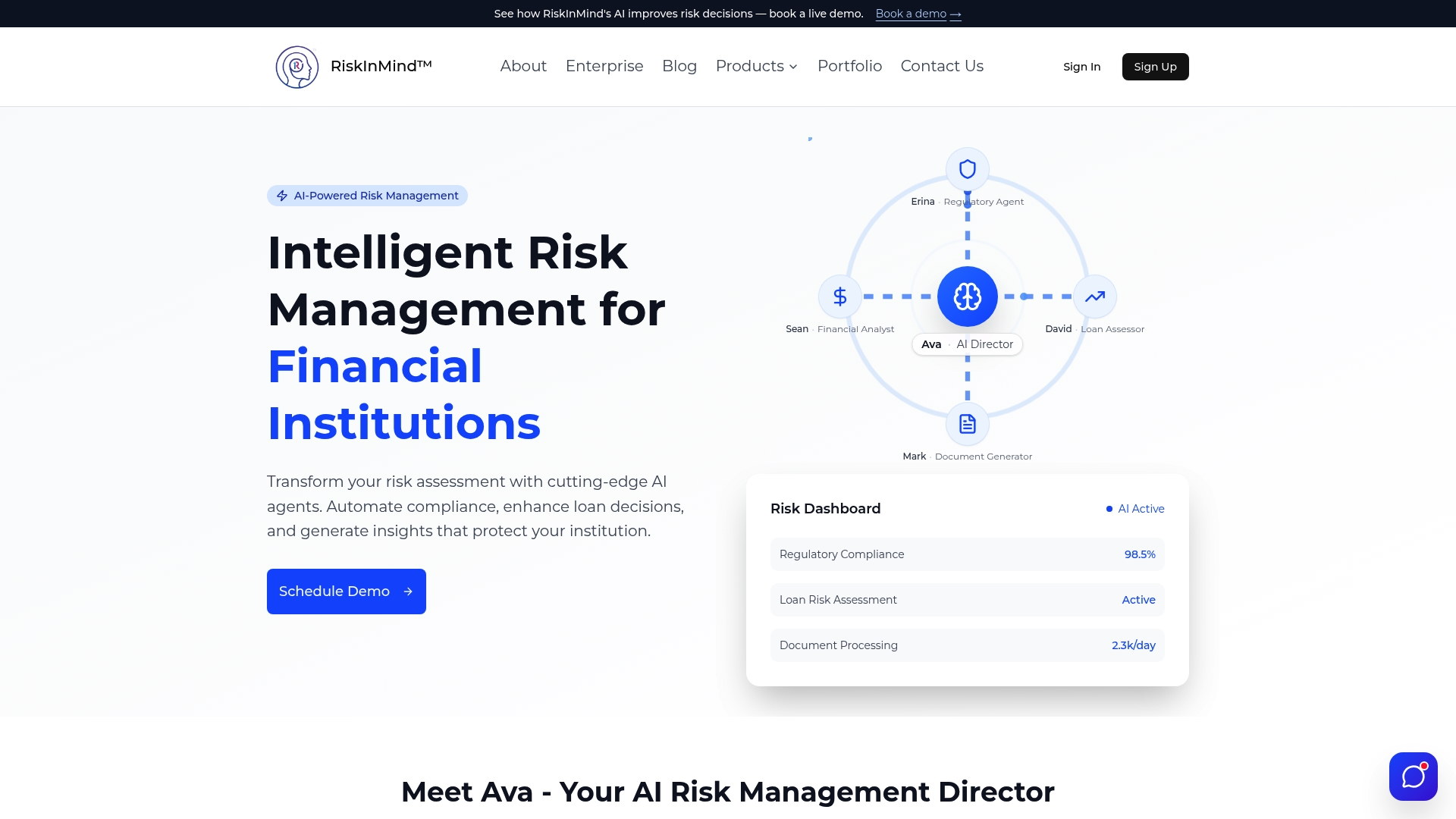
Riskinmind's peer benchmarking and risk analysis platform gives compliance teams at credit unions, community banks, and lenders the data they need to contextualize their control performance against comparable institutions. The platform's AI agents, coordinated by Ava, process regulatory and portfolio data in real time, with response times under half a second, so your team works from current information rather than stale reports. Riskinmind holds SOC 2® certification and operates with bank-grade security, which means the platform itself meets the standards your institution is working to demonstrate.
FAQ
What is the fastest way to reduce manual compliance effort?
Automated API integrations with your core systems eliminate the largest source of manual work. Automated controls can cut manual evidence collection effort by 40–60%.
How does a unified control library improve compliance efficiency?
A single control library mapped to multiple frameworks allows one test to satisfy SOC 2, ISO 27001, HIPAA, and PCI DSS simultaneously. This test-once approach eliminates redundant evidence submissions across audit cycles.
What compliance tasks should never be fully automated?
Risk analysis, regulatory interpretation, and incident response require human judgment. Practitioners recommend keeping these human-centric while automating routine evidence gathering and control testing.
How do you measure ROI on compliance automation?
Track hours saved on manual evidence collection, reductions in audit findings, and cost avoidance from regulatory actions. A single corrective action plan from a regulator like OCR can cost up to $500,000, making automation investment straightforward to justify.
What is audit theater and how do you avoid it?
Audit theater is the false security created by point-in-time compliance snapshots that do not reflect the institution's actual control state between reviews. Continuous automated testing, running daily or weekly, replaces snapshots with a genuine, real-time compliance posture.