
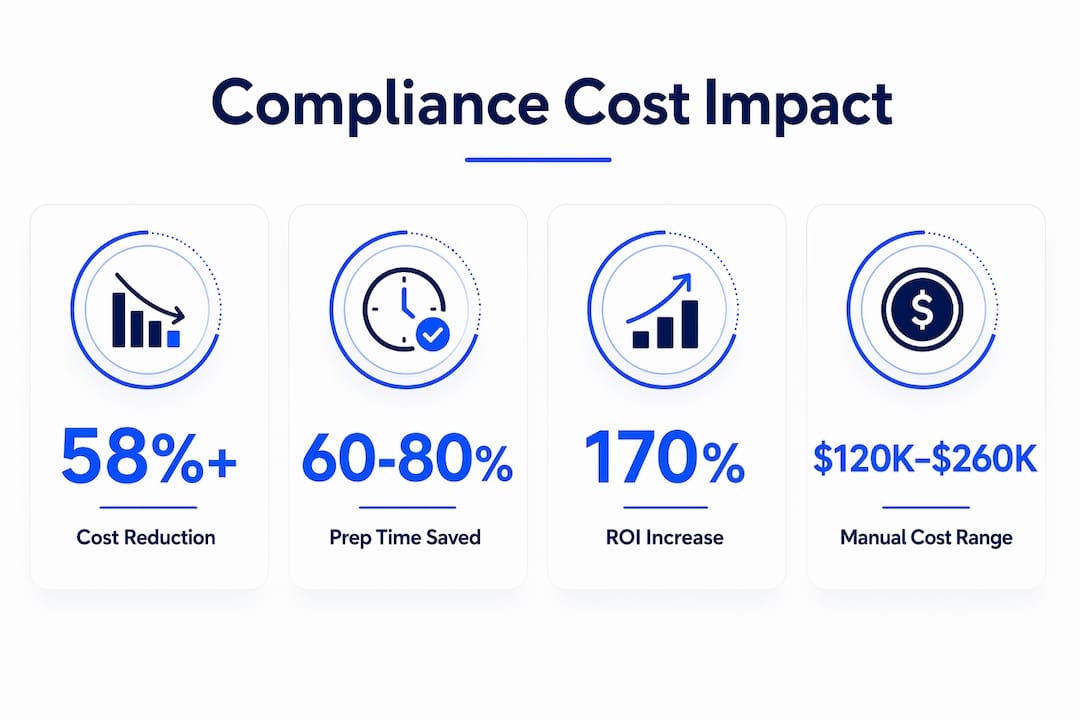
Automated compliance is defined as the use of technology to continuously monitor controls, collect evidence, and track regulatory obligations without manual intervention. For compliance officers and risk managers at credit unions, community banks, and lenders, the question is no longer whether to automate. It is how fast you can get there. Manual compliance programs cost between $120,000 and $260,000 annually, and that figure does not account for audit failures, regulatory fines, or the staff hours lost to evidence collection. Automation changes that equation entirely, and the ROI case is now well established.
Why invest in automated compliance: the cost reduction argument
Manual compliance is expensive in ways that rarely appear on a single budget line. Staff time, external auditors, document management, and remediation costs stack up across every framework your institution must satisfy. Manual programs cost between $120,000 and $260,000 per year. That number reflects labor alone and excludes the cost of a failed audit or a regulatory enforcement action.
Maintain 100% NCUA & OCC Audit Readiness
Monitor regulatory updates 24/7, check internal credit policies, and generate compliance trails with Erina (AI Regulatory Agent).
Automation reduces total compliance costs by more than 58% through automated evidence mapping and multi-framework control reuse. The savings compound when you manage more than one framework. Most compliance frameworks share 80–90% of their underlying controls. Adding a second or third framework after your first automation implementation costs a fraction of the original investment because the evidence collection infrastructure already exists.

The ROI timeline is faster than most compliance officers expect. Organizations using AI-powered compliance automation report ROI up to 170%, with positive returns typically achieved within 6–8 weeks. That speed comes from immediate labor savings on evidence collection, which is often the single largest time sink in any compliance program.
| Cost driver | Manual compliance | Automated compliance |
|---|---|---|
| Annual program cost | $120,000–$260,000 | Reduced by 58%+ |
| Audit prep duration | Weeks of manual effort | Days with continuous collection |
| Multi-framework cost | Full cost per framework | Marginal cost after first framework |
| ROI timeline | Ongoing cost center | Positive ROI within 6–8 weeks |
| Evidence collection | Manual screenshots and exports | API-based, continuous extraction |
Pro Tip: Focus your first automation investment on evidence collection and routine control monitoring. These two areas generate the fastest labor savings and the clearest ROI signal for your CFO.
How does continuous monitoring change audit readiness?
Periodic manual reviews create visibility gaps. A control can fail on a Monday and remain undetected until the next quarterly review. Automation closes that gap by monitoring configurations, access controls, and policy adherence in real time. The practical impact is that configuration drift and security gaps are detected weeks or months earlier than manual reviews allow.
For financial institutions managing frameworks like SOC 2, PCI DSS, or the Bank Secrecy Act, early detection is not a convenience. It is a risk management necessity. A control failure caught in real time costs far less to remediate than one discovered by an external auditor. Automated alerts and dashboards give your compliance team the ability to act before a finding becomes a violation.
Continuous compliance monitoring also eliminates the frantic pre-audit scramble that consumes compliance teams every quarter. Automated systems maintain audit-ready documentation at all times. When an auditor requests evidence, the package is already assembled.
The business case extends beyond risk avoidance. Continuous audit readiness accelerates enterprise sales cycles because prospective clients and partners can receive compliance documentation on demand. That is a direct revenue benefit that manual compliance programs cannot replicate.
Key operational improvements from continuous monitoring include:
- Real-time alerts when controls drift outside acceptable parameters
- Automated evidence packages updated continuously via API integrations with cloud platforms
- Reduced regulatory awareness lag from weeks to near-instantaneous detection
- Consistent compliance posture that strengthens partner and client trust
- Faster response to regulatory changes, including frameworks like the EU AI Act and DORA
Manual vs. automated compliance: how do they compare?
The gap between manual and automated compliance is not a matter of degree. It is a structural difference in how compliance functions inside your institution. Manual processes rely on periodic reviews, spreadsheet tracking, and staff-driven evidence collection. Each of these creates a point of failure.
| Capability | Manual compliance | Automated compliance |
|---|---|---|
| Monitoring frequency | Periodic, scheduled reviews | Continuous, real-time |
| Evidence collection | Manual screenshots and exports | API-based, automated extraction |
| Audit prep time | Weeks | Days |
| Multi-framework support | Duplicated effort per framework | Shared controls, reused evidence |
| Scalability | Limited by staff capacity | Scales with regulatory volume |
| Error rate | High, due to manual handling | Low, with automated validation |
| Regulatory change response | Weeks of lag | Near-instantaneous |
Manual audit prep time drops by 60–80% with automation. That reduction comes from eliminating tasks like screenshotting system configurations, manually exporting logs, and organizing evidence folders before each audit cycle. Compliance teams that previously spent weeks preparing for a SOC 2 audit can complete the same preparation in days.
Scalability is where the structural difference becomes most visible. Manual compliance lacks the capacity to keep pace with evolving multi-jurisdictional regulations. Automated systems scale with regulatory volume because the monitoring infrastructure does not depend on headcount. Adding a new jurisdiction or framework does not require hiring additional staff.
API integrations with cloud platforms like AWS, Azure, and Google Cloud allow automated systems to pull evidence directly from the source. This eliminates transcription errors and creates a defensible, timestamped audit trail that manual processes cannot match.
What should compliance teams know before implementing automation?
Automation does not replace compliance judgment. Automating routine evidence collection while keeping risk assessments and regulatory interpretations in human hands produces the best outcomes. Teams that try to automate compliance decisions, rather than compliance tasks, create new risks.
The practical implementation sequence for financial institutions follows a clear pattern:
- Audit your current evidence collection process. Identify which controls require the most manual effort and which generate the most audit findings. These are your highest-value automation targets.
- Map your framework overlaps. Before selecting a platform, document the control overlap between your active frameworks. This determines how much multi-framework savings you can capture from day one.
- Assess your system integrations. Automated compliance platforms pull data from your existing infrastructure. Confirm that your core banking system, cloud environment, and identity management tools support API connections.
- Plan for staff training. Automation changes how compliance staff spend their time, not whether they are needed. Training should focus on interpreting automated alerts and managing exception workflows.
- Start with one framework. Implement automation for your highest-priority framework first. Capture the ROI data, then expand to additional frameworks using the shared control infrastructure.
Multi-jurisdictional regulatory environments add complexity that manual programs cannot manage at scale. Regulations like the EU AI Act and DORA impose overlapping obligations that require continuous tracking. Automation handles the tracking. Your team handles the interpretation.
Pro Tip: Avoid the common mistake of automating reporting before automating evidence collection. Reporting automation produces no value if the underlying evidence is still gathered manually.
The role of automation in financial compliance also requires a cultural shift. Compliance teams accustomed to periodic review cycles need to adapt to a continuous monitoring model. That transition takes deliberate change management, not just new software.
Key Takeaways
Automated compliance is the most cost-effective way for financial institutions to manage growing regulatory volume, reduce audit risk, and maintain continuous audit readiness.
| Point | Details |
|---|---|
| Cost reduction is immediate | Automation cuts compliance program costs by 58%+ and delivers positive ROI within 6–8 weeks. |
| Continuous monitoring closes gaps | Real-time alerts detect control failures weeks earlier than periodic manual reviews. |
| Multi-framework savings compound | Control overlap of 80–90% means each additional framework costs far less to automate. |
| Audit prep time drops sharply | Automated evidence collection reduces audit preparation from weeks to days. |
| Automation supports, not replaces, judgment | Automate evidence collection and monitoring; keep risk assessment and regulatory interpretation with your team. |
Compliance automation is not a cost center. It is a revenue decision.
The framing that compliance officers most often use when presenting automation to their boards is cost reduction. That framing is accurate but incomplete. Compliance automation transforms GRC from a box-checking exercise into a continuous competitive advantage. Organizations with 365-day audit readiness close enterprise deals faster. They respond to partner due diligence requests in hours, not weeks. That is revenue acceleration, not just cost avoidance.
What I have observed consistently is that institutions that treat compliance as a reactive function always pay more. They pay in staff overtime before audits, in remediation costs after findings, and in lost deals when prospects ask for compliance documentation and the answer is "we are working on it." Automation removes all three of those costs simultaneously.
The regulatory environment is not becoming simpler. Frameworks like DORA and the EU AI Act signal that regulators expect continuous, documented compliance, not annual snapshots. Institutions that build continuous compliance infrastructure now will absorb new regulatory requirements at marginal cost. Those that wait will face the same implementation burden at a higher price point, under greater regulatory pressure.
The shift in mindset is this: audit readiness is not a project with a deadline. It is an operational state. Automation is the only practical way to maintain that state without consuming your entire compliance budget on labor.
— Raj
How Riskinmind supports your compliance automation goals
Riskinmind is built for financial institutions that need compliance and risk management to work together without friction. The platform's AI agents monitor regulatory obligations in real time, flag control failures before they become audit findings, and maintain documentation that is always ready for review.
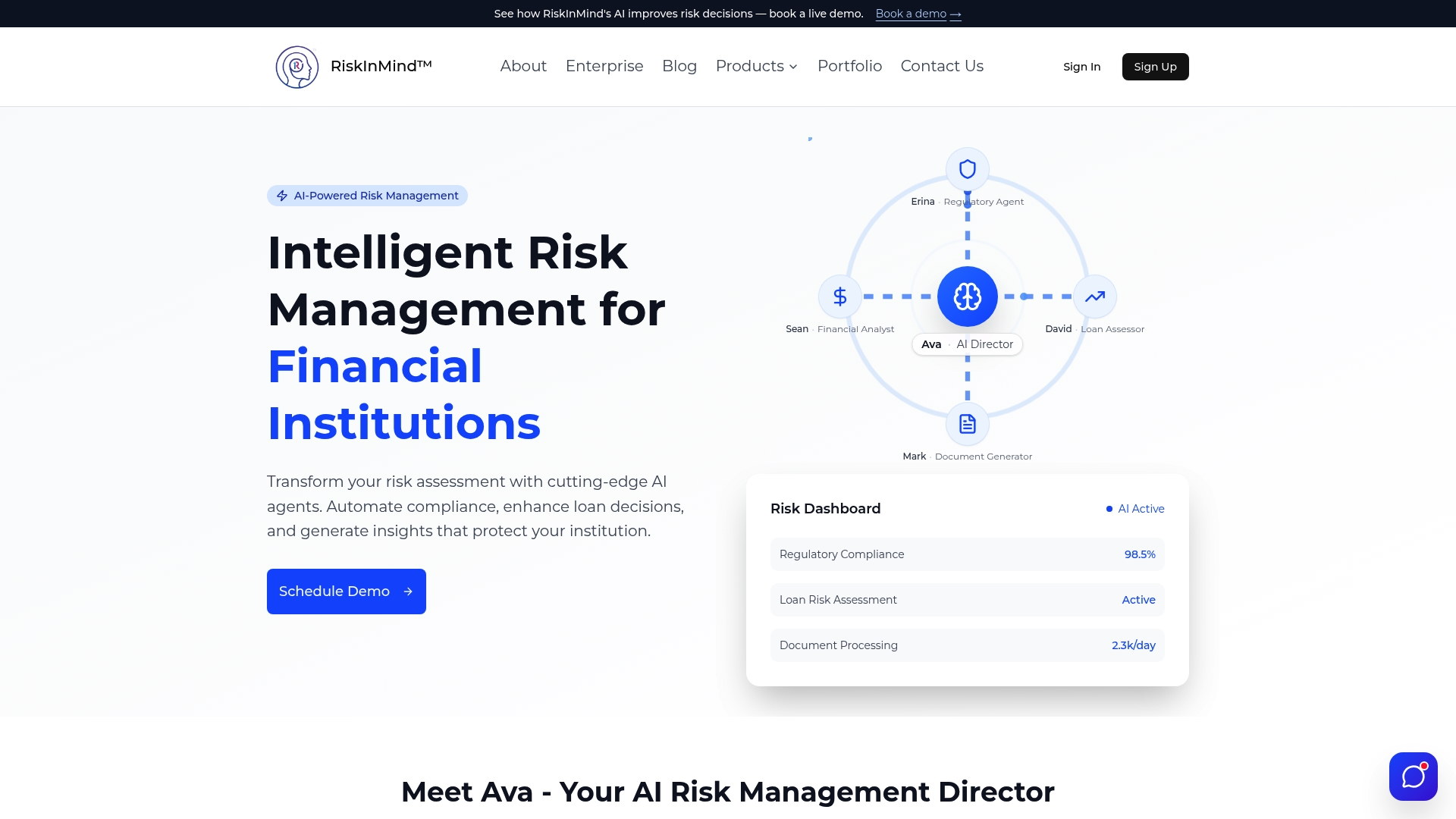
For institutions managing loan portfolios alongside compliance obligations, Riskinmind's loan application platform integrates compliance workflows directly into the underwriting process. The CRE Loan Risk Predictor adds AI-driven risk analysis for commercial real estate portfolios, with compliance monitoring built in. Both tools operate under Ava, Riskinmind's central AI director, and meet SOC 2® certification standards. Compliance officers can request a demo directly through the Riskinmind website.
FAQ
What is automated compliance in financial institutions?
Automated compliance is the use of technology to continuously monitor controls, collect evidence, and track regulatory obligations without manual intervention. It replaces periodic manual reviews with real-time monitoring and API-based evidence collection.
How much can automation reduce compliance costs?
Automation reduces total compliance costs by more than 58%, with organizations reporting ROI up to 170% and positive returns within 6–8 weeks of implementation.
How does automation improve audit readiness?
Automated compliance software maintains audit-ready documentation continuously, reducing audit preparation time by 60–80% compared to manual processes. Evidence is collected via API and updated in real time.
What should compliance teams automate first?
Automate evidence collection and routine control monitoring before anything else. These tasks generate the fastest ROI and free your team to focus on risk assessment and regulatory interpretation.
Can automation handle multiple compliance frameworks at once?
Yes. Most frameworks share 80–90% of their underlying controls, so adding a second or third framework after initial implementation requires only marginal additional effort and cost.