
Risk management documentation standards are defined as the structured policies, procedures, and recorded outputs that financial institutions use to capture, maintain, and communicate risk information for governance, regulatory compliance, and decision-making. Frameworks including ISO 27001, ISO 27005, NIST ERM guidance, and BCBS 239 each specify distinct documentation requirements for risk registers, treatment plans, audit trails, and data lineage records. For credit union executives, CROs, and bank risk officers, meeting these standards is not optional. Regulators and auditors treat documentation quality as direct evidence of risk governance maturity, and gaps in records translate directly into examination findings and capital consequences.
1. What are the essential components of effective risk management documentation?
Effective risk documentation is built on five core artifact types, each serving a distinct governance purpose. Treating any one of them as a one-time exercise rather than a living record is the fastest path to an audit finding.
Automate Regulatory Model Risk Governance
Examine models against 32 qualitative criteria and resolve risk Tiers with pre-deployment checklists per OCC 2011-12 guidelines.
The risk register is the foundational document. Each entry should carry a unique risk ID, a plain-language description, likelihood and impact ratings, assigned owner, current control status, and a scheduled review date. Without those fields, the register cannot support prioritization or accountability.

Risk treatment plans must be explicitly linked to register entries. Each plan specifies the selected control, the rationale for choosing it, the responsible party, and the implementation timeline. Auditors under ISO 27001 use these links as evidence of control alignment between assessed risks and deployed mitigations.
Statements of Applicability (SoA) document which controls from a reference set have been selected, which have been excluded, and the justification for each decision. The SoA is not a formality. It is the document that connects your risk assessment outputs to your control framework in a way that survives external scrutiny.
Audit trails capture the history of reviews, internal audit findings, corrective actions, and sign-offs. They demonstrate that the risk management process is continuous, not episodic.
Supporting documentation rounds out the set: risk criteria definitions, acceptance thresholds, monitoring plans, and escalation protocols. These records give context to every decision recorded in the register and treatment plans.
- Risk register with risk ID, likelihood, impact, owner, controls, and review date
- Risk treatment plans linked to register entries with timelines and responsible parties
- Statement of Applicability with control selection justifications
- Audit trails covering reviews, findings, and corrective actions
- Supporting records including risk criteria, thresholds, and monitoring plans
Pro Tip: Link every treatment plan entry directly to its parent risk register item using a shared risk ID. Auditors expect to trace a control decision back to the assessed risk in a single step, not across disconnected spreadsheets.
2. Which international standards govern risk management documentation
Four frameworks define the documentation requirements that financial institutions must understand and apply. Each operates at a different scope, and together they cover information security, enterprise risk, and banking-specific data governance.
| Framework | Scope | Key Documentation Requirement | Certifiable? |
|---|---|---|---|
| ISO 27005 | Information security risk management | Cyclical process records: context, identification, analysis, treatment, monitoring | No |
| ISO 27001 | Information security management system | Risk assessment outputs, treatment plans, Statement of Applicability | Yes |
| NIST ERM | Cybersecurity and enterprise risk integration | Risk registers with scenario documentation rolled up to enterprise profiles | No |
| BCBS 239 | Banking risk data aggregation and reporting | Data lineage, ownership records, governance narratives, supervisory reporting | Regulatory |
ISO 27005 structures risk management documentation into a cyclical process covering context establishment, risk identification, analysis, treatment selection, and ongoing monitoring. It is guidance rather than a certifiable standard, which makes it an ideal framework for institutions to tailor defensible, repeatable documentation practices that feed directly into ISO 27001 evidence requirements.
ISO 27001 mandates documented risk assessment and treatment outputs as distinct, auditable artifacts. The Statement of Applicability listing selected controls and their justifications is a certification requirement, not a recommendation. Auditors verify that these documents are current, linked, and reviewed on a defined cycle.
NIST ERM guidance promotes risk registers that roll up cybersecurity risk documentation to enterprise risk profiles. The goal is legibility at the board and executive level, where cybersecurity risk must be weighed alongside credit risk, operational risk, and market risk in a single governance view.
BCBS 239 sets the highest bar for banking-specific documentation. Its 14 principles span governance, data aggregation, risk reporting, and supervisory review. The framework requires banks to demonstrate that risk data is accurate, complete, and timely, with governance records evidencing ownership, accountability, and data definitions at every stage.
Pro Tip: ISO 27005 and ISO 27001 work as a pair. Use ISO 27005 to design your risk assessment methodology and generate the process records; use ISO 27001 to determine which of those records must be retained as formal evidence for certification audits.
3. How to implement and maintain comprehensive risk documentation
Implementation is where documentation standards either take hold or collapse into compliance theater. The following numbered practices reflect what regulators and auditors actually examine.
-
Establish a cyclical documentation process. Risk identification, analysis, treatment selection, and monitoring must each produce distinct records, and those records must reference each other. A risk assessment that does not connect to a treatment plan is an incomplete artifact under both ISO 27001 and BCBS 239.
-
Standardize scenario descriptions in your risk register. NIST guidance specifies that scenario documentation should capture the asset at risk, the threat source, the vulnerability exploited, and the estimated likelihood and impact. Simple technical risk listings without this structure cannot support enterprise-level prioritization.
-
Enforce version control and change documentation. Every update to a risk register entry, treatment plan, or SoA must carry a timestamp, the name of the person making the change, and the reason for the update. Undated or unsigned revisions are a common ISO 27001 audit finding.
-
Document data lineage for every risk metric. BCBS 239 requires end-to-end traceability of risk data, showing origin, transformation, and final reporting. This means your documentation must include data ownership records, critical data element definitions, and a governance narrative explaining how raw data becomes a reported risk figure.
-
Combine technical metadata with governance narratives. Documentation handoffs between data engineering and risk reporting frequently break BCBS 239 traceability unless data lineage and ownership are documented together. Technical metadata alone does not satisfy supervisory questions about accountability.
-
Integrate cybersecurity and enterprise risk registers. Maintaining separate silos for information security risk and enterprise risk creates gaps that examiners will find. NIST's approach positions documentation as a tool for enhancing legibility of cybersecurity risk data within the broader enterprise risk profile, not as a parallel record-keeping exercise.
-
Embed evidence of monitoring and corrective action. Audit trails must show that identified risks were reviewed, that control effectiveness was tested, and that findings led to documented corrective actions. Auditors expect well-linked documents that demonstrate continuous use, not disconnected worksheets produced for each audit cycle.
Pro Tip: Schedule a quarterly documentation review that specifically checks linkages between risk register entries, treatment plans, and audit trail records. Broken links between these artifacts are the most common reason institutions fail ISO 27001 surveillance audits.
4. How documentation standards vary by institution size and regulatory context
Documentation requirements for risk management frameworks do not apply uniformly. A community bank with $500 million in assets operates under different practical constraints than a global systemically important bank subject to BCBS 239 in full. Understanding where you sit on that spectrum determines how you scope your documentation program.
Smaller institutions such as community banks and credit unions can implement ISO 27001-aligned documentation using simplified risk registers and treatment plans without the full data lineage infrastructure that BCBS 239 demands of larger banks. The core artifacts remain the same. The depth of metadata, the number of data owners, and the complexity of governance narratives scale with institutional size and the sophistication of the risk data environment.
Larger institutions and those with cross-border operations face layered regulatory expectations. BCBS 239 compliance requires documentation that satisfies not just internal governance but also supervisory review by national regulators. The risk assessment methodology must be repeatable, auditable, and capable of producing accurate risk aggregates under stressed conditions, not just in normal operating environments.
Regulatory regime differences also shape documentation scope. U.S. institutions subject to OCC or Federal Reserve examination guidance must align their documentation practices with those agencies' expectations for model risk management, credit risk classification, and operational risk event recording. European institutions face additional requirements under EBA guidelines and DORA for operational resilience documentation.
- Assess your institution's documentation maturity against ISO 27001 clause requirements before selecting a framework
- Scale data lineage documentation to the complexity of your risk data environment, not to the most demanding standard available
- Map regional regulatory requirements to your chosen framework to identify gaps before an examination
- Plan progressive updates: start with a compliant risk register and SoA, then build toward full data lineage documentation over a defined roadmap
Balancing documentation completeness with operational efficiency is a real tension. Documentation that no one reads or updates because it is too burdensome to maintain is worse than a simpler system that stays current. The goal is records that support decisions, not records that satisfy a checklist.
Key takeaways
Effective risk management documentation standards require linked, version-controlled artifacts spanning risk registers, treatment plans, Statements of Applicability, audit trails, and data lineage records aligned to ISO 27001, ISO 27005, NIST ERM, and BCBS 239.
| Point | Details |
|---|---|
| Core artifacts are non-negotiable | Risk registers, treatment plans, SoA, and audit trails must exist as linked, current documents. |
| Framework selection drives scope | ISO 27001 governs certification evidence; BCBS 239 governs banking data traceability at a higher level of complexity. |
| Linkage is the audit test | Auditors verify connections between risk assessments, controls, and review cycles, not the existence of documents in isolation. |
| Data lineage satisfies BCBS 239 | Combine technical metadata with governance narratives to prove risk data integrity to supervisors. |
| Scale to institutional context | Documentation depth should match your institution's size, regulatory regime, and risk data complexity. |
Why documentation standards deserve more strategic attention than they get
There is a pattern I have observed consistently across financial institutions of varying sizes: documentation is treated as the output of risk management rather than as the mechanism through which risk governance actually functions. That distinction matters more than most risk officers acknowledge.
When a credit union's risk register is a static spreadsheet updated once a year before examination, it is not a governance tool. It is a compliance artifact. The difference between those two things is whether the documentation connects to decisions. ISO 27001 auditors are trained to detect this gap, and BCBS 239 supervisors are even less forgiving. They want to see that risk data flows from source systems through defined transformations to reported figures, with ownership and accountability documented at each step.
The integration of cybersecurity risk into enterprise risk registers is the area where I see the most consistent underinvestment. Institutions maintain separate information security risk documentation and enterprise risk documentation, and the two sets of records rarely speak to each other. NIST's guidance on this point is clear: cybersecurity risk documentation should be legible and actionable at the enterprise level. That requires a shared taxonomy, shared risk ID conventions, and a governance process that explicitly connects the two registers.
The institutions that handle regulatory examinations most confidently are not the ones with the most documentation. They are the ones whose documentation tells a coherent story: here is the risk we identified, here is how we assessed it, here is the control we selected and why, here is the evidence that the control is working, and here is what we did when it was not. That narrative is what good documentation standards are designed to produce. Building toward it is worth the investment.
— Raj
How RiskInMind supports audit-ready risk documentation
Financial institutions that want to close the gap between documentation standards and operational reality need platforms built for that purpose, not adapted from general-purpose tools.
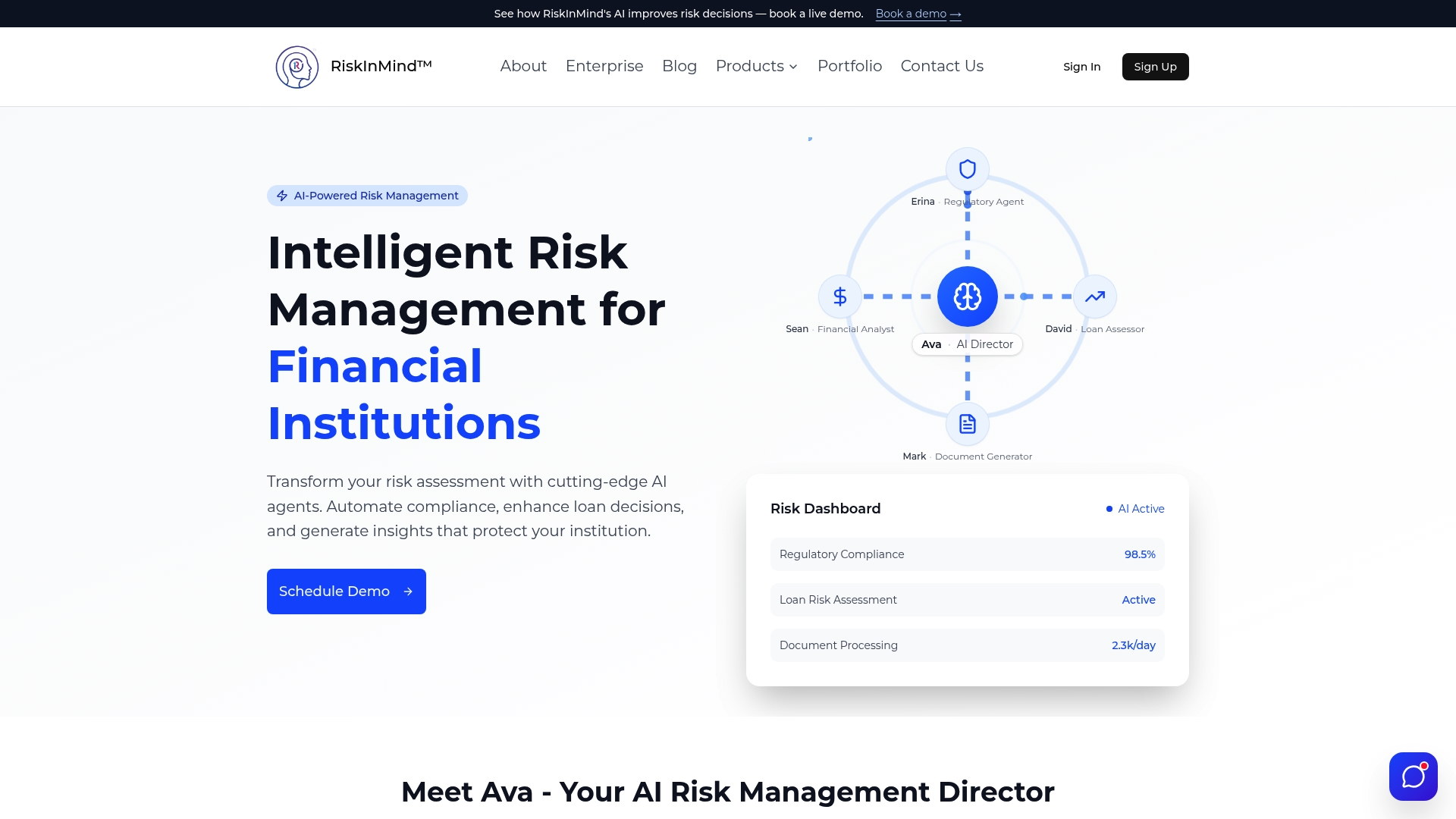
Riskinmind is designed specifically for credit unions, community banks, and lenders that need to maintain compliant risk registers, treatment plans, and audit trails without building a documentation infrastructure from scratch. The platform's AI agents automate record creation, version control, and linkage between risk assessments and control documentation, directly addressing the audit pitfalls that ISO 27001 and BCBS 239 examiners target. For institutions managing loan portfolio risk alongside information security and operational risk, Riskinmind's loan application platform integrates risk documentation into the underwriting workflow, producing audit-ready records at the point of decision. Explore how the platform supports enterprise risk reporting aligned with regulatory expectations.
FAQ
What is a Statement of Applicability in risk documentation?
A Statement of Applicability is a required ISO 27001 document that lists every control from the standard's reference set, indicates whether each has been selected or excluded, and provides the justification for that decision. Auditors use it to verify that control choices are grounded in the risk assessment rather than applied generically.
How does BCBS 239 affect risk documentation requirements for banks?
BCBS 239 requires banks to document risk data with end-to-end traceability, including data ownership, critical data element definitions, and lineage from source to reported figure. Governance narratives must accompany technical metadata to satisfy supervisory review under stressed conditions.
What is the difference between ISO 27005 and ISO 27001 for documentation purposes?
ISO 27005 provides guidance on how to conduct and document the risk management process, while ISO 27001 specifies which documentation outputs must be retained as formal evidence for certification. Institutions use ISO 27005 to design their methodology and ISO 27001 to determine their mandatory record set.
How often should risk registers be reviewed and updated?
ISO 27001 requires risk assessments and treatment plans to be reviewed at planned intervals and whenever significant changes occur. Most financial institutions set a minimum annual review cycle, with triggered reviews following incidents, material control changes, or new regulatory guidance.
What makes risk documentation fail an audit?
The most common audit failure is disconnected documentation: risk assessments that are not linked to treatment plans, treatment plans that are not linked to control evidence, and audit trails that show no record of review or corrective action. Auditors expect a traceable chain from identified risk to active control to ongoing monitoring.