
Model governance compliance requirements are defined as the structured policies, roles, controls, and documentation standards that financial institutions must maintain to meet regulatory expectations for model risk management. The Federal Reserve, FDIC, and OCC issued SR 26-2 in april 2026, replacing SR 11-7 and reaffirming that governance, validation, and monitoring form the core of sound model risk management. Internationally, the EU AI Act adds documentation retention and transparency mandates that now affect any institution deploying AI or machine learning models. For risk and compliance professionals at credit unions, community banks, and larger lenders, understanding these requirements is not optional. Regulatory penalties, reputational damage, and operational failures all trace back to gaps in model governance.
1. What are model governance compliance requirements?
Model governance compliance requirements define how financial institutions identify, validate, monitor, and document the models they use to make credit, pricing, and risk decisions. The industry standard term for this discipline is model risk management, or MRM. Both phrases describe the same obligation: ensuring that models are fit for purpose, appropriately controlled, and subject to independent review.
Automate Regulatory Model Risk Governance
Examine models against 32 qualitative criteria and resolve risk Tiers with pre-deployment checklists per OCC 2011-12 guidelines.
SR 26-2 sets the current U.S. benchmark. It applies directly to institutions with assets above $30 billion but is scalable for smaller firms. That scalability matters because community banks and credit unions face the same core governance expectations, even if the depth of controls can be proportionate to their risk profile.

2. Key regulatory frameworks shaping compliance in 2026
Three frameworks now define the compliance landscape for model governance.
SR 26-2 (U.S. Interagency Guidance): The Federal Reserve, FDIC, and OCC published this guidance on april 17, 2026. It emphasizes a risk-based tailored approach rather than a one-size-fits-all standard. The agencies do not impose enforceable penalties for non-compliance with SR 26-2 directly, but examiners use it as the benchmark for sound practice.
EU AI Act: This regulation requires organizations to retain comprehensive technical documentation for 10 years after a model enters service. Requirements include model cards, data governance records, copyright policies, and documented safety evaluations. Any U.S. institution serving European clients or using EU-based AI vendors must account for these obligations.
Bank of England PRA and OSFI: Both regulators require clear functional separation of model roles and quantitative performance metrics that trigger revalidation or suspension. Their frameworks reinforce that monitoring must be ongoing, not periodic.
Pro Tip: Map your existing controls against SR 26-2, the EU AI Act, and OSFI simultaneously. Shared requirements like risk assessment and documentation can be implemented once to satisfy all three, cutting compliance workload significantly.
3. Top model governance compliance requirements financial institutions must meet
The following requirements represent the core obligations that compliance professionals must build into their governance programs.
-
Maintain a complete model inventory. Every model in production must be cataloged, classified by risk tier, and linked to the business decisions it supports. An incomplete inventory is the most common gap examiners find.
-
Define roles and accountability clearly. Governance policies must name who owns each model, who validates it, and who has authority to approve changes. ISO 42001 and the EU AI Act both require this governance infrastructure, not just technical documentation.
-
Conduct independent model validation. Validation must be performed by a team or function separate from model developers. The depth of validation should be proportionate to the model's risk tier.
-
Treat documentation as a living library. Institutions that treat documentation as a one-time task create immediate compliance gaps when models change. Living documentation means inventory records, validation reports, and monitoring data are updated continuously.
-
Manage vendor and third-party model risk. Institutions retain full responsibility for models they purchase or license. Vendor model oversight must be built into the governance framework, including validation and ongoing monitoring of externally sourced models.
-
Set quantitative performance thresholds. Monitoring frameworks must include accuracy, calibration, and error distribution metrics with defined action thresholds. The Bank of England's PRA and OSFI both specify that these metrics must trigger revalidation or suspension when breached.
-
Link model risk to business impact. Institutions must document how model outputs affect credit decisions, pricing, and capital allocation. This linkage is what connects model risk management to enterprise risk management.
-
Build an incident tracking and reporting framework. Model failures, overrides, and unexpected outputs must be logged, investigated, and reported to appropriate governance bodies. Without this, patterns of model weakness go undetected.
Pro Tip: Assign a risk tier to every model at intake, not after validation. Tiering at intake determines the depth of documentation, validation, and monitoring required from day one, which prevents under-resourced governance on high-impact models.
4. How to implement a risk-based approach to model governance
A risk-based approach means governance controls scale with the actual risk a model poses, not with its technical complexity alone. The Bank of England's PRA is explicit that one-size-fits-all governance is inefficient and often fails regulatory scrutiny.
The practical steps for building this approach are:
- Tier your model inventory. Classify models as high, medium, or low risk based on business impact, data sensitivity, and decision materiality. High-risk models require full independent validation; low-risk models may need only periodic review.
- Allocate resources proportionately. Assign validation staff, documentation depth, and monitoring frequency based on tier. This prevents over-investing in low-risk models while under-governing high-impact ones.
- Unify control mapping across frameworks. Shared requirements across ISO, NIST, and the EU AI Act can be implemented once rather than three times. Siloed compliance programs create burnout and increase the risk of gaps.
- Shift from point-in-time to continuous validation. Most compliance failures occur when institutions validate a model at deployment and then leave it unchanged. Continuous validation catches drift, data changes, and performance degradation before regulators do.
- Secure board-level oversight. Leadership commitment is not a formality. Governance programs without board visibility lack the authority to enforce controls across business lines.
Pro Tip: Build your control mapping in a spreadsheet before investing in any platform. Identify which SR 26-2, EU AI Act, and OSFI requirements overlap. You will find that a single documentation standard covers the majority of all three frameworks.
5. Best practices for maintaining compliance with evolving standards
Model governance best practices are not static. Regulations change, models evolve, and the risk profile of any institution shifts over time. The compliance professionals who stay ahead of regulatory scrutiny treat governance as an operational discipline, not a project.
The most effective practices are:
- Update documentation on every model change. A model retrained on new data is a different model for governance purposes. Documentation must reflect the current state, not the state at initial validation.
- Enforce segregation of duties. The team that builds a model cannot be the team that validates it. This separation is required by SR 26-2 and reinforced by the EU AI Act's transparency mandates.
- Integrate vendor risk into internal governance. Third-party models carry the same compliance obligations as internally built ones. Vendor contracts should specify validation rights, performance reporting, and incident notification.
- Use automation to maintain monitoring at scale. As model inventories grow, manual monitoring becomes unsustainable. AI-driven compliance tools can flag performance threshold breaches, flag documentation gaps, and generate audit-ready reports automatically.
- Prepare for AI-specific regulatory changes. The EU AI Act is already in effect for high-risk AI systems. U.S. regulators are expected to issue AI-specific model risk guidance that builds on SR 26-2. Institutions that build AI governance infrastructure now will face less disruption when those rules arrive.
The table below contrasts reactive and proactive governance approaches across key compliance dimensions.
| Compliance dimension | Reactive approach | Proactive approach |
|---|---|---|
| Validation timing | Point-in-time at deployment | Continuous with defined triggers |
| Documentation | Updated at audit | Updated at every model change |
| Vendor oversight | Annual review | Ongoing monitoring with contractual rights |
| Regulatory tracking | Post-publication response | Pre-publication engagement and gap analysis |
| Board reporting | Annual summary | Quarterly with quantitative metrics |
6. Common challenges and pitfalls in model governance compliance
Most compliance failures in model governance share a common root: governance programs designed for a snapshot in time rather than a continuously changing environment.
- Over-reliance on point-in-time validation. Institutions that validate at deployment and then leave models unchanged accumulate compliance debt. Every model change, data update, or business context shift creates a new validation obligation.
- Underestimating vendor model risk. Purchased or licensed models are not exempt from governance requirements. Institutions that assume vendor accountability transfers with the contract expose themselves to direct regulatory criticism.
- Weak linkage between model risk and business impact. Regulators expect institutions to show how model outputs affect decisions and capital. A governance program that tracks model performance without connecting it to business outcomes fails this test.
- Outdated or incomplete model inventories. An inventory that does not reflect current production models is worse than no inventory. It creates a false sense of control and misleads examiners.
- Ignoring AI-specific regulatory requirements. The EU AI Act's 10-year documentation retention requirement and the anticipated U.S. AI governance guidance represent a new compliance layer. Institutions that treat AI models the same as traditional statistical models will face gaps.
- Unclear accountability among stakeholders. When model ownership is shared informally across teams, no one takes responsibility for validation, monitoring, or incident reporting. Governance policies must name specific roles and individuals.
You can find real compliance failure examples from financial institutions that illustrate how each of these pitfalls plays out in practice.
Key takeaways
Effective model governance compliance requires continuous validation, unified control mapping, and clear accountability structures aligned with SR 26-2 and international frameworks.
| Point | Details |
|---|---|
| SR 26-2 sets the 2026 U.S. standard | The Federal Reserve, FDIC, and OCC replaced SR 11-7 with a risk-based, scalable framework in april 2026. |
| Living documentation is mandatory | Model records must be updated continuously, not just at deployment or audit. |
| Vendor models carry full institution liability | Institutions retain compliance responsibility for all third-party models they use. |
| Unified control mapping reduces workload | Mapping shared requirements across SR 26-2, ISO, and the EU AI Act avoids duplicated compliance effort. |
| Board oversight is a regulatory expectation | Governance programs without leadership visibility lack the authority to enforce controls across business lines. |
My view on where model governance compliance actually breaks down
The compliance failures I see most often do not come from ignorance of the regulations. They come from treating model governance as a documentation exercise rather than a risk management discipline. Teams produce validation reports, file them, and move on. Then the model drifts, the business context changes, and no one notices until an examiner does.
The SR 26-2 update is a genuine opportunity. The risk-based, proportionate approach it endorses gives smaller institutions a defensible path to governance that does not require the same infrastructure as a $500 billion bank. The mistake is reading "proportionate" as "minimal." Proportionate means calibrated to actual risk, which sometimes means more governance, not less, for a community bank running a high-impact credit scoring model.
The other pattern I find consistently underestimated is vendor risk. Compliance professionals often assume that buying a model from a reputable vendor transfers accountability. It does not. The SR 26-2 guidance on vendor oversight is unambiguous on this point. You own the governance obligation regardless of who built the model.
The institutions that get this right share one characteristic: they have a single, unified compliance framework that maps across all applicable regulations. They are not running separate programs for SR 26-2, OSFI, and the EU AI Act. They built one control structure and showed how it satisfies all three. That approach, more than any technology investment, is what separates institutions that pass examinations from those that spend months in remediation.
— Raj
How Riskinmind supports model governance and compliance programs
Financial institutions managing growing model inventories and evolving regulatory obligations need more than spreadsheets and periodic reviews. Riskinmind's AI-powered platform automates core compliance processes including risk assessment, documentation management, and performance monitoring, giving compliance teams real-time visibility across their entire model portfolio.
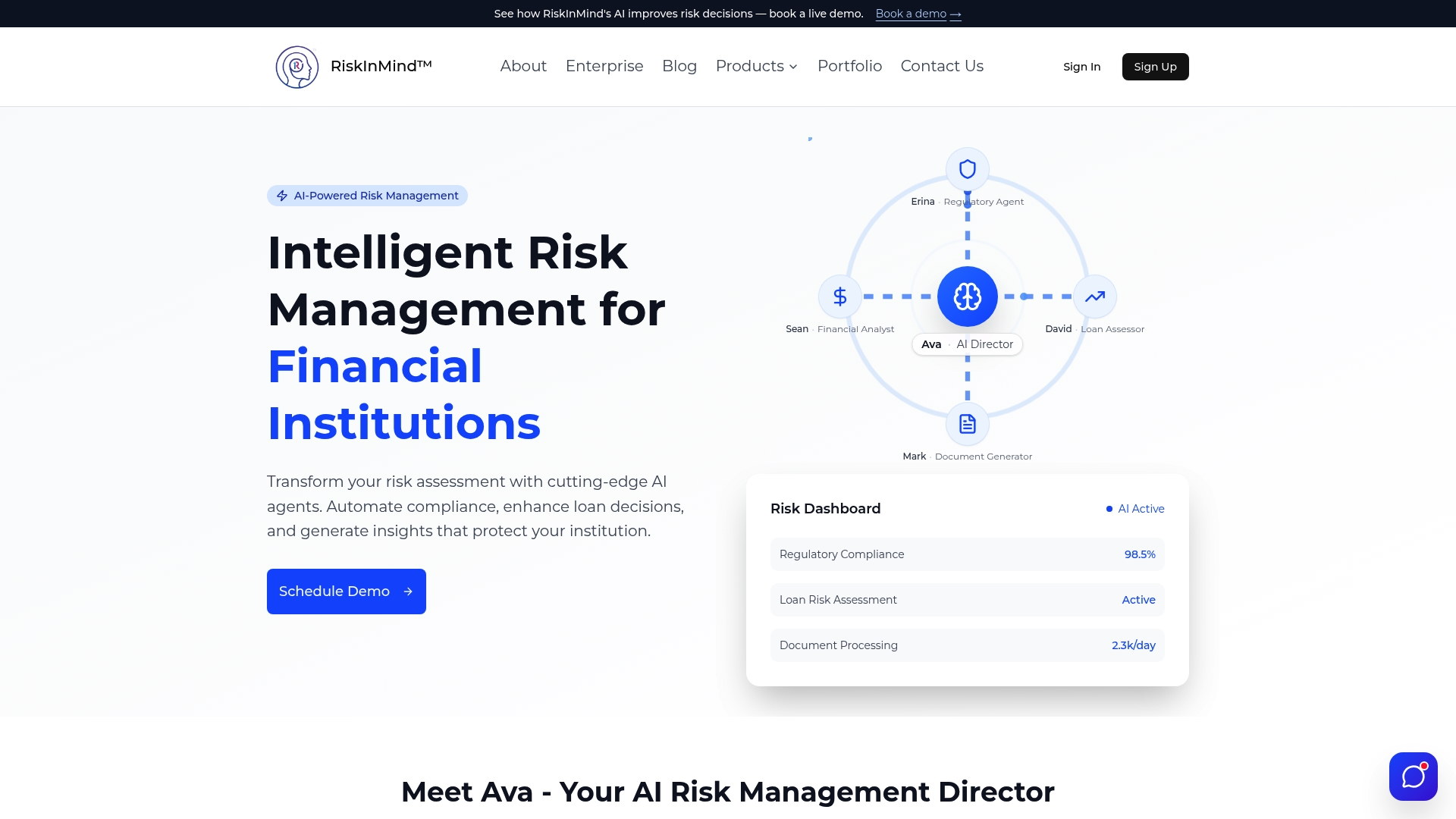
Riskinmind's AI agents, coordinated by Ava, handle regulatory compliance monitoring, credit risk assessment, and audit-ready reporting with response times under half a second. The platform holds SOC 2® certification and is built specifically for credit unions, community banks, and lenders navigating the demands of SR 26-2 and international frameworks. For institutions managing loan application risk or building out their compliance process for 2026, Riskinmind provides the governance infrastructure to meet regulatory expectations without adding headcount.
FAQ
What is the difference between SR 11-7 and SR 26-2?
SR 26-2, issued in april 2026 by the Federal Reserve, FDIC, and OCC, replaces SR 11-7 and introduces a risk-based, proportionate approach to model risk management that scales with institution size and model complexity.
Does the EU AI Act apply to U.S. financial institutions?
Yes, if a U.S. institution deploys AI models that affect EU clients or uses EU-based AI vendors, the EU AI Act's documentation retention and transparency requirements apply, including a 10-year record-keeping obligation.
What does "living documentation" mean in model governance?
Living documentation means model records, validation reports, and monitoring data are updated continuously whenever a model changes, rather than being filed once at deployment and left static.
Who is responsible for vendor model compliance?
The institution using the model retains full compliance responsibility, regardless of whether the model was built internally or purchased from a third party. SR 26-2 is explicit that vendor model oversight must be integrated into the institution's governance framework.
How often should models be revalidated?
Revalidation should be triggered by defined quantitative performance thresholds, such as accuracy or calibration breaches, not by a fixed calendar schedule. Continuous monitoring is the standard expected by the Bank of England's PRA and OSFI.