
Residual risk in banking is the exposure that remains after controls are applied — the net vulnerability your institution carries even after policies, automated rules, collateral, and monitoring are in place. The moment you have a residual risk figure, three actions follow immediately: (1) quantify the net exposure using a defensible method, (2) compare it against your board-approved risk appetite, and (3) choose a treatment — accept, mitigate, transfer, or escalate — and document the decision with a named owner.
Before your next examiner visit, capture at minimum:
- The date of the most recent control effectiveness test
- A current KRI snapshot tied to the exposure
- The name of the decision owner and the treatment selected
- The board or committee that approved the appetite threshold
Automate Regulatory Model Risk Governance
Examine models against 32 qualitative criteria and resolve risk Tiers with pre-deployment checklists per OCC 2011-12 guidelines.
Pro Tip: Examiners do not just want the residual risk rating — they want the logic behind it. Document your inputs, assumptions, and control test dates in the same record as the final rating.
Table of Contents
- What is residual risk in banking, and where does it fit in the risk lifecycle?
- How residual risk differs from inherent risk and related terms
- How to calculate residual risk: a step-by-step method with a worked example
- Examples of residual risk types across banking categories
- Practical strategies for managing residual risk
- What US regulators and examiners expect on residual risk
- How to measure and monitor residual risk continuously
- Common pitfalls and red flags that quietly increase residual risk
- Governance, decisioning, and documentation: the required record fields
- How AI platforms can operationalize continuous residual risk assessment
- Key Takeaways
- The board conversation most risk officers get wrong
- Riskinmind gives your team audit-ready residual risk monitoring without the manual lag
- Authoritative US regulator guidance and key references
What is residual risk in banking, and where does it fit in the risk lifecycle?
The working formula is straightforward: Residual Risk = Inherent Risk − Control Effectiveness. Inherent risk is the gross exposure before any mitigant is applied; control effectiveness is the degree to which your policies, automated rules, monitoring systems, and capital buffers actually reduce that exposure. The difference is what your institution is left holding.
That formula is useful for communication, but it understates the real complexity. Control effectiveness is rarely a static percentage — it shifts with staff turnover, system changes, transaction volume spikes, and the passage of time between tests. A control rated 80% effective at last year's audit may be operating at 60% today.
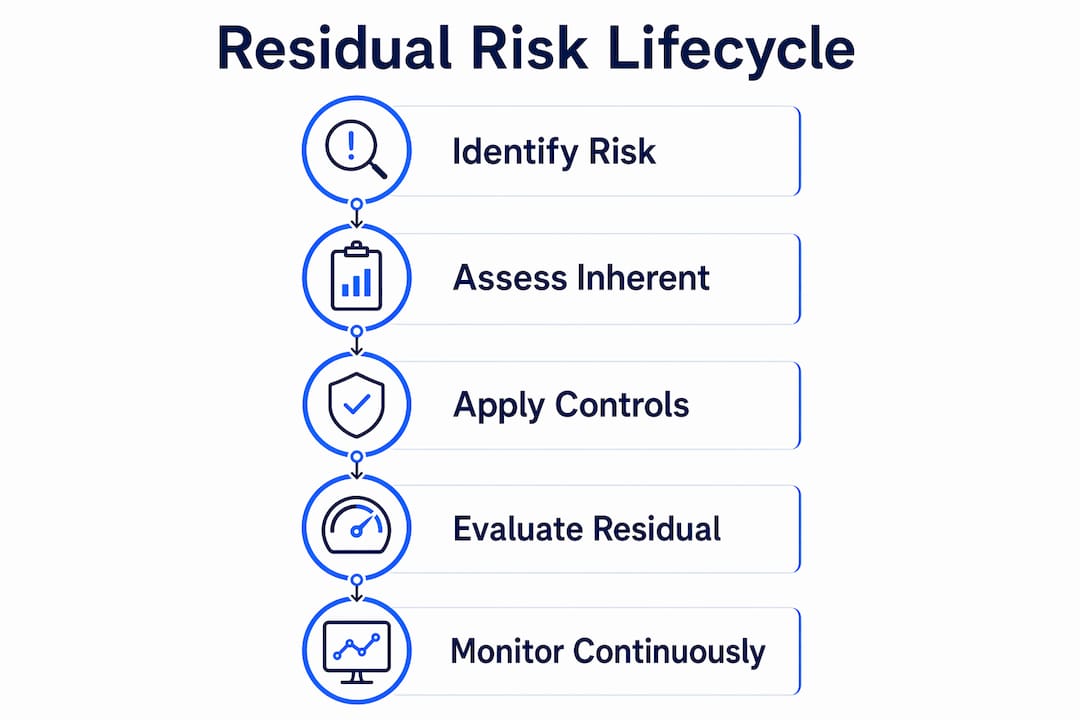
Residual risk sits at the fourth step of the standard risk lifecycle: identify the risk, assess inherent exposure, apply controls, then measure what remains. That net figure is what governance bodies and regulators actually act on. The lifecycle does not end there — the residual rating feeds back into appetite comparisons, treatment decisions, and the next monitoring cycle.
What counts as control effectiveness in a banking context includes documented policies and procedures, automated transaction rules, real-time monitoring alerts, collateral and guarantee coverage, and capital mitigants. What does not count: untested controls, controls that exist on paper but have no documented test result, or mitigants whose coverage has not been verified against current exposure levels.
How residual risk differs from inherent risk and related terms
Practitioners and examiners use several overlapping terms, and imprecise language in board papers or examination responses creates unnecessary friction. The distinctions matter.
Inherent (gross) risk is the raw exposure assuming no controls exist. It answers: how bad could this get if nothing were in place? Residual (post-control) risk — also called net risk or post-control exposure in practitioner guides — is what remains after controls are functioning as designed. Tolerated or accepted risk is the portion of residual risk your institution has explicitly decided to carry, documented against the board-approved appetite.
A concrete example: a community bank extends a $2 million commercial loan to a borrower with a below-investment-grade credit profile. The inherent credit risk is high. The bank takes a first-lien position on commercial real estate collateral, requires quarterly financial covenants, and monitors the account with automated alerts. After those controls, the residual credit risk is materially lower — but not zero. If the collateral is illiquid commercial property in a stressed market, the residual exposure could still be significant, and the bank must decide whether that net figure falls within appetite.
When writing for boards and examiners, use "inherent risk" and "residual risk" consistently and define them once in any report. Avoid interchanging "net risk" and "residual risk" in the same document without a definitional note, since some regulatory frameworks use "net" in a capital-calculation context that carries different meaning.

How to calculate residual risk: a step-by-step method with a worked example
A defensible residual risk calculation follows four steps. Each step generates evidence you will need for audit.
- Define inherent exposure. Express it as likelihood × impact, using a calibrated scale (for example, a 1–5 likelihood score and a dollar-denominated impact band). For a credit exposure, inherent risk might be a probability of default multiplied by loss given default on the unmitigated position.
- Inventory controls and rate their effectiveness. List each control, assign an effectiveness rating based on the most recent test result, and note the test date. Use a range (for example, High/Medium/Low or a percentage band) rather than a single static number, because control effectiveness is a time-varying parameter that should incorporate exception rates and KRI trends.
- Compute adjusted net exposure. Apply the blended control effectiveness to the inherent score to produce a residual rating. For quantitative models, this may be a dollar figure; for qualitative heat-map approaches, it produces a residual risk tier (High/Medium/Low).
- Aggregate across units or portfolio. Sum residual exposures by risk category, business line, or portfolio segment to produce an institution-level view for the board and CRO.
Worked example: commercial loan AML scenario
| Input | Value |
|---|---|
| Inherent risk score (likelihood × impact) | 4 × 4 = — (High) |
| Control 1: automated transaction monitoring | Effectiveness: High (last tested: recent quarter) |
| Control 2: enhanced due diligence (EDD) procedures | Effectiveness: Medium (last tested: recent quarter) |
| Control 3: relationship manager annual review | Effectiveness: Low (no documented test on file) |
| Blended control effectiveness | Medium (one untested control degrades the aggregate) |
| Residual risk rating | Medium-High |
| Appetite threshold | Medium |
| Status | Exceeds appetite — treatment required |
The untested relationship manager review is the critical gap. A single undocumented control pulls the blended effectiveness down and pushes the residual rating above appetite. That is the kind of finding examiners surface during targeted reviews.
For audit-readiness, capture the following fields alongside every residual risk calculation:
- Control owner name and title
- Date of last effectiveness test and test methodology
- KRI snapshot at the time of assessment
- Assumptions used in the likelihood and impact ratings
- Name of the approving officer or committee
- Treatment decision and next review date
A complete risk assessment for financial institutions should embed these fields in a centralized record, not a spreadsheet that lives on one analyst's desktop.
Examples of residual risk types across banking categories
Understanding residual risk in the abstract is one thing; recognizing it in your own portfolio is another. Four categories account for most of the residual exposure community and regional banks carry.
Residual credit risk. A bank holds a secured commercial real estate loan with a first-lien mortgage and a personal guarantee. The inherent credit risk is reduced by collateral coverage and the guarantee, but residual exposure remains if the property is illiquid, the guarantor's net worth is concentrated in the same asset class, or covenant compliance has not been tested recently. The examiner will ask for the most recent appraisal date and covenant compliance certificate.
Residual operational risk. A back-office team performs daily reconciliations manually using spreadsheets. The bank has a four-eyes review policy, but the second reviewer is the same supervisor who approves exceptions. The control exists, but its independence is compromised. Residual operational risk from that manual process is higher than the policy suggests, and the impact of residual risk from operational failures — per the Federal Reserve's risk definitions — includes both earnings loss and reputational damage.
Residual third-party risk. A bank outsources core data processing to a cloud vendor. The vendor has a SOC 2 report, but the bank has not reviewed it in 18 months and has no contractual right to audit. A vendor outage would directly affect transaction processing. The residual risk here is not just operational; it carries compliance and reputational dimensions that a static vendor risk rating will not capture.
Residual AML/compliance risk. Even with AML enhanced due diligence and transaction monitoring, institutions retain residual exposure to false negatives — transactions that pass through monitoring rules because the typology has shifted or the rules have not been tuned to current patterns. The residual AML risk is the gap between what your monitoring detects and what is actually occurring in the portfolio.
One category that practitioners underestimate: mitigation side-effects. When a bank uses credit derivatives to hedge loan book exposure, it reduces credit risk but introduces counterparty risk and liquidity risk on the derivative position. Those newly created exposures must be quantified and treated as part of the overall portfolio assessment — not ignored because they arose from a risk-reduction action.
Practical strategies for managing residual risk
Once you have a residual risk rating, the governance question is which treatment to apply. The four standard options each carry different cost, capital, and operational implications.
Accept. Appropriate when residual risk falls within board-approved appetite, the cost of further mitigation exceeds the expected loss reduction, and the exposure is well-monitored. Acceptance is not passive — it requires a documented decision, a named owner, and a defined review date.

Treat (mitigate further). Deploy additional or stronger controls to reduce the residual exposure. This is the correct response when residual risk exceeds appetite and a cost-effective control exists. Treatment plans must specify the control to be added, the expected reduction in residual rating, the owner, and the timeline.
Transfer. Shift the financial consequence through insurance, guarantees, or credit derivatives. Transfer does not eliminate residual risk — it changes who bears it and may introduce new exposures (see the hedging side-effect point above).
Avoid. Exit the activity or decline the exposure entirely. Appropriate when residual risk cannot be reduced to appetite levels at acceptable cost, or when the regulatory or reputational downside is disproportionate.
A treatment decision checklist should address:
- Does the residual rating exceed the board-approved appetite threshold?
- What is the cost of the proposed treatment relative to the expected loss reduction?
- What is the capital impact of accepting versus treating?
- Is the treatment operationally feasible within the required timeline?
- Who owns the treatment plan, and who monitors progress?
- Does the exposure trigger any regulatory concentration or reporting threshold?
Escalate immediately when residual risk exceeds appetite without an approved treatment plan, when a concentration risk emerges across multiple exposures in the same category, or when a control failure has gone undetected for more than one monitoring cycle.
What US regulators and examiners expect on residual risk
The OCC, Federal Reserve, and FDIC do not use a single uniform residual risk framework, but their examination guidance converges on several expectations that compliance officers should treat as baseline requirements.
Regulators expect documented residual risk assessments that are explicitly linked to the institution's board-approved risk appetite. A residual risk rating that exists in isolation — with no connection to appetite thresholds or treatment decisions — is a common examination finding. Supervisors can require remedial action or additional capital buffers when control procedures are found to be deficient, and that authority applies whether the deficiency is in the control itself or in the documentation supporting it.
The OCC's nine risk categories — credit, interest rate, liquidity, price, foreign exchange, transaction, compliance, strategic, and reputation — provide the taxonomy examiners use to classify residual exposures. Your residual risk assessments should map to these categories so that examiner findings can be addressed within the same framework your institution uses internally.
Examiner triggers that typically prompt deeper review include: residual risk ratings that have not changed over multiple assessment cycles despite portfolio growth or market stress; control test results that are not reflected in residual ratings; and treatment plans that are approved but show no documented progress. Fragmented manual evidence is a recurring exam finding — assessments stored in separate spreadsheets, email chains, and shared drives that cannot be assembled quickly during an examination.
An audit-readiness checklist for an examiner visit should include:
- Board minutes approving the risk appetite statement and any material changes
- Residual risk assessment records with inputs, assumptions, and rating rationale
- Control testing results with dates, methodologies, and owners
- KRI trend data for the prior four quarters
- Active treatment plans with milestone status
- Evidence of escalation for any residual risk that exceeded appetite
For a deeper look at what regulatory reporting requires in terms of format and frequency, the documentation standards matter as much as the content.
How to measure and monitor residual risk continuously
A residual risk rating produced once a year is a snapshot, not a monitoring program. The exposures that cause examination findings and losses are usually the ones that shifted between annual reviews.
High-value KRIs for tracking residual risk include: control failure rates (the percentage of controls that failed their most recent test), exception rates on automated monitoring rules, near-miss incident counts by risk category, detection lag (the time between when a risk event occurred and when it was identified), and third-party SLA breach frequency. Each KRI should have a defined threshold that triggers escalation before the residual rating formally exceeds appetite.
Control testing cadence should be calibrated to the control's criticality and the volatility of the underlying exposure. The table below maps control types to recommended testing frequency and reporting ownership.
| Control Type | Recommended Test Cadence | Reporting Owner |
|---|---|---|
| Automated transaction monitoring rules | Monthly | BSA/AML Officer |
| Credit covenant compliance checks | Quarterly | Credit Risk Officer |
| Vendor SOC 2 / third-party review | Annual (or on material change) | Third-Party Risk Manager |
| Manual reconciliation procedures | Quarterly | Operational Risk Officer |
| Model validation (credit, CECL) | Annual | Model Risk Officer |
| Policy compliance attestations | Annual | Chief Compliance Officer |
A monitoring dashboard for residual risk should surface, at minimum: the current residual rating by risk category, the trend direction (improving, stable, deteriorating), the date of the last control test, the KRI status against threshold, and the named owner. AI-enabled monitoring can automate KRI aggregation and flag threshold breaches in real time, reducing the lag between a control deterioration and a management response.
Common pitfalls and red flags that quietly increase residual risk
The most damaging residual risk exposures are rarely the ones on the heat map. They are the ones that grew undetected because the monitoring program had a structural gap.
The most common pitfalls:
- Static effectiveness ratings. Assigning a fixed percentage to a control and never updating it between formal reviews. A control rated 85% effective two years ago may have degraded significantly if the underlying process changed or staff turned over.
- Ignoring control interactions. Two controls that each appear adequate may create a gap when they interact. An automated alert system and a manual review process can both be functioning individually while leaving a window where alerts are generated but not reviewed within the required timeframe.
- Fragmented evidence. Control test results, KRI data, and treatment plans stored in separate systems or spreadsheets cannot be assembled quickly for an examiner. The fragmentation itself is a finding, independent of whether the underlying risk is well-managed.
- Stale testing. Controls that have not been tested within their required cadence should be treated as unverified, not as effective. An untested control degrades the blended effectiveness rating for the entire risk category.
Red flags that should prompt immediate reassessment and escalation:
- A residual risk rating that has not changed across three or more consecutive assessment cycles despite portfolio growth or market stress
- A control failure that was not reflected in the residual rating within one monitoring cycle
- A treatment plan that is more than 90 days past its milestone date with no documented update
- A new product, channel, or vendor relationship that has not been mapped to the existing residual risk framework
Mitigation side-effects deserve a specific note. When a bank deploys a hedge, purchases insurance, or outsources a function to reduce one type of residual risk, the new arrangement introduces its own exposures. A credit derivative reduces loan book credit risk but creates counterparty and liquidity risk on the derivative. That newly created residual exposure must be assessed and owned — not treated as a byproduct that falls outside the framework.
Governance, decisioning, and documentation: the required record fields
Governance of residual risk is a decision flow, not a filing exercise. The sequence is: identify the risk, quantify the inherent exposure, apply and test controls, measure residual exposure, compare to appetite, select a treatment, document the decision, and monitor progress. Each step generates evidence that examiners will request.
The decision to accept, treat, transfer, or avoid a residual risk should be captured in a treatment plan record that includes:
- Risk category and specific exposure description
- Inherent risk rating and basis
- Controls applied and their tested effectiveness ratings
- Residual risk rating and the date it was calculated
- Appetite threshold and whether the residual rating exceeds it
- Treatment selected (accept/treat/transfer/avoid) with rationale
- Owner name and title
- Implementation timeline and milestones
- KPIs or KRIs that will signal whether the treatment is working
- Board or committee escalation trigger (the residual rating level or event that requires escalation)
Approval authority should be tiered. A residual risk rating within appetite can be accepted by the relevant risk officer. A rating that exceeds appetite requires CRO review and a documented treatment plan. A rating that materially exceeds appetite, or that has persisted above appetite for more than two review cycles, should be escalated to the board risk committee with a formal remediation plan. Documentation standards for financial institutions should specify these thresholds explicitly so that escalation is automatic, not discretionary.
How AI platforms can operationalize continuous residual risk assessment
Manual residual risk processes have a structural limitation: they produce point-in-time ratings that are already aging by the time they reach the board. Advanced practitioners treat residual risk as dynamic, and that requires monitoring infrastructure that can recalibrate control effectiveness in near-real time.
AI-powered platforms address this in several ways:
- Real-time control effectiveness recalibration. By ingesting control test results, exception rates, and KRI feeds continuously, an AI platform can update residual ratings as conditions change rather than waiting for the next scheduled review.
- Automated KRI aggregation. Instead of analysts pulling data from multiple systems, the platform aggregates KRI time series across risk categories and flags threshold breaches automatically.
- Cross-silo correlation. AI can detect when control failures in one area are correlated with deteriorating indicators in another — the kind of interaction risk that manual periodic reviews routinely miss.
- Audit-ready logging. Centralized logs of control tests, KRI time series, and treatment-plan evidence resolve the common exam finding that residual risk evaluations are fragmented and inconsistent.
When evaluating an automation platform for residual risk monitoring, a compliance officer should verify: real-time dashboards with drill-down to individual control records, immutable audit logs with timestamps and user attribution, control-testing automation with configurable cadence, scenario simulation capability for stress-testing residual ratings, and SOC 2 certification confirming the platform's own security posture.
Consider a community bank that moved from annual residual risk reviews to continuous monitoring through an AI platform. Within two quarters, the bank identified that its automated transaction monitoring rules had not been tuned to a new product's transaction patterns — a gap that would have been invisible until the next annual review. Detecting that control decay early allowed the bank to retune the rules before the exposure materialized as a regulatory finding.
Key Takeaways
Residual risk in banking is a decision variable, not just a compliance metric — the institutions that manage it well use it to determine where to deploy capital and where to grow safely.
| Point | Details |
|---|---|
| Quantify net exposure first | Calculate residual risk using inherent exposure minus tested control effectiveness before any governance decision. |
| Compare to board-approved appetite | Every residual risk rating must be explicitly mapped to the institution's appetite threshold to determine whether treatment is required. |
| Document the treatment decision | Record the owner, timeline, KPIs, and escalation triggers for every treatment plan — this is the evidence examiners request first. |
| Monitor continuously, not annually | Control effectiveness decays between reviews; KRI-driven monitoring and regular control testing catch deterioration before it becomes an exam finding. |
| Riskinmind automates the process | Riskinmind's AI platform aggregates KRIs, logs control tests, and produces audit-ready residual risk records in real time for financial institutions. |
The board conversation most risk officers get wrong
There is a version of the residual risk presentation that risk officers give boards every quarter, and it is almost always the wrong one. It leads with the heat map, walks through each rating, and ends with a list of open treatment plans. The board nods, asks a few questions about the red items, and moves on. Nothing changes.
The more effective frame is to present residual risk as a capital allocation question. Where the residual rating exceeds appetite, the institution is either carrying uncompensated risk or it needs to price that risk into the activity. Where residual risk is well within appetite, there may be room to grow. That reframe shifts the conversation from compliance theater to strategic decision-making, and it is the frame that senior regulators and sophisticated board members actually respond to.
The pushback you will encounter is cost. Treatment plans require resources, and boards will ask whether the mitigation cost is justified by the expected loss reduction. The answer requires you to have a credible expected loss figure — which means your inherent risk ratings and control effectiveness assessments need to be defensible, not just directionally reasonable. That is why the calculation methodology matters as much as the governance process. A board that trusts the inputs will act on the output.
One practical tip: when presenting a residual risk that exceeds appetite, always bring three things — the current rating with its evidence, the proposed treatment with its cost and timeline, and the residual rating you expect after treatment. Boards make better decisions when they can see the before and after, not just the problem.
Riskinmind gives your team audit-ready residual risk monitoring without the manual lag
The gap between knowing your residual risk and being able to prove it to an examiner is almost always a documentation and monitoring problem, not an analytical one. Riskinmind's AI platform closes that gap by automating KRI aggregation, control-testing logs, and treatment-plan tracking in a single portfolio monitoring solution built specifically for credit unions, community banks, and lenders.
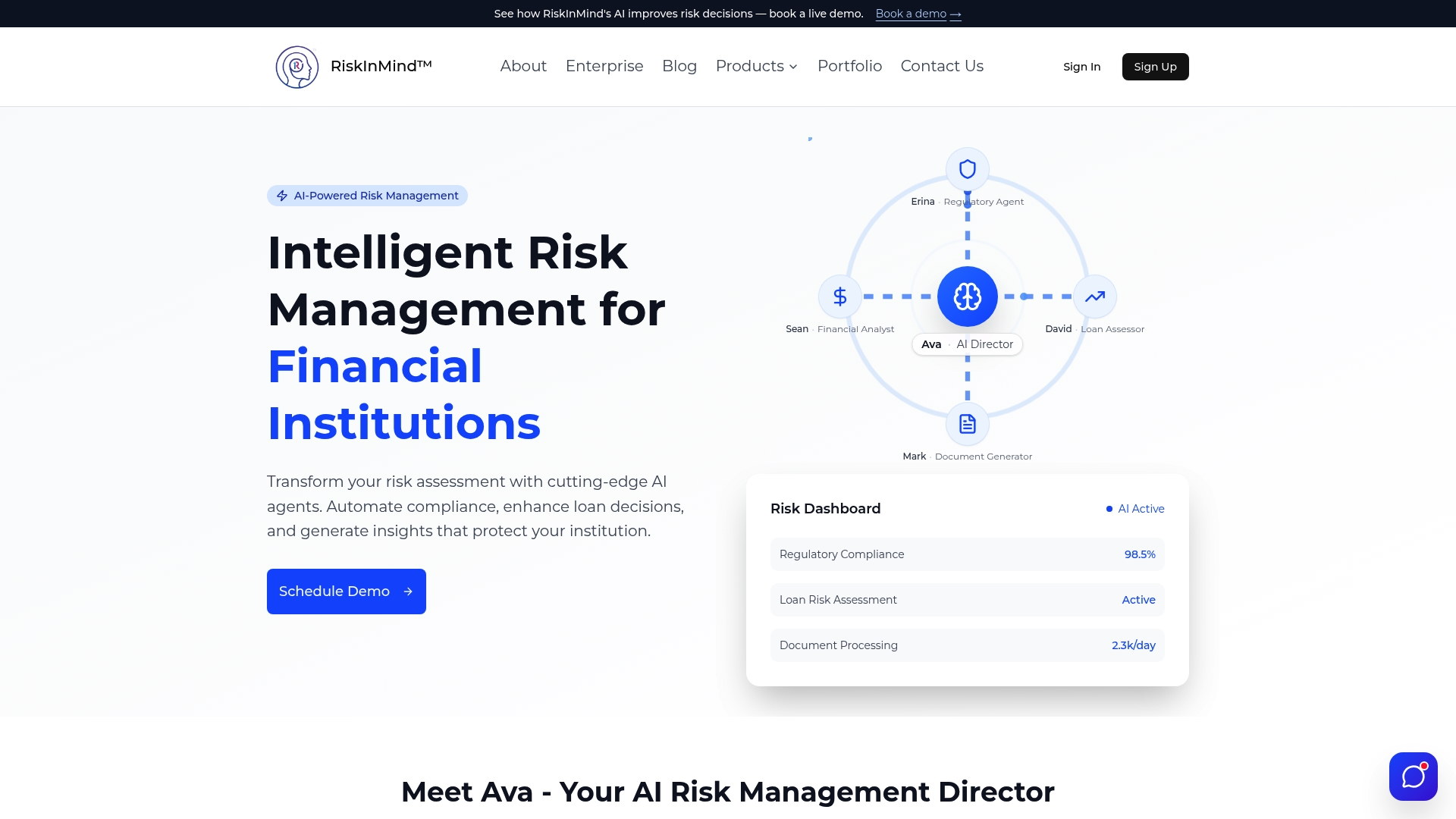
The platform's specialized AI agents continuously recalibrate control effectiveness ratings as new test results and exception data arrive, so your residual risk records reflect current conditions rather than last quarter's snapshot. Every control test, KRI threshold breach, and treatment-plan update is logged with timestamps and user attribution, producing the centralized audit trail that examiners expect and that fragmented spreadsheet environments cannot deliver. Riskinmind holds SOC 2® certification and processes data with bank-grade security, so the platform itself meets the security standards your institution requires. For teams managing loan application risk at origination, the platform integrates residual credit risk scoring directly into the underwriting workflow. Request a demo to see how continuous monitoring changes your examination posture.
Authoritative US regulator guidance and key references
These primary sources should be in your examination preparation file and cited when documenting your residual risk methodology.
- OCC — Categories of Risk (1996, updated guidance): Defines the nine OCC risk categories — credit, interest rate, liquidity, price, foreign exchange, transaction, compliance, strategic, and reputation — that structure examiner assessments. Available at OCC risk categories.
- Federal Reserve — SR Letter 96-14 Attachment: The Fed's definitions of risk types evaluated at examinations, including operational risk, credit risk, market risk, liquidity risk, and legal risk. Available at Federal Reserve SR 96-14.
- NIST SP 800-30 / CSRC Glossary: The NIST definition of residual risk as the "portion of risk remaining after security measures have been applied" is widely cited in technology and operational risk contexts. Available at NIST CSRC glossary.
- Stanford OCRO — Definition of Residual Risk: A concise institutional definition: residual risk is "the risk remaining after leadership's response to the risk — design of appropriate process and controls, and implementation of the same." Available at Stanford OCRO.
- Riskinmind — How to optimize risk reporting: Practical guidance on dashboard design and reporting cadence for financial institutions. Available at risk reporting optimization.
This article is general information for risk management professionals and does not constitute legal, regulatory, or compliance advice. Confirm current regulatory requirements with the OCC, Federal Reserve, FDIC, or a qualified compliance professional for your institution's specific situation.