
Regulatory compliance workload at financial institutions has not just grown. It has compounded. New frameworks layer on top of existing ones, examination cycles accelerate, and the cost of falling behind is measured in seven-figure penalties and reputational damage. The role of AI in regulatory compliance is no longer a future consideration for compliance officers and risk managers. It is a present reality reshaping how institutions monitor obligations, detect violations, and prepare for audits. What AI does not do is replace your judgment. What it does is absorb the volume so your judgment can focus where it matters most.
Table of Contents
- Key Takeaways
- The role of AI in regulatory compliance: what it actually means
- How agentic AI transforms compliance monitoring
- Risks and limitations you need to anticipate
- Practical steps for implementing AI-driven compliance
- My perspective on where this is all heading
- How Riskinmind supports your compliance program
- FAQ
Automate Regulatory Model Risk Governance
Examine models against 32 qualitative criteria and resolve risk Tiers with pre-deployment checklists per OCC 2011-12 guidelines.
Key Takeaways
| Point | Details |
|---|---|
| AI handles volume, not judgment | AI automates monitoring and filtering, but human oversight remains critical for final decisions and escalation. |
| Continuous monitoring changes everything | Agentic AI platforms monitor compliance in real time, replacing periodic manual reviews with persistent surveillance. |
| New risks emerge alongside new tools | Generative AI enables synthetic identity fraud and document forgery, requiring AI-defensive strategies in parallel. |
| Implementation requires governance first | Start with focused, well-governed workflows before expanding AI across the full compliance function. |
| Obligation mapping accelerates audits | Linking regulatory requirements to controls via structured models transforms exams from investigative to confirmatory. |
The role of AI in regulatory compliance: what it actually means
"AI-driven compliance" gets used loosely, so it is worth being precise. What is AI-driven compliance in a financial institution context? It is the application of machine learning, natural language processing, and autonomous AI agents to automate, monitor, and analyze the workflows that regulatory compliance depends on, from transaction surveillance to regulatory change management to audit evidence assembly.
The core technologies divide into three layers. Machine learning models detect statistical anomalies in transaction data, flag behavioral patterns inconsistent with a customer's profile, and score risk across large populations with a speed no human team can replicate. Natural language processing reads regulatory text, extracts obligations, and maps those obligations to internal controls. AI agents go further still: they reason across multiple data sources, take multi-step actions, and generate complete audit trails autonomously.
Common applications in financial institutions today include:
- Regulatory change monitoring: AI scans regulatory publications, classifies changes by relevance and urgency, and routes updates to the appropriate control owners.
- Transaction monitoring: AI models flag suspicious activity in real time, dramatically reducing the manual review burden on AML teams.
- Controls testing: AI agents execute automated tests against control objectives and document results with evidence that survives examination scrutiny.
- Audit readiness: AI assembles structural evidence models that map requirements to controls to proof, so your team is not scrambling at examination time.
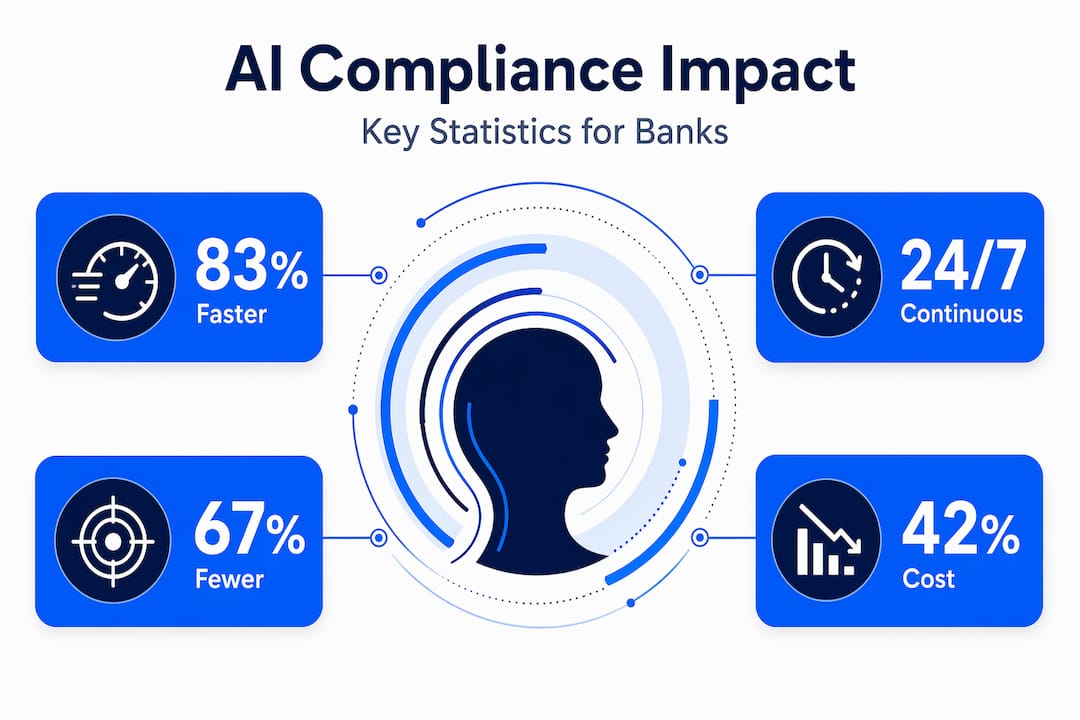
AI adoption in compliance is accelerating because the math is compelling. 83% of firms using AI for compliance report time savings as a primary benefit, with 71% citing cost reduction as well.
Pro Tip: Before deploying AI for regulatory monitoring, build a clean obligation inventory first. AI is only as accurate as the regulatory requirements you feed it. Garbage in, garbage out applies with exceptional force in compliance.
How agentic AI transforms compliance monitoring
The traditional compliance model is periodic and reactive. Your team reviews reports on a weekly or monthly cycle, runs manual spot-checks, and prepares for exams by assembling evidence that was never built with examination in mind. That model does not fail because your team lacks skill. It fails because the volume of data and the pace of regulatory change have outgrown it.
Agentic AI operates on a fundamentally different model. Here is how the workflow typically unfolds in practice:
- Continuous ingestion: The AI agent monitors transaction data, regulatory feeds, and internal policy documentation without interruption, operating across time zones and business hours alike.
- Anomaly detection and severity classification: When a potential violation surfaces, the agent classifies its severity, cross-references it against the relevant regulatory obligation, and determines whether it can be auto-remediated or requires human escalation.
- Automated remediation or escalation: Lower-risk findings trigger automated workflow responses. High-risk or ambiguous findings are routed to a compliance officer with full context attached, including the data, the reasoning chain, and the suggested response.
- Tamper-proof audit trail generation: Every action the agent takes is logged with timestamps and immutable documentation, producing the kind of evidence that satisfies regulators without requiring your team to reconstruct it after the fact.
The efficiency impact is material. Banks using AI compress regulatory response cycles from months to days and reduce AML false positives by more than 30%. Complex data set analysis that previously took weeks now takes minutes for breach detection. That is not a marginal improvement. That is a structural change in what a compliance team can accomplish.
"AI compliance requires human-in-the-loop validation to meet audit and regulatory standards; complete automation without oversight risks compliance failures and regulatory drift." — AI moves from monitoring to managing compliance workflows
This is the part that separates well-governed AI implementations from ones that eventually fail an examination. Human review remains critical in validating AI summaries and interpretations. AI handles the initial filtering and workflow management. You handle the judgment calls that require context, experience, and accountability.
Risks and limitations you need to anticipate
AI in compliance is not a risk-free proposition. The same technologies that make your compliance function faster also introduce new threat surfaces and governance challenges that require deliberate management.

The most immediate new risk category is AI-enabled fraud. Illicit actors now use generative AI to create synthetic identities, forge documentation at scale, and obfuscate transaction patterns in ways that older rule-based detection systems cannot recognize. Your AI compliance system needs to be paired with AI-defensive security posture management, not treated as a standalone solution.
Regulatory drift is a subtler but equally serious problem. When AI models are trained on historical regulatory requirements and not continuously integrated with a live obligation inventory, they drift out of alignment with current rules. An AI that correctly monitored for BSA violations under last year's guidance may not correctly monitor for them under this year's. Integration with a dynamic regulatory feed is not optional.
There is also the complexity introduced by overlapping frameworks. Financial institutions navigating the EU AI Act alongside GDPR, prudential regulations, and domestic frameworks are not managing one compliance program. They are managing several simultaneously, each with different obligations around explainability, data governance, and model risk management.
Key governance requirements for any AI compliance deployment:
- Explainability: Regulators increasingly expect you to explain why the AI flagged a transaction or classified a risk. Black-box models create examination exposure.
- Auditability: Every AI action must be logged and retrievable. This is non-negotiable for examination readiness.
- Bias monitoring: AI models trained on historical data can embed historical biases into current decisions, which creates fair lending and fair servicing risk.
- Model validation: AI models in compliance contexts require the same periodic validation and documentation as credit risk models.
Understanding advanced AI risk management is essential for institutions that want the benefits without the blind spots.
Pro Tip: Treat your AI compliance models the same way you treat credit risk models under SR 11-7. Document the development methodology, validate independently, and review on a defined cycle. Regulators are watching.
Practical steps for implementing AI-driven compliance
Knowing why AI helps is not the same as knowing how to deploy it without creating new problems. The institutions that extract the most value from AI-driven compliance follow a disciplined implementation sequence.
Comparison: traditional compliance vs. AI-driven compliance
| Dimension | Traditional compliance | AI-driven compliance |
|---|---|---|
| Monitoring frequency | Periodic, sample-based | Continuous, full population |
| Violation detection speed | Days to weeks | Real time to minutes |
| Audit evidence | Assembled retrospectively | Generated automatically |
| Regulatory change response | Manual research and routing | Automated classification and mapping |
| Staff time allocation | High volume, low complexity work | Judgment, escalation, and oversight |
The implementation sequence that produces measurable results without destabilizing your existing program:
- Define the governed workflow first. Pick one high-volume, well-documented compliance process, such as transaction monitoring or regulatory change tracking, and build governance around the AI before expanding scope.
- Build your obligation inventory. Map every applicable regulatory requirement to the controls and evidence that demonstrate compliance. This is the foundation that makes AI-driven audit readiness possible.
- Deploy specialized agents with an orchestration layer. Multi-agent orchestration with human-in-the-loop escalation outperforms single-model deployments because specialized agents reason more accurately within their domain.
- Integrate regulatory feeds dynamically. Use an obligation graph architecture to map regulatory changes directly to affected controls, so your team gets impact analysis in hours rather than weeks.
- Establish audit-ready documentation from day one. Compliance platforms should generate tamper-proof logs with every action. Regulators have begun asking to see AI decision logs during exams, and you want those logs to be clean from the start.
- Measure and report ROI explicitly. Track time savings per workflow, false positive reduction rates, and examination preparation hours saved. Quantified results build the institutional support needed to scale the program. Organizations that govern this process well report significant time savings as the most consistent near-term return.
The institutions scaling compliance without adding headcount are the ones that have learned to automate risk assessment within a disciplined governance structure rather than deploying AI broadly and hoping for the best.
My perspective on where this is all heading
I've watched compliance programs struggle with the same fundamental problem for years. The work isn't intellectually demanding. It's voluminous. Your best compliance analysts spend hours on tasks that could be handled by a well-governed AI agent, and that misallocation of talent is one of the most expensive problems in financial services that nobody talks about directly.
What I've found to be true is that the institutions gaining the most from AI in compliance aren't the ones with the most sophisticated models. They're the ones that industrialized their repetitive processes first and built governance around them second. They treated AI as infrastructure, not innovation theater.
The thing that concerns me most is complacency. Once AI is handling continuous monitoring, there's a natural human tendency to stop checking. That's exactly when regulatory drift and model decay create examination exposure. The governance cadence matters as much as the technology itself.
The future I find genuinely compelling is multi-agent orchestration where a central AI director coordinates specialized agents for credit risk, AML, regulatory change, and fair lending, each operating with domain expertise and escalating to human officers for anything that falls outside their confidence threshold. That's not a distant scenario. It's already in production at the most forward-leaning institutions, and the audit trail quality it produces is redefining what examination readiness looks like.
Continuous governance isn't optional. AI compliance doesn't manage itself. The professionals who embrace that responsibility will find it amplifies their impact rather than threatening their role.
— Raj
How Riskinmind supports your compliance program
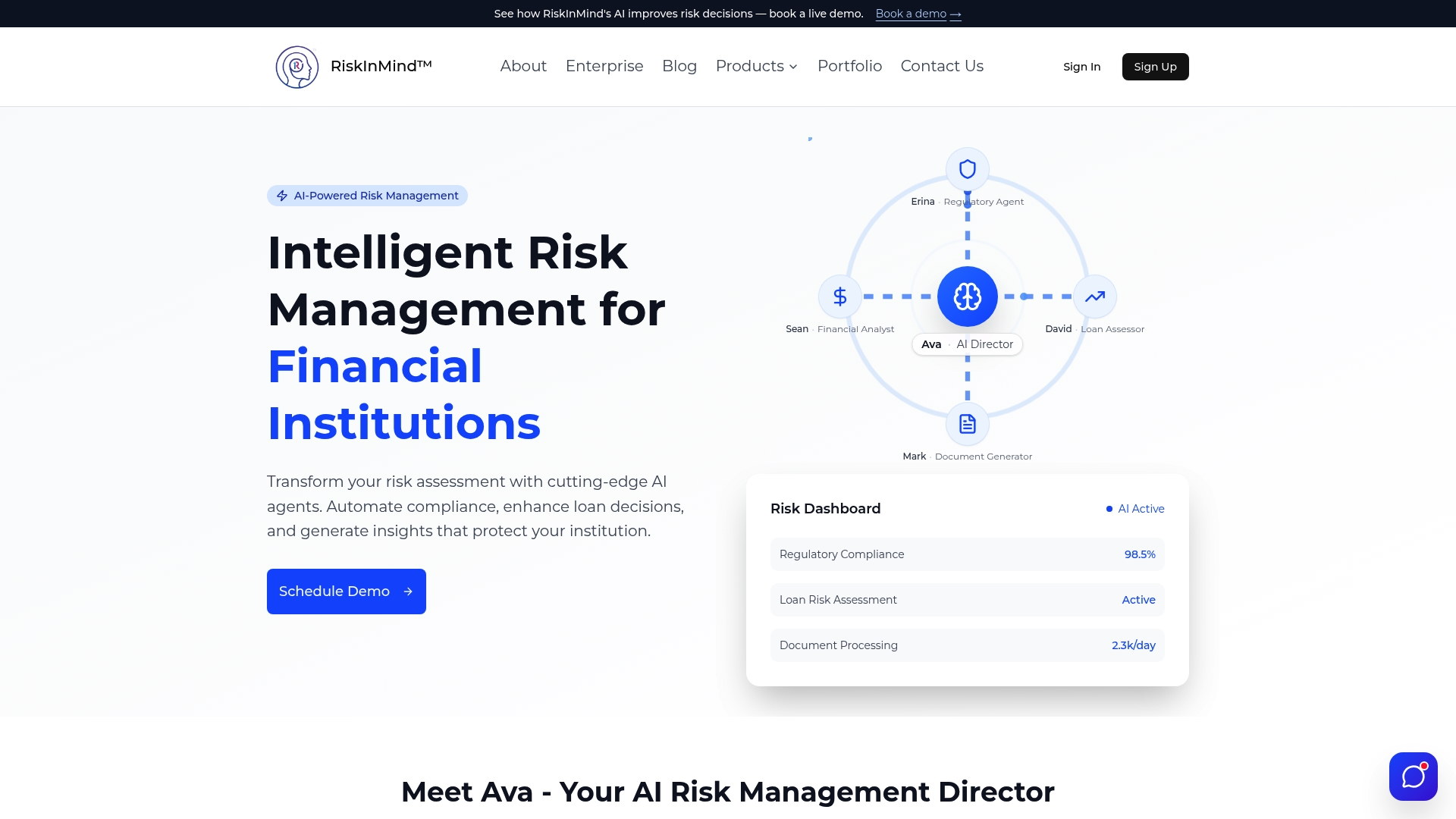
Riskinmind was built specifically for the compliance and risk challenges facing credit unions, community banks, and lenders. Its AI-powered platform deploys specialized agents for regulatory compliance, credit risk assessment, and portfolio monitoring, all coordinated by Ava, a central AI director that routes tasks, manages escalations, and maintains the audit trail your examiners will expect to see.
For compliance officers looking to reduce manual workload without sacrificing examination readiness, Riskinmind's AI risk management platform offers real-time monitoring, automated documentation, and response times under half a second. If your institution originates commercial real estate loans, the CRE loan risk predictor applies AI-driven analysis that supports both credit quality and regulatory adherence in a single workflow. The platform carries SOC 2® certification and bank-grade security, so the compliance infrastructure around the AI is as sound as the AI itself.
FAQ
What is the role of AI in regulatory compliance?
AI automates monitoring, anomaly detection, regulatory change tracking, and audit trail generation, allowing compliance teams to maintain continuous coverage across large data populations rather than relying on periodic, sample-based reviews.
Why use AI for compliance in financial institutions?
Banks and credit unions use AI for compliance because it compresses response cycles from months to days, reduces false positives by over 30%, and allows compliance staff to redirect time from high-volume routine tasks to judgment-intensive oversight work.
What are the main risks of AI-driven compliance?
The primary risks include regulatory drift from outdated model training, AI-enabled fraud using synthetic identities and forged documents, explainability gaps that create examination exposure, and overlapping framework complexity from layered regulatory obligations such as the EU AI Act and GDPR.
Do AI compliance tools replace compliance officers?
No. AI supports monitoring and filtering but is not suited for final decision-making, regulatory interpretation, or the judgment calls that determine examination outcomes. Human oversight is required for defensible compliance.
What should financial institutions prioritize when deploying AI for compliance?
Start with a single, well-governed workflow backed by a clean obligation inventory, deploy specialized agents with an orchestration layer, and build tamper-proof audit documentation from the first day of deployment rather than retrofitting it later.