
What is model risk management?
Model risk management (MRM) is the disciplined process of identifying, assessing, mitigating, and monitoring risks that arise from the use of quantitative models in financial decision-making. The 2026 interagency guidance issued jointly by the Office of the Comptroller of the Currency (OCC), the Federal Reserve Board, and the Federal Deposit Insurance Corporation (FDIC) defines model risk as the potential for adverse financial consequences when decisions are based on model output that is inaccurate, misapplied, or built on flawed assumptions.
Models themselves are simplified representations of real-world relationships. They apply statistical, economic, or financial theories to input data to produce quantitative estimates, and that simplification is precisely where risk enters. A credit scoring model that underweights economic volatility, a stress-testing framework calibrated on pre-crisis data, or a vendor pricing model applied outside its intended scope can each generate outputs that look authoritative while quietly driving poor decisions.
Automate Regulatory Model Risk Governance
Examine models against 32 qualitative criteria and resolve risk Tiers with pre-deployment checklists per OCC 2011-12 guidelines.
The core elements of an effective MRM program include:
- Model identification and inventory: Maintaining a complete, current catalog of all models in use or under development.
- Risk assessment and materiality classification: Evaluating each model's inherent risk, exposure, and purpose to determine the level of oversight required.
- Model validation: Independent review of whether a model performs as intended, including conceptual soundness, data quality, and outcomes analysis.
- Ongoing monitoring: Continuous evaluation of model performance as market conditions, data, and business activities evolve.
- Governance and controls: Clear policies, defined roles, and an independent challenge function that operates separately from model development.
| MRM Element | Core Function |
|---|---|
| Model inventory | Tracks all models and their risk ratings |
| Materiality assessment | Calibrates oversight intensity to model risk |
| Validation | Confirms conceptual soundness and output reliability |
| Monitoring | Detects performance deterioration over time |
| Governance | Establishes accountability and independent challenge |
Where does model risk actually come from?
Model risk can result from incorrect assumptions, data errors, model misuse, or changes in the business environment that degrade model performance. These sources are not always obvious at the point of model deployment, which is what makes them particularly dangerous for institutions that treat validation as a one-time event rather than an ongoing discipline.
Data quality problems are among the most common culprits. A credit scoring model trained on loan performance data from a low-default-rate period will carry embedded optimism that only surfaces when economic conditions shift. Similarly, a model applied to a portfolio segment it was never designed to evaluate, such as using a consumer credit model for small business lending, introduces misapplication risk even if the model itself is technically sound.
"Even a fundamentally sound model producing accurate outputs consistent with the model's design objective can exhibit high model risk if it is misapplied or misused." — Federal Reserve SR 26-2 Guidance
Vendor and third-party models present a specific category of risk. Institutions often receive limited documentation on vendor model methodologies, making independent validation harder. Vendor models require specific validation strategies, including understanding the vendor's conceptual design and conducting ongoing performance monitoring to confirm fitness for purpose. When a vendor model is customized for a specific institution's needs, those adjustments must be documented, justified, and evaluated as part of the validation process.
Additional sources of model risk include:
- Incorrect or outdated assumptions baked into model design that no longer reflect current market dynamics.
- Model complexity that exceeds the institution's capacity to understand, challenge, or explain outputs.
- Aggregate risk from interdependencies among models that share common data, assumptions, or methodologies.
- Inadequate monitoring controls that fail to detect gradual performance deterioration before it affects decisions.
How to manage model risk: the lifecycle framework
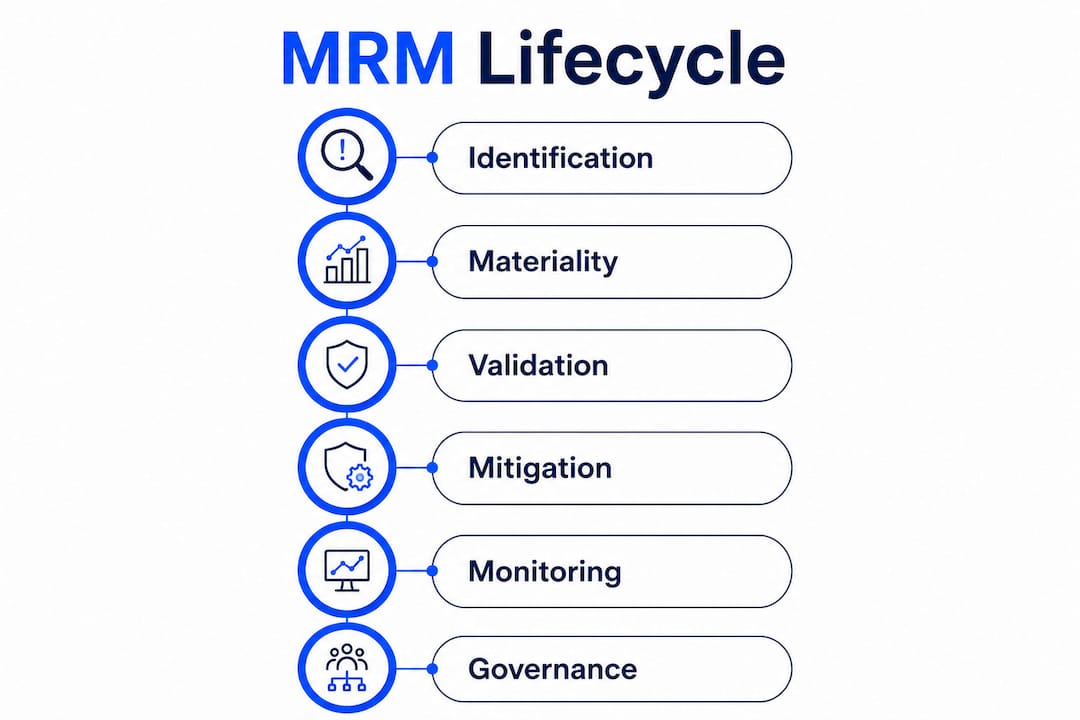
Managing model risk follows a structured lifecycle, and the rigor applied at each stage should be proportional to the model's materiality. A high-exposure capital adequacy model demands a fundamentally different level of scrutiny than a low-volume internal reporting tool.
1. Model identification Every model in use or under development must be cataloged in a model inventory. The inventory should capture enough detail about each model's purpose, exposure, and risk rating to support both individual and aggregate risk assessment.

2. Materiality assessment Model materiality is determined by combining model exposure (the significance of model output to business decisions) with model purpose (the nature and importance of what the model supports). High-materiality models warrant rigorous validation and continuous monitoring. Models deemed immaterial may require only basic identification and performance tracking, though institutions should monitor conditions that could make them material in the future.
3. Validation Independent model validation evaluates conceptual soundness, data integrity, and whether outputs align with expected performance. Validation also identifies limitations and clarifies appropriate use. When performance deviates meaningfully from expectations, institutions must consider whether model adjustments, recalibration, or full redevelopment are warranted.
4. Mitigation Mitigation strategies include model overlays, output adjustments, use restrictions, and in some cases model replacement. For a practical framework on risk mitigation within financial institutions, the approach should be tied directly to the findings from validation and ongoing monitoring.
5. Ongoing monitoring Monitoring evaluates whether a model continues to perform as expected given changes in products, client behavior, data relevance, or market conditions. An effective monitoring plan also tracks model limitations identified at development and flags any trigger events, such as a material change in data sources or model use.
6. Governance Governance provides the policy framework and accountability structure that holds the entire lifecycle together. Effective governance includes clear policies, defined roles for model owners, users, validators, and senior management, and an independent challenge function with the organizational standing to effect change.
| Lifecycle Stage | Key Activity | Oversight Level |
|---|---|---|
| Identification | Inventory and cataloging | All models |
| Materiality assessment | Risk rating assignment | All models |
| Validation | Conceptual and empirical review | Scaled to materiality |
| Mitigation | Overlays, restrictions, redevelopment | As warranted |
| Monitoring | Ongoing performance evaluation | Continuous |
| Governance | Policy, roles, independent challenge | Firm-wide |
Pro Tip: Document every validation finding, exception, and remediation action in a centralized system. Per the Federal Reserve's guidance on documentation, adequate records support continuity of operations and make model remediation efforts significantly more manageable during examinations.
Why model risk management programs matter
Institutions with strong MRM programs reduce their exposure to financial loss, flawed reporting, and regulatory penalties, while building genuine confidence in model-driven decisions. The importance of model risk management extends beyond technical compliance: institutions that manage model risk well make better credit decisions, hold more appropriate capital, and avoid the reputational damage that follows a high-profile model failure.
The cost of weak MRM is concrete. Flawed credit scoring models can approve loans that should be declined or reject creditworthy borrowers, creating both credit losses and fair lending exposure. Stress testing models that underestimate tail risk can lead institutions to hold insufficient capital buffers precisely when they are needed most. Predictive models that degrade silently, without monitoring controls to catch the drift, can distort portfolio management decisions for months before anyone notices.
Key benefits of a well-structured MRM program include:
- Reduced likelihood of financial loss from model errors or misapplication.
- Enhanced regulatory compliance and a stronger posture during examinations.
- Improved risk culture, with model users who understand model limitations and apply outputs appropriately.
- Greater confidence in model-driven decisions across credit, capital, and liquidity management.
- Earlier detection of model performance deterioration before it affects business outcomes.
The board of directors and senior management hold ultimate accountability for establishing a risk culture that supports effective model risk management across the institution. That accountability is not delegable to the model validation team alone.
What U.S. regulators expect from your MRM program
The OCC, Federal Reserve Board, and FDIC issued updated interagency guidance in 2026 that replaced the 2011 framework and set a risk-based approach to MRM tailored to each institution's model risk profile, size, and operational complexity. The guidance is most directly applicable to banking organizations with over $30 billion in total assets, though institutions below that threshold with significant model complexity or non-traditional activities should treat it as highly relevant.
"Each banking organization ultimately is responsible for adopting model risk management practices that are appropriate and effective for managing the specific risks the banking organization faces or is likely to face." — OCC/Federal Reserve/FDIC 2026 Interagency Guidance
Regulatory expectations center on several interconnected requirements:
- Risk-based governance framework: Policies and procedures must reflect the institution's risk appetite and define governance requirements across the full model lifecycle.
- Independent validation: Validation must be conducted by individuals with appropriate expertise, sufficient independence from model development, and the organizational authority to effect change. The SR 26-2 update represents the most significant shift in these expectations since 2011.
- Model inventory: Institutions must maintain a comprehensive inventory with sufficient detail to support risk assessment at both the individual and aggregate levels.
- Board and senior management accountability: Leadership must set the tone for model risk culture and ensure adequate resources are allocated to MRM functions.
- Internal audit role: Internal audit assesses overall MRM rigor and adherence to policy rather than duplicating validation work, providing an independent evaluation of governance effectiveness.
- Vendor model oversight: Third-party models require the same validation discipline as internally developed models, including ongoing monitoring and outcome analysis.
The guidance does not prescribe exact procedures, but examiners evaluate whether an institution's MRM practices are proportionate to its actual model risk exposure and whether governance structures genuinely support independent challenge.
Common challenges in building and sustaining an MRM program
Even institutions with well-designed MRM frameworks encounter persistent implementation challenges. Understanding where programs typically break down is as useful as knowing what sound practice looks like.
Incomplete model inventories remain a foundational problem. Models developed outside formal channels, particularly in business lines or through vendor relationships, often escape the inventory entirely. An inventory that does not capture all models cannot support accurate aggregate risk assessment.
Misaligned incentives between model developers and validators can compromise governance objectivity. When validators report to the same business unit that develops and uses models, the independence required for effective challenge is structurally undermined. Clearly independent reporting lines and accountability structures are critical to preserving objectivity, and regulators scrutinize these arrangements closely.
Resource constraints create pressure to apply uniform, low-effort oversight across all models rather than calibrating rigor to materiality. The result is often over-documentation of low-risk models and under-validation of high-exposure ones. A well-designed materiality framework solves this by directing resources where they matter most.
Model drift without detection is a monitoring failure. Models that performed well at deployment can degrade gradually as market conditions, client behavior, or data sources shift. Without trigger-based monitoring and defined performance thresholds, institutions may not detect deterioration until it has already affected decisions. For a step-by-step risk assessment approach that addresses this challenge, building explicit performance benchmarks into the monitoring plan from the outset is the most effective preventive measure.
Vendor model opacity is a growing concern as institutions rely more heavily on third-party and AI-powered models. Limited access to vendor methodologies, training data, and model logic makes independent validation harder and can leave institutions unable to explain model outputs to examiners or customers.
Finally, model risk management cannot entirely eliminate risk. The goal is not a risk-free model environment but a disciplined, well-documented program that identifies, controls, and monitors risk at a level proportionate to each model's materiality and the institution's overall risk profile.
How Riskinmind supports model risk management
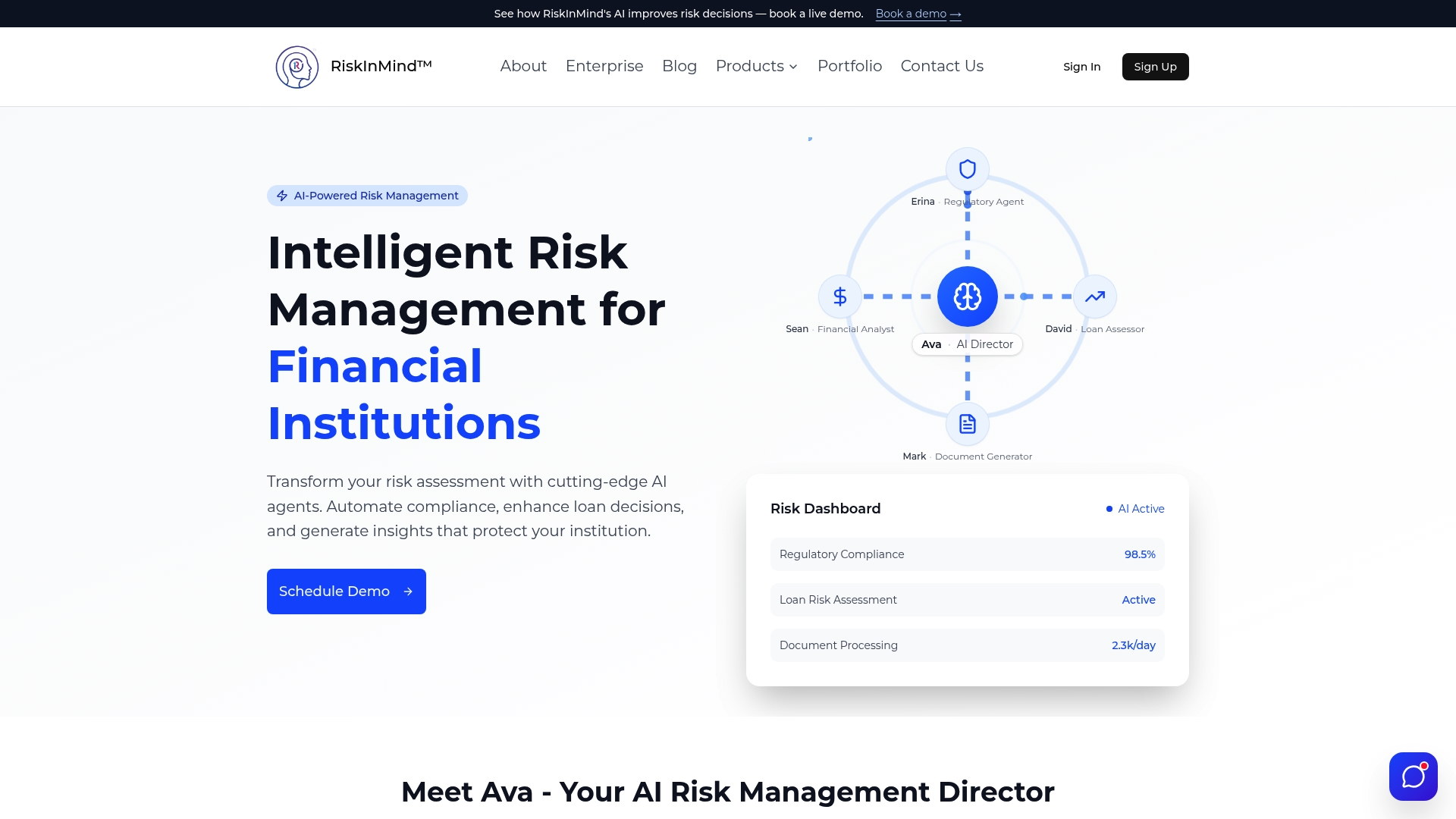
Riskinmind's AI-powered platform is built for the operational realities that financial risk professionals and compliance officers face daily. Its specialized AI agents handle regulatory compliance monitoring, credit risk assessment, and portfolio analysis in real time, with response times under half a second and SOC 2® certified security. For institutions managing complex model inventories and evolving regulatory expectations, Riskinmind provides the automation and audit-ready documentation infrastructure that manual processes cannot match. Explore how AI-driven underwriting and portfolio risk tools can strengthen your MRM program.
Key Takeaways
Model risk management is the structured process of identifying, assessing, mitigating, and monitoring model risks across the full model lifecycle, calibrated to each model's materiality and the institution's risk profile.
| Point | Details |
|---|---|
| Materiality drives oversight | High-exposure models require rigorous validation; immaterial models need basic identification and performance tracking. |
| Independent challenge is non-negotiable | Validators must have expertise, independence from developers, and authority to effect change. |
| Monitoring is continuous | Models that no longer perform as expected may warrant overlays, recalibration, or full redevelopment. |
| Governance anchors the lifecycle | Clear policies, defined roles, and board accountability hold the entire MRM framework together. |
| Vendor models need the same rigor | Third-party models require validation of conceptual soundness and ongoing performance monitoring. |