
Mobile banking risk is defined as the potential for unauthorized access, fraud, and data breaches arising from vulnerabilities in mobile devices, applications, and communication channels used for banking transactions. With 54% of consumers relying on mobile apps as their primary account management channel, the attack surface for financial institutions has expanded dramatically. Regulatory frameworks including PCI DSS, PSD2 strong customer authentication requirements, and GDPR all impose obligations that intersect directly with mobile banking security risks. For compliance officers, risk assessors, and financial analysts, understanding what is mobile banking risk means understanding a threat environment that now begins on the user's device, not at the institution's backend.
What is mobile banking risk and its core technical vulnerabilities?
Mobile banking risk concentrates on three technical fault lines: malware, insecure communication, and weak authentication. Each fault line has grown more dangerous as attackers professionalize their methods.
Maintain 100% NCUA & OCC Audit Readiness
Monitor regulatory updates 24/7, check internal credit policies, and generate compliance trails with Erina (AI Regulatory Agent).
Malware and banking trojans
Android banking trojan attacks increased 56% in 2025, with unique malware packages targeting financial institutions jumping 271% in the same period. That scale signals a shift from opportunistic attacks to organized, financially motivated campaigns. These trojans use overlay attacks, session hijacking, and runtime memory inspection to hijack legitimate app sessions without triggering backend fraud systems. The malware operates silently inside the app's process, making server-side detection nearly impossible without device-level telemetry.
Insecure communication channels
60% of mobile banking apps are vulnerable to Man-in-the-Middle (MITM) attacks because they lack SSL pinning or equivalent communication security controls. An MITM attack intercepts data in transit between the app and the bank's server, exposing credentials and session tokens without the user's knowledge. Attackers on public Wi-Fi networks exploit this gap routinely. SSL pinning, certificate transparency monitoring, and enforced TLS 1.3 are the baseline controls that close this vector.

Authentication weaknesses and local data storage
Apps using single-factor authentication face significantly higher unauthorized access rates than those enforcing multifactor authentication (MFA). Beyond login, local data storage of sensitive information is frequently underprotected, exposing session tokens, cached credentials, and transaction histories when a device is compromised or stolen. Unencrypted SQLite databases and plaintext log files remain common findings in mobile banking app audits.
- Overlay attacks: Malicious apps display fake login screens over legitimate banking apps to harvest credentials.
- Runtime tampering: Attackers modify app logic in memory after launch, bypassing security checks without altering the installed binary.
- Reverse engineering: Over 60% of mobile banking apps lack basic code protection, enabling attackers to decompile and analyze app logic for exploitable weaknesses.
- Weak key storage: Top CISOs identify poor cryptographic key storage as a critical gap that enables credential extraction from compromised devices.
Pro Tip: Require your app security team to conduct static and dynamic analysis on every release cycle, not just at initial deployment. Runtime behavior changes between releases, and attackers exploit the gap between audits.
How does mobile banking risk compare with other digital banking channels?
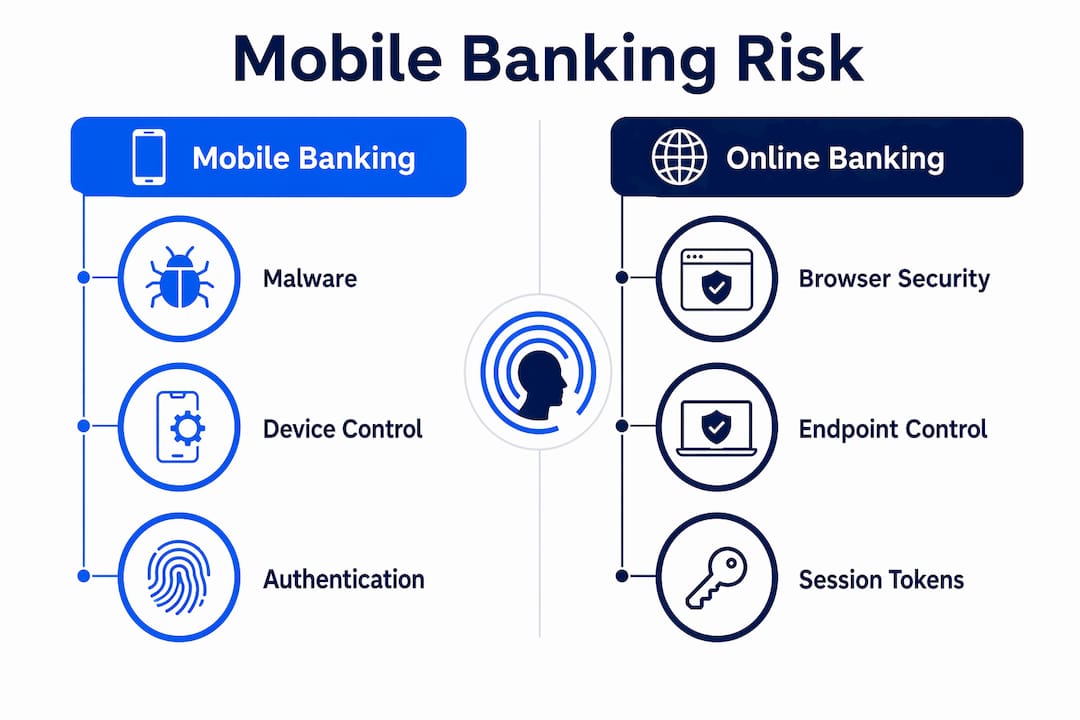
Mobile banking introduces attack vectors that web-based online banking does not face at the same scale. The comparison matters because risk frameworks built for desktop or browser-based banking systematically underestimate mobile exposure.
| Risk dimension | Mobile banking | Online (desktop) banking |
|---|---|---|
| Device control | Consumer-owned, unmanaged | Often managed or semi-managed |
| Malware exposure | High; OS-level trojans active | Lower; browser-based threats |
| Authentication options | Biometrics, MFA, device binding | Password, MFA, hardware tokens |
| Physical loss risk | High; portable device | Low; stationary workstation |
| Communication security | Variable; public Wi-Fi exposure | More controlled network environments |
| App code exposure | High; decompilable binaries | Lower; server-side logic hidden |
The device control gap is the defining difference. Online banking typically runs in a browser on a machine with endpoint protection, managed DNS, and corporate network controls. Mobile banking runs on a consumer device where the institution has no visibility into the operating environment. Weak device security such as absent screen locks or unencrypted storage amplifies every other risk category. Biometric authentication adds a meaningful layer, but it does not compensate for a compromised operating system. A device running a banking trojan with root access can intercept biometric authentication results before they reach the app's security logic.
The mobile risk management workflow for financial institutions must account for this unmanaged device reality as a foundational assumption, not an edge case.
What are the emerging fraud trends in mobile banking risk management?
Financial fraud now primarily starts on the compromised user device, making backend controls insufficient without device-level security signals. This shift redefines where the fraud perimeter sits.
- Device takeover fraud: Malware with full remote device control capabilities executes transactions from within the legitimate banking session, bypassing behavioral analytics that expect normal user patterns.
- Overlay and context hijacking: 38% of mobile banking malware families engage in context hijacking, displaying fraudulent interfaces that capture credentials and OTPs before they reach the legitimate app.
- AI-accelerated malware development: Attackers use large language models to write, test, and iterate malware code faster than security teams can analyze and respond. Phishing messages generated with AI are grammatically indistinguishable from legitimate bank communications.
- Smishing and SIM swapping: Phishing and smishing remain the leading social engineering vectors for credential theft. SIM swapping enables attackers to intercept one-time passwords sent via SMS, effectively bypassing SMS-based two-factor authentication entirely.
- Session hijacking: Malware intercepts active authenticated sessions and executes transactions without requiring the user's credentials at all.
"85% of mobile banking malware families have account takeover capabilities, and 73% have full remote device control. These are not theoretical threats. They are deployed at scale against financial institutions right now, and backend fraud systems cannot see them operating inside a legitimate session."
The operational and reputational consequences compound quickly. Reputational damage from mobile fraud drives long-term customer attrition and pushes customers toward costlier service channels, creating a secondary financial impact beyond direct fraud losses. UK Finance recorded 12,000 mobile banking fraud cases with £29.6 million blocked in a single reporting period. That figure represents only detected and blocked fraud, not total exposure.
How can financial institutions effectively mitigate mobile banking risks?
Effective mobile banking risk management requires controls at the device, application, authentication, and monitoring layers simultaneously. No single control is sufficient.
Device trust and app hardening
Institutions must establish device trust before authentication begins. Device posture checks assess whether a device is rooted or jailbroken, running outdated OS versions, or exhibiting behavioral signals of compromise. Runtime Application Self-Protection (RASP) embeds security logic directly into the app binary, allowing the app to detect and respond to tampering, hooking, and overlay attacks at runtime. Runtime protection must be a core fraud control, not an optional enhancement.
Authentication and access controls
- Enforce MFA for all transaction-initiating actions, not just login.
- Implement risk-based step-up authentication that triggers additional verification when behavioral signals deviate from baseline.
- Replace SMS-based OTP with authenticator apps or hardware tokens where SIM swapping risk is elevated.
- Apply session timeout policies that terminate inactive sessions within defined thresholds.
Pro Tip: Bind session tokens to device fingerprints. A token stolen from one device becomes unusable on another, neutralizing a significant class of session hijacking attacks.
Continuous monitoring and compliance integration
| Control layer | Specific measure | Regulatory alignment |
|---|---|---|
| Device trust | Posture checks, jailbreak detection | PCI DSS, PSD2 |
| App protection | RASP, code obfuscation, certificate pinning | PCI DSS |
| Authentication | MFA, risk-based step-up | PSD2 strong customer authentication |
| Monitoring | Runtime telemetry, behavioral analytics | GDPR, PCI DSS |
| User education | Phishing awareness, smishing identification | FFIEC guidance |
Multi-layered risk management combining device trust, app protection, strong authentication, user education, and continuous runtime monitoring is the recognized standard. Regulatory frameworks including PSD2 and PCI DSS do not prescribe specific technologies, but they do require demonstrable controls at each layer. Integrating mobile banking risk into the enterprise risk framework means assigning ownership, defining risk appetite thresholds, and reporting mobile-specific metrics to the board alongside credit and operational risk. A structured risk assessment approach applied specifically to mobile channels gives institutions the documentation regulators expect during examinations.
User education remains underinvested relative to its impact. Smishing campaigns succeed because users do not recognize fraudulent SMS messages. Quarterly awareness training that uses real examples from recent campaigns measurably reduces credential theft rates.
Key Takeaways
Mobile banking risk is a device-level threat that backend controls alone cannot address, requiring institutions to deploy layered security across device trust, app protection, authentication, and continuous monitoring.
| Point | Details |
|---|---|
| Malware is the primary technical threat | Android banking trojans surged 56% in 2025, with most families capable of full device control. |
| MITM attacks exploit communication gaps | 60% of mobile banking apps lack SSL pinning, leaving data in transit exposed. |
| Fraud starts on the device | Backend fraud systems cannot detect attacks executing inside legitimate authenticated sessions. |
| Layered controls are mandatory | PCI DSS and PSD2 require demonstrable controls at device, app, authentication, and monitoring layers. |
| Reputation risk compounds financial loss | Mobile fraud drives customer attrition and shifts volume to costlier service channels. |
The device-centric shift that most risk frameworks still miss
The most consequential change in mobile banking risk over the past three years is not the sophistication of individual malware families. It is the structural shift in where fraud originates. Most enterprise risk frameworks were built when the bank's perimeter was the bank's infrastructure. Mobile banking moved the effective perimeter to a consumer device the institution does not own, cannot manage, and cannot directly observe.
Risk assessors who treat mobile banking as a subset of digital banking channel risk miss this distinction. The device is not just another endpoint. It is an uncontrolled environment where the attacker may already have root-level access before the user opens the banking app. Backend behavioral analytics, transaction monitoring, and fraud scoring systems all operate on data that has already passed through a potentially compromised layer. That is a fundamental problem that no amount of server-side sophistication fully resolves.
The practical implication is that institutions need runtime telemetry from the device itself, not just from the transaction stream. RASP-generated signals, device posture data, and behavioral biometrics collected at the app layer give fraud teams visibility into what is actually happening on the device. The 2026 guide to mobile risk management addresses this shift in detail, and I think it represents the most important reorientation compliance officers can make this year.
The balance between security and user experience is real, but it is often overstated as a reason to delay controls. Risk-based step-up authentication adds friction only when signals warrant it. Most users never encounter it. The institutions that resist stronger controls on user experience grounds are, in practice, accepting higher fraud losses and regulatory exposure in exchange for marginal convenience.
— Raj
How Riskinmind supports mobile banking risk analysis
Riskinmind's peer benchmarking and risk analysis platform gives compliance officers and risk assessors a structured way to measure their institution's mobile banking risk exposure against peer institutions. The platform's AI-driven analytics, powered by Ava and a suite of specialized risk agents, surface gaps in mobile risk posture that internal assessments frequently miss.
Riskinmind holds SOC 2® certification and processes risk signals in real time, with response times under half a second. For financial institutions building or refining their mobile risk frameworks, the platform provides the benchmarking data and analytical depth needed to make defensible decisions and satisfy examiner expectations. Request a demo at riskinmind.ai to see how peer comparison data applies to your institution's specific mobile risk profile.
FAQ
What is mobile banking risk in simple terms?
Mobile banking risk is the potential for fraud, unauthorized account access, and data breaches that arise from using mobile devices and apps for banking. It includes threats from malware, insecure communication, weak authentication, and physical device loss.
How safe is mobile banking compared to online banking?
Mobile banking carries a higher inherent risk than desktop online banking because consumer devices are unmanaged, more exposed to malware, and physically portable. However, institutions that enforce MFA, RASP, and device trust controls can substantially reduce that gap.
What are the most common mobile banking threats in 2026?
Android banking trojans with account takeover and remote device control capabilities are the leading technical threat. Social engineering attacks including smishing and SIM swapping remain the leading human-layer threats.
How do regulators address mobile banking security risks?
PSD2 mandates strong customer authentication for payment initiation and account access. PCI DSS requires encryption, access controls, and monitoring across all channels including mobile. GDPR imposes data protection obligations that apply to all personal data processed through mobile apps.
What is the first step in a mobile banking risk assessment?
The first step is establishing a device trust baseline: identifying what devices access the institution's mobile app, what OS versions and security configurations they run, and whether any exhibit compromise indicators. This baseline informs every subsequent control decision.