
A mobile risk management workflow is a structured, continuous process that identifies, assesses, and mitigates security risks across mobile devices, applications, and networks used by financial institutions. For credit unions, community banks, and lenders, this process is not optional. Regulatory frameworks including NIST, OWASP MASVS, FINRA, PCI-DSS, and SOX all carry mobile-specific compliance obligations that demand documented, repeatable workflows. Mobile Device Management (MDM) platforms and automated testing tools form the operational backbone of these programs. Without both, risk teams face unacceptable exposure gaps.
What does a mobile risk management workflow require to succeed?
A successful mobile risk management workflow starts with three non-negotiable foundations: a unified device management platform, enforced security policies, and trained personnel. Skipping any one of these creates a gap that attackers or auditors will find first.
Maintain 100% NCUA & OCC Audit Readiness
Monitor regulatory updates 24/7, check internal credit policies, and generate compliance trails with Erina (AI Regulatory Agent).
Device enrollment and identity integration
MDM and Unified Endpoint Management (UEM) platforms must integrate directly with your identity provider to enforce conditional access. A device that fails a compliance check should be blocked from corporate resources automatically, without waiting for a human decision. This architecture removes the human delay that attackers exploit most.

Device security policies must cover authentication, encryption, approved application lists, and network controls. Strong authentication layers, including biometrics and multi-factor authentication, are the baseline. A minimum six-digit PIN combined with biometric unlock is the current enterprise standard. Encryption at rest and in transit must be enforced at the MDM policy level, not left to individual users.
Incident response procedures for lost or compromised devices define the speed of your recovery. Lost devices must be reported within 4 hours to enable effective remote wipe through MDM platforms. That four-hour window is the difference between a contained incident and a reportable breach under most state and federal notification rules.
Pro Tip: Map your MDM conditional access rules directly to your institution's data classification tiers. Devices accessing loan origination systems or portfolio data should face stricter controls than those used only for internal communications.
Essential tools for mobile risk programs
| Tool Category | Primary Function | Compliance Relevance |
|---|---|---|
| MDM/UEM Platform | Device enrollment, policy enforcement, remote wipe | FINRA, SOX, PCI-DSS |
| Identity Provider (IdP) | Conditional access, MFA enforcement | NIST 800-63 |
| Mobile App Security Testing | Static and dynamic vulnerability analysis | OWASP MASVS |
| Risk Scoring Engine | Prioritize findings by business impact | Internal GRC frameworks |
| Audit Reporting Dashboard | Governance evidence, executive visibility | SOX, GDPR |
Employee training rounds out the prerequisites. Security awareness programs must address mobile-specific threats: phishing via SMS, rogue Wi-Fi networks, and malicious app sideloading. Annual training is the minimum. Quarterly micro-training on emerging threats is the standard that regulators increasingly expect.
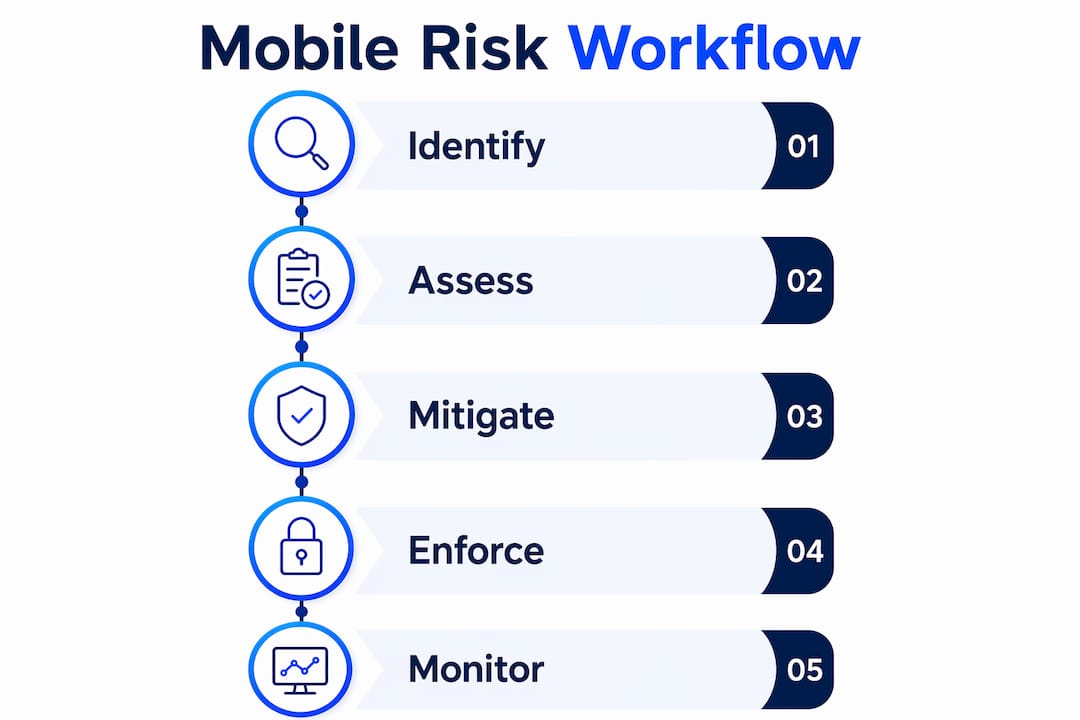
How to execute a multi-layered mobile risk assessment
Industry-standard mobile app risk assessments employ three distinct testing layers: static analysis, dynamic runtime analysis, and manual penetration testing. Each layer catches different vulnerability classes. Relying on only one produces a false sense of security.
Step-by-step assessment execution
-
Static analysis. Inspect compiled mobile application binaries without executing them. This process identifies hardcoded credentials, insecure data storage, weak cryptography implementations, and improper permission declarations. Static analysis maps directly to OWASP MASVS controls and produces findings before any device is exposed.
-
Dynamic runtime analysis. Execute the application in a controlled environment and observe its behavior. This layer captures insecure network communications, improper session handling, and data leakage that only appears during active use. Dynamic analysis is the only method that reveals how the app behaves under real-world conditions.
-
Manual penetration testing. Conduct targeted testing against authentication flows, authorization logic, and business-specific controls. For financial institutions, this means testing loan application workflows, account access controls, and transaction authorization paths. Automated tools miss business logic flaws. Manual testing finds them.
-
Risk scoring and prioritization. Assign severity scores to each finding, then calibrate those scores against real-world exploitability and business impact. A frequent pitfall is severity inflation, where risks are over-scored without considering actual exploitability. Over-scoring wastes remediation resources on low-probability threats while critical gaps wait.
-
Framework mapping. Map every finding to OWASP MASVS controls and your institution's applicable compliance frameworks. This step converts technical findings into audit-ready evidence that compliance and legal teams can use directly.
Pro Tip: Run static analysis on every build in your CI/CD pipeline. Reserve dynamic and manual testing for major releases and quarterly scheduled assessments. This cadence balances thoroughness with operational capacity.
Comparing assessment methods for resource planning
| Method | What It Finds | Resource Requirement | Best Frequency |
|---|---|---|---|
| Static analysis | Code-level flaws, misconfigurations | Low (automated) | Every build |
| Dynamic runtime analysis | Runtime behavior, network leakage | Medium | Major releases |
| Manual penetration testing | Business logic, auth flaws | High (specialist time) | Quarterly |
A complete step-by-step risk assessment for financial institutions integrates all three methods into a single documented cycle. That documentation becomes your primary evidence artifact for regulatory examinations.
What are effective strategies to automate and enforce mobile risk mitigation?
Automation is not a convenience in mobile risk programs. It is the only way to maintain consistent policy enforcement across hundreds or thousands of devices without proportionally scaling your risk team.
The most effective approach embeds automated mobile app security testing directly into DevSecOps pipelines. Automated tests aligned to business impact tiers provide actionable remediation guidance and reduce the cycle time between vulnerability discovery and fix deployment. When a build fails a security gate, the developer receives specific, prioritized guidance rather than a raw vulnerability list.
MDM and UEM platforms handle device-level enforcement automatically. Non-compliant devices are quarantined before they access sensitive systems. Conditional access policies enforce this without requiring a security analyst to intervene in each case.
Backend-driven enforcement is the only reliable control model for mobile risk. Relying solely on client-side checks is ineffective because attackers can bypass them. Centralized policy enforcement with raw, normalized mobile risk signals sent to backend services prevents tampering and ensures consistent decisions across every transaction.
Continuous monitoring tools track mobile app permissions, privacy flags, and insecure connections in production. These tools alert your team when an app update introduces a new permission request or when a device begins communicating over an unencrypted channel. Catching these changes in production, rather than waiting for the next scheduled assessment, is the operational difference between a proactive and a reactive program.
Audit-ready reporting and executive dashboards are not optional extras. Governance and regulatory proof require documented evidence of control effectiveness over time. Dashboards that show control status, incident counts, and remediation timelines give CROs and board risk committees the visibility they need without requiring them to interpret raw security data.
Common automation pitfalls to avoid:
- Automating tests without defining business impact tiers first, which produces undifferentiated finding lists that overwhelm remediation teams.
- Relying on MDM alone without integrating identity-based conditional access, which leaves authentication gaps.
- Treating automated reporting as a substitute for human review of high-severity findings.
- Failing to test the automation itself, so silent failures go undetected until an audit or incident exposes them.
How does mobile risk workflow integration support broader compliance programs?
A mobile risk management workflow does not operate in isolation. It feeds directly into your institution's enterprise governance, risk, and compliance (GRC) program and satisfies specific obligations across multiple regulatory frameworks.
Financial compliance requirements with direct mobile risk implications include:
- SOX requires documented controls over financial data access, including mobile access to core systems.
- PCI-DSS mandates security controls for any device that stores, processes, or transmits cardholder data, including mobile endpoints.
- GDPR applies when mobile applications process personal data of EU residents, covering data minimization and breach notification requirements.
- FINRA rules require broker-dealers to supervise mobile communications and maintain records of mobile-based transactions.
Mapping your mobile risk workflow to your enterprise GRC system creates a unified control inventory. Each mobile control maps to one or more regulatory requirements. When an examiner asks for evidence of a specific control, your team pulls a single report rather than assembling evidence from disconnected systems.
Workflow coordination across mobile security, IT operations, and third-party risk management teams requires shared control metrics and a unified risk dashboard. Third-party mobile applications used by your institution carry their own risk profiles. Those profiles must feed into your overall vendor risk management process, not sit in a separate silo.
Security policies should adapt to new vulnerabilities and usage patterns at least annually. Annual policy review cycles, combined with quarterly threat briefings for key stakeholders, keep your program current without requiring constant full-scale reassessments. The review cycle should include input from security, compliance, legal, and the lines of business that depend on mobile workflows most heavily.
Key Takeaways
A mobile risk management workflow succeeds only when continuous assessment, backend-driven enforcement, and enterprise compliance integration operate as a single coordinated program rather than separate initiatives.
| Point | Details |
|---|---|
| Enforce device policies at the MDM level | Authentication, encryption, and conditional access must be automated, not left to individual users. |
| Use three testing layers | Static analysis, dynamic runtime analysis, and manual penetration testing each catch different vulnerability classes. |
| Calibrate risk scores to business impact | Severity inflation wastes remediation resources; prioritize findings by real-world exploitability. |
| Embed automation in DevSecOps pipelines | Automated security gates in CI/CD pipelines reduce fix cycle times and enforce consistent standards. |
| Map mobile controls to GRC frameworks | Connecting mobile risk workflows to SOX, PCI-DSS, and FINRA requirements produces audit-ready evidence efficiently. |
Why mobile risk programs fail before they start
Most mobile risk programs I have seen fail not because of technical gaps but because of structural ones. The security team builds a technically sound assessment process, then hands findings to a development team that has no defined SLA for remediation. Findings age. Risks compound. The next audit finds the same issues.
The fix is not a better testing tool. It is a governance structure that assigns ownership of every finding to a named individual with a defined remediation window. Without that structure, automation produces reports that no one acts on.
Cross-team collaboration is the other consistent gap. Security, DevOps, compliance, and the lines of business that own mobile applications each have different incentives. Security wants thoroughness. DevOps wants speed. Compliance wants documentation. Lines of business want uptime. A mobile risk program that does not account for all four incentives will be deprioritized by at least one of those groups, and that is where the exposure lives.
The emerging risk I watch most closely is the expansion of mobile access to core financial systems. As credit unions and community banks extend loan origination, portfolio monitoring, and member services to mobile channels, the attack surface grows faster than most risk teams realize. Understanding risk scoring in that context means treating mobile not as a peripheral channel but as a primary one with primary-level controls.
Treat your mobile risk program as a living program. Static one-time setups fail because the threat landscape does not stand still. The institutions that stay ahead of mobile risk are the ones that build review cycles, cross-team accountability, and automation into the program from day one.
— Raj
How Riskinmind supports your mobile risk program
Financial institutions managing mobile risk need more than a checklist. They need a platform that connects risk assessment, compliance reporting, and portfolio monitoring in one place.
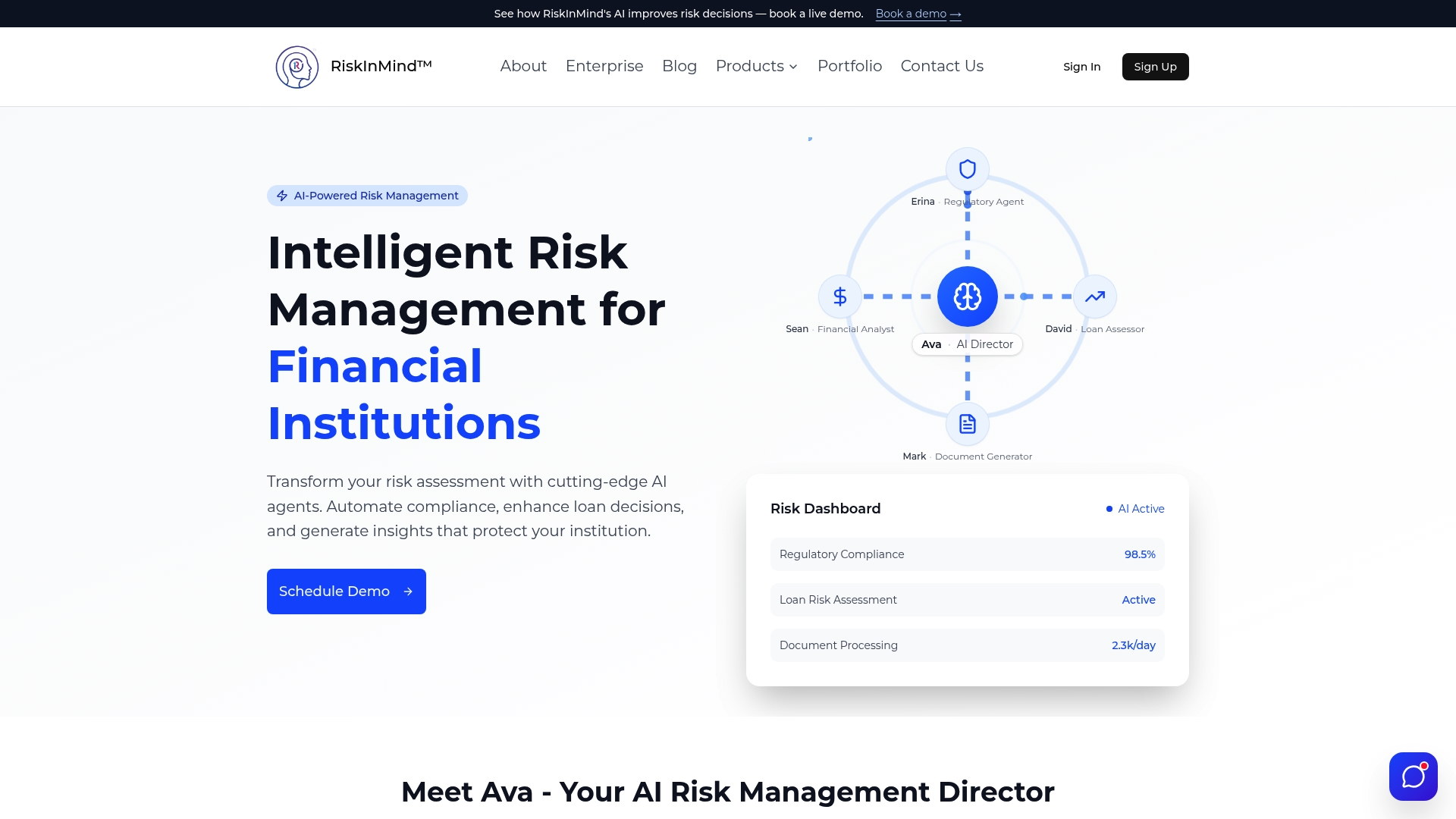
Riskinmind is built specifically for credit unions, community banks, and lenders. Its AI-powered platform automates core risk processes, including regulatory compliance monitoring and real-time risk dashboards, with SOC 2® certification and bank-grade security. Risk managers can use the loan application workflow to see how mobile risk controls integrate directly with credit decisioning. The free Business Loan Qualifier tool gives your team an immediate view of how risk insights apply to lending decisions. Request a demo to see how Riskinmind fits your institution's compliance and workflow requirements.
FAQ
What is a mobile risk management workflow?
A mobile risk management workflow is a structured process that continuously identifies, assesses, and mitigates security risks across mobile devices, applications, and networks within an organization. For financial institutions, it combines MDM enforcement, multi-layered app testing, and compliance reporting into a single repeatable program.
How often should mobile risk assessments be conducted?
Static analysis should run on every application build, while dynamic and manual penetration testing should occur at major releases and quarterly intervals. Security policies should be reviewed at minimum annually to address new vulnerabilities and regulatory changes.
What is the role of OWASP MASVS in mobile risk workflows?
OWASP MASVS (Mobile Application Security Verification Standard) provides the control framework that maps static, dynamic, and manual testing findings to specific security requirements. Financial institutions use it to produce audit-ready evidence that satisfies regulators examining mobile application security controls.
Why is backend-driven enforcement better than client-side controls?
Client-side mobile risk checks can be bypassed by attackers who modify the application or intercept communications. Backend enforcement applies security decisions centrally, ensuring consistent policy application regardless of what happens on the device itself.
How does mobile risk workflow integration support regulatory compliance?
Mapping mobile controls to frameworks like SOX, PCI-DSS, and FINRA within your GRC system creates a unified control inventory. That inventory produces the documented evidence regulators require during examinations without requiring your team to assemble evidence from disconnected sources each time.