
Regulatory reporting is defined as the mandatory submission of structured financial and operational data by financial institutions to supervisory authorities such as the Financial Conduct Authority (FCA), the Bank of England (BoE), and the Federal Reserve. Data submitted via regulatory reporting supports authorities in monitoring solvency, systemic risk, market manipulation, and compliance adherence across the financial system. Unlike financial reporting, which targets investors and shareholders, regulatory reporting targets supervisors and carries legal force. Failure to meet accuracy standards or submission deadlines triggers supervisory intervention, financial penalties, reputational damage, and in severe cases, license revocation.
What is regulatory reporting and why does it matter?
Regulatory reporting is the formalized process through which banks, credit unions, lenders, and other regulated entities submit standardized data to government and supervisory bodies on a prescribed schedule. The data covers capital adequacy, credit risk exposure, liquidity ratios, transaction records, and counterparty details, all formatted to exact technical specifications. Non-compliance risks include fines, reputational damage, and license revocation, making this function one of the highest-stakes obligations a financial institution carries.
Maintain 100% NCUA & OCC Audit Readiness
Monitor regulatory updates 24/7, check internal credit policies, and generate compliance trails with Erina (AI Regulatory Agent).
The distinction between regulatory reporting and financial reporting is not merely procedural. Financial reporting communicates performance to investors using frameworks like GAAP or IFRS. Regulatory reporting communicates risk and stability data to supervisors using frameworks like COREP, FINREP, MiFIR, and EMIR. The audience, granularity, confidentiality requirements, and legal consequences differ substantially between the two.

| Dimension | Regulatory reporting | Financial reporting |
|---|---|---|
| Primary audience | Supervisory authorities (FCA, BoE, Fed) | Investors, shareholders, analysts |
| Data granularity | Transaction-level, position-level | Aggregated financial statements |
| Legal obligation | Mandatory with penalties for non-compliance | Mandatory for public companies; varies |
| Confidentiality | Submitted under supervisory confidentiality | Publicly disclosed |
| Frameworks used | COREP, FINREP, MiFIR, EMIR, Basel IV | GAAP, IFRS |
The importance of regulatory reporting extends beyond individual firm compliance. Supervisors aggregate data across institutions to identify systemic vulnerabilities, detect market manipulation, and calibrate macroprudential policy. When data quality degrades across the system, the entire supervisory picture distorts.
Pro Tip: Treat regulatory reporting as a governance function, not a finance task. Firms that assign it to general accounting staff without specialist oversight consistently underperform on accuracy and timeliness.
What are the main reporting frameworks and data standards?
The regulatory reporting landscape is governed by a set of frameworks that vary by jurisdiction, institution type, and risk category. COREP (Common Reporting) and FINREP (Financial Reporting) are the primary frameworks used under the European Banking Authority (EBA) for capital adequacy and financial data. MiFIR governs transaction reporting for investment firms under MiFID II. EMIR covers derivative trade reporting. Basel IV sets the capital adequacy standards that drive much of the underlying data collection.
Data formats are equally prescribed. Regulatory reporting requires standard formats like XML or XBRL to allow automated ingestion and cross-institution comparison by supervisors. XBRL (eXtensible Business Reporting Language) is the dominant taxonomy for structured financial data, enabling regulators to validate, aggregate, and analyze submissions without manual processing. Institutions that submit data outside approved taxonomies face rejection and resubmission penalties.
Reporting frequency varies widely from daily liquidity coverage ratio reports to weekly position reports, monthly capital returns, and quarterly COREP submissions, depending on jurisdiction and report type. Large institutions operating across multiple jurisdictions manage dozens of simultaneous reporting streams, each with unique templates, deadlines, and validation rules. This volume alone explains why regulatory reporting is not a side activity. It needs specialized teams, leadership, systems, and risk management protocols to avoid supervisory intervention.
The Legal Entity Identifier (LEI) is a 20-character ISO code that uniquely identifies legal entities in regulated transactions and reports globally. Without LEI, reports referencing entity names introduce ambiguity that undermines supervisory accuracy. LEI is now mandatory across MiFIR, EMIR, and several other frameworks, making it a foundational element of any regulatory reporting checklist.
How do financial institutions manage the regulatory reporting process?
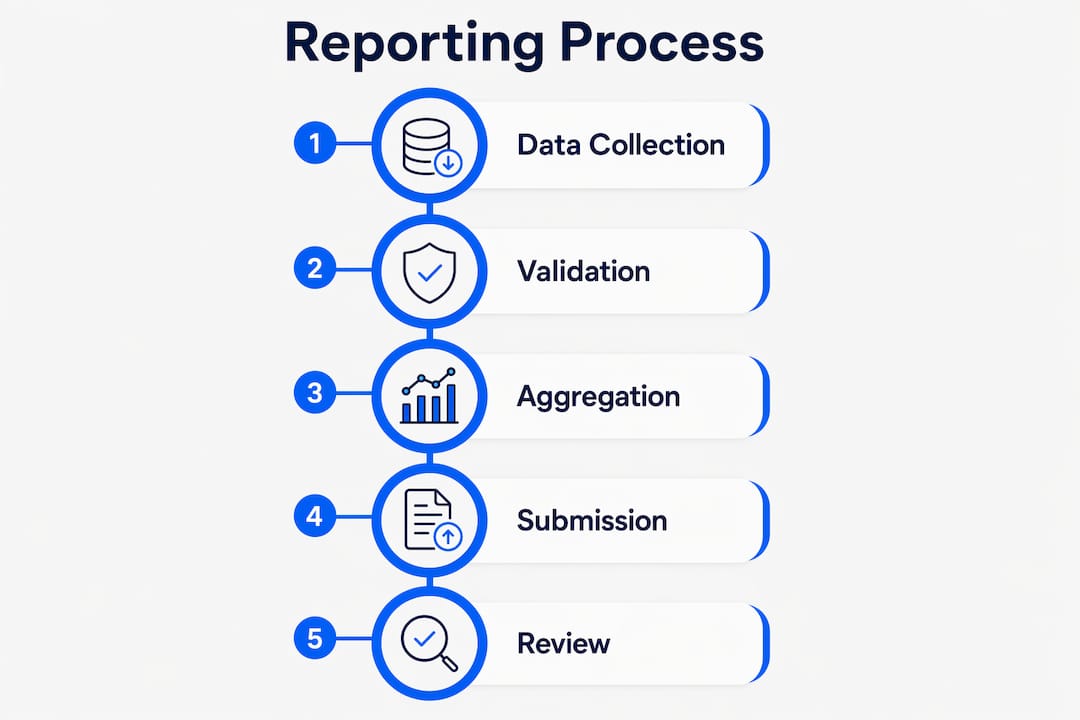
Effective management of the regulatory reporting process requires a structured operating model, not improvised effort at quarter-end. The core process steps follow a consistent sequence regardless of framework or jurisdiction.
- Data collection: Pull transaction, position, and exposure data from core banking systems, trading platforms, and loan management systems into a centralized data store.
- Data validation: Apply business rules and taxonomy checks to identify errors, missing fields, and format violations before aggregation begins.
- Data aggregation: Consolidate validated data into the required report templates, applying the correct calculation methodologies for each regulatory metric.
- Reconciliation: Cross-check aggregated figures against source systems and prior submissions to identify discrepancies that could trigger supervisory questions.
- Submission: Transmit completed reports through the regulator's designated portal or API within the prescribed deadline window.
- Post-submission controls: Archive submission records, document data lineage, and log any exceptions or adjustments for audit purposes.
Fragmented manual data architectures sourcing from multiple systems cause distrust and scalability issues. When data flows through spreadsheets and manual reconciliation steps, errors compound and traceability breaks down. Supervisors increasingly expect institutions to demonstrate not just accurate outputs but full explainability of how each figure was derived. This concept, known as supervisory defensibility, means that clear data lineage and explainable controls are now a compliance requirement in their own right, not just an operational preference.
For compliance officers managing risk reporting for financial institutions, the practical implication is that every data transformation between source system and submitted report must be documented, repeatable, and auditable.
Pro Tip: Run automated validation checks immediately after data collection, not after aggregation. Catching errors at the source eliminates the costly rework that occurs when problems surface at the submission stage.
What are the common challenges and risks in regulatory reporting?
The compliance risks in regulatory reporting are concrete and consequential. Supervisory intervention, financial penalties, and reputational damage are the most visible outcomes of reporting failures, but the underlying causes are often structural rather than isolated errors.
The most significant challenges compliance officers face include:
- Data quality degradation: Inconsistent data definitions across source systems produce figures that cannot be reconciled, leading to submission errors and restatements.
- Regulatory change velocity: Frameworks like Basel IV and IFRS 9 undergo frequent technical amendments, requiring continuous updates to calculation logic and report templates.
- Jurisdictional fragmentation: Global standards like Basel IV are implemented differently across jurisdictions, so a firm operating in the US, EU, and UK simultaneously faces three distinct implementation variants of the same underlying rule.
- Manual process risk: Spreadsheet-based workflows introduce version control failures, formula errors, and single points of failure that automated systems eliminate.
- Late submission penalties: Regulators treat late submissions as evidence of inadequate governance, triggering enhanced supervisory scrutiny beyond the immediate penalty.
Understanding top regulatory compliance risks with real examples from banks illustrates how quickly a data quality issue escalates from an internal problem to a supervisory matter. The FCA has issued multi-million-pound fines for persistent transaction reporting failures under MiFIR, and the pattern in those cases is consistent: fragmented systems, insufficient validation, and inadequate specialist oversight.
Treating regulatory reporting as an occasional finance task causes systemic failures as volume and complexity grow. The firms that avoid supervisory intervention are those that have built continuous governance functions with dedicated leadership, not those that mobilize general staff at reporting deadlines.
Pro Tip: Investing in integrated reporting platforms that consolidate data governance, validation, and submission in a single environment mitigates the majority of these risks at the source rather than managing them as recurring incidents.
Which technologies support accurate and efficient regulatory reporting?
Modern regulatory reporting technology has moved well beyond spreadsheet automation. The current generation of platforms addresses the full reporting lifecycle, from data ingestion through submission and archiving, with built-in validation logic, taxonomy management, and audit trails.
The following table summarizes the key capability categories and what each delivers for compliance teams:
| Technology capability | Function | Compliance benefit |
|---|---|---|
| Integrated data governance | Centralizes data from multiple source systems | Eliminates reconciliation gaps and improves lineage |
| XBRL/XML taxonomy management | Applies current regulatory taxonomies automatically | Reduces format errors and resubmission risk |
| Automated validation rules | Checks data against business rules pre-submission | Catches errors before they reach the regulator |
| LEI registry integration | Validates entity identifiers against global LEI database | Prevents entity ambiguity in cross-border reports |
| Multi-jurisdictional configuration | Supports regional rule variants within one platform | Enables consistent governance across operating geographies |
| AI-assisted anomaly detection | Flags statistical outliers in submission data | Surfaces data quality issues that rule-based checks miss |
Automation and integration are key to regulatory reporting success, particularly for institutions managing multiple simultaneous reporting obligations. Cloud-enabled platforms that update taxonomy libraries in response to regulatory amendments remove the manual burden of tracking technical standard changes across frameworks like EBA, FINRA, and the Prudential Regulation Authority (PRA).
AI-driven tools add a layer of analytical depth that rule-based systems cannot replicate. Machine learning models trained on historical submission data identify anomalous patterns that indicate upstream data quality problems, often before validation rules trigger. For compliance officers evaluating regulatory compliance tools, the critical selection criterion is whether the platform supports end-to-end data lineage from source transaction to submitted figure, because that traceability is what supervisory defensibility requires.
Real-time risk monitoring capabilities further strengthen the reporting function by surfacing portfolio-level risk signals continuously rather than at reporting cycle intervals, giving compliance teams the lead time to investigate and resolve data issues before submission deadlines.
Key takeaways
Regulatory reporting is a continuous governance function requiring specialist teams, integrated technology, and full data lineage to satisfy supervisory expectations and avoid penalties.
| Point | Details |
|---|---|
| Core definition | Regulatory reporting is mandatory structured data submission to supervisory authorities like the FCA, BoE, and Federal Reserve. |
| Framework diversity | Frameworks including COREP, FINREP, MiFIR, and EMIR each carry distinct templates, deadlines, and technical standards. |
| Process discipline | The reporting process requires data collection, validation, aggregation, reconciliation, submission, and post-submission controls in sequence. |
| Supervisory defensibility | Regulators expect full data lineage and explainable controls, not just accurate output figures. |
| Technology investment | Integrated platforms with XBRL taxonomy management, LEI validation, and AI anomaly detection reduce error rates and penalty exposure. |
Why regulatory reporting demands more than most firms give it
I have worked with compliance teams across community banks and credit unions that consistently underestimate what regulatory reporting actually requires. The assumption that a capable finance team can absorb reporting obligations alongside their existing workload is one of the most expensive mistakes a financial institution can make. The volume of simultaneous reporting streams, the precision of technical taxonomies, and the pace of regulatory change make this a full-time specialist function, not a quarterly project.
What I find most underappreciated is the supervisory defensibility dimension. Regulators are no longer satisfied with accurate numbers delivered on time. They want to see the data trail. They want to understand which system produced each figure, what transformation logic was applied, and who reviewed it. Institutions that cannot answer those questions in an examination are treated as having inadequate governance, regardless of whether the submitted numbers were correct.
The shift toward AI-assisted validation and integrated reporting platforms is not a technology trend. It is a direct response to the explainability expectations that modern supervisors have made explicit. Manual workflows cannot produce the audit trails that regulators now require at scale. The firms investing in end-to-end platforms today are building the supervisory defensibility that will differentiate them in the next examination cycle.
Continuous process review matters as much as the initial platform investment. Regulatory requirements change, and a platform configured for last year's taxonomy is a liability in the current reporting cycle. Build the review cadence into the governance calendar, not as a reactive response to regulatory updates but as a standing operational discipline.
— Raj
How Riskinmind supports your regulatory reporting obligations
Riskinmind's AI-powered platform is built specifically for the regulatory and compliance demands that credit unions, community banks, and lenders face every reporting cycle. The platform consolidates loan data, automates compliance workflows, and provides real-time risk dashboards that give compliance officers the data lineage and audit trails that supervisory defensibility requires.
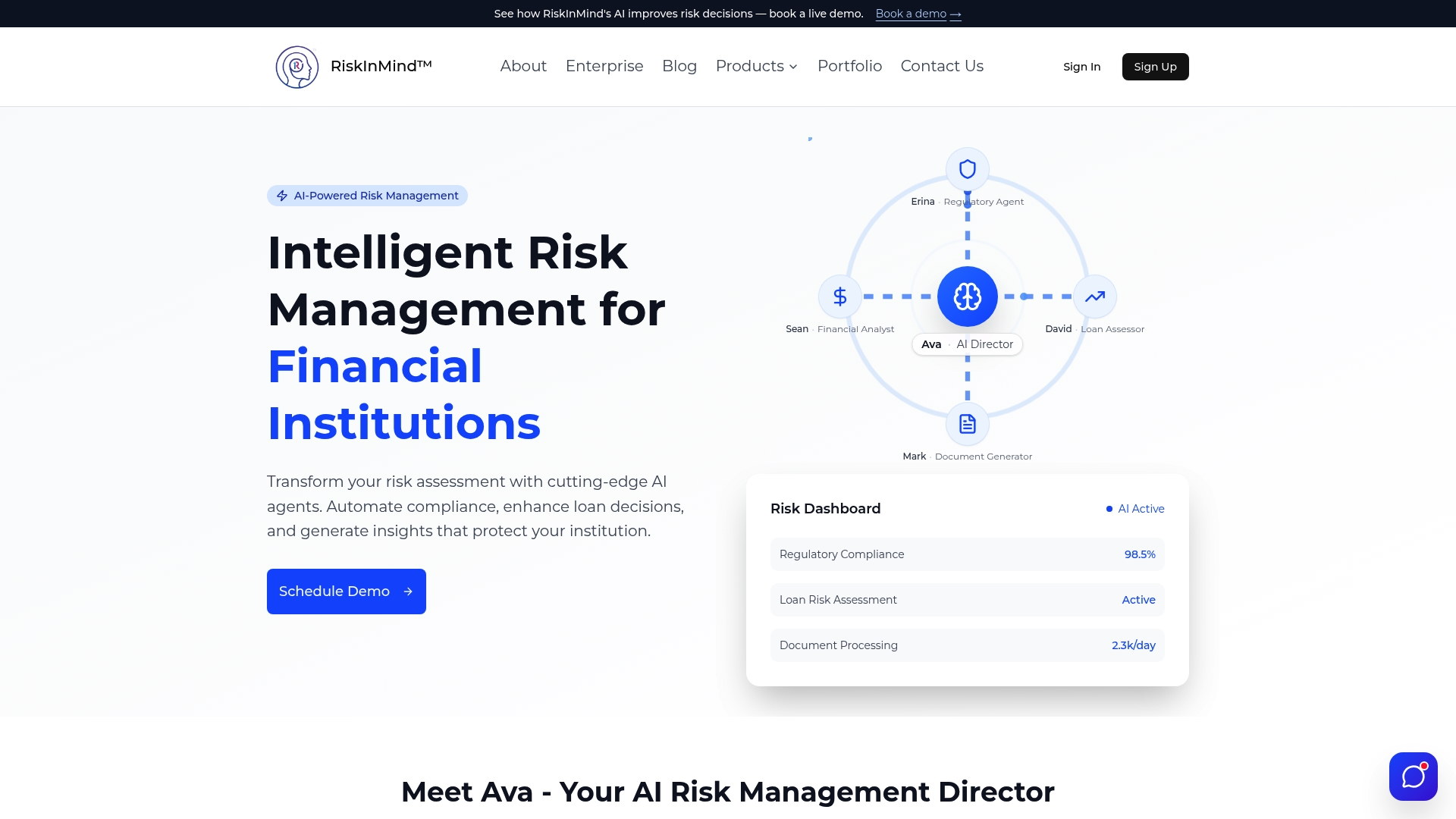
Ava, Riskinmind's central AI director, coordinates specialized agents covering regulatory compliance, credit risk, and portfolio monitoring to deliver validated, submission-ready data without the manual reconciliation burden that creates errors and delays. The loan application platform integrates compliance data directly into the reporting workflow, reducing the gap between origination data and regulatory submission. For institutions benchmarking their risk profiles against peers, the peer benchmarking tool provides the comparative context that strengthens both internal governance and supervisory conversations. Explore Riskinmind's full platform to see how automated reporting and risk intelligence work together.
FAQ
What is regulatory reporting in simple terms?
Regulatory reporting is the process by which financial institutions submit structured data to supervisory authorities to demonstrate compliance with capital, risk, and conduct requirements. The data is formatted to exact technical standards and submitted on prescribed schedules.
What are the main types of regulatory reporting?
The main types include capital adequacy reporting under COREP and Basel IV, financial statement reporting under FINREP, transaction reporting under MiFIR, and derivative trade reporting under EMIR. Each type targets a different supervisory objective and uses distinct templates and taxonomies.
What happens if a financial institution fails to meet regulatory reporting requirements?
Failure to meet accuracy or deadlines triggers supervisory intervention, financial penalties, reputational damage, and in serious cases, license revocation. Regulators also treat persistent failures as evidence of inadequate governance, which intensifies ongoing supervisory scrutiny.
How often must regulatory reports be submitted?
Reporting frequency varies from daily liquidity reports to weekly, monthly, and quarterly submissions depending on the framework and jurisdiction. Large institutions typically manage multiple simultaneous reporting cycles across different regulatory bodies.
What role does the LEI play in regulatory reporting?
The Legal Entity Identifier is a mandatory 20-character ISO code that uniquely identifies legal entities in regulated transactions and reports. Without a valid LEI, submissions referencing entity names introduce ambiguity that can invalidate reports and trigger resubmission requirements.