
What risk committees actually do in banking institutions
The risk committee in a bank is an independent board-level body with a single mandate: oversee the institution's global risk management framework and ensure that risk-taking stays within the boundaries the board has approved. That is the core function, and every regulatory requirement, governance best practice, and operational protocol flows from it.
The Basel Committee on Banking Supervision describes the board risk committee as responsible for advising on current and future risk appetite, overseeing implementation of the risk appetite statement, reporting on risk culture, and coordinating with the Chief Risk Officer. The Financial Stability Board reinforces this framing, defining risk committees as board-level oversight bodies that advise on risk appetite and strategy while actively monitoring implementation. Neither body treats the committee as a passive recipient of management reports. Both expect it to challenge, probe, and, when necessary, push back.
Automate Regulatory Model Risk Governance
Examine models against 32 qualitative criteria and resolve risk Tiers with pre-deployment checklists per OCC 2011-12 guidelines.
For US banking institutions, the regulatory baseline is codified in 12 CFR § 252.22, which mandates a standalone risk committee for bank holding companies with $50 billion or more in total consolidated assets. The OCC Comptroller's Handbook extends similar expectations to covered banks through its heightened standards framework.
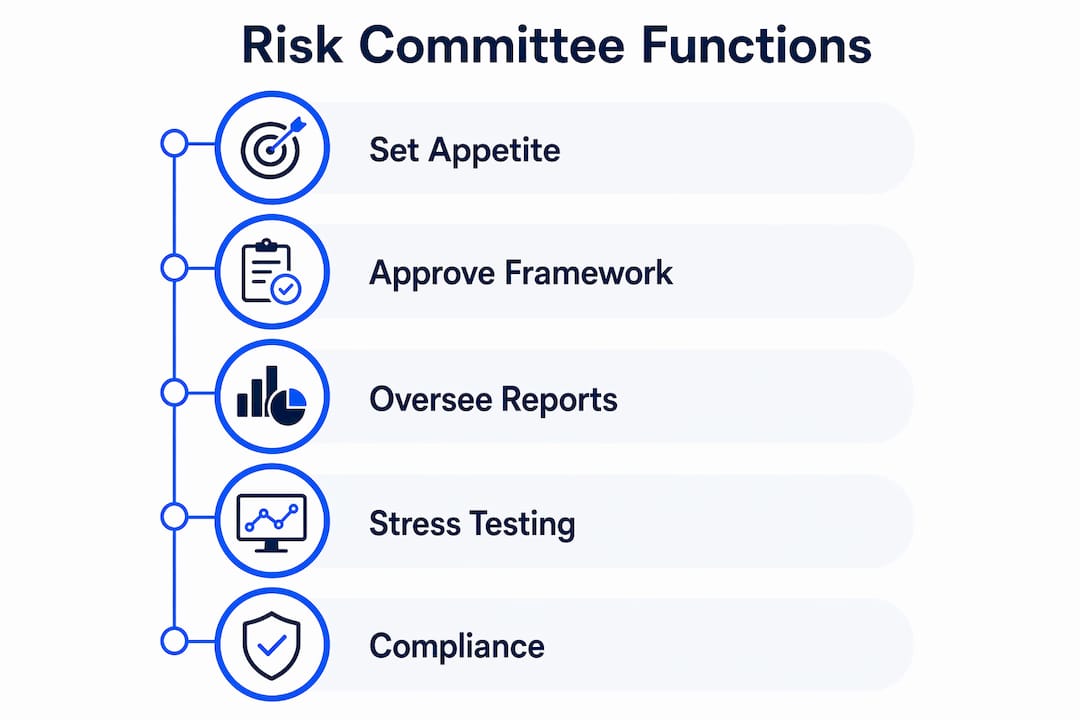
The core functions of a bank risk committee include:
- Approving and periodically reviewing risk management policies for global operations
- Setting and advising on the institution's risk appetite statement
- Overseeing the enterprise-wide risk management framework
- Monitoring risk culture and risk-taking activities across business lines
- Receiving and reviewing regular reports from the Chief Risk Officer
- Coordinating with audit and other board committees to prevent coverage gaps
- Ensuring the CRO has sufficient independence, stature, and board access
Table of Contents
- How US regulations define risk committee requirements
- Key responsibilities and governance functions of bank risk committees
- How the risk committee and Chief Risk Officer work together
- What makes risk committees effective, and where they fall short
- What types of risk does the risk committee oversee?
- How risk committees drive stress testing and scenario analysis
- Key Takeaways
How US regulations define risk committee requirements
The Federal Reserve's Subpart C, codified at 12 CFR § 252.22, sets the floor for risk committee governance at large bank holding companies. The requirements are specific, and governance professionals who treat them as a compliance checklist rather than a governance architecture miss the point.
The regulation requires the committee to function as an independent body of the board of directors, with risk oversight as its sole and exclusive responsibility. It cannot share that mandate with another committee or fold it into a broader governance function. The committee must operate under a formal, written charter approved by the full board, report directly to the board of directors, and meet at least quarterly, or more frequently as circumstances require.
| Requirement | Mandate under 12 CFR § 252.22 |
|---|---|
| Applicability threshold | Bank holding companies with $50 billion or more in total consolidated assets |
| Committee independence | Sole and exclusive function dedicated to risk oversight |
| Charter | Formal, written, approved by the full board |
| Meeting frequency | At least quarterly; more often as needed |
| CRO reporting | Not less than quarterly; committee must receive and review reports |
| Documentation | Full records of proceedings and risk management decisions |
| Member qualifications | At least one member with experience managing large, complex financial firm risks |
| Reporting line | Directly to the board of directors |
Member qualification requirements deserve attention beyond the table. The regulation specifies that at least one committee member must have experience identifying, assessing, and managing risk exposures of large, complex financial firms. That is a materially different bar than general financial literacy. The committee chair must also meet independence standards that the Federal Reserve defines separately.
The OCC Comptroller's Handbook adds a governance dimension that the Federal Reserve rule implies but does not spell out as directly. The OCC guidance states that the board or its risk committee must approve any significant changes to the risk governance framework and concurrently monitor compliance with that framework. The committee is expected to use independent risk management and internal audit reports to question, challenge, and, when necessary, oppose management recommendations that could push the bank's risk profile beyond its approved appetite.
Minimum member and meeting requirements under Subpart C:
- At least one member with demonstrated experience at large, complex financial firms
- Chair must satisfy applicable independence criteria
- Meetings documented with full records of decisions and risk management actions
- CRO reports reviewed not less than quarterly
- Committee may meet more frequently than quarterly when risk conditions warrant
Key responsibilities and governance functions of bank risk committees
The risk committee's governance scope is broader than most board committees because risk touches every business line, product, and geography simultaneously. That breadth is precisely why the regulatory framework insists on exclusivity: a committee that also handles compensation or audit cannot give risk the sustained attention it requires.
The OCC's oversight loop captures the operational logic well. The committee approves governance framework changes and then monitors compliance with those same changes, using independent audit and risk reports as the primary challenge mechanism. That cycle, approve then verify, is what distinguishes active oversight from passive receipt of management updates.

A well-functioning risk committee does not simply ratify the risk appetite statement once a year. The Basel Committee is explicit that risk appetite is not static: the committee should actively oversee adjustments to risk appetite and culture as market conditions, business strategy, and the external environment shift. Passive reception of quarterly dashboards does not satisfy that standard.
Key responsibilities and governance functions include:
- Approving the risk appetite statement and overseeing its implementation across business lines
- Monitoring limit utilization and reviewing limit breach reports with management responses
- Overseeing risk culture indicators, not just quantitative risk metrics
- Reviewing stress testing results and their implications for capital and liquidity adequacy
- Approving material changes to risk management policies and frameworks
- Coordinating with the audit committee to prevent gaps or duplication in oversight coverage
- Evaluating the adequacy of resources allocated to the risk management function
- Receiving and acting on emerging risk reports from the CRO
Effective risk reporting is the committee's primary information source, and the quality of that reporting directly determines the quality of oversight. A committee that receives only summarized dashboards without underlying limit breach data, culture indicators, and mitigation status is operating with incomplete information.
Pro Tip: Review your committee charter annually against the actual agenda items the committee addressed over the prior year. If the charter lists responsibilities the committee never touched, either the charter is aspirational rather than operational, or critical risks are going unreviewed. Either finding warrants immediate correction.
Committee charters function as governance constraints, not just organizational documents. Harvard Law School Forum research cautions that ambiguities or overlapping mandates in charter scope can impair oversight by creating redundant decision pathways or, worse, gaps where no committee claims clear ownership of a risk category. Reading a charter critically, asking what it prevents as much as what it authorizes, reveals the real governance architecture.
How the risk committee and Chief Risk Officer work together
The relationship between the risk committee and the CRO is the operational core of a bank's risk governance structure. Get it right, and the committee has a credible, independent view of the institution's actual risk profile. Get it wrong, and the committee is effectively reviewing management's preferred narrative.
Under 12 CFR § 252.22, the CRO must report directly to both the risk committee and the CEO. That dual reporting line is deliberate. It gives the CRO organizational standing independent of the business lines the CRO is charged with monitoring, while keeping the CEO informed of risk management deficiencies and emerging risks. The CRO is also responsible for reporting those deficiencies to the risk committee and resolving them in a timely manner, which means the committee must track resolution, not just acknowledge the initial report.

The Financial Stability Board goes further, requiring that the risk committee elevate the CRO's stature and independence through periodic reviews of CRO objectives and performance. That review function gives the committee real influence over whether the CRO can operate independently of revenue-generating pressures. A CRO whose performance evaluation is controlled entirely by the CEO has a structural incentive to soften risk assessments.
Key interaction points and reporting protocols between the risk committee and CRO:
- CRO provides written reports to the committee not less than quarterly, covering risk profile, limit utilization, and emerging risks
- CRO reports risk management deficiencies and tracks resolution timelines with committee oversight
- Committee participates in setting CRO objectives and reviewing CRO performance, per FSB guidance
- CRO has unfettered access to the committee, including the ability to meet independently of management
- Committee chair may engage directly with bank supervisors and regulators, often without the CEO present
- Basel Committee principles require the CRO to be independent, hold no revenue-generating or operational roles, and have sufficient authority to participate in strategic decisions affecting the bank's risk profile
The unfettered access provision is not ceremonial. Research on bank board risk committees, published through the Harvard Law School Forum, found that risk committee chairs consistently view direct access to risk management leadership as critical to the committee's credibility. When that access runs through the CEO or CFO, the information the committee receives is filtered, and the committee's independence is compromised in practice even if it remains intact on paper.
The committee-CRO operating rhythm mandated under Subpart C requires well-run secretariat functions to capture decisions, track action items, and maintain the documentation record that demonstrates regulatory compliance. Governance professionals who underestimate the administrative infrastructure required to sustain this rhythm typically find it during an examination, not before.
What makes risk committees effective, and where they fall short
Research on bank board risk committees produces a finding that surprises many governance professionals: the presence of a risk committee does not, on average, reduce a bank's risk profile. René Stulz and coauthors found that many large banks voluntarily adopted risk committees before the Dodd-Frank Act required them, which indicates genuine governance value beyond compliance. Yet establishing the committee does not by itself produce lower risk outcomes.
That finding does not undercut the case for risk committees. It clarifies what they actually do. A well-functioning risk committee improves the board's ability to monitor whether the bank is taking the risks it says it is taking, and whether those risks align with the approved appetite. The committee is a monitoring and credibility mechanism, not a risk-reduction lever. The distinction matters for how you evaluate committee performance.
The failure mode most governance professionals underestimate: treating committee work as dashboard review. Effective oversight links the risk appetite statement with risk culture indicators, limit utilization, breach reports, and mitigation status. A committee that reviews only summarized metrics without that connective tissue cannot hold management accountable in any meaningful way.
Common challenges and practical responses:
- Fragmented oversight: Risk topics spread across audit, compensation, and strategy committees without clear ownership. Solution: map risk categories to committee charters explicitly and review the map annually.
- Dashboard summarization failures: Management presents aggregated metrics that obscure individual limit breaches or emerging concentrations. Solution: require raw breach data and mitigation status alongside summary metrics.
- Ambiguous charters: Overlapping mandates between the risk and audit committees create redundancy or gaps. Solution: conduct a joint charter review with both committees and resolve ambiguities in writing.
- Regulatory agenda crowding: Examination findings and compliance matters consume meeting time at the expense of forward-looking risk discussion. Solution: structure agendas to separate regulatory response items from strategic risk oversight.
- Inadequate CRO independence: CRO performance review controlled entirely by the CEO weakens the committee's independent information source. Solution: implement FSB-recommended committee involvement in CRO objective setting and performance review.
Enterprise-grade risk platforms address several of these failure modes directly by aggregating risk data across business lines, surfacing limit breaches in real time, and generating the documentation trail that supports both committee oversight and regulatory examination. The technology does not replace committee judgment, but it removes the information gaps that make effective judgment impossible.
What types of risk does the risk committee oversee?
The risk committee's mandate covers the full spectrum of risks that can affect a bank's safety and soundness, not just the categories that appear most frequently in regulatory reports. That breadth is what distinguishes a board-level risk committee from a management-level risk function.
Credit risk is typically the largest single exposure for most US banking institutions. The committee oversees credit risk appetite, concentration limits by sector, geography, and borrower type, and the adequacy of credit risk management policies. It reviews stress testing results for the loan portfolio and monitors delinquency trends and reserve adequacy at a portfolio level, not loan by loan.
Market risk encompasses interest rate risk in the banking book, trading book exposures where applicable, and foreign exchange risk. For community banks and credit unions, interest rate risk in the banking book is often the dominant market risk concern, and the committee's oversight of asset-liability management policies sits squarely within this category.
Operational risk covers losses from failed internal processes, systems, people, and external events. Cybersecurity risk has become the fastest-growing operational risk category for US financial institutions, and risk committees at institutions of all sizes now devote meaningful agenda time to cyber threat assessments, incident response frameworks, and third-party vendor risk.
Liquidity risk is explicitly included in the Subpart C risk committee mandate. The Federal Reserve's enhanced prudential standards require the risk committee to oversee liquidity risk management as part of its global framework responsibilities. The committee reviews liquidity stress scenarios, contingency funding plans, and compliance with liquidity coverage requirements.
Compliance and conduct risk rounds out the core categories. The committee monitors the bank's compliance risk profile, including regulatory examination findings, enforcement actions, and the adequacy of the compliance management system. Conduct risk, covering employee behavior and sales practices, has received heightened regulatory attention since 2016 and now appears regularly on risk committee agendas at larger institutions.
The step-by-step risk assessment process that supports committee oversight requires mapping each risk category to specific metrics, limits, and escalation thresholds. Without that mapping, the committee cannot determine whether the institution is operating within its approved appetite for any given risk type.
Beyond these core categories, risk committees at larger institutions also oversee strategic risk, reputational risk, model risk, and increasingly, climate-related financial risk. The Basel Committee guidance on emerging risks requires the committee to coordinate with other board committees to ensure that no risk category falls between oversight mandates.
How risk committees drive stress testing and scenario analysis
Stress testing is where the risk committee's oversight function becomes most consequential. The committee does not run the models, but it owns the governance of the process: approving the scenarios, reviewing the results, and determining whether the outcomes require adjustments to risk appetite, capital planning, or business strategy.
For US bank holding companies subject to the Federal Reserve's supervisory stress testing requirements, the risk committee's role in reviewing and challenging stress test assumptions is both a regulatory expectation and a governance necessity. The committee must satisfy itself that the scenarios are sufficiently severe, that the models are fit for purpose, and that management's proposed responses to adverse outcomes are credible. A committee that simply receives stress test results without interrogating the assumptions has not fulfilled its oversight function.
Scenario analysis extends beyond regulatory stress tests. The committee oversees management's use of scenario analysis for emerging risks, including cyber incidents, geopolitical disruptions, and climate-related physical and transition risks. These scenarios often lack the historical data that supports traditional credit or market risk models, which means the committee's judgment about scenario plausibility and severity carries more weight than in established risk categories.
The risk assessment methodology that underpins stress testing requires the committee to understand model limitations, not just model outputs. A committee that cannot articulate why a particular scenario produces a specific capital impact cannot credibly challenge management's interpretation of the results.
Effective stress testing governance at the committee level involves several specific practices. The committee should review and approve the range of scenarios before testing begins, not just the results after the fact. It should receive a clear explanation of how stress test outcomes connect to the risk appetite statement and capital adequacy targets. When results reveal vulnerabilities, the committee should track management's remediation commitments through to completion, using the same documentation discipline that applies to limit breach resolution.
The risk dashboard features that support committee oversight of stress testing should display scenario results alongside current risk appetite limits, making the gap between stressed outcomes and approved thresholds immediately visible. Committees that rely on narrative summaries without that visual anchoring often underestimate the severity of adverse scenarios until the results are presented in isolation from the institution's actual risk position.
Key Takeaways
Risk committees in US banking institutions function as independent board-level oversight bodies that set risk appetite, monitor the enterprise-wide risk framework, and hold management accountable through direct CRO reporting, all within a regulatory structure codified at 12 CFR § 252.22.
| Point | Details |
|---|---|
| Regulatory mandate | 12 CFR § 252.22 requires a standalone risk committee for bank holding companies with $50 billion or more in assets. |
| Core function | The committee approves risk management policies, oversees the global risk framework, and advises on risk appetite. |
| CRO reporting | The CRO must report directly to both the risk committee and the CEO not less than quarterly. |
| Effectiveness limit | Research shows risk committees improve board monitoring but do not reduce a bank's risk profile on average. |
| Governance pitfall | Treating committee work as dashboard review, without linking metrics to limit breaches and culture indicators, undermines accountability. |