
Neural network underwriting uses layered statistical models to score applicants, classify risk and support pricing by learning non-linear patterns directly from data, including images and text. We see the strongest case when you have large, multi-source datasets, meaningful interactions between variables, or unstructured inputs that GLMs and tree ensembles handle poorly, and when pricing or acceptance decisions carry material financial weight.
TL;DR:
- Start with a dense network for tabular data, adding image or text models only after the baseline proves stable and input needs justify them.
- Validate ranking with AUC, but prioritize calibration for pricing; use time based holdouts, because random splits can leak future information and inflate performance.
- Pair feature attribution with an independent check and human review; save each decision’s rationale beside its model version, since explanations do not prove causation.
- Choose a low risk, recoverable pilot, keep ambiguous or high impact cases with underwriters, and ensure scoring failures fall back to rules or manual review.
Automate Regulatory Model Risk Governance
Examine models against 32 qualitative criteria and resolve risk Tiers with pre-deployment checklists per OCC 2011-12 guidelines.
Table of Contents
- How neural networks work and which architectures underwriters use
- Where neural networks fit in underwriting: concrete use cases
- Explainability and fairness tools for neural underwriting models
- Regulatory and governance expectations for AI underwriting
- An implementation checklist for piloting neural underwriting responsibly
- Metrics, backtesting and monitoring for model validation
- What the research says about neural underwriting
- Data preprocessing and feature engineering for underwriting networks
- Integrating neural underwriting into existing loan processing workflows
- Handling class imbalance and rare events in credit risk
- Security and privacy for underwriting data in neural networks
- Raj's perspective: where to start and where teams go wrong
- How we help teams deploy neural underwriting with governance built in
- FAQ
- Sources
How neural networks work and which architectures underwriters use
A neural network passes inputs through stacked layers of weighted calculations. During training, gradient descent adjusts those weights to minimize a loss function that measures the gap between predictions and observed outcomes. The result is a model that can represent interactions no analyst specified in advance, which is why neural networks suit problems where GLMs underperform, such as image analysis and complex pattern detection.
Architecture follows the input type:
- Dense deep neural networks (DNNs) score tabular application data such as demographics, prior claims and policy terms.
- Convolutional networks (CNNs) read images, including vehicle damage photos and property imagery.
- Recurrent networks and transformers process sequences and text, such as medical reports, underwriter notes and claim narratives.
A few questions drive the choice. What are your input types? Is the label binary, or ordinal (standard, preferred, substandard, decline)? What operational limits apply, such as latency, hardware and the need to explain each decision to a regulator? Ordinal labels often favor models that respect the ranking of classes instead of treating each tier as unrelated. Most pilots start with a dense network on tabular data and add image or text components only after the baseline proves stable.
Where neural networks fit in underwriting: concrete use cases
The best pilot is the task where non-linear signal is strongest and the business impact is easiest to measure. We see recurring candidates such as:
- Risk classification and tiering: finer risk buckets and more nuanced segmentation than rating tables allow.
- Premium setting: rate design where interactions between variables, such as age, territory and vehicle type, change price sensitivity in ways additive models miss.
- Document and image processing: summarizing medical records and scoring property or damage photos, then feeding automated flags to the underwriter.
- Telematics and time-series scoring: converting driving or usage traces into behavior-based pricing signals.
- Fraud signals: passing fraud indicators into the underwriting decision to reduce adverse selection before the policy binds.
None of these removes the underwriter. A well-built system routes clean, low-risk files through quickly and sends ambiguous files to a person with the model's reasoning attached. For background on how this differs from rules-based automation, see our 2026 guide to AI-powered underwriting.
Explainability and fairness tools for neural underwriting models
A model you cannot explain is a model you cannot defend to an examiner. Several techniques carry most of the load:
- SHAP attributes a prediction to its input features by averaging each feature's contribution across combinations. FinRegLab's policy analysis notes that sampling approximations can affect explanation quality.
- LIME fits a simple local model around one prediction. It is fast and readable, but it can mislead when interactions dominate the local region.
- Surrogate models approximate the network with a decision tree or rule set that humans can read.
- Alternative-model search tests competing specifications for better fairness and accuracy tradeoffs.
FinRegLab finds that no single tool performs best across all regulatory tasks, and that automated searches across model alternatives often beat dropping individual features. Triangulate: use one method to attribute, another to sanity-check it, and a human review to interpret the output. Explanation outputs support adverse-action notices and fair-lending analysis, but they describe model behavior, not causation, so word disclosures carefully.
Pro Tip: Save the explanation generated at decision time with the model version that produced it. Re-running SHAP months later against a retrained model produces a different answer than the one the customer received.
Regulatory and governance expectations for AI underwriting
Examiners increasingly treat model governance as the product. According to InsuranceAnalysisPro, the NAIC Model Bulletin calls for a formal written AIS program with named accountability and a model inventory, plus the ability to demonstrate rollback and incident response within hours. The same source stresses that insurers own the risk of third-party data and models they use.
What examiners commonly ask to see:
- Validation reports covering performance, stability and fairness testing
- Decision logs tied to pinned model versions
- Vendor due diligence files, including audit rights in contracts
- Human oversight records showing when and why underwriters overrode the model
- Active monitoring for proxy discrimination, where neutral variables correlate with protected characteristics
The EU AI Act is a useful reference point even for U.S. carriers, because its high-risk obligations shape vendor documentation practices you will likely inherit. Build the artifacts once, in a form that serves both regimes: inventory, tiering rationale, override policy and monitoring logs. Our posts on AI governance policy for banks and AI in regulatory compliance walk through the policy side.
An implementation checklist for piloting neural underwriting responsibly
Sequence matters more than speed. This plan keeps model development and governance moving together:
- Build the model inventory, run a gap analysis against the AIS expectations, and select a pilot use case with a clear business metric.
- Write the policy, assign risk tiers, and develop the pilot model with explainability built in from the first training run.
- Months 6–12: stand up logging, monitoring and drift alerts, then validate the pilot on out-of-time data.
- Months 12–18: scale to adjacent products, train underwriters on reading model output, and set a regular board reporting cadence.
Data governance runs underneath every phase: map lineage from source system to feature, write vendor contracts that grant audit rights, and design sampling strategies that give fairness tests enough volume in each protected group. Our guide to AI risk management best practices expands on the monitoring tasks.
Pro Tip: Choose a pilot where a wrong answer is cheap and recoverable, such as triage routing, before you let a model influence a binding price.
Metrics, backtesting and monitoring for model validation
Start with discrimination and calibration. AUC tells you how well the model ranks risks. Calibration tells you whether a predicted loss rate behaves like the actual loss rate, and that second property is what pricing depends on. A model with strong AUC and poor calibration will misprice even when it ranks perfectly. The Brier score captures both in one number and is useful for comparing candidates.
Add fairness checks alongside accuracy: compare outcomes and error rates across protected groups, and record any tradeoff against predictive power, since constraining a model can cost some accuracy. Backtest on time-based holdouts instead of random splits, because random splits leak future information and flatter the model. Run scenario stress tests for downturns and shifts in the applicant mix, and track drift in both inputs and outputs.

In production, watch operational signals as closely as statistical ones: override rates, adverse-action frequency, referral volumes and stability diagnostics. A rising override rate often signals that underwriters have stopped trusting the model before any metric shows degradation.
What the research says about neural underwriting
The evidence is consistent on one point: explainability, not raw accuracy, often decides adoption. FinRegLab's consumer lending work shows diagnostic tools can surface features tied to disparities, and that the right tool depends on the specific regulatory task. Earlier IEEE conference work on mortgage underwriting applied multiple neural networks to emulate underwriters' judgments and discussed ordinal classification strategies. Taken together, these studies show networks can reproduce and extend human judgment, while governance determines whether anyone lets them run.
Data preprocessing and feature engineering for underwriting networks
Neural networks are less forgiving of messy inputs than tree models, so preparation carries real weight. Start with missing values: in underwriting, a blank field is often informative (an applicant who skipped an optional question), so add an explicit missing ness indicator before imputing. Scale numeric inputs so that income and age do not compete on different magnitudes, and transform heavily skewed variables such as income or claim amounts with a log or rank transform.
Categorical variables with many levels, such as occupation codes, ZIP codes and vehicle models, work well as learned embeddings, which let the network place similar categories near each other without exploding the input width. Engineer features that mirror underwriting logic: ratios (debt to income, claims per policy year), recency windows, and trends instead of single snapshots.
Guard against leakage. Any field populated after the decision, such as a claim outcome or a post-bind adjustment, must stay out of training. Split data by time, never at random, so the model never sees the future.
Finally, review features for proxy risk before training. A variable that stands in for a protected characteristic can pass a direct-feature check and still produce disparate outcomes, which is why InsuranceAnalysisPro warns that frameworks should monitor for proxies actively.
Integrating neural underwriting into existing loan processing workflows
Most institutions will not replace their loan origination system; they will wrap it. The cleanest pattern places the model behind a scoring service that the existing system calls at defined decision points, such as application intake, document review and final credit decision. The service returns a score, reason codes and a version identifier, and the origination system stores all three with the case file.
Design for approval, decline and referral, rather than a simple approve-or-decline path. Route low-confidence or high-impact cases to a human with the model's explanation attached, and capture the underwriter's final call and rationale as feedback data. That override record is both a governance artifact and the best training signal you will get.
Keep latency and fallback in view. If the scoring service fails, the workflow should degrade to the existing rules or manual path, not stall applications. Version every model and keep the previous one deployable, so rollback takes minutes instead of a release cycle.
Integration also touches people. Underwriters need to see why a file was scored as it was, in language they recognize, or they will route around the tool. Our Loan Application product page shows how we structure that handoff between automated analysis and human review.

Handling class imbalance and rare events in credit risk
Defaults, fraud and severe claims are rare, so a model that predicts "no event" for everyone looks accurate while being useless. Fix the evaluation first: stop relying on accuracy, and use precision-recall curves, recall at a fixed review capacity, and calibration measured within the rare class.
Then choose a training approach. Class weighting raises the penalty for missing a rare event and is the simplest option. Oversampling the minority class, or synthesizing new examples, can help but risks overfitting to duplicated cases, so validate on untouched time-based data. Undersampling the majority class speeds training but discards information. Focal loss shifts the network's attention toward hard, misclassified examples and suits extreme imbalance.
Resampling distorts predicted probabilities, so recalibrate afterward. A model trained on a rebalanced set will overstate event rates unless you map its scores back to true base rates, and pricing needs true base rates.
For very sparse outcomes, consider anomaly detection as a complement, and pool related event types into a broader target when single-event counts are too thin. Always report confidence intervals on rare-event metrics, because a handful of cases can swing results.
Security and privacy for underwriting data in neural networks
Underwriting files hold some of the most sensitive data an institution touches: medical histories, income, identity documents. Neural networks add risks beyond ordinary data handling. Models can memorize training records, and attackers can attempt membership inference (testing whether a person was in the training set) or extract fragments of training data from outputs.
Reduce exposure at every stage. Minimize what you collect and train on, mask or tokenize direct identifiers before they reach the modeling environment, and encrypt data at rest and in transit. Restrict access by role, and log every read of training data and every model query. Where feasible, apply regularization and, for higher-sensitivity use cases, differential privacy techniques that limit what any single record can leak.
Third parties deserve scrutiny. If a vendor hosts the model or processes applicant documents, contracts should grant audit rights, define retention and deletion, and prohibit using your data to train other clients' models. We build around that last point: our platform keeps processing in-house, with zero third-party data exposure, SOC 2® aligned controls and granular audit trails, as described in our post on SOC 2 audit trails for AI loan underwriting.
Finally, secure the model itself. Treat weights and feature pipelines as controlled assets, monitor for adversarial or manipulated inputs such as altered documents, and include privacy incidents in your response and rollback plan.
Raj's perspective: where to start and where teams go wrong
Start with the inventory and a named owner. Teams that skip both end up unable to answer an examiner's first question. Pick a pilot where the business case is obvious and governance can be built in from day one, not retrofitted. And do not outsource your judgment: vendor assurances are a starting point, so validate every model on your own book of business before it influences a decision.
— Raj
How we help teams deploy neural underwriting with governance built in
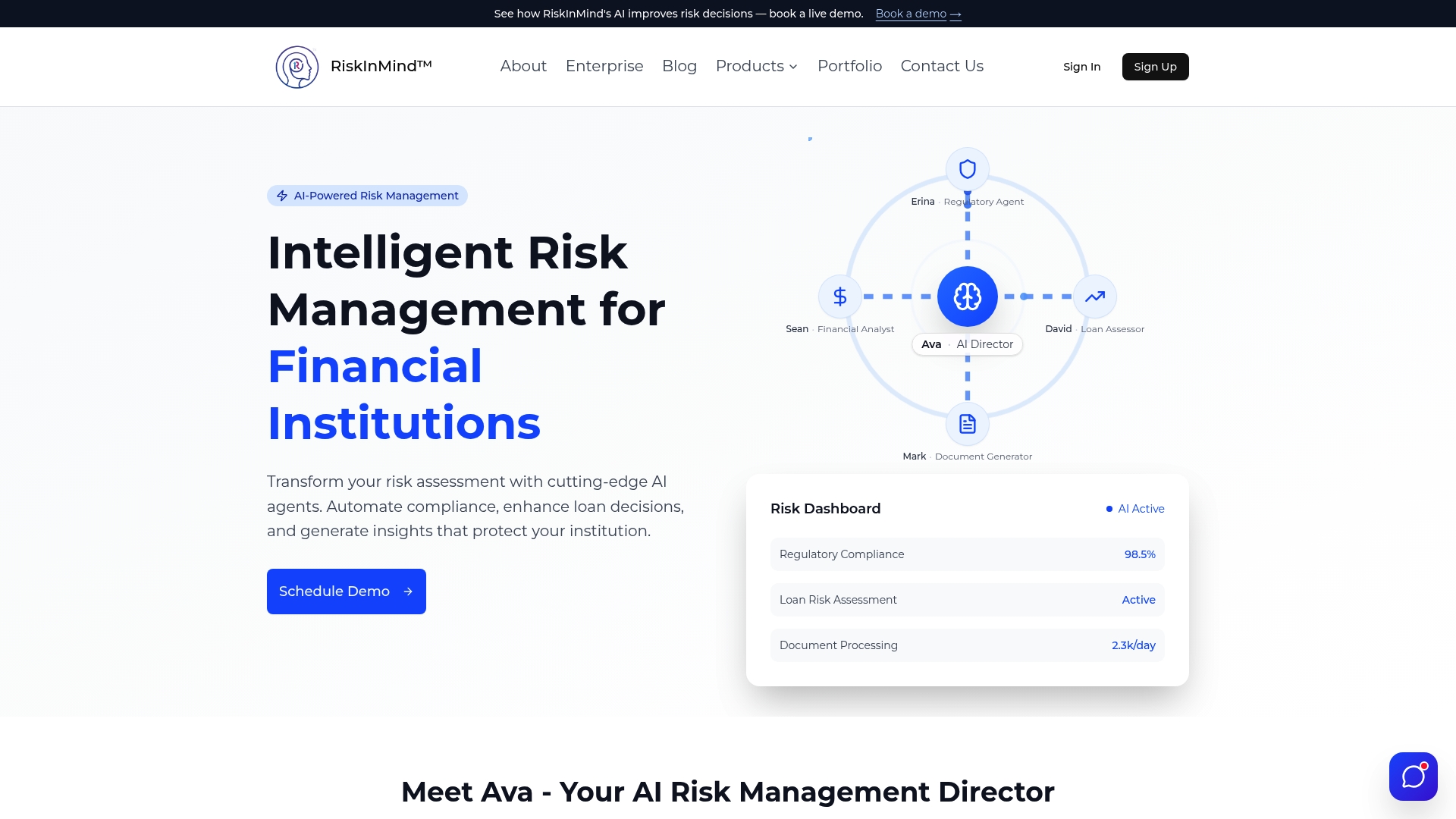
We built our platform for institutions that want underwriting automation they can defend to an examiner. Our AI agents, coordinated by a central AI director named Ava, support underwriting, compliance and portfolio monitoring with:
- Granular audit trails and SOC 2® aligned controls, with processing kept in-house
- Real-time workflows with fast response times
See how it works in our Loan Application product, explore the Bank OS platform, or review pricing and book a demo.
This article is general information, not a substitute for advice from a qualified financial advisor. Consult a qualified financial professional about your own circumstances before acting on anything here.
FAQ
Is underwriting getting replaced by AI?
No. Neural networks are taking over repetitive scoring and document review, while underwriters keep judgment on complex, ambiguous and high-impact cases. Regulators also expect documented human oversight, which keeps people in the loop.
What are the three types of underwriting?
The most common split is insurance underwriting, loan underwriting and securities underwriting. Each evaluates risk before an institution commits capital, though the data and decisions differ.
How are neural networks used in finance?
Financial institutions use them for credit scoring, fraud detection, document analysis and risk classification. They are strongest on large datasets and unstructured inputs such as images and text, as the Actuary Institute's overview explains.
How do you explain a neural network's underwriting decision?
Combine attribution methods such as SHAP, local approximations such as LIME and surrogate models, then review the results with a human. FinRegLab finds no single tool covers every regulatory task.