
Neural networks are AI models that mimic the structure of the human brain to detect complex, nonlinear patterns in data, making them the most capable tools available for modern financial risk assessment. The question of why use neural networks for risk comes down to a fundamental limitation in traditional models: Value at Risk (VaR) and generalized linear models (GLMs) assume linear relationships and normal distributions that rarely hold during credit shocks, market dislocations, or fraud events. A 2026 systematic review analyzing 81 studies confirms that AI methods including neural networks outperform traditional approaches at handling nonlinear shocks and rare events across credit scoring, fraud detection, market risk forecasting, and systemic risk modeling. Frameworks like SAT-GNN, GA-BP networks, and explainability tools such as SHAP are now central to how financial institutions build, validate, and deploy these models.
Why use neural networks for risk assessment over traditional models?
Traditional statistical models fail at the edges of the distribution. VaR underestimates tail risk during market stress. GLMs cannot capture interaction effects between borrower attributes, macroeconomic variables, and behavioral signals simultaneously. Neural networks solve this by learning nonlinear relationships directly from data, without requiring the analyst to specify those relationships in advance.
Automate Regulatory Model Risk Governance
Examine models against 32 qualitative criteria and resolve risk Tiers with pre-deployment checklists per OCC 2011-12 guidelines.
The advantages of neural networks in risk assessment are concrete and measurable:
- Nonlinear pattern detection: Neural networks identify complex interactions between variables that logistic regression and scorecard models miss entirely.
- Unstructured data processing: They incorporate text, images, and behavioral sequences alongside structured financial data, giving analysts a richer picture of borrower or counterparty risk.
- Real-time scoring: Unlike batch-updated statistical models, neural networks process streaming data for immediate risk signals, enabling continuous portfolio monitoring.
- Rare event modeling: Deep learning architectures handle low-frequency, high-impact events more reliably than models calibrated on historical averages.
- Ensemble compatibility: Neural networks integrate into hybrid pipelines alongside gradient-boosted trees and traditional scorecards, improving discrimination metrics without replacing existing governance infrastructure.
The performance gap is significant. Hybrid GA-BP and SAT-GNN neural networks achieved accuracy up to 97.94% and AUC scores up to 0.952 in credit risk early warning systems, with substantial recall improvements over benchmark models. That level of recall matters in credit risk because missing a deteriorating borrower is far more costly than a false positive.
Pro Tip: When evaluating neural network models for credit risk, prioritize AUC and recall over accuracy alone. A model with 97% accuracy but poor recall on defaulting borrowers provides false confidence in portfolio quality.

The interpretability challenge is real but manageable. Neural networks are not inherently transparent, which creates friction in regulated environments. The solution is not to avoid them. It is to pair them with explainability frameworks from the start.
How do governance and explainability frameworks address neural network risks?
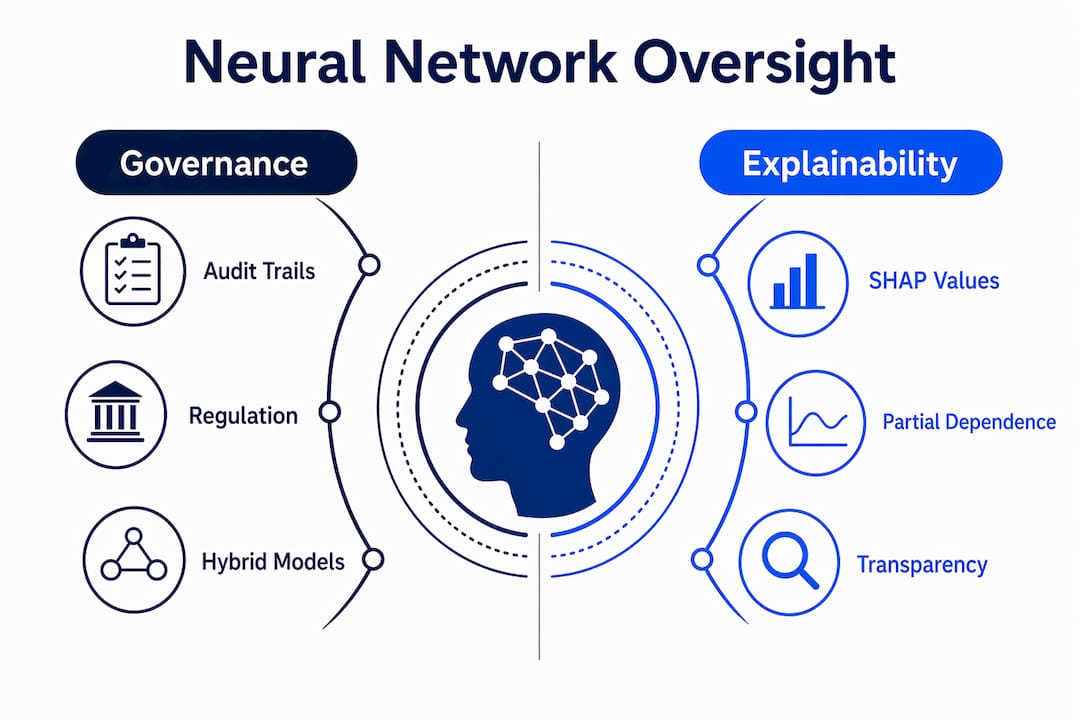
Deploying a neural network without a governance framework is not a risk management strategy. It is a risk creation strategy. The Bank of England's Prudential Regulation Authority makes this explicit: its model risk management principles for AI/ML require independent validation, proportionate controls, and continuous monitoring for all models used in financial decision-making. Neural networks are not exempt.
A practical governance workflow for neural network deployment in regulated finance includes these steps:
- Define model purpose and risk tier. Assign a risk classification based on the decision the model supports, such as loan approval, fraud flagging, or capital allocation.
- Build explainability pipelines in parallel. Use SHAP values and partial dependence plots from the start, not as an afterthought. Explainability techniques like SHAP allow institutions to generate applicant-level decision reasons that satisfy regulatory audit requirements.
- Conduct independent validation. The team validating the model must be separate from the team that built it. This is a PRA requirement and a sound operational principle.
- Establish adverse-action compliance outputs. Neural network outputs must be translated into audit-ready reasons for adverse credit decisions, as required under Regulation B. This demands a dedicated explainability pipeline, not a manual workaround.
- Monitor continuously for drift. Model performance degrades as economic conditions change. Automated monitoring for input distribution shifts and output score drift is non-negotiable.
The "black box" concern is legitimate but overstated when governance is built correctly. Hybrid AI pipelines that combine neural networks with traditional models deliver improved predictive performance while maintaining the transparency needed for governance and operational stability. The neural network handles complex pattern recognition. The traditional model or rule layer provides the auditable decision boundary.
Pro Tip: Do not wait for a regulatory examination to build your explainability pipeline. Integrate SHAP or partial dependence plots into your model development workflow before the first production deployment.
What are real-world applications of neural networks in financial risk?
Neural networks for risk assessment are not theoretical. They are in production across credit risk, insurance pricing, market risk, and systemic risk monitoring.
Credit risk early warning systems
GA-BP neural networks and SAT-GNN models now power early warning systems for listed company financial distress. The SAT-GNN architecture uses sparse attention transformers combined with graph neural network layers to capture both sequential behavioral patterns and relational borrower structures. This combination detects deterioration signals weeks earlier than traditional financial ratio models.
Graph neural networks add a dimension that no traditional model can replicate: borrower-to-borrower relational risk. When one borrower in a network defaults, the model propagates that signal through connected entities, identifying contagion risk before it appears in individual financial statements. Robustness evaluation under adversarial stress testing is required to validate these models for production use.
Insurance and actuarial risk modeling
| Risk domain | Traditional approach | Neural network advantage |
|---|---|---|
| Multi-peril property | Separate GLMs per peril | Single model capturing cross-peril correlations |
| Fraud detection | Rules-based scoring | Deep learning on behavioral sequences |
| Commercial real estate | Appraisal-based ratios | Image and text data fusion for property risk |
| Credit early warning | Logistic regression | GA-BP and SAT-GNN with AUC up to 0.952 |
Neural networks in insurance risk modeling outperform gradient-boosted models in complex risk structures, particularly when unstructured data such as property images or claims text is available. The ability to process images and text alongside structured policy data is a capability gap that no traditional actuarial model closes.
Market risk and systemic risk
Deep learning models for market risk forecasting capture regime changes and volatility clustering that GARCH models miss during stress periods. For systemic risk, graph-based neural networks model interconnections between financial institutions, identifying contagion pathways that bilateral exposure matrices cannot represent.
How do neural networks enable dynamic, real-time risk management?
Traditional risk models operate on fixed update cycles. A credit scorecard might be recalibrated annually. A VaR model might be updated quarterly. Neural networks break this constraint entirely.
Dynamic recalibration and streaming data integration allow neural networks to update risk scores continuously as new transaction data, market prices, or behavioral signals arrive. For a community bank monitoring a commercial real estate portfolio, this means detecting covenant stress in near real time rather than discovering it at the next quarterly review.
Key capabilities that enable continuous risk assessment include:
- Streaming data pipelines: Neural networks process incoming data feeds without waiting for batch aggregation, producing updated risk scores within milliseconds.
- Sparse attention transformers: SAT-GNN and similar architectures handle ultra-long behavioral sequences, such as 24 months of daily transaction history, without the computational cost of full attention mechanisms.
- Fusion layers: These combine structured financial data with unstructured inputs like loan officer notes or property descriptions in a single model pass.
- Adaptive thresholds: Models recalibrate decision boundaries as portfolio composition and macroeconomic conditions shift, reducing the lag between market change and risk signal.
The practical benefit for lending institutions is a shift from periodic risk snapshots to a continuous risk posture. For real-time risk assessment in banking and commercial real estate, this is not a marginal improvement. It is a structural change in how credit and market risk are managed.
Pro Tip: Pair your neural network's real-time output with automated alert thresholds tied to your credit policy. The model generates the signal. The policy determines the response. Without that connection, real-time scoring produces noise, not action.
Key Takeaways
Neural networks outperform traditional risk models because they learn nonlinear relationships from diverse financial data, process information in real time, and integrate unstructured inputs that statistical models cannot handle.
| Point | Details |
|---|---|
| Nonlinear risk detection | Neural networks capture complex variable interactions that VaR and GLMs structurally cannot model. |
| Measurable accuracy gains | GA-BP and SAT-GNN models achieved AUC up to 0.952 in credit risk early warning, outperforming traditional benchmarks. |
| Governance is non-negotiable | PRA model risk management principles require independent validation and continuous monitoring for all AI/ML models. |
| Explainability enables compliance | SHAP and partial dependence plots translate neural network outputs into audit-ready, Regulation B-compliant decision reasons. |
| Hybrid pipelines balance performance and transparency | Combining neural networks with traditional models improves discrimination metrics while maintaining governance stability. |
My view on neural networks in regulated risk environments
The most common mistake I see financial institutions make is treating neural network adoption as a binary choice: either deploy the black box and accept the opacity, or stick with the scorecard and accept the performance ceiling. Neither position is defensible in 2026.
The institutions getting this right are building hybrid architectures from day one. The neural network handles what it does best: detecting nonlinear patterns in high-dimensional data, processing behavioral sequences, and flagging anomalies that no rule set would catch. The traditional model or rule layer sits on top, providing the auditable decision boundary that regulators and examiners expect to see. This is not a compromise. It is the correct architecture for a regulated environment.
The governance piece is where I see the most operational risk. Teams deploy a neural network, achieve strong backtest results, and then discover six months later that they cannot explain a single adverse action decision to a regulator. Building the explainability pipeline after the fact is expensive, slow, and often requires retraining the model. Build it first. The AI risk management practices that hold up under examination are the ones designed for explainability from the model architecture stage, not retrofitted after deployment.
The institutions that will lead in credit risk, commercial real estate, and portfolio monitoring over the next three years are the ones investing in neural network governance infrastructure now, not waiting for a regulatory mandate to force the issue.
— Raj
How Riskinmind applies neural networks to lending risk
Riskinmind integrates neural networks and large language models directly into its risk platform for credit unions, community banks, and lenders. The platform's AI agents process structured loan data and unstructured documents together, producing risk scores with response times under half a second.

The Loan Application product uses AI-driven risk assessment to support underwriting decisions with audit-ready outputs, addressing the explainability requirement that regulated lenders face. For commercial real estate portfolios, the CRE Loan Risk Predictor applies advanced AI models to property and borrower data, delivering risk signals that traditional appraisal-based analysis misses. Both products operate within Riskinmind's SOC 2® certified, bank-grade security environment, with Ava, the platform's central AI director, coordinating specialized agents across credit risk, compliance, and market analysis functions.
FAQ
What makes neural networks better than traditional risk models?
Neural networks learn nonlinear relationships directly from data, handling rare events and complex variable interactions that VaR and GLMs cannot model. A 2026 systematic review of 81 studies confirms their superior performance across credit scoring, fraud detection, and market risk forecasting.
How do financial institutions address the black box problem?
Institutions use explainability techniques such as SHAP values and partial dependence plots to generate audit-ready, applicant-level decision reasons from neural network outputs. Hybrid pipelines that combine neural networks with traditional models further reduce opacity while preserving predictive performance.
What does Regulation B require for AI-based credit decisions?
Regulation B requires that adverse action notices include specific, applicant-level reasons for credit denial. Neural network outputs must be translated into these reasons through a dedicated explainability pipeline to achieve compliance.
Are neural networks suitable for real-time risk monitoring?
Neural networks process streaming data continuously, updating risk scores as new transactions, market prices, or behavioral signals arrive. This contrasts with traditional models updated on fixed quarterly or annual cycles, making neural networks the preferred architecture for continuous portfolio monitoring.
What governance framework applies to neural networks in banking?
The Bank of England's Prudential Regulation Authority requires independent validation, proportionate controls, and continuous monitoring for all AI/ML models used in financial decision-making. These principles apply directly to neural networks deployed in credit risk, fraud detection, and market risk applications.