
AI loan underwriting brings structured, auditable evidence review to a process that has historically depended on manual document handling, and it produces faster decisions without sacrificing defensibility when institutions pair automation with human oversight. Expect meaningful gains in consistency and speed. The right next step is not a full rollout. It is a single, well-scoped pilot on one high-value use case.
- AI underwriting improves consistency across evaluations, leading to better risk selection and pricing, with early reports showing meaningful reduction in decision variability.
- Implementing AI initially should focus on high-volume, low-complexity tasks such as document triage and evidence review to maximize risk-adjusted returns.
- AI systems require robust explainability and audit trails, including decision records and natural-language rationales, to satisfy regulatory and compliance demands.
- Pilot projects should be tightly scoped, involve key stakeholders early, and ensure data readiness and clear integration points before scaling up.
- Governance is the key to success; systems must be built with auditability, human oversight, and compliance considerations from the start, not treated as mere technology procurement.
Automate Regulatory Model Risk Governance
Examine models against 32 qualitative criteria and resolve risk Tiers with pre-deployment checklists per OCC 2011-12 guidelines.
Table of Contents
- What Business Value Does AI Loan Underwriting Actually Deliver?
- Which AI Technologies Power Modern Underwriting Systems?
- Where Should You Deploy AI Underwriting First?
- How Do You Keep AI Underwriting Decisions Explainable and Auditable?
- How Do You Roll Out AI Underwriting Without Breaking Anything?
- What Are the Biggest Risks in AI Loan Underwriting?
- How Do You Measure Whether AI Underwriting Is Actually Working?
- What Should You Actually Ask a Vendor Before Deploying AI Underwriting?
- Why Governance, Not Technology, Determines Whether AI Underwriting Works
- How RiskInMind Helps You Move From Pilot to Production
- Sources
What Business Value Does AI Loan Underwriting Actually Deliver?
The most measurable payoff from AI underwriting is not raw speed. It is consistency. Every file gets evaluated against the same criteria, in the same sequence, with the same evidentiary standard, which reduces the variance that creeps in when ten underwriters interpret a borderline file ten different ways. That consistency compounds into better risk selection and pricing, because a model can weigh dozens of structured and unstructured inputs simultaneously in ways a manual reviewer working under deadline pressure typically cannot.
The efficiency case is more familiar to anyone who has run a lending operation. Document collection, verification, and cross-checking eat the bulk of underwriter time on a standard file. Automating that layer shortens time-to-decision and reduces the administrative overhead that comes with re-requesting missing documents or manually reconciling data from multiple sources. Early-adopter banks deploying AI to identify creditworthiness signals report meaningful reductions in decision cycles, though the outcomes depend heavily on how tightly the tools are integrated into existing workflows rather than bolted on as a side process.
At the portfolio level, the effects show up over quarters, not days. Institutions that apply AI-assisted scoring across a book of business often see improved segmentation, because models can separate marginal-but-approvable borrowers from genuinely high-risk ones with more precision than a rules-based scorecard alone. That precision tends to translate into lower loss rates on the margin and gives lending teams room to expand origination volume without proportionally expanding underwriting headcount.
The value clusters into three areas:
- Accuracy: more consistent evidence review reduces decision variance across underwriters and offices.
- Speed: shorter time-to-decision on both retail and commercial files, with the biggest gains where document review dominates the workflow.
- Portfolio economics: sharper segmentation supports growth in originations without a matching increase in loss rates.
Statistic callout: Industry reporting on early-adopter banks shows AI-derived signals can surface creditworthiness indicators that traditional scoring missed entirely, though the research is clear that these gains only materialize with careful validation and workflow integration, not a plug-and-play deployment.
Which AI Technologies Power Modern Underwriting Systems?
Underwriting automation is not one model doing one job. It is a stack, and understanding the roles each layer plays matters more than chasing any single "AI underwriting" buzzword.
Predictive scoring models handle the quantitative side: default probability, loss-given-default, and pricing recommendations built from structured data like credit bureau files, cash flow history, and collateral valuations. These are typically gradient-boosted trees or neural networks trained on historical performance data. They are fast and accurate at pattern recognition, but they do not explain themselves well on their own.
That is where large language models earn their place, not as decision-makers but as explainers and synthesizers. An LLM can read a loan file, a set of financial statements, and an underwriter's notes, then produce a plain-language summary of why a scoring model flagged a file as marginal. Generative AI's role in processing unstructured data has expanded quickly because these models can parse medical records, tax returns, and correspondence in formats that traditional rule engines choke on.
Rule engines still matter, and dismissing them as legacy technology is a mistake. They enforce the hard constraints, regulatory limits, policy exclusions, and eligibility cutoffs, that no probabilistic model should be allowed to override quietly.
Underneath all three sits the ingestion layer: OCR for scanned documents, NLP for extracting entities and figures from unstructured text, and information extraction pipelines that convert a stack of PDFs into structured fields a scoring model can actually use. Poor OCR accuracy on handwritten or low-quality scans remains one of the most underrated failure points in automated underwriting software, and it is worth testing on your institution's actual document quality, not a vendor's clean demo set.
An agentic orchestration layer coordinates these components: routing files, triggering the right model for the right task, and flagging cases for human review when confidence scores drop below a threshold. This is where human-in-the-loop placement gets decided, and it should sit at the point where a wrong decision is expensive, not at the end of the pipeline as an afterthought.
Key architecture considerations:
- Feature stores that keep training data and live-scoring data consistent to avoid quiet model drift.
- Model-serving infrastructure sized for latency, since a five-second delay per file adds up fast at scale.
- Clear handoff points between automated scoring and human underwriter review.
Pro Tip: Test your OCR and NLP pipeline against your institution's actual document quality, not a vendor's clean demo set. The gap between the two is where most automated loan underwriting projects quietly underperform.
Where Should You Deploy AI Underwriting First?
Not every underwriting task deserves automation on day one. The use cases with the best risk-adjusted return share one trait: they reduce manual effort in high-volume, lower-complexity steps before touching judgment-heavy decisions.
- Intake automation and document triage. Automating the sorting, classification, and initial data extraction from incoming loan documents removes the least valuable work from underwriters' desks first, freeing their time for actual credit judgment.
- Enhanced credit assessment with alternative data. Ensemble models that blend traditional bureau data with cash flow, rental history, or transaction-level banking data give retail and consumer lenders a sharper view of borrowers who look identical on a standard credit report.
- Automated evidence review for complex life underwriting files. Medical records, lab results, and physician notes are exactly the kind of dense, unstructured evidence where AI's structural discipline improves consistency far more than it improves raw speed, letting underwriters focus on interpretation instead of assembly.
- Commercial underwriting triage. Surfacing out-of-appetite risk early, before an analyst spends four hours building a credit memo, saves the most expensive resource in commercial lending: senior underwriter time.
Mortgage underwriting sits slightly apart from these four because it carries heavier federal disclosure requirements, but the same intake-automation logic applies to income and asset verification, which remains one of the most document-intensive steps in the process.
How Do You Keep AI Underwriting Decisions Explainable and Auditable?
Every AI-assisted underwriting decision needs a paper trail that can survive a regulator's question six months later, not just a model's confidence score at the moment of approval.
Start with decision records: what data the model saw, which sources it pulled from, what score it produced, and which human reviewed or overrode that score. This is not bureaucratic overhead. It is the difference between a defensible decision and an unexplainable black box. AI can actually make underwriting more reviewable than manual processes precisely because it generates a clearer record of evidence used and the path from information to assessment, something a rushed manual file review often skips entirely.
Explainability techniques suited to underwriting fall into two camps: feature attribution methods that show which inputs drove a given score, and natural-language rationale generation that translates those attributions into something a compliance officer or borrower can actually read. Both matter. A SHAP value chart satisfies a model validator; a plain-English explanation satisfies a customer service representative fielding a denial question.
Model lifecycle governance needs the same rigor banks already apply to other quantitative models under existing model risk management frameworks:
- Maintain a model inventory with documented purpose, owner, and risk tier for every AI component in the underwriting stack.
- Run periodic validation tests comparing AI-assisted outcomes against manual review on a sampled basis.
- Require formal approval gates before any model version moves from testing into production scoring.
- Document how each model aligns with state-level insurance and lending regulation, since state regulators are actively framing responsible AI use rather than waiting for a single federal standard.
That last point deserves emphasis. Federal consumer protection law, including fair lending requirements, sets the floor. State insurance and banking regulators are increasingly setting their own expectations on top of it, and institutions operating across multiple states need governance flexible enough to satisfy the strictest jurisdiction they touch.
How Do You Roll Out AI Underwriting Without Breaking Anything?
A pilot that tries to reinvent your entire underwriting process at once is a pilot designed to fail. The institutions that succeed keep the change close to existing workflows and expand from there.
- Select a contained pilot use case. Pick something with clear before-and-after metrics, like document triage or evidence review on a single product line, rather than end-to-end automated loan approval. Starting with the underwriting problem instead of the technology is the single most repeated piece of advice from institutions that have already gone through this.
- Involve the right stakeholders early. That means underwriters who will use the tool daily, compliance officers who will defend it later, and IT staff who understand your loan origination system's integration limits.
- Run a data readiness audit. Check for missing fields, inconsistent formatting across branches or acquired portfolios, and stale data that hasn't been refreshed since a prior system migration. Most delays in underwriting automation trace back to this step, not the model itself.
- Map integration points explicitly. Your LOS, your decisioning engine, and your reporting and audit systems all need defined handoffs with the new AI layer, not informal workarounds that break the first time someone changes a field name.
- Set go/no-go criteria before you start. Define the accuracy, consistency, and time-to-decision thresholds that will determine whether the pilot graduates to production, before anyone has an emotional stake in the outcome.
- Design the pilot as a real evidence-review experiment. Freeze acceptance criteria for the pilot's duration, log every decision, and require post-issue audits on a sample of cases to compare AI-assisted outcomes against manual review directly.
- Build rollout governance before scaling. That includes training plans for underwriters, clear authority for who can override a model recommendation, defined rollback triggers if performance degrades, and a communication plan for both staff and affected borrowers.
Data readiness deserves its own line item, because it is where most timelines slip. Common cleanup issues include duplicate borrower records across legacy systems, inconsistent document naming conventions that break OCR pipelines, and historical loan performance data that lacks the granularity needed to train a fair, well-calibrated scoring model.
Pro Tip: Pilots that stay close to your current underwriting workflow win internal buy-in faster than ambitious re-engineering projects. Underwriters trust a tool that fits into their existing process far more than one that asks them to relearn their job.
What Are the Biggest Risks in AI Loan Underwriting?
Bias is the risk every institution names first, and rightly so. A model trained on historical lending data can encode past discriminatory patterns even without ever seeing a protected-class variable, because proxy variables like zip code or education history can carry the same signal by another name. Preprocessing checks (auditing training data for proxy correlation), postprocessing checks (comparing approval and pricing outcomes across demographic groups), and ongoing monitoring after deployment all need to run continuously, not just at model launch.
Model drift is the quieter risk. A scoring model calibrated on 2023 economic conditions will start misjudging risk as interest rates, employment patterns, or borrower behavior shift, and the degradation is often gradual enough to go unnoticed without dedicated monitoring.
Data protection carries specific weight in underwriting because the evidence involved, income documentation, medical records for life underwriting, tax filings, is exactly the sensitive category that attracts the most regulatory scrutiny and the highest breach liability. Any vendor handling that data needs a security assessment that goes well beyond a sales pitch.
Practical mitigations to put in place before go-live:
- Run bias testing across protected-class proxies before deployment, not just at annual review.
- Set drift-detection thresholds that trigger automatic retraining review, not just quarterly check-ins.
- Require vendor security certifications, data encryption standards, and breach-notification terms in writing.
- Negotiate contractual validation rights and audit clauses so your risk team can inspect model performance, not just take a vendor's word for it.
- Define SLAs for uptime and response time that match how central the tool becomes to your decision pipeline.
How Do You Measure Whether AI Underwriting Is Actually Working?
Two categories of metrics matter, and conflating them is a common mistake. Business KPIs, like average time-to-decision, approval rate stability, and loss rate by segment, tell you whether the pilot is delivering value. Model metrics, like calibration accuracy, false-positive and false-negative rates, and fairness indicators across demographic groups, tell you whether it is doing so safely.
Track both from day one of any pilot:
- Time-to-decision compared against your pre-pilot baseline, measured on identical file types.
- Approval consistency across underwriters and branches handling comparable risk profiles.
- Fairness indicators, including approval and pricing parity across demographic groups.
- Operational alerts for confidence-score drops, data pipeline failures, or unusual override rates by staff.
Statistic callout: Reporting on early-adopter institutions suggests that real gains from AI-derived credit signals only materialize when paired with rigorous validation, not automatic adoption. Set your pass/fail criteria before the pilot begins, and let the data decide, not sunk-cost pressure to declare victory.
What Should You Actually Ask a Vendor Before Deploying AI Underwriting?
Publisher proof points are only useful if you turn them into acceptance criteria rather than marketing copy. RiskInMind's own capabilities offer a reasonable template for what to demand from any AI underwriting vendor.
SOC 2® certification and bank-grade security should be a baseline requirement, not a differentiator, given how sensitive underwriting evidence is. Ask for the actual audit report, not a badge on a website. Agent orchestration that coordinates specialized functions, credit risk assessment, compliance checks, document review, under a central coordinating layer like RiskInMind's Ava, matters because it reflects the architecture discussed earlier: predictive scoring, explainability, and rule enforcement working as coordinated components rather than disconnected tools. Sub-second processing times matter specifically for real-time decisioning use cases, like point-of-sale lending, where a slow response kills the customer experience regardless of accuracy.
Before signing anything, request:
- A live demo using file types that resemble your actual portfolio, not a clean sample set.
- Case studies or reference clients in your institution type, whether that is a credit union, community bank, or lender.
- Documented validation methodology and sample audit trail output.
- Clear answers on data residency, encryption, and breach-notification terms.
Why Governance, Not Technology, Determines Whether AI Underwriting Works
The mistake I see repeated across financial institution AI adoption is treating this as a technology procurement decision when it is fundamentally a governance decision. The models are increasingly commoditized. What separates institutions that get real value from AI underwriting from those that get an expensive experiment is whether they built auditability and human oversight into the design from day one, rather than retrofitting it after a regulator or a bad loan forced the question.
Start with a problem, not a platform. Pick one underwriting bottleneck that is genuinely painful, build a validation plan before you build the pilot, and treat the human underwriter as the accountable decision-maker the model serves, not a rubber stamp the model replaces. Then get a vendor demo and press hard on the audit trail, because that is where the real difference between vendors shows up.
— Raj
How RiskInMind Helps You Move From Pilot to Production
If the roadmap above convinced you that governance and integration matter as much as model accuracy, that is exactly the gap RiskInMind was built to close. Rather than handing you a standalone scoring model and leaving the orchestration, audit trails, and compliance mapping to your own engineering team, RiskInMind delivers the full stack, predictive scoring, document ingestion, explainability, and human-in-the-loop workflow, coordinated by its central AI director, Ava, and backed by SOC 2® certification and bank-grade security controls built for the sensitivity of underwriting evidence.
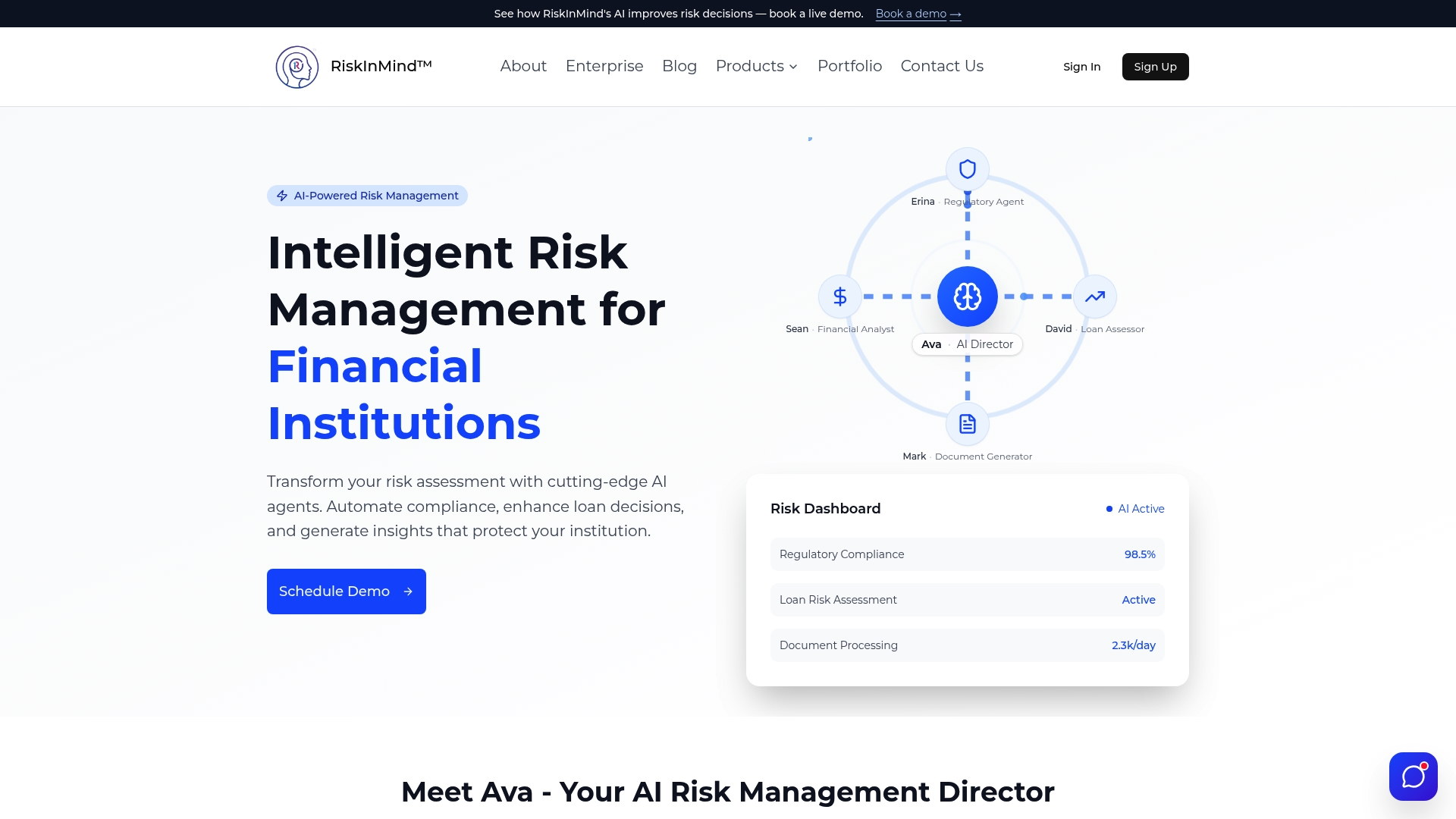
That matters most for credit unions and community banks that don't have the internal resources to stitch together separate OCR, NLP, and scoring vendors into a coherent, auditable pipeline. RiskInMind's sub-second processing supports real-time decisioning without sacrificing the decision logs and lineage tracking your compliance team will need during examination. If you're evaluating how automated underwriting compares to your current manual process and legacy LOS, that comparison page walks through the practical differences in workflow and outcomes. Portfolio managers weighing the monitoring and benchmarking side of this decision can also review RiskInMind's peer benchmarking and portfolio analysis tools to see how ongoing performance tracking fits into the picture. The next step is straightforward: request a demo using your own file types and see what the audit trail actually looks like before you commit to anything.
This article is general information, not a substitute for advice from a qualified financial advisor. Consult a qualified financial professional about your own circumstances before acting on anything here.
Sources
- AI and life underwriting in transition (SOA expert panel report, 2026)
- Underwriter’s edge: Harnessing generative AI for optimal outcomes (Deloitte)
- Phys