
An AI governance policy for a bank has one job: create enterprise-level accountability, an auditable system inventory, risk-tiered controls, and continuous monitoring that supervisors can verify without a scramble. Two baseline standards should anchor the policy language: the NIST AI Risk Management Framework, built around four functions (Govern, Map, Measure, Manage), and ISO 42001, which supplies the management-system scaffolding auditors already recognize.
If you lead risk or compliance at a bank and you're starting this quarter, three moves matter more than anything else in the policy document itself:
- Name an accountable executive, whether that's a Chief AI Officer or an existing CRO with expanded authority.
- Build a complete inventory of every AI system in production or pilot, including vendor tools embedded in loan origination or fraud platforms.
- Classify each system by risk tier before writing a single control.
Automate Regulatory Model Risk Governance
Examine models against 32 qualitative criteria and resolve risk Tiers with pre-deployment checklists per OCC 2011-12 guidelines.
Pro Tip: Deloitte's Trustworthy AI Governance Index found that most banks still need to materially strengthen governance capability before they can scale AI safely, which means the institutions moving fastest right now are the ones treating governance as infrastructure, not paperwork.
TL;DR:
- Banks should appoint a senior accountable executive, such as a Chief AI Officer, before developing specific policies or controls.
- Creating a comprehensive inventory of all AI systems, including vendor tools and embedded models, with risk tier classification, is essential for effective governance.
- Policies must directly implement the four functions of the NIST AI RMF—Govern, Map, Measure, Manage—and align with ISO 42001 for operational structure.
- Every control requires an owner, evidence artifact, threshold for success or failure, and a review trigger to ensure auditability and ongoing compliance.
- Automated platforms can significantly streamline evidence collection, monitoring, and documentation, but legal review and controls testing remain critical manual steps.
Table of Contents
- AI Governance Policy Banks Need: Program vs. Model Controls
- Why Banks Need a Formal AI Governance Policy Now
- What Do Regulators Expect From an AI Governance Policy?
- Core Controls Every Bank AI Policy Should Contain
- How to Roll Out an AI Governance Policy: A Phased Plan
- How Platform Automation Speeds Up Evidence Collection
- Getting Your Bank's Culture to Actually Follow the Policy
- Where AI Governance Meets Cybersecurity Controls
- The Biggest Governance Mistakes I See Banks Make
- Turning Policy Language Into Operational Evidence
- Key Takeaways
- Sources
AI Governance Policy Banks Need: Program vs. Model Controls
Banks tend to conflate AI governance with model risk management, and that conflation causes gaps. Model governance covers a single system: its model card, its version history, its drift thresholds. AI governance is the program layer above it, the accountability structure, the inventory, the escalation paths, that makes model-level controls consistent across every business line.
The NIST AI RMF gives this structure four functions your policy should mirror directly:
- Govern: roles, policies, and risk appetite statements approved by the board.
- Map: context for each system, including who it affects and what could go wrong.
- Measure: testing methodology, performance metrics, and bias checks.
- Manage: response plans, decommissioning rules, and residual risk tracking.
A policy that only states good intentions in prose fails the moment an examiner asks for evidence. Governance has to be operational, meaning every function above produces a document, a log entry, or a dashboard that someone can point to on demand. That distinction between what a policy says and what a bank can actually prove is where most programs collapse under review. Enterprise risk frameworks already built for credit and operational risk are usually the fastest path to that operational structure, since AI risk just becomes another register entry rather than a parallel bureaucracy.
Why Banks Need a Formal AI Governance Policy Now
Supervisory attention on AI has moved from advisory to expected practice. The OCC's 2025 bulletin makes clear that examiners will assess AI use through existing model risk and third-party risk lenses, not as a separate, lighter-touch category. Banks without documented AI controls are being asked to produce them retroactively, which is a far worse position than having them ready.
Operational failures reinforce the same point. Model drift in a credit-decisioning tool doesn't announce itself; it shows up months later as a shift in approval rates or a fair-lending complaint. Without monitoring baked into policy, banks often discover drift only after a regulator or an internal audit flags it.
There's an upside worth stating plainly: governance done well is what lets a bank deploy AI faster, not slower. Deloitte's research found that banks treating governance as an operating capability, rather than a compliance afterthought, deploy AI more broadly and see stronger revenue growth than peers still bolting on controls after the fact.
What Do Regulators Expect From an AI Governance Policy?
Supervisors and standards bodies aren't asking for identical documents, but their expectations overlap enough that one policy can satisfy all of them if you build it around the right evidence.
NIST AI RMF as the operational baseline. Each function translates into specific policy language:
- Govern requires documented roles, a risk appetite statement, and board-level sign-off authority for high-risk systems.
- Map requires a use-case narrative for every system: who it touches, what data it uses, what harm looks like if it fails.
- Measure requires a testing protocol with defined thresholds, not just a statement that "testing occurs."
- Manage requires an incident response plan and a documented decommissioning process.
ISO 42001 as the management-system shell. Where NIST tells you what to do, ISO 42001 tells you how to structure the management system around it, policy ownership, internal audit cycles, and continuous improvement loops that mirror ISO 27001 for information security. Banks that already run ISO-aligned programs elsewhere can extend the same audit muscle to AI with minimal retraining.
U.S. agency guidance you need to evidence directly. The FDIC's interagency model risk management guidance revises long-standing model risk expectations to explicitly cover AI, meaning continuous validation and monitoring aren't optional add-ons anymore. The Federal Reserve applies similar expectations through supervisory letters tied to existing SR 11-7 model risk guidance. For each of these three, keep a record of: the guidance version you mapped against, the internal control that satisfies it, and the date you last reviewed that mapping.
Banks with any EU-facing operations or vendors should also be aware that the EU AI Act imposes documentation and human-oversight obligations on high-risk systems like credit scoring, with extraterritorial reach if outputs affect EU residents. Even purely domestic banks often find the mapping exercise useful, since it previews where U.S. rules are likely headed.
Core Controls Every Bank AI Policy Should Contain
A policy document is only as strong as the controls it forces into existence. Each control below needs four things attached to it: a named owner, a minimum evidence artifact, a pass or fail threshold, and a review trigger, a format drawn from practical governance checklist approaches that examiners find easy to audit.
-
Executive accountability and decision rights. Name a CAIO or equivalent, define what decisions require their sign-off, and set a board reporting cadence regularly, at least annually for high-risk systems. Deloitte's research points to a Model Review Board structure with accountability spread across all three lines of defense as the pattern that holds up best under scrutiny. Learn more about structuring the AI director role inside a bank's existing reporting lines.
-
A complete system inventory with risk tiering. Every AI system, whether built in-house or embedded in a vendor tool, gets logged with its purpose, its data sources, and a risk tier (high, medium, low) based on the consequences of failure. Credit decisioning and fraud detection almost always land in the high tier.
-
Model governance artifacts. Model cards should record purpose, training data, performance metrics, limitations, and approval history, all of which best-practice model governance frameworks treat as non-negotiable fields. Pair each card with a version log and a documented drift threshold that triggers review.
-
Data governance and lineage. Document where training and inference data originates, how it's refreshed, and who's accountable for its quality. Weak data lineage is the most common gap examiners cite when a model's outputs drift unexpectedly.
-
Vendor and third-party controls. Contracts should include audit rights, documented model behavior disclosures, and an exit plan if the vendor can't meet your evidence standards. This is where many banks discover their biggest blind spot, since a purchased underwriting tool is still your regulatory exposure.
-
Monitoring, incident response, and decommissioning. Define what triggers an alert, who responds, and how a system gets formally retired rather than quietly abandoned in production.
-
Training and evidence retention. Role-based AI literacy, not generic training, and a retention schedule for every approval record, test result, and review date.
How to Roll Out an AI Governance Policy: A Phased Plan
Turning policy language into working controls takes a sequenced rollout, not a single big-bang launch. Here's a phasing approach that keeps momentum without overwhelming existing risk teams.
-
Phase 0, readiness check (2 to 4 weeks). Take a snapshot inventory of known AI systems, secure an executive sponsor, and shortlist the two or three highest-impact systems (usually credit decisioning or fraud detection) for priority treatment.
-
Phase 1, policy drafting (4 to 6 weeks). Write permitted and restricted use cases, define risk tier rules, and assign decision rights, who can approve a high-risk system, who can override a flagged output.
-
Phase 2, operationalization (6 to 10 weeks). Stand up the model registry, populate model cards for existing systems, run validation tests against defined thresholds, and add audit-rights clauses to vendor contracts at renewal.
-
Phase 3, monitoring and alerting (ongoing from week 10). Build dashboards for drift detection, set alert thresholds, and document an incident workflow with clear escalation timing.
-
Phase 4, maturity and board integration (quarterly cycle). Establish a board reporting cadence, select KPIs (inventory completeness, percentage of systems with current model cards, mean time to remediate flagged drift), and revisit the policy annually.
| Phase | Primary Deliverable | Typical Owner |
|---|---|---|
| 0: Readiness | Inventory snapshot, executive sponsor | CRO or interim AI lead |
| 1: Policy drafting | Written policy with risk tiers | Compliance and legal |
| 2: Operationalization | Model registry, vendor clauses | Model risk team |
| 3: Monitoring | Drift dashboards, incident workflow | Risk operations |
| 4: Maturity | Board reporting cadence, KPIs | CAIO and board risk committee |
How Platform Automation Speeds Up Evidence Collection
Collecting the evidence supervisors want, approval records, test results, drift logs, is where most governance programs bog down, because it's manual work layered onto teams already stretched thin. This is the piece a bank-grade platform can genuinely accelerate.
A platform built for financial institutions can maintain a live system inventory, generate model registry entries automatically as new tools go into production, and flag drift the moment performance metrics cross a defined threshold, cutting the lag between a problem occurring and someone noticing it.
The gap between having a governance policy on paper and having governance evidence on demand is exactly where automated inventory and monitoring earn their keep, turning a quarterly scramble into a standing, auditable record.
Riskinmind's platform, for instance, is built with SOC 2® certification and produces audit logs alongside its risk dashboards, the kind of artifact trail examiners ask for directly. Automation here doesn't replace the policy itself. Procurement review, legal sign-off, and independent controls testing still belong to your teams, not the software.
Getting Your Bank's Culture to Actually Follow the Policy
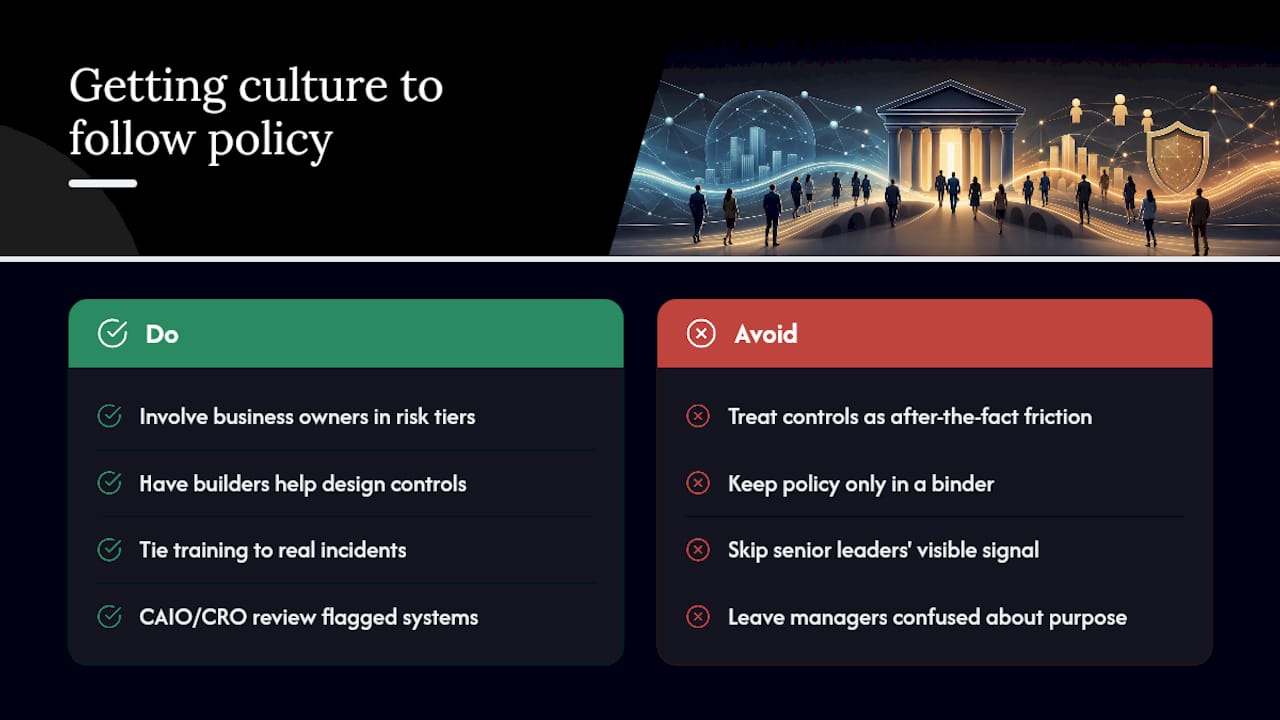
A governance policy that lives only in a compliance binder changes nothing. The harder work is getting underwriters, data scientists, and business line leaders to treat AI controls as part of how they work, not as a separate approval gate they route around when deadlines get tight.
Resistance usually shows up in predictable places. Business units that adopted an AI tool before governance existed often see new controls as friction added after the fact, rather than protection built in from the start. That perception problem is real, and it's why sequencing matters: involve business line owners in classifying their own systems' risk tiers rather than handing them a finished rulebook. People who help build a control are far more likely to maintain it.
Middle management is usually the harder audience, not front-line staff. A loan officer will follow a clear rule. A team lead balancing throughput targets against a new validation step needs to understand why the step exists, not just that it's mandatory. Tie training to actual incidents where possible, a real drift event, a documented near-miss, rather than abstract policy language.
Culture change also needs a visible signal from the top. When a CAIO or CRO personally reviews flagged systems rather than delegating that entirely, it tells the organization the policy has teeth. Banks that skip this signal tend to see governance decay within a year, controls exist on paper but stop getting updated once the initial rollout excitement fades.
Where AI Governance Meets Cybersecurity Controls
AI systems introduce attack surfaces that traditional cybersecurity frameworks weren't built to catch, and a governance policy that ignores this overlap leaves a real gap. Training data can be poisoned. Model outputs can be manipulated through adversarial inputs designed to trigger false approvals. A model registry, if not access-controlled the same way a core banking system is, becomes a soft target.

The practical fix is integration, not duplication. Your existing cybersecurity framework, likely built around NIST's Cybersecurity Framework already, should extend its access control and incident response processes to cover AI systems specifically rather than treating them as a separate risk category with its own security team. Model cards and registries should carry the same classification and access restrictions as any sensitive system of record.
Incident response plans deserve particular attention here. A cybersecurity breach and a model integrity failure can look identical in early symptoms, unexpected outputs, unusual data access patterns, so your incident workflow should route both scenarios to a joint response team rather than two disconnected ones working in parallel. Vendor contracts should also carry security requirements alongside the audit rights already covered under third-party AI controls, since a compromised vendor model is both a governance failure and a security incident simultaneously.
The Biggest Governance Mistakes I See Banks Make
The most common failure isn't a missing policy. It's treating governance as a compliance checkbox instead of an operating capability, which leaves evidence gaps the moment an examiner asks a pointed question. Weak vendor clauses are a close second; banks assume a purchased model is the vendor's risk, not theirs.
If you do one thing in the next 90 days, appoint an accountable owner and finish the system inventory before writing a single control. Everything else, tiering, model cards, monitoring, follows naturally once you know what you're actually governing.
— Raj
Turning Policy Language Into Operational Evidence
Writing the policy is the easier half. Maintaining a live inventory, current model cards, and drift alerts across dozens of systems by hand is where most compliance teams lose the thread, especially at institutions running lean risk departments. Riskinmind was built specifically for that gap: a bank-grade platform where the inventory, monitoring, and audit logs your policy requires get generated as a byproduct of normal operations, not as a separate quarterly project.
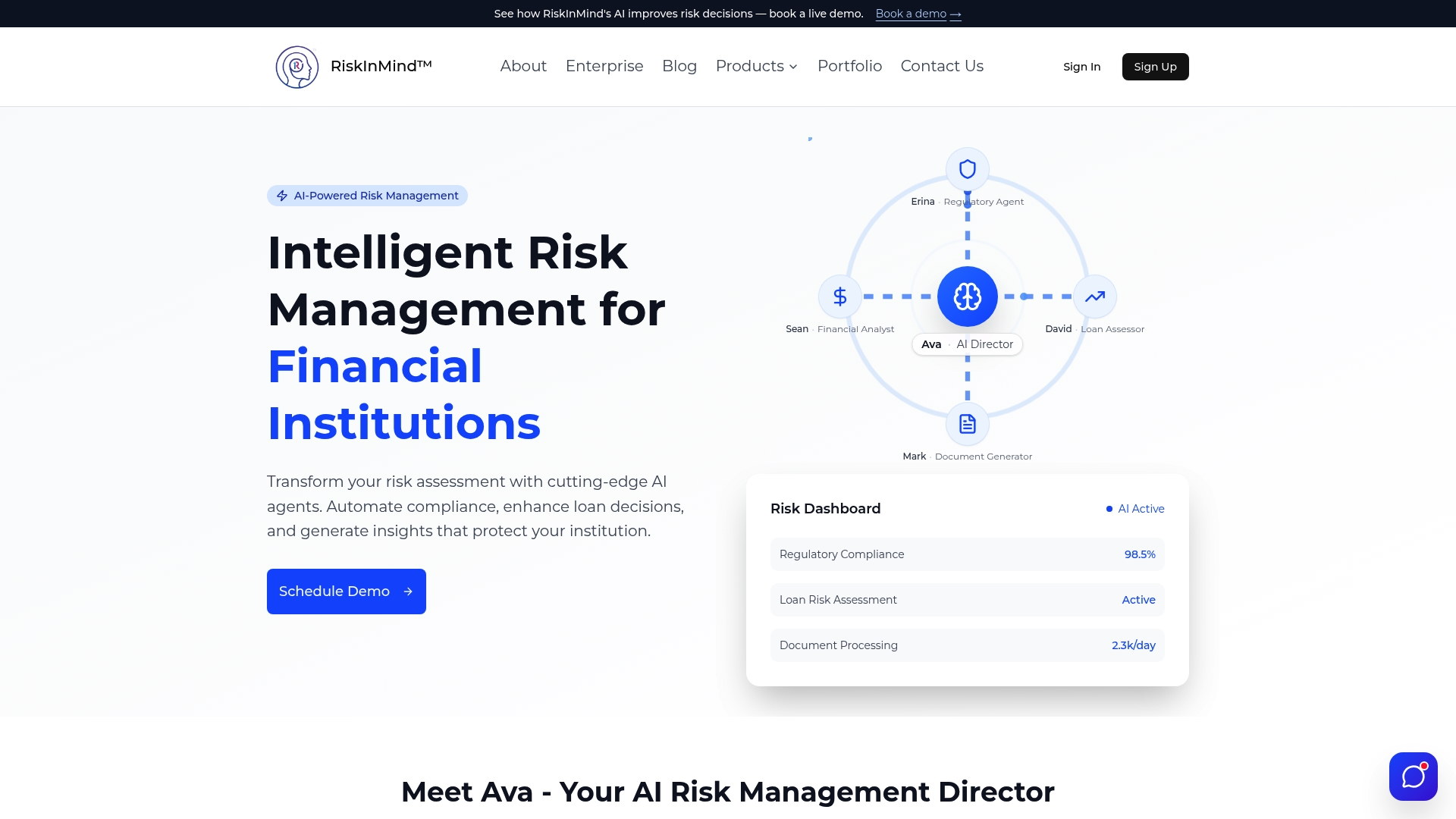
The platform's AI agents, coordinated by a central director, handle tasks like credit risk assessment and regulatory reporting while automatically producing the approval records and test results supervisors expect to see. For lending-specific governance needs, the loan application solution ties underwriting decisions directly to audit-ready documentation, and the portfolio monitoring tools generate the alerting and board-reporting data your Phase 3 and Phase 4 rollout will need. None of this replaces your legal review or your controls testing program. It gives your team a running head start on the evidence trail. If your inventory is still living in a spreadsheet, a demo is the fastest way to see what automated evidence collection actually looks like in practice.
Key Takeaways
An effective AI governance policy for banks combines named executive accountability, a complete risk-tiered inventory, documented model artifacts, and continuous monitoring mapped to NIST AI RMF and ISO 42001.
| Point | Details |
|---|---|
| Appoint an owner first | Name a CAIO or equivalent with board reporting authority before drafting detailed controls. |
| Build the inventory early | Log every AI system, including embedded vendor tools, and assign a risk tier to each one. |
| Map to NIST and ISO 42001 | Use NIST AI RMF's four functions and ISO 42001's management structure as your policy backbone. |
| Document with four fields | Give every control a named owner, evidence artifact, threshold, and review trigger. |
| Automate evidence collection | Platforms like Riskinmind can generate inventory, drift alerts, and audit logs, though legal review still applies. |
Sources
- Banking on trust (Deloitte, 2026)
- NIST AI Risk Management Framework (Playbook)
- OCC bulletin (2025)
- FDIC interagency model risk guidance (2026)