
LLM compliance monitoring is the continuous, runtime observability of a large language model's inputs, outputs, and lineage rather than a one-time approval stamp. For financial institutions, the first priority is a full inventory of every LLM use case paired with baseline observability, anchored to frameworks like the NIST AI RMF Generative AI profile. Everything else, from drift detection to audit evidence, builds on that foundation.
TL;DR:
- Continuous monitoring captures real-time alerts on model drift, hallucinations, and silent degradation to prevent unnoticed behavior shifts in deployed models.
- Logging, audit trails, and version controls are essential to demonstrate accountability and traceability for regulators during investigations or audits.
- Limiting false positives through threshold tuning and balancing sensitivity reduces alert fatigue and maintains investigator trust in the monitoring system.
- Surveillance functions like trade, conduct, and AML monitoring benefit significantly from LLMs by analyzing unstructured communication data and reducing investigation times.
- Building an effective program involves risk-classifying use cases, establishing measurable KPIs, integrating into CI/CD pipelines, and following recognized standards like NIST AI RMF.
Automate Regulatory Model Risk Governance
Examine models against 32 qualitative criteria and resolve risk Tiers with pre-deployment checklists per OCC 2011-12 guidelines.
Table of Contents
- What Is LLM Compliance Monitoring, and Why Does It Matter in Finance?
- Core Components of an LLM Compliance Monitoring Program
- Key Security and Compliance Risks in LLM Deployment
- Where LLM Monitoring Pays Off Fastest in Financial Services
- How to Build an LLM Monitoring Program: A Phased Roadmap
- What Standards and Guidance Should Anchor Your Program?
- How Riskinmind Operationalizes LLM Monitoring for Financial Institutions
- Compliance Isn't a Checkbox Anymore
- See How Riskinmind Handles Monitoring in Practice
- Sources
- FAQ
What Is LLM Compliance Monitoring, and Why Does It Matter in Finance?
Traditional model validation asks one question: did the model work correctly when we tested it? LLM compliance monitoring asks a harder, ongoing question: is the model still behaving correctly right now, on this prompt, with this data, under today's conditions? That distinction is the whole ballgame for regulated lenders and credit unions.
A validated credit scoring model rarely changes its statistical behavior overnight. A large language model can. Vendor updates, retrieval index changes, fine-tuning passes, and even shifts in customer phrasing can move a model's outputs in ways a quarterly review would never catch. This is why generative AI compliance requires runtime observability rather than periodic snapshots, a point NIST's Generative AI profile makes explicit by recommending that firms embed testing, evaluation, validation, and verification (TEVV) directly into production systems rather than treating them as pre-launch checkpoints.
Two runtime risks drive most of the urgency:
- Drift: the model's behavior shifts after deployment due to updates, new data patterns, or edge cases it wasn't tuned for.
- Hallucination: the model generates plausible but false statements, a serious problem when outputs touch loan disclosures, regulatory filings, or customer communications.
- Silent degradation: performance decays gradually rather than failing loudly, so nobody notices until an examiner or a customer complaint does.
Regulators have been clear that they are not writing brand-new rulebooks for AI. A Federal Reserve official's speech on AI governance reinforced a technology-neutral stance: existing governance, model risk management, and consumer protection obligations apply to AI systems the same way they apply to any other model. That means LLM regulatory compliance isn't a separate discipline bolted onto your existing framework. It's your existing framework, tested against a system that changes behavior on its own. Our earlier look at AI's role in regulatory compliance covers how that lifecycle view reshapes governance reviews.
Core Components of an LLM Compliance Monitoring Program
A working monitoring for LLMs program is built from seven interlocking controls. Skip one, and you create a blind spot an examiner or a plaintiff's attorney will eventually find.
Telemetry and observability come first. Every production interaction needs a trace: the prompt, the response, the model version, token counts, latency, and any retrieval sources pulled into context. Without this, you cannot reconstruct what happened when a customer disputes an automated decision six months later.
Audit logging and versioning turn telemetry into evidence. Logs must be immutable, timestamped, and tied to a specific model version and prompt template, with data lineage showing where training or retrieval data originated. Regulators and internal auditors consistently value this kind of documented traceability more than marketing claims about model quality, according to NIST's Generative AI profile.
Drift detection and continuous testing compare live outputs against established baselines. This is where "judge model" techniques come in: smaller evaluation models score production outputs against compliance rubrics in near real time, flagging deviations before they compound.
Access controls and secrets management protect the API keys, fine-tuning pipelines, and vector databases that feed your LLMs. A credential leak in a retrieval-augmented system is a data breach with a chatbot attached.
Data minimization and retention policies govern what personal or account data ever reaches a prompt in the first place, including PII detection and redaction at ingestion. Legal analysts note that generative AI compliance extends well past security into purpose limitation and consent tracking, since LLMs often process far more unstructured data than the systems they replace, per Deloitte's review of generative AI's legal implications.
Alerting and investigation workflow convert anomalies into case files: prioritized queues, evidence packaging, and a documented chain of custody for anything that might reach an examiner.
CI/CD integration gates new model versions or prompt changes behind automated tests and red-team results before they ever touch production traffic.
Pro Tip: Treat inter-judge disagreement as a signal, not noise. When two evaluation models score the same output differently, that gap often marks genuine regulatory ambiguity, a pattern recent governance research recommends routing straight to human arbitration rather than averaging away.
Key Security and Compliance Risks in LLM Deployment
Monitoring exists to catch specific failure modes, and mapping signals to risks keeps a program from drowning in alerts that don't matter.
- Oversharing and sensitive-data retrieval: retrieval-augmented systems can pull account numbers, SSNs, or internal risk notes into a prompt context that then gets logged, cached, or sent to a third-party API.
- Hallucination in regulatory or customer-facing text: an LLM confidently inventing a loan term, a compliance disclosure, or a regulatory citation creates real legal exposure, not just an embarrassing error.
- Behavioral drift from model updates: a vendor's silent model refresh or a routine fine-tuning pass can change tone, accuracy, or bias profile without any internal change request being filed.
- Third-party and supply-chain risk: embedded models and APIs from external vendors inherit whatever compliance gaps those vendors have, and few institutions have full visibility into a vendor's own training data or update cadence.
- Alert fatigue: overly sensitive monitoring floods investigators with false positives, and teams start ignoring alerts altogether, which defeats the entire purpose of continuous monitoring.
That last risk deserves more attention than it usually gets. A monitoring system that generates ten flags for every genuine issue trains its own investigators to stop looking closely. Tuning thresholds against real baseline behavior, not generic defaults, is what separates a program examiners trust from one that just generates noise.
Where LLM Monitoring Pays Off Fastest in Financial Services
Three surveillance domains show the clearest return on LLM compliance monitoring investment, largely because they already generate the high-volume, unstructured data that language models handle better than legacy rule engines.
- Trade surveillance. LLM-enhanced systems cross-reference trading activity with communications, chat logs, and voice transcripts to spot patterns keyword-based rules miss entirely. Vendor exhibits filed with the SEC describe agentic AI deployments in investigation workflows that cut investigation time by roughly 50% while preserving traceable evidence chains.
- Conduct surveillance. Instead of reviewing communications and transactions in separate silos, LLM-integrated tools unify both streams and package supporting evidence automatically. Public disclosures on Actimize's SURVEIL-X platform describe generative AI integration reducing false positives by as much as 85% in some communications surveillance scenarios, with true-risk detection improving several-fold over rule-based baselines.
- AML and suspicious activity detection. LLMs parse account documents, wire narratives, and customer correspondence to surface patterns that structured transaction monitoring alone tends to miss, particularly around layered or narrative-based laundering schemes.
Beyond these three, monitoring infrastructure directly supports regulatory reporting and examiner requests. When a request for information comes in, having immutable logs and case-packaged evidence already assembled turns a weeks-long scramble into a same-day response. The operational signal to track isn't just detection volume. It's how much investigator time shrinks per case and how much of that gain holds up once your team stops double-checking every flag manually.
How to Build an LLM Monitoring Program: A Phased Roadmap
Most institutions try to monitor everything at once and end up monitoring nothing well. A phased build works better.
- Inventory and risk-classify every LLM use case. List each place an LLM touches customer data, credit decisions, or regulatory output, then rank by potential harm and exposure. A chatbot answering hours-of-operation questions does not need the same scrutiny as a model drafting adverse-action notices.
- Define monitoring objectives and measurable KPIs. Set compliance scorecards, drift thresholds, and false-positive tolerance levels before you instrument anything. Without a target, you can't tell if monitoring is working.
- Instrument telemetry and establish baselines. Capture prompts, responses, and metadata for every high-risk use case, then run parallel evaluation against your existing rules-based systems for a defined pilot window before cutting over fully.
- Set human-in-the-loop thresholds and escalation paths. Decide in advance what disagreement level between judge models triggers automatic human review, and who owns that review. This is where governance-from-metrics research offers a genuinely useful framework: compliance gates tied to per-use-case metrics rather than blanket sign-offs.
- Embed monitoring into CI/CD and vendor due diligence. New model versions, prompt changes, and third-party API updates should pass automated compliance tests and red-team checks before touching production, and vendor contracts should require disclosure of model update schedules.
- Train investigators and rehearse incident response. Run tabletop exercises using real (anonymized) flagged cases so your team knows the escalation path before a genuine incident forces them to learn it live. Our guide to scaling compliance training programs walks through building that muscle memory.
Pro Tip: Start your pilot with the lowest-risk, highest-volume use case you have, like an internal document summarizer, not your highest-risk one. You need clean baseline data before you can trust drift alerts on anything that actually matters to a regulator.
Governance from metrics beats governance from memory. Teams that operationalize compliance as a continuous signal can automate go/no-go routing and quarantine underperforming models automatically, rather than waiting for the next scheduled audit to catch a problem that's been live for months, per that same governance research.
What Standards and Guidance Should Anchor Your Program?
Every control in an LLM compliance monitoring program should map back to a recognized standard, both because it's good practice and because examiners ask for exactly that mapping.
- NIST AI RMF and its Generative AI profile provide the clearest technical blueprint: inventory AI systems, run continuous TEVV, conduct supplier risk assessments, and treat governance as an ongoing metric rather than a one-time gate, per the NIST profile itself.
- SEC and Federal Reserve messaging confirms that existing supervisory expectations, not new AI-specific rulebooks, govern how firms deploy these systems, as reinforced in Federal Reserve commentary on AI governance.
- GSA continuous-monitoring directives describe oversight boards, centralized AI inventories, and periodic reviews for high-impact systems, a model worth borrowing even for institutions outside federal procurement, per GSA's AI compliance plan.
- SOC 2 and ISO 27001 remain the enterprise certifications examiners and business partners recognize as baseline trust signals for the infrastructure hosting these models.
When presenting monitoring artifacts to an examiner or an internal audit committee, lead with the traceable log, not the marketing summary. Our governance policy breakdown covers what documentation examiners actually expect to see in that review.
How Riskinmind Operationalizes LLM Monitoring for Financial Institutions
Riskinmind was built around the idea that compliance monitoring for LLMs has to run inside the same workflow as underwriting and portfolio management, not as a separate bolt-on. The platform's suite of specialized AI agents, coordinated by a central AI director named Ava, each handle a distinct risk domain while feeding telemetry and audit trails into one system of record. That structure mirrors the oversight-board model regulators favor: centralized visibility with specialized execution underneath it.
The platform is designed with SOC 2 aligned controls, security-focused architecture, and real-time processing to support timely monitoring signal delivery before anomalies escalate. For credit unions and community banks, the deployment pattern typically follows the pilot-first approach outlined earlier: start with a lower-risk use case, integrate telemetry and human-in-the-loop review, then scale to higher-stakes workflows like credit memo generation and CECL modeling. Our breakdown of how an AI director role functions in risk management covers how that orchestration layer keeps agents accountable to a single audit trail.

Compliance Isn't a Checkbox Anymore
The biggest mistake I see institutions make is treating LLM compliance monitoring as an extension of their old audit cycle: something you check quarterly, sign off on, and file away. That mindset made sense for static models. It fails for systems that can shift behavior between two customer interactions.
The fix isn't more paperwork. It's reframing compliance as a continuous signal your oversight board reviews on a set cadence, with supplier risk assessments built into every vendor contract and clear numeric thresholds for when a human has to step in. Instrumentation comes before investigation workflow, always. You cannot investigate what you never logged in the first place.
— Raj
See How Riskinmind Handles Monitoring in Practice
Most institutions patching together LLM compliance monitoring end up stitching several point tools together: one for logging, one for drift detection, one for case management, and none of them talking to each other. Riskinmind was built to close that gap by running telemetry, audit trails, and agent orchestration through Ava inside a single platform, rather than asking your team to reconcile outputs across five vendors.
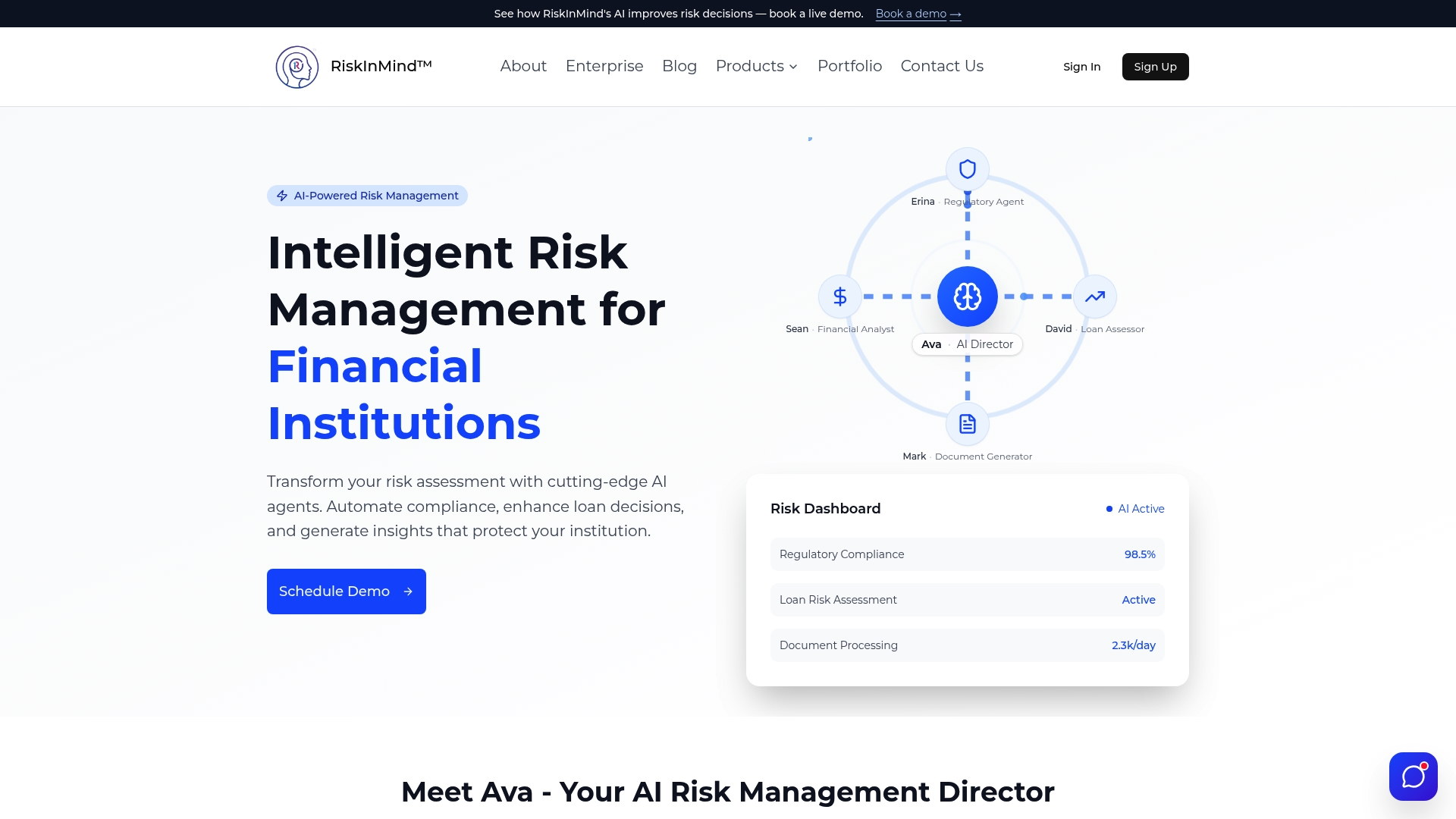
The platform includes specialized agents for regulatory monitoring, credit risk assessment, and portfolio surveillance with an integrated audit-ready reporting layer and strong security controls. This approach can be especially beneficial for institutions managing compliance with limited resources. If your institution is evaluating how to bring continuous LLM oversight into an existing risk program, the Starter, Professional, and Enterprise plans outline how Riskinmind scales from a single pilot use case to full portfolio coverage. Request a demo to see how Ava and the agent suite handle a real monitoring workflow before you commit.
This article is general information, not a substitute for advice from a qualified financial advisor. Consult a qualified financial professional about your own circumstances before acting on anything here.
Sources
- Artificial Intelligence Risk Management Framework: Generative Artificial Intelligence Profile (NIST)
- Federal Reserve speech on AI governance
- NICE Actimize — Exhibit describing Agentic AI and InvestigateAI capabilities
- NICE Actimize press disclosure on SURVEIL-X and Actimize Intelligence
- govllm: governance-from-metrics framework (arXiv)
FAQ
Can an LLM Be Used for Regulatory Compliance?
Yes, LLMs are already used across trade surveillance, conduct surveillance, and AML detection, where they analyze communications and transactions that rules-based systems handle poorly. Vendor disclosures describe deployments cutting investigation time by roughly 50% while keeping evidence traceable for examiners.
What Is LLM Monitoring?
LLM monitoring is the continuous, runtime observation of a language model's inputs, outputs, drift, and behavior after deployment, distinct from one-time pre-launch validation. It includes telemetry, audit logging, drift detection, and alerting built into production systems, an approach NIST's Generative AI profile recommends explicitly.
How Can AI Be Used in Compliance Monitoring?
AI, including LLMs, can flag anomalous communications, cross-reference trading data with chat logs, and automate evidence packaging for investigators. Some deployments report false-positive reductions as high as 85% in communications surveillance when generative AI is layered onto existing rule-based tools.
What Is an Example of Compliance Monitoring?
A concrete example is trade surveillance software that watches both trading activity and voice or chat communications for patterns suggesting market abuse, then packages the flagged evidence for an investigator. Riskinmind applies a similar continuous-monitoring pattern to lending and portfolio risk, routing agent-generated signals through a central oversight layer for review.
What Does LLM Compliance Monitoring Cost?
Pricing depends on institution size and which product lines are deployed. Riskinmind's current Starter, Professional, and Enterprise plans are listed on its pricing page rather than published as flat rates here.