
An AI-driven compliance monitoring and reporting program combines monitoring automation, intelligence automation, and workflow automation into a single, continuous system that converts regulatory signals into documented, examiner-ready evidence. For credit unions, community banks, and lenders, the recommended approach is to prioritize demonstrable effectiveness, audit-ready evidence trails, and bank-grade security over feature counts alone. A 90-day phased pilot is the fastest path to validated, examiner-ready deployment.
Immediate benefits you can expect from a well-configured program:
- Faster regulatory horizon scanning with prioritized alerts mapped to your policy inventory
- Audit-ready evidence trails generated automatically rather than assembled under exam pressure
- Consistent validation records that satisfy Federal Reserve, FDIC, and OCC examiner expectations
- Reduced manual overhead on HMDA reporting, loan-calculation checks, and disclosure reviews
Automate Regulatory Model Risk Governance
Examine models against 32 qualitative criteria and resolve risk Tiers with pre-deployment checklists per OCC 2011-12 guidelines.
Pro Tip: Before your first vendor demo, document your current monitoring universe — the specific regulations, loan types, and reporting obligations your team tracks manually. That list becomes your configuration baseline and your ROI benchmark.
Key Takeaways
AI-driven compliance monitoring programs deliver examiner-ready evidence continuously — institutions that deploy a validated three-layer architecture within a 90-day phased plan are better positioned for supervisory scrutiny than those relying on manual monitoring cycles.
| Point | Details |
|---|---|
| Regulatory standard | Federal Reserve and FDIC/OCC expect demonstrable effectiveness, not just activity counts. |
| Three-layer architecture | Monitoring, intelligence, and workflow automation convert regulatory signals into audit-ready evidence. |
| Operational risk | 64% of lenders reported compliance issues leading to rework or legal exposure, per HousingWire. |
| 90-day roadmap | A phased 30/30/30 deployment produces validated, examiner-ready controls before full go-live. |
| Riskinmind fit | SOC 2® certified, bank-grade security, and specialized AI agents configured to your regulatory universe in 90 days. |
Table of Contents
- Why AI-driven compliance programs are urgent for community banks today
- What are the core functions of AI-driven compliance monitoring?
- What do regulators actually expect from AI-enabled controls?
- How does a realistic 90-day implementation roadmap look?
- How do you measure whether compliance controls actually work?
- What technical and governance criteria should you use to choose a vendor?
- How does Riskinmind map to these criteria?
- What operational changes does a sustained compliance program require?
- The gap between compliance activity and compliance evidence
- Riskinmind offers a 90-day path to audit-ready compliance
- Primary sources and further reading
- Sources
Why AI-driven compliance programs are urgent for community banks today
The regulatory environment for U.S. financial institutions has tightened considerably, and the pressure is not abstract. Federal Reserve Governor Michelle W. Bowman has stated publicly that supervisors expect institutions to understand their AI use cases, assess materiality, and apply existing risk-management frameworks — adapting guidance where necessary rather than waiting for prescriptive rules. That framing places the burden of proof on the institution, not the regulator.
Operationally, the volume of regulatory change is outpacing manual compliance capacity. A HousingWire survey of mortgage lenders found that a significant portion of lenders reported compliance-related issues leading to rework or legal exposure, and many institutions struggle to keep systems aligned with federal and state rule changes. Those numbers reflect a structural problem: manual monitoring simply cannot scale with the pace of regulatory churn.
Institutions that build governance infrastructure now gain speed to market on future regulatory changes. Those that delay face compounding technical debt and exam-cycle scrambles. Within the next 30 days, your team can scope your monitoring universe and map your three to five highest-risk use cases — that scoping exercise alone clarifies the business case for automation.
What are the core functions of AI-driven compliance monitoring?
The three-layer architecture that underpins effective automated compliance programs breaks down as follows:
- Monitoring automation — continuous ingestion of regulatory feeds, agency publications, and internal data streams, with alerts triggered against predefined parameters
- Intelligence automation — large language model summarization, severity scoring, and prioritization of updates mapped to your policy inventory
- Workflow automation — automatic task assignment, evidence capture, deadline tracking, and audit-trail generation
High-value use cases for lean compliance teams include:
- Regulatory horizon scanning for CFPB, OCC, FDIC, and state-level rule changes
- HMDA data integrity checks and CRA reporting support
- Loan-calculation and disclosure accuracy verification
- Policy-to-regulation gap analysis with severity ratings
- Communications monitoring for fair lending and BSA/AML signals
- Automated document generation and examiner-ready evidence packaging
A practical example: a new CFPB interpretive rule enters the monitoring layer, gets summarized and severity-rated by the intelligence layer, and lands in the workflow layer as an assigned remediation task with a deadline, an owner, and a linked policy document — all within minutes of publication. That flow is what AI-driven compliance monitoring converts from a multi-day manual process into a continuous, documented cycle.
What do regulators actually expect from AI-enabled controls?
Supervisory expectations have shifted from activity counts to outcome evidence. The Financial Times analysis of AI governance in financial services confirms that as AI adoption scales, regulators expect outcomes-based evidence: testing results, evaluation records, and systematic recordkeeping aligned with NIST AI Risk Management Framework principles.
For examiners, the evidence package typically needs to include:
- Validation records showing the model performs as intended under representative conditions
- Model governance documentation covering version history, change logs, and approval workflows
- Audit-ready decision trails linking each regulatory update to a remediation action and its outcome
- Third-party and vendor risk management documentation for any AI tools in the compliance stack
The NIST AI RMF provides a principles-based structure for organizing this evidence — mapping to its Govern, Map, Measure, and Manage functions gives your documentation a recognized framework that examiners can follow.
Pro Tip: Package your validation evidence as versioned artifacts — dated test results, model performance summaries, and gap-closure records — stored in a single location your examiner can access without a data request. Institutions that present pre-organized evidence packages consistently report shorter exam cycles.
How does a realistic 90-day implementation roadmap look?
A phased 90-day deployment, as detailed in automated regulatory intelligence platform implementation guidance, keeps scope manageable and produces validated evidence before go-live.
-
Days 1–30 (Configuration): Define your monitoring universe, configure regulatory feed parameters, map your policy inventory to source regulations, and establish baseline alert thresholds. Governance checkpoint: sign-off from compliance owner and model owner on scope and data connections.
-
Days 31–60 (Workflow and training): Design remediation workflows, integrate with your case management and document systems, and deliver role-based training for compliance, operations, and frontline staff. Governance checkpoint: workflow sign-off and a first-pass validation run against historical regulatory changes.
-
Days 61–90 (Parallel operations and validation): Run the automated system alongside existing manual processes, compare outputs, document discrepancies, and package examiner-ready evidence. Governance checkpoint: go/no-go decision based on validation results and evidence completeness.
Common mistakes that derail deployments:
- Over-filtering alerts until the system misses material regulatory changes
- Deploying as a standalone tool disconnected from case management and document systems
- Underestimating the staff time required for initial configuration and policy mapping
How do you measure whether compliance controls actually work?
Outcome-focused KPIs tell a more credible story to examiners than activity counts. The Independent Banker's guidance on call report automation reinforces that investing in data architecture and automated edit checks reduces filing errors and exam-time scrambling — the same logic applies to your KPI design.
| KPI | Definition | Target Threshold |
|---|---|---|
| Time-to-detection | Hours from regulatory publication to internal alert | Under one day |
| Policy coverage rate | Percentage of active regulations mapped to a policy | High percentage |
| High-severity gap closure | Percent of critical gaps remediated within SLA | 90% within 30 days |
| Evidence completeness | Percent of remediation actions with full audit trail | Complete at exam time |
Validation methods that satisfy examiner expectations include backtesting against prior regulatory cycles, holdout testing on a sample of updates, human-in-the-loop review logs, and periodic revalidation on a defined cadence (quarterly at minimum). Drift monitoring — tracking whether model outputs remain consistent as regulatory language evolves — is increasingly expected for AI-enabled controls.
A short validation checklist for compliance officers:
- Confirm model version and approval date are documented
- Verify test results cover at least one full regulatory cycle
- Check that all alert dispositions carry a documented rationale
- Confirm third-party vendor validation records are current
What technical and governance criteria should you use to choose a vendor?
Procurement decisions for AI-driven compliance platforms deserve the same rigor you apply to any model in your risk stack. Key technical criteria include data lineage documentation, explainability logs, integration APIs compatible with your core systems, sub-second processing latency, and scalable recordkeeping. On the governance side, look for model validation capabilities, versioning controls, delegated role assignments, and full audit logging.
Security expectations are non-negotiable: SOC 2® certification, bank-grade encryption at rest and in transit, data residency controls that keep your data within U.S. boundaries, and a documented third-party risk management program. An AI-driven compliance checklist can help your team score vendors systematically.
Procurement red flags: vendors who cannot produce independent validation evidence, who resist audit-access clauses in their SLAs, or whose roadmap is opaque about how regulatory updates are sourced and maintained.
Pro Tip: Negotiate an audit-access clause into your vendor SLA before signing. You need the contractual right to review the vendor's model documentation and test results — not just their marketing materials — when an examiner asks.
How does Riskinmind map to these criteria?
Riskinmind's platform is built specifically for credit unions, community banks, and lenders, and its architecture maps directly to the three-layer compliance model described above. The Konfer whitepaper on GRC automation underscores that integrated agent architectures can shorten policy-update cycles and automate evidence capture — Riskinmind's suite of specialized AI agents, coordinated by a central AI director named Ava, operationalizes exactly that design.
| Checklist Criterion | Riskinmind Capability |
|---|---|
| Monitoring automation | Continuous regulatory feed ingestion with real-time alerts |
| Intelligence automation | LLM-powered summarization, severity scoring, policy mapping |
| Workflow automation | Automated task assignment, deadline tracking, evidence capture |
| Audit-ready reporting | Versioned artifacts, decision trails, examiner-ready packages |
| Security | SOC 2® certified, bank-grade encryption, U.S. data residency |
| Implementation timeline | 90-day phased deployment with validation milestones |
Institutions that deploy Riskinmind typically report reduced policy-update cycle times and faster evidence assembly at exam time — outcomes that reflect the platform's design priority: continuous audit-readiness rather than periodic scrambles. Demos are available, and the platform's SOC 2® certification and bank-grade security posture satisfy the vendor risk expectations outlined above.
What operational changes does a sustained compliance program require?
Embedding an AI-driven compliance program into daily operations requires clear role definitions and a training plan that keeps pace with regulatory change. The role of compliance officers shifts from manual monitoring to quality control and escalation management.
Core role assignments:
- Compliance owner: accountable for program scope, policy mapping, and examiner communication
- Model owner: responsible for validation cadence, version control, and change documentation
- Data steward: manages data connections, feed quality, and integration health
- Validation lead: runs periodic revalidation, holdout tests, and drift monitoring
Operationalizing the program follows a logical sequence:
- Deliver role-based training at go-live, covering alert review, workflow disposition, and evidence packaging
- Schedule quarterly revalidation reviews tied to the regulatory calendar
- Build a change management process that routes new regulatory developments through the monitoring layer automatically
- Package evidence continuously so exam preparation is a byproduct of daily operations, not a separate project
The gap between compliance activity and compliance evidence
Most compliance teams at community institutions are not under-resourced because they lack effort — they are under-resourced because their effort produces activity logs rather than examiner-ready evidence. That distinction is where AI-driven programs create their most durable value. Counting alerts cleared or policies reviewed tells an examiner what your team did. Versioned validation records, severity-rated gap closures, and documented decision rationales tell an examiner that your controls work.

The institutions that will navigate the next supervisory cycle most effectively are those that treat governance infrastructure as a continuous operational function, not a pre-exam project. Procurement decisions made now, with the right vendor criteria and a validated 90-day roadmap, determine whether your institution is presenting evidence or assembling it when the examiner arrives.
Riskinmind offers a 90-day path to audit-ready compliance
Credit unions and community banks that need examiner-ready compliance evidence without building a larger team have a direct path forward with Riskinmind. The platform delivers the three-layer architecture — monitoring, intelligence, and workflow automation — backed by SOC 2® certification and bank-grade security, configured to your regulatory universe in 90 days.
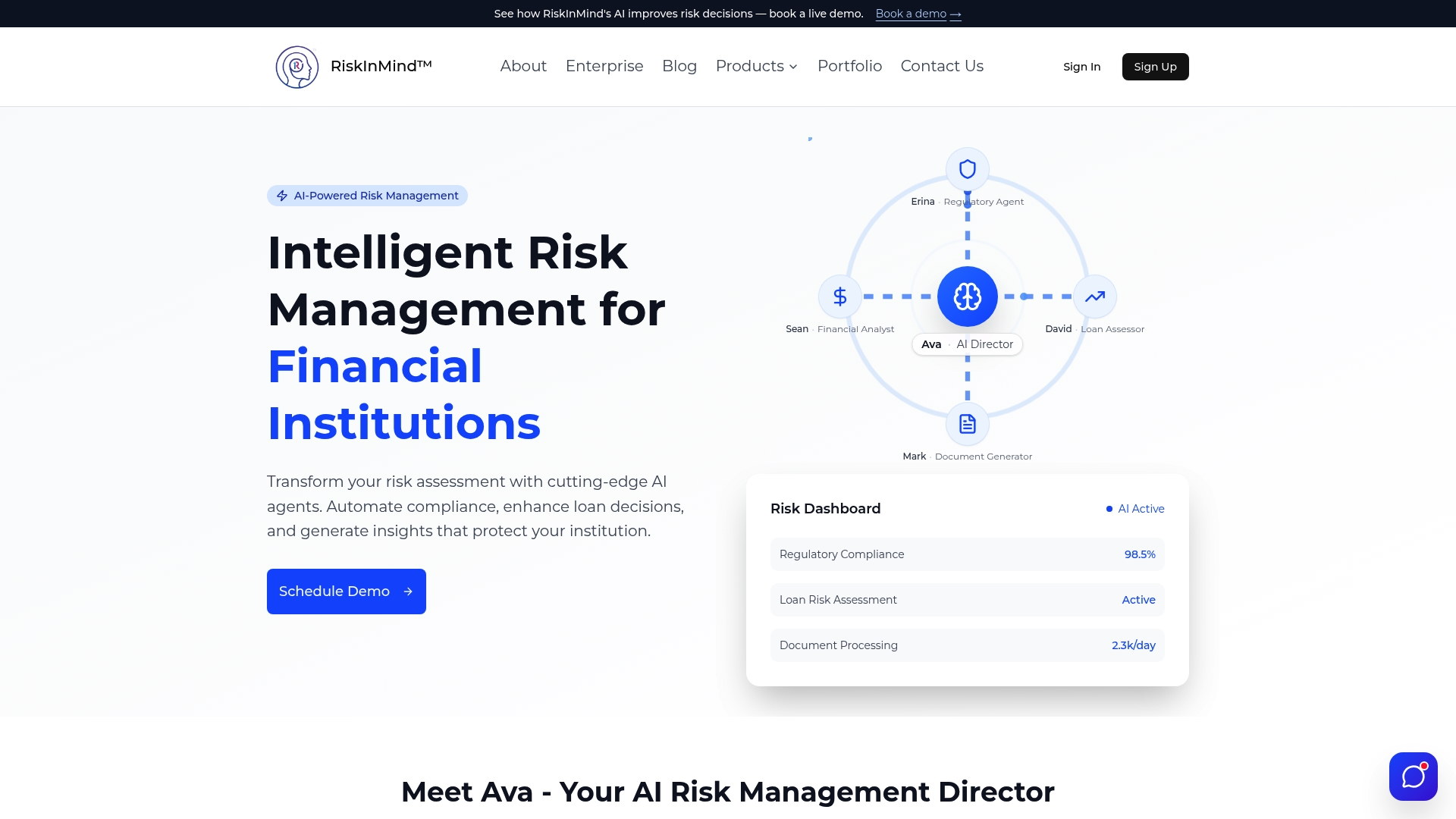
Riskinmind's AI agents, coordinated by Ava, handle regulatory horizon scanning, policy gap analysis, loan-calculation checks, and audit-trail generation continuously — so your compliance team reviews and decides rather than searches and assembles. The comparison with manual underwriting and legacy systems makes the operational contrast concrete. Book a demo to see the 90-day configuration and validation plan applied to your institution's specific monitoring universe.
Primary sources and further reading
The following primary regulatory references and industry analyses informed this guide. Compliance teams should reference original sources when preparing examiner evidence packages and board briefings.
- Federal Reserve — Governor Bowman speech on AI supervisory expectations (May 2026)
- Financial Times — AI governance in financial services
- HousingWire — Mortgage lender compliance and loan calculation accuracy survey
- AI Fintech Insider — Automated regulatory intelligence platform implementation
- Independent Banker — 5 Ways Community Banks Can Streamline Call Reports
- Konfer — 10X productivity in GRC compliance whitepaper
- SIA Partners — 2026 AI Regulation in U.S. Financial Services
- NIST AI Risk Management Framework
This article is general information, not a substitute for advice from a qualified financial advisor. Consult a qualified financial professional about your own circumstances before acting on anything here.
Sources
- Federal Reserve — Speech by Governor Michelle W. Bowman (May 1, 2026)
- AI Fintech Insider — Automated regulatory intelligence platform implementation
- HousingWire — Mortgage lenders struggle with compliance and loan calculation accuracy
- Independent Banker — 5 Ways Community Banks Can Streamline Call Reports