
Compliance testing programs serve one primary function: proving that your controls work in practice, not just on paper, and generating the evidence trail regulators and prosecutors need to evaluate your institution's good faith. For U.S. banks, credit unions, and lenders, that evidence trail is the difference between a corrective action and an enforcement action.
TL;DR for senior risk and compliance professionals:
- Assurance and deterrence: Systematic testing validates that controls operate as designed, deters misconduct by making gaps visible, and produces contemporaneous evidence that satisfies SEC/FINRA examination standards and the DOJ's evaluation framework.
- Management value: Risk-aligned testing tells leadership where to allocate resources, which controls carry residual risk, and whether remediation is actually sticking.
- Regulator defensibility: Board-directed, independently assessed programs generate the audit-ready evidence trail examiners expect, supporting credible reporting up the governance chain.
Automate Regulatory Model Risk Governance
Examine models against 32 qualitative criteria and resolve risk Tiers with pre-deployment checklists per OCC 2011-12 guidelines.
Table of Contents
- What does a compliance testing program actually do?
- Core components every effective program needs
- Why independence and a validation mindset change everything
- How does AI change compliance testing, and what are the limits?
- Practical steps to modernize your testing program
- KPIs, dashboards, and continuous improvement
- What red flags do examiners actually look for?
- How should you evaluate vendors and internal automation solutions?
- Key Takeaways
- Why testing is a management tool, not a compliance exercise
- Riskinmind supports your compliance testing program
- Useful sources and further reading
What does a compliance testing program actually do?
Compliance testing verifies that systems, processes, and controls meet legal, contractual, and internal obligations, and that evidence exists to prove it. That scope is broader than an audit and different from quality assurance: it maps obligations to controls, assigns owners, specifies test methods, and requires documented evidence for every finding.
The program serves compliance officers, CROs, internal audit partners, business-line managers, and the board. Each group reads the results differently. A CRO wants residual risk exposure. A board member wants assurance that the program is working and that the institution can defend itself under regulatory scrutiny.
"One hallmark of an effective compliance program is its capacity to improve and evolve. Prosecutors should consider whether the company has engaged in meaningful efforts to review its compliance program and ensure that it is not stale." — DOJ Criminal Division, Evaluation of Corporate Compliance Programs (Updated September 2024)
The Federal Reserve's SR 08-8 sets the baseline for U.S. depository institutions: testing scope and frequency must follow a comprehensive risk assessment, and internal audit cannot substitute for compliance-specific testing. SEC and FINRA examiners apply comparable logic, asking whether testing is risk-aligned, repeatable, and capable of driving durable remediation.
Core components every effective program needs
Regulators evaluate whether testing validates risks and produces durable remediation, not merely whether a testing program exists. That distinction shapes every design decision.
Essential checklist:
- Risk-aligned scoping tied to the current risk assessment, not last year's control inventory
- Documented test methodology with reproducible steps and defined sampling rationale
- Evidence requirements specifying what artifacts constitute proof (transaction samples, system screenshots, interview notes)
- Finding ownership assigned at the control level, not the department level
- Remediation timelines with escalation triggers and retesting milestones
- Linkage to the risk register so open findings affect residual risk ratings
Workflow-aligned testing goes beyond policy checks. It follows a transaction or decision through the actual process, capturing contemporaneous records at each step. Every sample must be labeled with the control under review, the test date, the tester, and the result. That labeling is what makes evidence reproducible and examiner-ready.
| Report Element | What to Include |
|---|---|
| Test objective | Specific control or obligation being tested |
| Scope and population | Date range, business unit, transaction type |
| Sample size and method | Random, judgmental, or stratified; selection rationale |
| Evidence artifacts | File references, screenshots, system exports |
| Findings and ratings | Severity, root cause, control owner |
| Remediation tracking | Owner, due date, retest date |

Why independence and a validation mindset change everything
Independent, board-directed testing improves objectivity and regulator credibility in ways that self-assessed programs cannot replicate. The Harvard Law School Forum on Corporate Governance frames this as a "validation mindset": treating compliance as an empirical discipline that tests whether controls work under real conditions, not a rule-following exercise that demonstrates expenditure.
Independence has a structural meaning here. The testing function must be separated from the business owners of the controls being tested. It should be coordinated with internal audit but not absorbed by it. The Federal Reserve is explicit that internal audit cannot replace compliance-specific testing for high-risk areas. Third-party assessments add a further layer: independent evaluations provide a fresh perspective and a prioritized roadmap that carries more weight with examiners than internal self-assessments alone.
Pro Tip: When presenting third-party findings to the board, frame each finding as a prioritized remediation item with an assigned owner, a due date, and a retest milestone. Boards that see findings translated into tracked action items are better positioned to demonstrate governance credibility to examiners than those that receive narrative summaries without accountability structures.
Understanding the role of compliance officers in structuring these governance layers is foundational before designing independence models.
How does AI change compliance testing, and what are the limits?
AI and automation accelerate evidence collection, continuous monitoring, and anomaly detection, but they require model governance and explainability to be regulator-acceptable. KPMG notes that compliance leaders are consolidating fragmented testing into unified frameworks that push routine checks to front-line automation, freeing senior compliance staff for validation and strategy.
| Dimension | Benefits | Risks and Controls Needed |
|---|---|---|
| Sampling speed | Automated extraction covers full populations, not samples | Data quality errors propagate at scale; validate source feeds |
| Continuous monitoring | Real-time anomaly detection reduces detection lag | Alert fatigue; tune thresholds and require human review of escalations |
| Evidence collection | Automated artifacts are timestamped and indexed | Audit trail must be immutable; confirm storage controls |
| Cost | Lower per-test cost at scale | Model drift degrades accuracy silently; schedule periodic revalidation |
| Explainability | Consistent logic across large datasets | Black-box outputs are not regulator-acceptable; require documented model logic |
For software and data controls specifically, embedding compliance checks into delivery pipelines and preserving an auditable artifact for every test is the standard that examiners increasingly expect.
Pro Tip: Before deploying any AI-driven testing tool, require the vendor to produce a model validation report, a data residency statement, and documentation of human-in-the-loop escalation rules. A SOC 2® attestation is a floor, not a ceiling.
Practical steps to modernize your testing program
A realistic 6–9 month modernization roadmap follows this sequence:
- Months 1–2 (Risk mapping): Inventory all in-scope controls, map them to regulatory obligations, and assign owners. Identify the highest-risk areas for the pilot.
- Months 3–4 (Pilot): Run structured tests on two or three high-risk control families using documented methodology. Capture evidence artifacts and route findings into a remediation tracker.
- Months 5–6 (Automate and integrate): Introduce automated compliance checks for evidence collection in the piloted areas. Validate automated outputs against manual results before expanding.
- Months 7–9 (Scale and govern): Extend coverage, establish a testing calendar aligned to the risk assessment cycle, and formalize board reporting cadence.
KPIs to track from day one:
- Percent of in-scope controls with assigned owners
- Percent of controls tested on schedule
- Mean time to remediate (MTTR) open findings
- Repeat findings per quarter (the single most telling metric)
Resourcing: the pilot phase typically requires one dedicated testing lead and access to a subject-matter expert for each control family. Model validation and vendor onboarding for AI tools usually warrant external expertise, particularly for institutions without an existing model risk management function.
KPIs, dashboards, and continuous improvement
The right metrics show whether testing reduces repeat findings and shortens remediation cycles, not just how many tests were completed. Volume of tests run is an activity metric; it tells you nothing about program effectiveness.
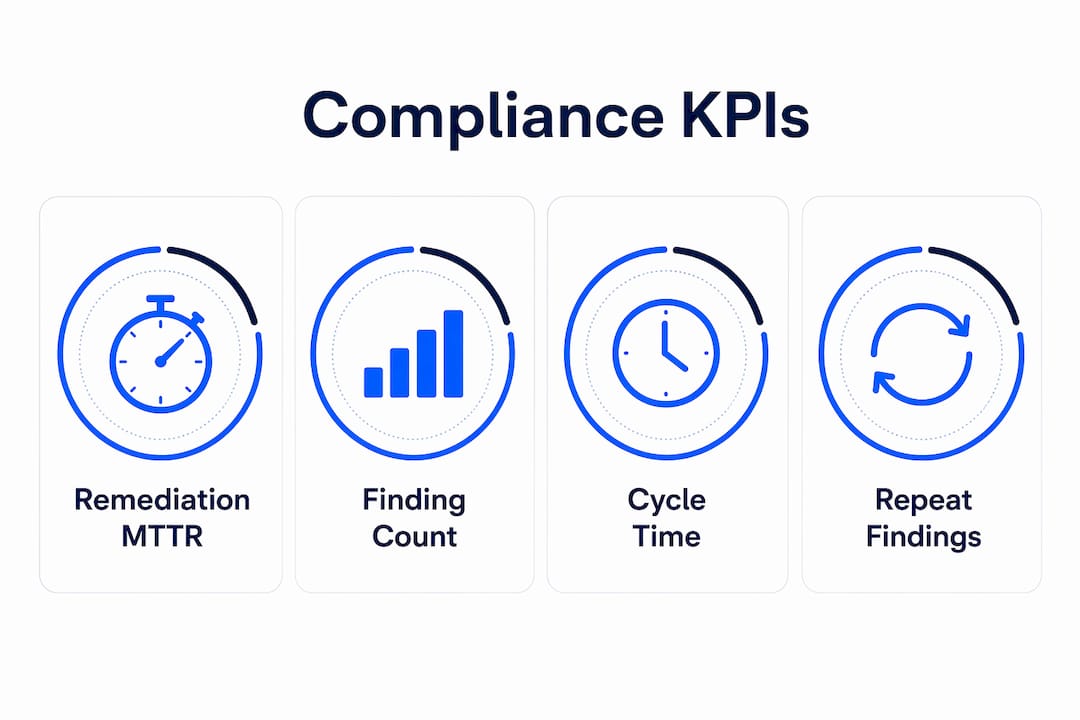
| KPI | What It Measures | Interpretation |
|---|---|---|
| Remediation MTTR | Average days from finding to closure | Declining trend signals improving accountability |
| High-risk control coverage | % of high-risk controls tested in period | Below 80% warrants immediate scope review |
| Evidence automation rate | % of evidence collected without manual intervention | Rising rate reduces cost and human error |
| Repeat findings per quarter | Findings recurring after remediation | Any recurrence signals root-cause failure |
A practical dashboard surfaces these four KPIs alongside a heat map of open findings by control family and a remediation aging report. Benchmarking against prior quarters reveals trend direction; benchmarking against peer institutions, using tools like Riskinmind's peer benchmarking analysis, contextualizes your program's maturity relative to comparable institutions.
Compliance reporting automation centralizes the data feeds that make these dashboards accurate and timely.
What red flags do examiners actually look for?
Examiners focus on whether testing validates risks and produces durable remediation. The most common failures they cite are:
- Check-the-box testing: Tests that mirror policy language word-for-word rather than testing actual transactions or system behavior. Mitigation: redesign tests around process walkthroughs and transaction samples.
- Static annual schedules: Testing calendars that do not respond to new products, regulatory changes, or elevated risk signals. Mitigation: tie the testing calendar to the risk assessment cycle and trigger ad hoc tests for material changes.
- Overreliance on attestations: Programs where management sign-off substitutes for independent evidence. Mitigation: require independent sample testing alongside any attestation.
- No retesting after remediation: Closing findings without verifying the fix is the single most damaging gap for regulatory defensibility. Examiners will ask what permanent changes were made to prevent recurrence, and "we closed the finding" is not an answer.
- Weak evidence storage: Scattered artifacts that cannot be retrieved quickly under examination pressure. Mitigation: centralize evidence in an indexed repository linked to each control.
Compliance monitoring best practices address the sampling and evidence-storage disciplines that prevent most of these failures.
How should you evaluate vendors and internal automation solutions?
Pick vendors that can prove SOC 2®/bank-grade security, demonstrate model validation and explainability, and supply audit-ready evidence trails. Security posture is a threshold criterion; model governance is what separates acceptable tools from regulator-defensible ones.
Vendor evaluation checklist:
- SOC 2® Type II attestation (not just Type I) and bank-grade data encryption at rest and in transit
- Data residency documentation confirming U.S.-based storage for regulated data
- Model validation reports produced by qualified, independent reviewers
- Documented drift detection schedule and remediation process for model degradation
- Human-in-the-loop escalation rules for automated findings that exceed defined thresholds
- Integration with your existing case-management and evidence-storage systems
- Scalability documentation covering transaction volume and concurrent user load
Pro Tip: Ask vendors specifically how their system handles a false-positive finding at scale. A vendor that cannot explain the escalation workflow and the human review step has not built the governance layer regulators will expect to see.
Riskinmind's AI compliance checklist provides a structured framework for working through these criteria before any vendor commitment.
Key Takeaways
Effective compliance testing programs validate controls empirically, generate regulator-ready evidence, and drive remediation that sticks, making them the operational core of any defensible compliance posture.
| Point | Details |
|---|---|
| Treat testing as validation | Design tests around real transactions and system behavior, not policy language mirrors. |
| Independence is structural | Separate testers from control owners; third-party assessments add examiner credibility internal reviews cannot match. |
| AI requires governance | Automation accelerates evidence collection but demands model validation, drift detection, and human-in-the-loop escalation to be regulator-acceptable. |
| Measure remediation, not volume | Repeat findings per quarter and MTTR reveal program effectiveness; test counts alone do not. |
| Riskinmind for AI-driven testing | Riskinmind's AI agents, SOC 2® security, and real-time dashboards support evidence-ready compliance testing for banks, credit unions, and lenders. |
Why testing is a management tool, not a compliance exercise
The compliance programs that hold up under examination share one trait: leadership treats testing results as management information, not a regulatory obligation to discharge. When findings feed directly into the risk register, when remediation timelines carry executive accountability, and when the board sees repeat-finding trends alongside capital and credit metrics, testing stops being a back-office function and starts shaping institutional decisions.
At Riskinmind, that philosophy is embedded in how the platform is built. Evidence-focused testing linked to remediation tracking is not a feature added for compliance optics; it reflects a conviction that a financial institution's ability to prove its controls work is as strategically significant as the controls themselves. SOC 2® certification and AI agent architecture are the technical expression of that conviction.
Riskinmind supports your compliance testing program
Compliance officers and CROs at community banks, credit unions, and lenders face a specific challenge: building a testing program that satisfies Federal Reserve SR 08-8, DOJ evaluation criteria, and SEC/FINRA standards without the staffing footprint of a large institution. Riskinmind addresses that gap directly.
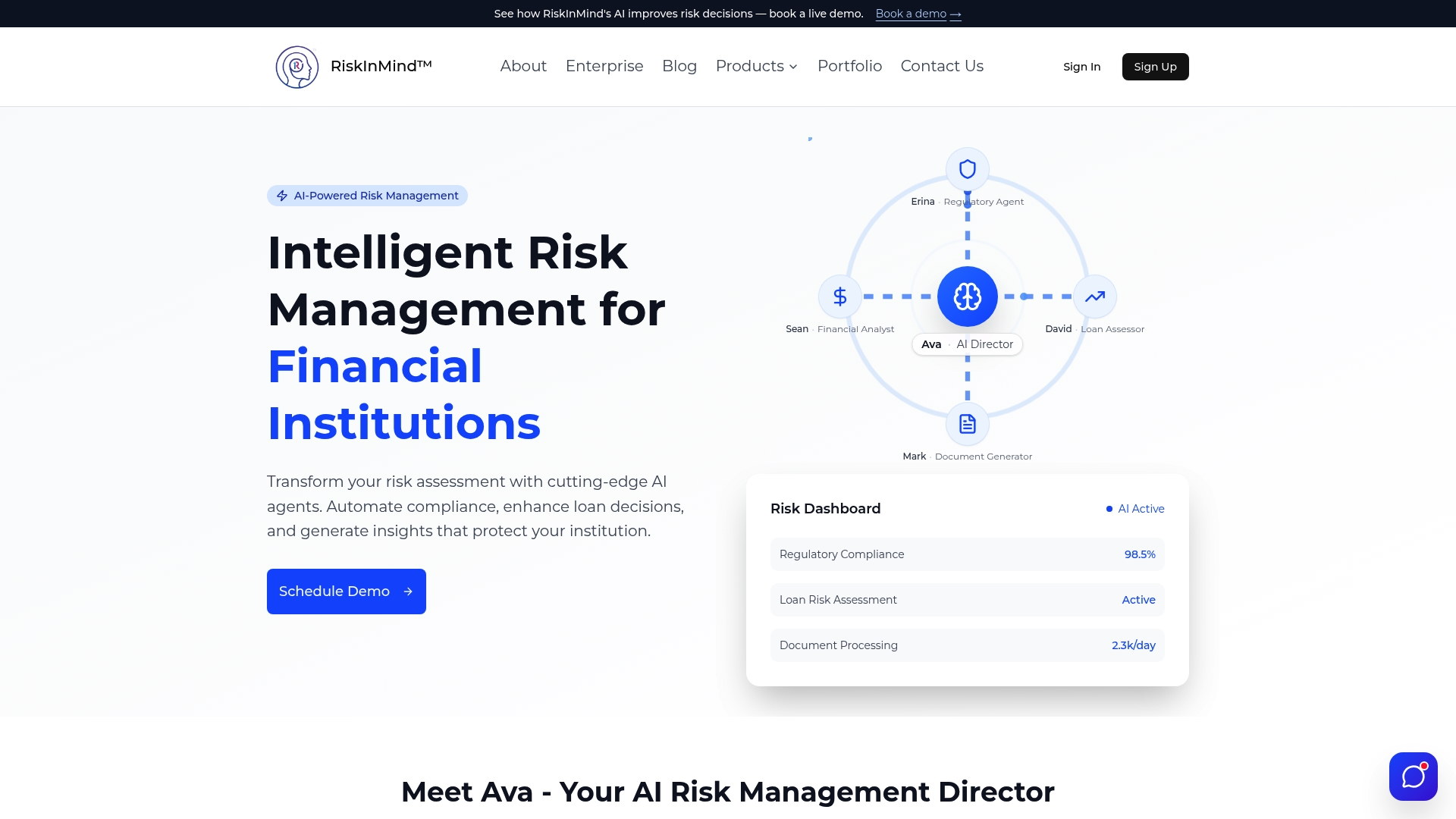
The platform's specialized AI agents handle real-time evidence extraction, continuous control monitoring, and remediation tracking, while Ava, the central AI director, coordinates across risk domains. Dashboards surface KPIs including MTTR and repeat-finding trends in a format designed for board reporting. SOC 2® certification and bank-grade security meet the vendor threshold criteria described above, and the platform's model validation capabilities support the governance layer regulators expect when AI is in the testing workflow.
Request a demo or start a pilot through the Riskinmind platform to see how evidence-ready compliance testing works in practice for institutions your size.
Useful sources and further reading
- Federal Reserve SR 08-8: Compliance Risk Management Programs and Oversight — the foundational supervisory letter on testing scope, frequency, and the role of internal audit
- DOJ Criminal Division: Evaluation of Corporate Compliance Programs (Updated September 2024) — the framework prosecutors use to assess program design, testing, and remediation
- OIG/HCCA Resource Guide: Measuring Compliance Program Effectiveness — a broad metrics library applicable across regulated industries
- Harvard Law School Forum on Corporate Governance: Testing Compliance — the academic case for a validation mindset
- KPMG: Unlocking Optimized Compliance Monitoring Programs — practitioner guidance on consolidation and automation
- Compliance Risk Concepts: What Makes a Great Compliance Testing Program — examiner-focused design criteria and common deficiency patterns
- Riskinmind Blog: The Role of AI in Regulatory Compliance for Banks — technical and governance considerations for AI in banking compliance
- Riskinmind Blog: Why Invest in Automated Compliance for Financial Institutions — business-case analysis for automation and analytics investment