
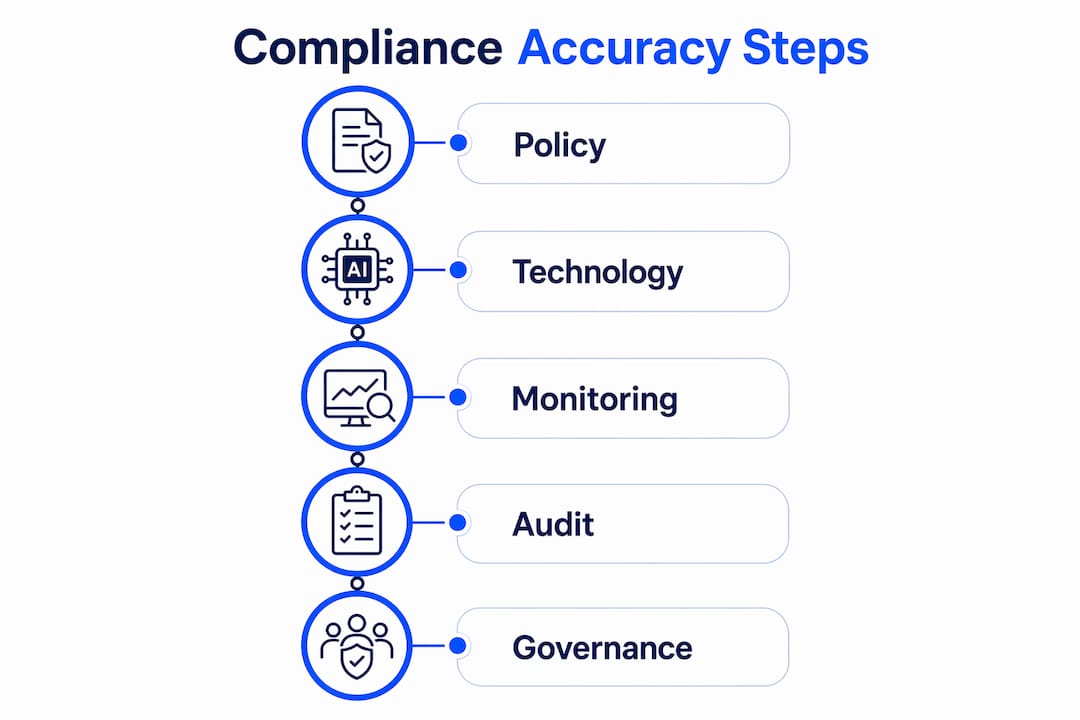
Compliance accuracy is defined as the precision and reliability with which a financial institution adheres to regulatory requirements across all applicable frameworks. For compliance officers and risk managers at credit unions, community banks, and lenders, getting this right is not optional. Regulators expect effective compliance programs to evolve as institutions change products, technologies, or markets. Knowing how to enhance compliance accuracy requires three things working together: sound policy infrastructure, continuous monitoring, and AI tools governed by mandatory human review.
How to enhance compliance accuracy through strong policy foundations
The most common reason compliance programs fail is not a lack of intent. It is a lack of structure. Building a compliance program requires developing 15–25 distinct policies, each reviewed and approved annually. That number is not arbitrary. It reflects the minimum coverage needed to address the range of regulatory obligations facing a modern financial institution under frameworks like SOC 2, the Bank Secrecy Act, and the Community Reinvestment Act.
Maintain 100% NCUA & OCC Audit Readiness
Monitor regulatory updates 24/7, check internal credit policies, and generate compliance trails with Erina (AI Regulatory Agent).
Risk assessment must come before policy creation, not after. You cannot write an accurate policy for a risk you have not yet measured. Once risks are mapped, each control should link to every applicable framework it satisfies. This control-mapping approach prevents duplication and makes cross-framework compliance far more manageable.
Governance cadence is what keeps a program alive. Daily log reviews, monthly metric reports, quarterly governance committee meetings, and annual policy approvals form the backbone of a sustainable program. Governance committees review risk registers, incidents, and audit findings quarterly and approve material changes. Every control needs a named owner and a documented evidence artifact. Without both, accountability disappears.
- Conduct a formal risk assessment before drafting any policy.
- Map each control to every regulatory framework it addresses.
- Assign a named owner to every control with documented evidence requirements.
- Schedule quarterly governance reviews with a standing agenda covering risk registers and audit findings.
- Review and formally approve all 15–25 policies on an annual cycle.
Pro Tip: Start your policy library with the framework your institution is most likely to be examined on first. Mastering one framework before adding others prevents the shallow coverage that regulators flag during examinations.
How can technology and AI tools improve compliance accuracy?
AI changes the economics of compliance work. AI removes 37 hours weekly spent on document review in compliance operations. That time savings is real, but it only holds value when the AI outputs are accurate and auditable. The key is pairing automation with structured human oversight.

AI compliance agents work best on high-volume, repeatable tasks: document classification, regulatory change monitoring, risk scoring, and evidence tagging. Each agent should produce structured outputs with clear confidence indicators. However, self-reported model confidence scores are not calibrated and cannot be trusted for operational decisions without validation against labeled institutional data. Threshold tuning based on your own data is the only reliable method.
The operational benchmark that matters most is the human approval rate. A stable approval rate above 90% signals that an AI agent's recommendations are genuinely useful and accurate. When that rate drops, it is a leading indicator of model drift, data quality issues, or scope creep. Track it weekly, not quarterly.
Ethical review is not optional. AI can identify regulatory loopholes but cannot replace ethical judgment. A mandatory human review layer prevents automated decisions that are technically compliant but operationally or reputationally unacceptable. Riskinmind's AI compliance agents, guided by the platform's central AI director Ava, are designed with this human-in-the-loop architecture built in. You can review how this works in practice through Riskinmind's AI compliance solutions.
Key prerequisites before deploying any AI compliance tool:
- Cleanse and standardize all regulatory data before model training. Fragmented, inconsistent data produces inaccurate and sometimes fabricated compliance outputs.
- Define the scope of AI authority clearly. AI recommends; humans decide.
- Establish an ethical review framework covering bias testing, explainability requirements, and escalation paths.
- Set confidence thresholds using labeled data from your own institution, not vendor defaults.
- Monitor the human approval rate weekly as the primary accuracy signal.
Pro Tip: Run a data audit before you deploy any AI compliance tool. If your source data contains inconsistencies across loan files, policy documents, or regulatory mappings, the AI will amplify those errors, not correct them.
| Task Type | AI Suitable | Human Review Required |
|---|---|---|
| Document classification | Yes | Spot-check sampling |
| Risk scoring | Yes | All high-risk cases |
| Regulatory change alerts | Yes | Policy impact assessment |
| Final compliance determination | No | Always |
| Ethical breach assessment | No | Always |
What are the best practices for continuous monitoring and audit readiness?
Continuous compliance readiness is fundamentally different from periodic audit preparation. Annual audits feel like finals; continuous readiness is steady training with weekly control health checks. The distinction matters because gaps found during an examination cost far more to remediate than gaps caught internally during routine monitoring.
Control health monitoring means tracking whether each control is operating as designed, not just whether it exists on paper. Automated evidence capture tools pull logs, approvals, and transaction records on a scheduled basis. This removes the manual scramble that typically precedes an audit and ensures evidence is current, not reconstructed after the fact.
Documenting decisions is as important as documenting outcomes. A complete audit trail enables decision reconstruction without re-invoking models and satisfies regulatory retention requirements. Every audit trail entry should include the input data reference, the model or process version used, the human reviewer's decision, and the final action taken.
The metrics that indicate a healthy compliance program include:
- Human approval rate for AI recommendations (target: above 90%)
- Number of open audit findings and average days to remediation
- Control testing completion rate against the annual schedule
- Policy review completion rate before annual deadlines
- Evidence collection lag time (days between control activity and documented artifact)
Internal audits scheduled on a quarterly or semiannual basis catch drift before regulators do. The role of automation in financial compliance is precisely this: shifting compliance teams from reactive documentation to proactive monitoring. That shift is where accuracy gains are most measurable.
How should organizations troubleshoot common compliance accuracy pitfalls?
The most damaging compliance mistake is treating the program as a completed project. Programs decay within 18 months without active governance and continuous improvement logging. A policy binder that was accurate in january is often outdated by july if no one owns the review cycle.
"Compliance accuracy erodes not from a single failure but from the accumulation of small gaps: an unreviewed policy, an untested control, an AI output no one questioned. The institutions that maintain accuracy are the ones that treat compliance as a daily operational discipline, not an annual documentation exercise."
Over-scoping is the second most common pitfall. Attempting to satisfy SOC 2, HIPAA, GDPR, and the Bank Secrecy Act simultaneously in the first year of a program almost always produces shallow coverage across all frameworks. Master a primary framework first, then extend to secondary frameworks using control mapping to capture overlapping requirements.
Skipping data governance before AI deployment creates a specific and serious risk. AI trained on fragmented data produces outputs that appear confident but are factually wrong. In a compliance context, a fabricated regulatory citation or an incorrect risk score can trigger examination findings. Data cleansing is not a technical prerequisite. It is a compliance prerequisite.
Ignoring ethical review of AI outputs creates regulatory exposure that is harder to defend than a simple control gap. Regulators increasingly expect institutions to demonstrate that automated compliance decisions were reviewed by a qualified human. Enforce structured review workflows and retain the reviewer's decision as part of the audit trail.
Key Takeaways
Compliance accuracy requires continuous governance, calibrated AI tools, and documented human oversight working together as an integrated program, not as separate initiatives.
| Point | Details |
|---|---|
| Build 15–25 distinct policies | Review and formally approve every policy annually to prevent coverage gaps. |
| Track the human approval rate | A rate above 90% confirms AI recommendations are accurate and operationally reliable. |
| Cleanse data before AI deployment | Fragmented source data produces inaccurate AI outputs that create regulatory exposure. |
| Document decisions, not just outcomes | Complete audit trails must include input data, model version, reviewer decision, and final action. |
| Treat compliance as a daily discipline | Programs without active governance decay within 18 months and fail examination readiness. |
What I have learned about compliance accuracy that most guides skip
The framing I see most often in compliance literature focuses on tools and checklists. That framing misses the harder problem. Compliance accuracy is a cultural output, not a technical one. The institutions I have observed that consistently score well in examinations share one trait: leadership treats compliance findings as operational intelligence, not as embarrassments to manage.
Pragmatic AI adoption matters more than ambitious AI adoption. The compliance teams that get the most value from AI are the ones that started with one high-volume, well-defined task, measured accuracy rigorously, and expanded only after the human approval rate confirmed the model was performing. They did not try to automate judgment. They automated volume.
Transparency in AI tools is not a nice-to-have. When a compliance officer cannot explain why an AI flagged a loan file or generated a specific risk score, that officer cannot defend the decision to a regulator. Explainability is a compliance requirement, not a product feature. Any AI tool that cannot show its reasoning in plain language is a liability in an examination setting.
The institutions that measurably improve accuracy embed compliance tasks into daily workflows. A weekly control health check takes 20 minutes. An annual audit scramble takes weeks. The math is not complicated. What is complicated is changing the organizational habit. That change starts with leadership, not with software.
— Raj
Riskinmind's tools for financial institution compliance accuracy
Compliance officers at credit unions and community banks face the same challenge: maintaining accuracy across multiple regulatory frameworks with limited staff and increasing examination scrutiny.
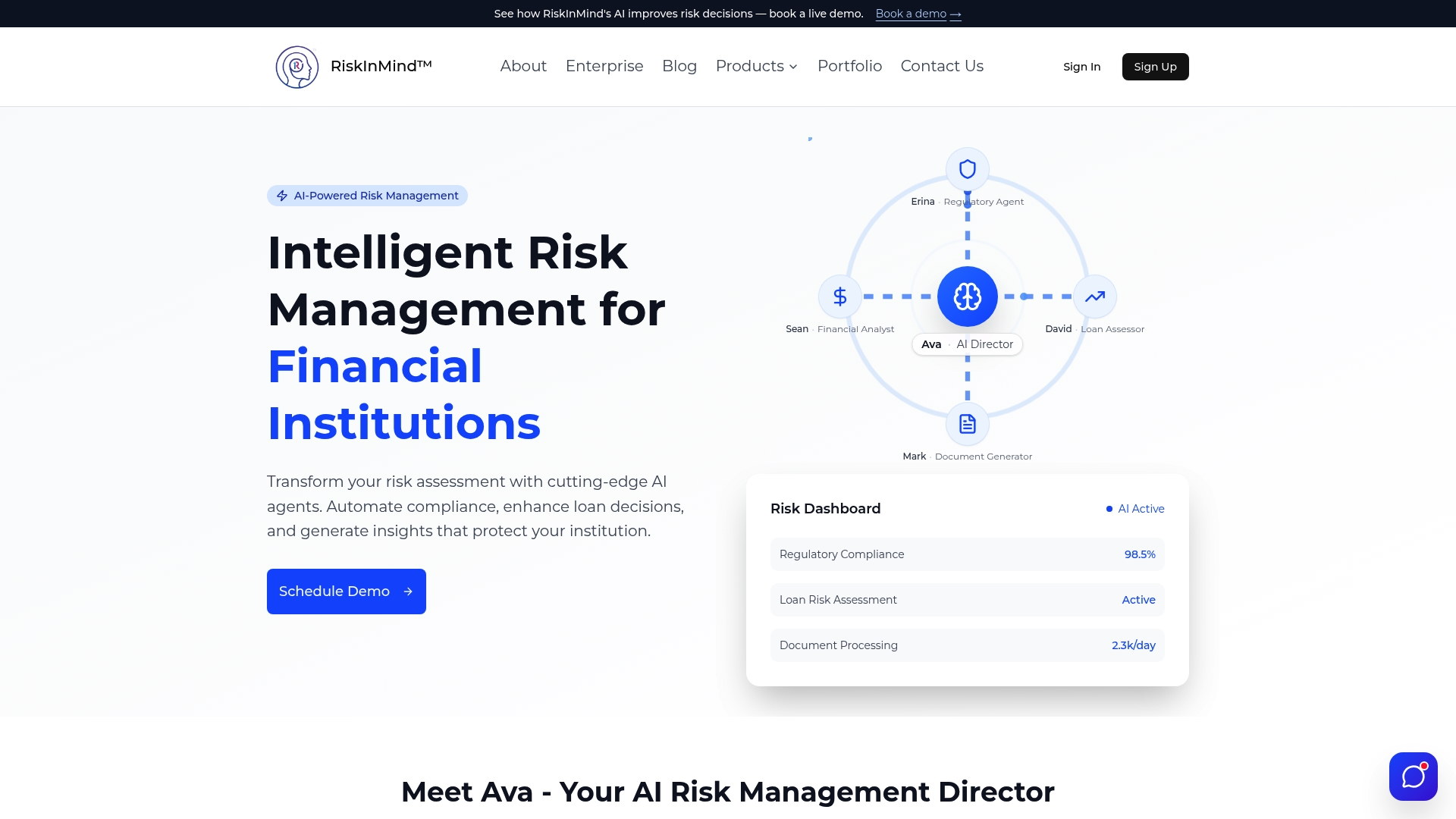
Riskinmind's AI-powered platform addresses this directly. Its specialized compliance AI agents automate evidence collection, generate risk scores with full audit trails, and flag control gaps in real time. The platform holds SOC 2® certification and processes requests in under half a second, which means your compliance data is current when you need it. For institutions managing loan portfolios, the loan application compliance tools connect risk scoring directly to regulatory reporting, reducing manual reconciliation and improving audit readiness. Riskinmind is built for the compliance workflows that financial institution professionals run every day.
FAQ
What is compliance accuracy in financial institutions?
Compliance accuracy is the degree to which a financial institution's controls, policies, and documented decisions precisely meet applicable regulatory requirements. It is measured through audit findings, control testing results, and human approval rates for AI-assisted recommendations.
How many policies does a compliance program need?
A compliance program requires 15–25 distinct policies, each reviewed and formally approved on an annual basis. The exact number depends on the institution's size, product mix, and applicable regulatory frameworks.
What is a good human approval rate for AI compliance tools?
A human approval rate above 90% indicates that an AI agent's recommendations are accurate and useful for compliance decisions. Rates below this threshold signal model drift, data quality issues, or misaligned scope that requires immediate investigation.
Why do compliance programs decay without active governance?
Compliance programs treated as completed projects lose accuracy within 18 months because regulatory requirements change, institutional products evolve, and undocumented control gaps accumulate. Active governance, including quarterly reviews and continuous evidence collection, prevents this decay.
What should a compliance audit trail include?
A complete compliance audit trail must include the input data reference, the model or process version used, the human reviewer's identity and decision, and the final action taken. This structure allows regulators to reconstruct any compliance decision without re-running the underlying process.