
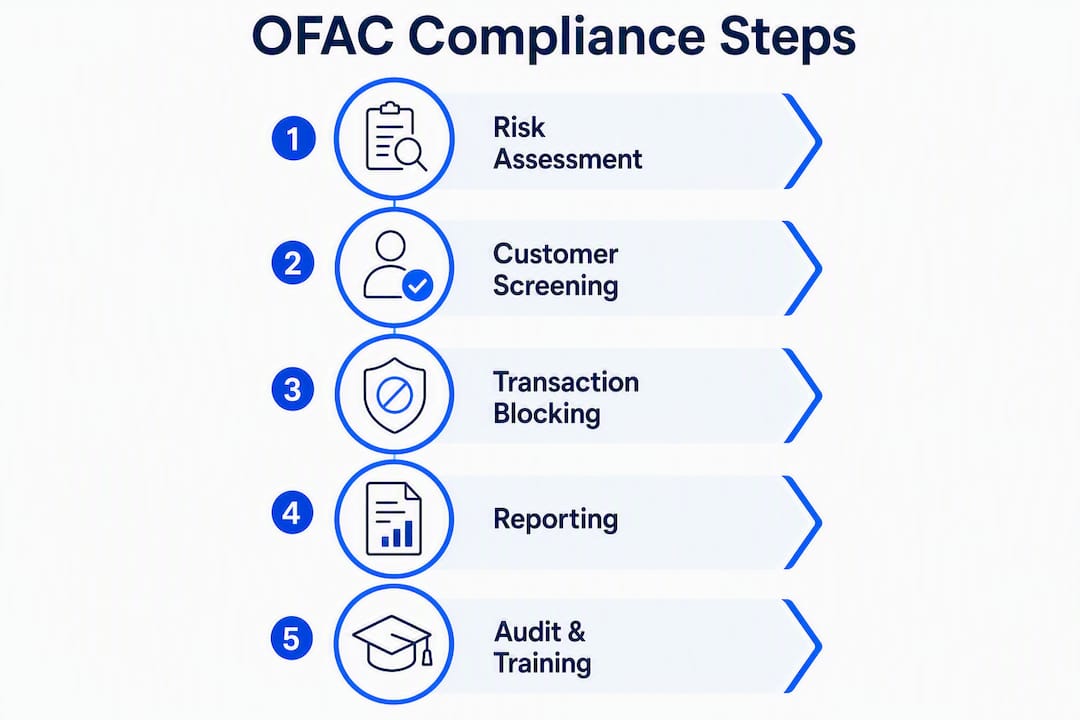
OFAC compliance in banking means maintaining a written, risk-based program that prevents your institution from processing transactions involving sanctioned persons, entities, or property, and that documents the controls, testing, and reporting demonstrating that prevention. Every U.S. bank, credit union, and lending institution must screen customers and transactions against current Office of Foreign Assets Control lists, block or reject prohibited activity, report violations on required timelines, and retain records for at least five years.
The seven core components your program must address:
- Management commitment — board-level endorsement and resource allocation
- Risk assessment — documented analysis of products, channels, customers, and geographies
- Internal controls — written policies and procedures mapped to your risk profile
- Independent testing — periodic audit by internal audit, external auditors, or qualified consultants
- Training — role-specific, documented, and recurring
- Designated OFAC officer — a named senior individual accountable for program oversight
- Recordkeeping — screening logs, blocked funds records, and investigation documentation retained per OFAC requirements
Maintain 100% NCUA & OCC Audit Readiness
Monitor regulatory updates 24/7, check internal credit policies, and generate compliance trails with Erina (AI Regulatory Agent).
Your immediate next steps: conduct a scoped OFAC risk assessment that maps your highest-risk products and transaction flows, confirm that screening covers beneficiaries and non-accountholder parties, and validate that your recordkeeping and reporting processes are audit-ready.
Table of Contents
- What is OFAC and why does it govern your bank?
- How sanctions lists work and what "blocked" really means
- When licenses or exceptions apply and how to handle requests
- When and how often should you screen customers and transactions?
- How to build a written, risk-based OFAC compliance program
- What is the operational workflow when you get a hit?
- Reporting obligations, examiner expectations, and enforcement risks
- How to evaluate screening vendors and tools
- Common program deficiencies and how to fix them
- How automation and AI can support your OFAC program
- Key Takeaways
- The compliance priorities that actually move the needle
- Riskinmind gives compliance teams audit-ready OFAC documentation from day one
- Authoritative sources for OFAC compliance
What is OFAC and why does it govern your bank?
The Office of Foreign Assets Control is an office within the U.S. Department of the Treasury. Its mandate is to administer and enforce economic and trade sanctions that advance U.S. foreign policy and national security objectives. OFAC targets foreign countries, regimes, terrorists, narcotics traffickers, weapons proliferators, and other designated threats.

OFAC's legal authority rests primarily on two statutes: the Trading With the Enemy Act (TWEA), which applies to wartime economic controls, and the International Emergency Economic Powers Act (IEEPA), which authorizes the President to declare a national emergency and impose sanctions in response to threats to national security, foreign policy, or the economy. Congress has also enacted program-specific statutes, such as the Antiterrorism and Effective Death Penalty Act, that expand OFAC's reach into particular threat categories.

A "U.S. person" for OFAC purposes includes any U.S. citizen or permanent resident alien, any entity organized under U.S. law, and any person physically located in the United States. That definition captures domestic banks, their domestic branches, and their foreign branches. Some sanctions programs extend obligations to foreign subsidiaries of U.S. entities, which means banks with cross-border operations must map jurisdictional reach carefully to avoid blind spots in overseas offices.
OFAC is not itself a bank regulator, but federal banking agencies, including the OCC, the Federal Reserve, the FDIC, and the NCUA, evaluate bank OFAC programs during routine BSA/AML examinations. The FFIEC BSA/AML Examination Manual sets the supervisory framework examiners use to assess whether a bank's OFAC program is appropriate for its risk profile. Enforcement findings can result in civil monetary penalties, reputational damage, and mandatory remediation, which makes examiner expectations a practical compliance floor, not a ceiling.
How sanctions lists work and what "blocked" really means
OFAC maintains multiple sanctions lists. The most operationally significant is the Specially Designated Nationals (SDN) List, which names individuals, entities, and vessels whose assets are blocked and with whom U.S. persons are generally prohibited from transacting. Beyond the SDN List, OFAC administers country-based programs (targeting entire jurisdictions such as Cuba, Iran, North Korea, and Syria), sectoral sanctions programs (targeting specific sectors of an economy, such as Russian energy or defense), and program-specific lists that may restrict particular activities without a full asset freeze.
The operational distinction between a blocked transaction and a prohibited transaction matters for your workflow. A blocked transaction involves property in which a sanctioned party has an interest; the institution must freeze those funds, hold them in a blocked account, and report them to OFAC. A prohibited transaction, by contrast, is one that cannot proceed but does not necessarily involve property to be frozen, such as a trade finance transaction with a sanctioned country that must simply be rejected and not executed.
OFAC defines "property interest" broadly. It includes direct ownership, indirect ownership, future interests, contingent interests, and partial interests. That breadth has real operational consequences:
- A wire transfer where the ultimate beneficiary is an SDN triggers a blocking obligation even if the originator appears clean.
- An entity that is 50% or more owned by one or more SDNs is itself treated as blocked, regardless of whether it appears on the SDN List by name.
- Trustees, powers of attorney, and spouses can create blocking obligations if they are themselves designated.
A practical flow when an interdiction arises: hold the transaction and freeze any associated property, escalate to your OFAC officer or legal counsel, document the alert and your investigation, report to OFAC on the required timeline, and maintain a blocked funds account with proper interest accrual.
Pro Tip: Screen the full ownership and beneficiary chain, not just the named account holder. A transaction that looks clean at the surface level can trigger a blocking obligation the moment you trace a 50%-plus ownership interest to an SDN. Capture beneficial ownership data at onboarding and keep it current.
When licenses or exceptions apply and how to handle requests
A license from OFAC is a formal authorization to engage in a transaction that would otherwise be prohibited. Licenses come in two forms. A general license is a published authorization that permits a category of transactions without requiring individual application; for example, certain humanitarian remittances to sanctioned countries or authorized exports under specific programs may be covered by a standing general license. A specific license is an individual authorization issued by OFAC in response to a written application, covering a particular transaction or set of transactions for a named party.
The practical effect of a license is permission to transact, but that permission is conditional. License terms must be followed exactly; deviating from the authorized scope, counterparty, or dollar amount can itself constitute a violation.
When a customer requests a transaction that may require a license, or when your institution identifies a potential need internally, follow these steps:
- Assess whether a general license already covers the transaction by reviewing OFAC's published program regulations and FAQ pages.
- If no general license applies, document the transaction details, the parties involved, and the specific sanctions program at issue.
- Contact the OFAC Hotline (1-800-540-6322) or submit an application through OFAC's online licensing portal for a specific license determination.
- While the application is pending, do not proceed with the transaction unless a general license or other exception explicitly permits it.
- Once a specific license is issued, retain a copy, follow all conditions, and document compliance with each license term in your transaction records.
A common scenario: a U.S. bank receives a request to process a remittance to a family member in a sanctioned country. A general license may authorize certain personal remittances up to a specified dollar threshold. The compliance officer's job is to confirm the transaction falls within the license's scope, document that determination, and process accordingly. If it falls outside the license, the transaction must be rejected and the customer informed that OFAC authorization is required.
When and how often should you screen customers and transactions?
Banks can be held liable under OFAC even without knowledge of a violation, which means screening cannot be limited to onboarding alone. The obligation to screen is continuous, and the frequency and method should reflect your institution's risk profile.
The table below maps screening touchpoints to recommended methods and timing:
| Screening Touchpoint | Recommended Method | Timing |
|---|---|---|
| Account opening (CIP/CDD) | Real-time, automated | At onboarding, before account activation |
| Account updates (new signers, beneficiaries, POA) | Real-time or same-day | At the time of the update |
| Periodic account base re-screening | Batch (nightly or weekly) | Frequency tied to risk profile; higher-risk accounts more frequently |
| Outbound wire transfers | Real-time, pre-execution | Before funds leave the institution |
| ACH origination and receipt | Real-time or intraday batch | Before settlement |
| Trade finance (LCs, guarantees) | Real-time | At issuance and amendment |
| Correspondent banking relationships | Periodic + event-driven | At onboarding and on material changes |
OFAC updates the SDN List and other program lists without a fixed schedule. Your screening vendor or internal process must consume list updates promptly; a feed that lags by 24 hours or more creates a window of exposure. Confirm your vendor's SLA for list update delivery and test it periodically.
When a potential match surfaces, follow this triage checklist:
- Confirm the alert is a genuine name match, not a false positive caused by common names or transliteration variants.
- Check the full ownership chain for the 50% rule before clearing any entity match.
- Screen beneficiaries and other account parties named in the transaction, not just the originator.
- Document your investigation steps, the data reviewed, and your conclusion in the case file.
- If the match cannot be cleared, escalate to your OFAC officer immediately and do not release the transaction.
- Contact the OFAC Hotline if the interdiction involves terrorism or narcotics-related activity.
A high volume of false positives signals that your filtering criteria need review. Tuning fuzzy-match thresholds, adding name derivatives, and improving entity resolution logic can reduce alert volume without increasing regulatory risk, but any tuning change should be documented and tested before deployment.
How to build a written, risk-based OFAC compliance program
OFAC does not prescribe a single program structure, but it expects every institution's program to be commensurate with its risk profile. That means a community bank with a domestic retail book faces different obligations than a correspondent bank with cross-border wire volume. The program design process starts with a risk assessment and builds outward from there.
Risk assessment framework
Your risk assessment should weigh the following factors:
- Products and services — cross-border wires, trade finance, correspondent accounts, and private banking carry higher inherent OFAC risk than domestic retail deposits.
- Third-party relationships — correspondent banks, payment processors, and fintech partners may introduce OFAC exposure that your institution inherits.
Core program components
A written program should document all of the following:
- Management commitment — a board resolution or senior management policy statement authorizing the OFAC program and allocating resources.
- Designated OFAC officer — a named individual (or role) with clear authority and accountability; the role of the compliance officer should be documented in the program policy.
- Internal controls — written procedures for onboarding screening, transaction screening, correspondent banking due diligence, trade finance controls, and blocked funds handling.
- Independent testing — periodic audits by internal audit, external auditors, or qualified consultants, with scope and frequency tied to risk profile.
- Training — role-specific training delivered at hire and annually, with attendance records retained.
- Policies and procedures — documented, current, and accessible to all relevant staff.
- Recordkeeping — screening logs, investigation case files, blocked funds records, and training documentation retained per OFAC requirements.
Sample internal controls mapped to banking activities:
- Onboarding: Automated SDN check at account opening; capture of beneficial ownership and beneficiary data for entities and trusts.
- Transaction screening: Real-time screening for outbound wires; intraday batch for ACH; pre-issuance check for trade finance instruments.
- Correspondent banking: Due diligence on correspondent's own OFAC program; contractual representations; periodic re-screening.
- Trade finance: Screen all parties named in letters of credit, including applicants, beneficiaries, and named carriers.
Independent testing should cover screening coverage, alert investigation quality, recordkeeping completeness, training currency, and whether the program has been updated to reflect new sanctions programs or list changes. Board reporting should include a summary of testing results, any identified gaps, remediation status, and blocked funds totals.
Document retention: retain all records relevant to OFAC compliance for a minimum of five years. Blocked property records must be retained for as long as the property remains blocked and for five years after unblocking.
What is the operational workflow when you get a hit?
A confirmed OFAC match requires a disciplined, documented response. The workflow below applies whether the hit surfaces at onboarding, during a transaction, or through periodic re-screening.
- Escalate — Notify your OFAC officer and legal counsel. For terrorism- or narcotics-related interdictions, contact the OFAC Hotline by phone or e-hotline as soon as possible.
Required documentation for each outcome:
Reporting obligations, examiner expectations, and enforcement risks
Reporting timelines and recordkeeping
OFAC's reporting requirements are specific and time-sensitive. For interdictions involving terrorism or narcotics trafficking, notify OFAC by phone or e-hotline immediately and follow up in writing within ten days. For most other blocked or rejected transactions, written reporting to OFAC is required within ten days of the event. Annual blocked funds reporting, covering all property blocked as of June 30, must be submitted to OFAC by September 30 of each year, with details on the amount blocked, the nature of the property, and interest accrued.
Recordkeeping requirements:
- Retain all records relevant to OFAC compliance for an appropriate period as required.
- Blocked property records must be maintained for the duration of the blocking period and for an extended period after unblocking.
- Screening logs, investigation case files, and training records should be retained on the same five-year schedule.
What examiners look for
Federal banking examiners assess OFAC programs during BSA/AML examinations using the FFIEC BSA/AML Examination Manual. Their review typically covers:
- Existence and currency of a written OFAC program
- Designation of a responsible OFAC officer with documented authority
- Evidence of independent testing, including scope, findings, and remediation
- Training records showing role-specific, recurring instruction
- Screening logs demonstrating coverage across onboarding, account updates, and transactions
- Blocked funds records and annual reporting documentation
- Documentation of investigation decisions, including false positive clearances
| Examiner Focus Area | What They Want to See |
|---|---|
| Written program | Current, board-approved policy with procedures |
| Designated officer | Named individual with documented responsibilities |
| Independent testing | Scope, findings, and remediation evidence |
| Training | Attendance logs, curriculum, and frequency |
| Screening logs | Coverage across all required touchpoints |
| Blocked funds | Segregated accounts, interest accrual, annual report |
| Investigation records | Decision memos with evidence and approver sign-off |
Enforcement posture and mitigation
OFAC operates under a strict liability standard: a violation can be found even when the institution had no knowledge of the sanctioned party's involvement. Civil monetary penalties can be substantial, and the reputational impact of a public enforcement action compounds the financial cost.
Institutions that present robust, well-documented programs and take immediate corrective action when an apparent violation occurs are more likely to receive mitigating consideration. Voluntary self-disclosure, a demonstrated history of compliance investment, and prompt remediation all factor into OFAC's enforcement calculus. The practical implication: your documentation is not just a compliance artifact; it is your primary defense in an enforcement proceeding.
How to evaluate screening vendors and tools
OFAC does not require institutions to use specific software, and manual scanning of OFAC's published list formats is technically permissible for very low-volume institutions. For most banks, however, automated screening is operationally necessary. The regulatory focus is on program design and outcomes, not on the specific product used.
When evaluating vendors, assess these core capabilities:
- List update cadence — how quickly does the vendor push SDN and program list updates after OFAC publishes them? Confirm the SLA in writing.
- Fuzzy-matching controls — can you tune match thresholds? Does the system handle name transliterations, aliases, and common name variants?
- Entity resolution and ownership screening — does the tool resolve the 50% ownership rule automatically, or does it require manual analysis?
- Beneficiary screening — can the system screen all parties in a transaction, including beneficiaries and intermediaries, not just the originator?
- Audit logging — does every screening decision, including false positive clearances, generate a timestamped, tamper-evident log?
- Scalability and SLA — can the system handle your peak transaction volume within your settlement windows?
- Integration — does it connect to your core banking platform, wire system, and ACH processor without manual data re-entry?
Questions to ask vendors during procurement:
- What is your documented false-positive rate on a representative dataset comparable to our transaction mix?
- Can you provide a test dataset and acceptance criteria for a proof of concept?
- How do you handle list updates during business hours versus overnight?
- What tuning options are available, and what is your process for validating tuning changes?
- How does your system document the list version used for each screening decision?
Cost considerations: higher upfront licensing costs for a sophisticated platform with entity resolution and ownership graph analysis often reduce the operational cost of manual false-positive review. A tool that generates a large volume of untuned alerts shifts cost to your analyst team and creates documentation risk if alerts are not fully investigated. Run a proof of concept with your own transaction data, define acceptance criteria before the POC begins, and measure true positive rate, false positive rate, and average review time per alert.
For guidance on improving compliance accuracy and reducing false positive volume, the evaluation framework matters as much as the vendor's marketing claims.
Common program deficiencies and how to fix them
Examiners consistently cite a predictable set of OFAC program weaknesses, knowing them in advance lets you remediate proactively rather than reactively.
No written program or an outdated one. The most common finding. A program that has not been updated to reflect new sanctions programs, list changes, or organizational changes is treated as deficient even if the underlying controls are sound. Remediation: Establish an annual review cycle with a documented sign-off by the OFAC officer and senior management. Maintain a version history.
Insufficient independent testing. Examiners expect testing that is genuinely independent, meaning it cannot be performed by the same staff who operate the controls being tested. Self-assessments do not satisfy this requirement. Remediation: Engage internal audit or an external consultant; document scope, methodology, findings, and remediation timelines.
Poor documentation of investigations. Clearing a false positive without a written rationale is a documentation gap that examiners will flag. Remediation: Require a decision memo for every alert, regardless of outcome. Standardize the template and enforce completion before case closure.
Inadequate screening coverage. Screening only named accountholders and missing beneficiaries, powers of attorney, or authorized signers is a recurring gap. Remediation: Audit your onboarding forms to confirm you capture all account parties; update transaction metadata requirements to include beneficiary identifiers for wires and ACH.
Failures to screen non-accountholder parties. Closely related to coverage gaps, but specifically involving parties who appear only in transaction data, such as wire beneficiaries or trade finance counterparties. Remediation: Map every transaction type to its associated parties and confirm each is screened.
Incomplete recordkeeping for blocked funds. Missing interest accrual records, incorrect account segregation, or failure to file the annual blocked funds report by September 30 are all citable deficiencies. Remediation: Assign a specific owner for blocked funds reporting; calendar the September 30 deadline with a 30-day preparation lead.
When presenting remediation progress to your board or to regulators, bring documented evidence: updated policy versions with effective dates, training attendance logs, testing reports with findings and closure dates, and screening log samples demonstrating coverage. Narrative assurances without supporting documentation carry little weight in an examination.
How automation and AI can support your OFAC program
Automation does not replace the compliance judgment your team provides, but it materially improves screening coverage, reduces reviewer workload, and generates the audit-ready records examiners expect. The practical use cases are specific and worth mapping against your current gaps.
Realistic AI applications in OFAC compliance:
- Entity resolution across transliterations — machine learning models can match Arabic, Cyrillic, or Chinese name variants to SDN entries that a simple string-match would miss.
- Ownership graph resolution — AI-assisted graph analysis can trace multi-layer ownership structures to apply the 50% rule at scale, which is operationally impractical to do manually for large correspondent or corporate portfolios.
- Alert prioritization — models trained on historical true-positive patterns can rank incoming alerts by likelihood of being a genuine match, letting analysts focus on the highest-risk cases first.
- Automated case-file generation — AI agents can pre-populate investigation templates with available data (transaction details, ownership records, prior screening history), reducing the time analysts spend on documentation.
- Continuous monitoring dashboards — real-time dashboards with full audit trails give your OFAC officer and senior management a live view of screening coverage, alert volumes, and open cases.
Governance guardrails are non-negotiable. Any AI component used in your OFAC program must be validated before deployment and monitored continuously:
- Maintain a validation dataset that reflects your actual transaction mix and includes known true positives.
- Backtest the model against historical alerts to confirm it would have caught validated matches.
- Document model explainability so examiners can understand why a specific alert was generated or suppressed.
- Schedule periodic model performance testing, at least annually, and after any significant change to your transaction mix or the sanctions lists.
- Preserve human-in-the-loop review for all high-risk decisions, including any case that may result in blocking.
When evaluating AI vendors specifically, ask about model provenance (who trained it and on what data), drift monitoring (how the vendor detects degradation over time), retraining cadence, data lineage documentation, SOC 2 certification, and audit logging at the model inference level.
Pro Tip: Set your acceptance threshold for automated alert suppression conservatively at first, then tighten it incrementally as you accumulate evidence that the model's false-negative rate is within your risk tolerance. Document each threshold change and the evidence supporting it. An examiner who asks why you suppressed a category of alerts needs to see a data-driven rationale, not a vendor's default setting.
For a deeper look at governance frameworks for AI in compliance, the AI-driven compliance checklist covers validation, testing, and examiner-ready documentation requirements in detail.
Key Takeaways
An exam-ready OFAC compliance program requires a written, risk-based framework covering screening, blocking, reporting, and independent testing, with documentation at every step.
| Point | Details |
|---|---|
| Start with a risk assessment | Map your highest-risk products, channels, and geographies before designing controls. |
| Screen beyond accountholders | Beneficiaries, powers of attorney, and 50%-owned entities all create blocking obligations. |
| Document every decision | False positive clearances, blocked funds records, and investigation memos must be retained for five years. |
| Test independently and regularly | Scope and frequency should match your risk profile; self-assessments do not satisfy examiner expectations. |
| Riskinmind supports exam readiness | Riskinmind's AI platform delivers real-time screening, ownership graph resolution, and audit-ready logs that support OFAC program documentation. |
The compliance priorities that actually move the needle
There is a tendency in OFAC compliance to treat the written program as the deliverable. It is not. The program is the framework; the deliverable is a defensible record showing that your controls worked, or that when they did not, you found the gap before an examiner did.
The most consequential shift a compliance officer can make is to align OFAC controls directly with existing BSA/AML infrastructure. Integrating OFAC screening into CIP, CDD, and transaction monitoring workflows is not just operationally efficient; it creates a single supervisory narrative that examiners can follow from onboarding through transaction execution. When your OFAC program and your AML program share data, share case management, and share testing cycles, you reduce the risk of coverage gaps and you present a coherent story to regulators.
On staffing and triage: the highest-risk flows deserve your best analysts. Cross-border wires, correspondent banking, and trade finance generate the most complex OFAC scenarios and the most consequential errors. Prioritize screening coverage and investigation depth for those flows first, and let automation handle the high-volume, lower-risk domestic activity. That allocation is not a shortcut; it is a risk-based decision that mirrors exactly what OFAC guidance recommends.
What evidence should you bring to an examiner? Not a policy binder. Bring screening logs showing coverage across every required touchpoint, testing reports with findings and closure dates, training records with role-specific curricula, and blocked funds documentation with interest accrual. An examiner who can trace a transaction from alert to decision memo to OFAC report without asking a follow-up question is an examiner who is satisfied. That traceability is what a well-run program produces, and it is the standard worth building toward.
Riskinmind gives compliance teams audit-ready OFAC documentation from day one
Compliance officers who have built OFAC programs manually know the real cost: analyst hours consumed by false positive triage, documentation assembled under exam pressure, and screening gaps discovered only when an examiner asks a question you cannot answer cleanly.
Riskinmind's AI platform addresses those gaps directly. Real-time screening with sub-half-second response times covers outbound wires and high-risk transaction flows before settlement. Ownership graph resolution applies the 50% rule automatically across multi-layer entity structures, which is the single most common manual gap in correspondent and corporate portfolios. Alert prioritization, powered by specialized AI agents coordinated by Ava, surfaces the highest-risk cases first so your analysts spend time where it matters. Every screening decision, clearance rationale, and escalation generates a timestamped, SOC 2-certified audit log that examiners can review without additional preparation from your team.
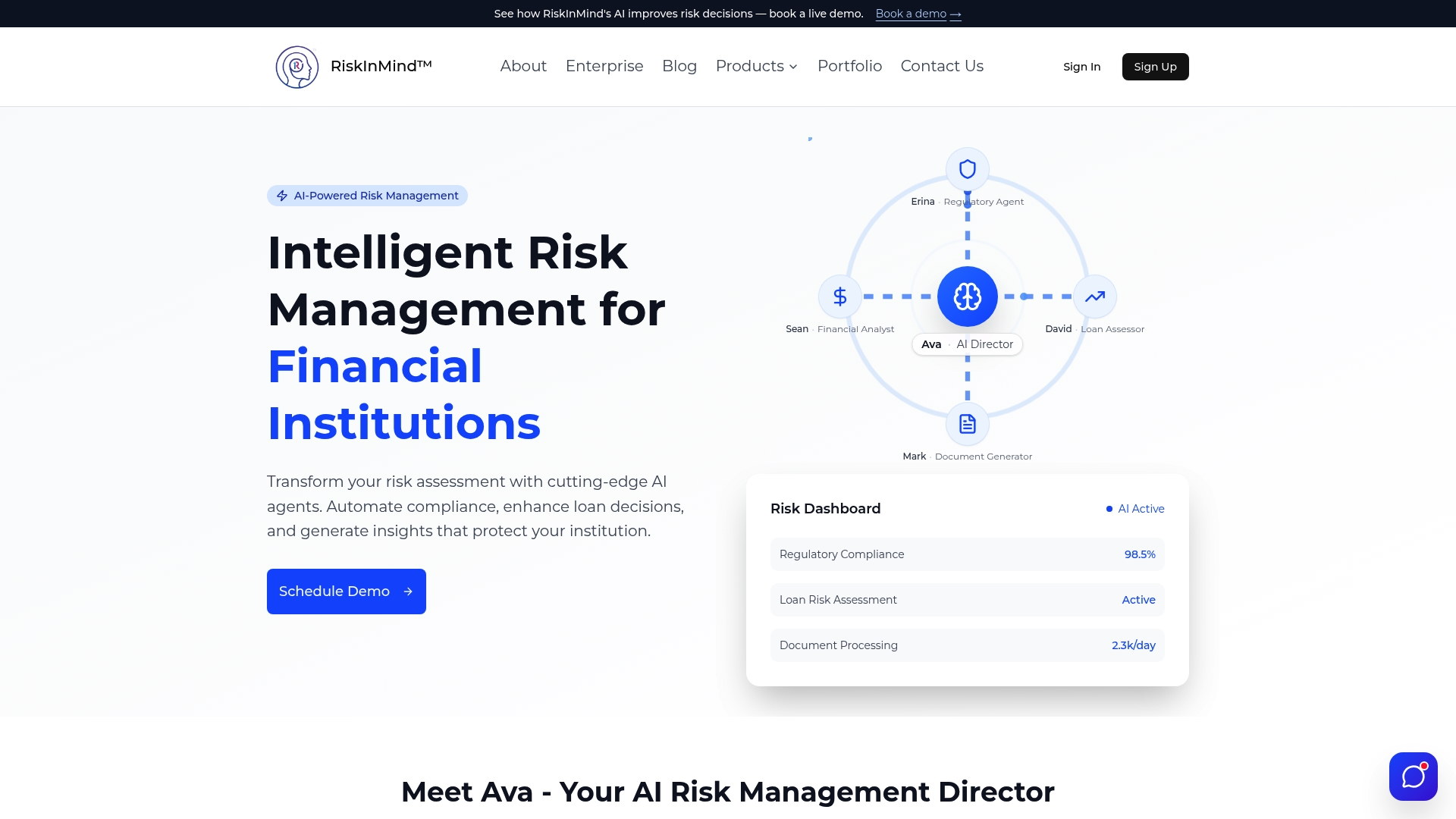
For credit unions, community banks, and lenders that need to demonstrate program effectiveness, not just program existence, Riskinmind produces the documentation trail that turns an examiner's question into a straightforward answer. Request a demo through the Riskinmind compliance automation platform to see how the platform maps to your current OFAC program gaps and what a POC with your own transaction data would look like.
Authoritative sources for OFAC compliance
- FFIEC BSA/AML Examination Manual, OFAC Chapter — the primary supervisory reference for what examiners assess; use this to benchmark your program against examiner expectations and to design independent testing scope.
- OFAC Compliance and Enforcement Guidelines — OFAC's own guidance on recommended program components, enforcement factors, and mitigation considerations; use this when drafting your written program and preparing for enforcement risk analysis.
- OFAC FAQ Pages (Licensing, Screening, Reporting) — OFAC's official FAQ library covers screening timing, property interest definitions, beneficiary obligations, and software use; use these to resolve specific operational questions and to document your interpretive basis for compliance decisions.
- OFAC Blocked Funds and Reporting Guidance — covers annual blocked funds reporting timelines, recordkeeping requirements, and the mechanics of reporting terrorism- and narcotics-related interdictions; use this when building your reporting calendar and blocked funds procedures.
- FFIEC BSA/AML Examination Manual (Full) — the broader examination manual that situates OFAC within the BSA/AML supervisory framework; use this when integrating OFAC controls with your AML/CFT program and when preparing for a combined BSA/OFAC examination.