
Regulatory compliance monitoring is the continuous collection and validation of evidence that an organization's controls are operating as designed, mapped against the rules that govern it. The single most important outcome is audit readiness on demand: when a regulator, examiner, or auditor asks for proof, you already have it, timestamped and traceable, rather than scrambling to reconstruct it after the fact.
That distinction separates a mature program from a periodic checklist exercise. Point-in-time reviews tell you what was true on the day someone looked. Continuous monitoring tells you what's true right now, and it builds a defensible evidence trail as a byproduct of normal operations. For institutions carrying SOC 2 or HIPAA obligations, that evidence pipeline is what turns an annual audit from a fire drill into a formality.
What continuous monitoring delivers when it's built correctly:
Maintain 100% NCUA & OCC Audit Readiness
Monitor regulatory updates 24/7, check internal credit policies, and generate compliance trails with Erina (AI Regulatory Agent).
- Faster remediation, because gaps surface quickly instead of during the next scheduled review
- Lower enforcement exposure, since regulators consistently credit organizations that can show ongoing control operation rather than after-the-fact fixes
- Audit-ready evidence packages that reduce preparation time significantly
Platforms like Riskinmind build this monitoring layer directly into daily workflows for banks and credit unions, rather than treating it as a separate compliance project.
Key Takeaways
Effective regulatory compliance monitoring requires continuous evidence collection, tuned severity scoring, and clear ownership across in-house, vendor, and hybrid delivery models to survive an audit intact.
| Point | Details |
|---|---|
| Continuous beats periodic | Change-triggered and evidence-layer monitoring close the gaps that scheduled reviews leave open. |
| Build the evidence pipeline first | Hashed, versioned, immutable evidence is what holds up under examiner scrutiny. |
| Track MTTD and MTTR | These two metrics prove the program is functioning, not just running. |
| Watch for ownership drift | Hybrid models fail when no one is clearly accountable for a specific control's evidence. |
| Riskinmind operationalizes the cycle | Its AI agents and evidence pipeline give banks and lenders continuous monitoring without building the infrastructure from scratch. |
Table of Contents
- Why Regulatory Compliance Monitoring Matters for Audits and Enforcement
- What Are the Core Components of a Compliance Monitoring System?
- How Do You Build a Compliance Monitoring Plan?
- Continuous Monitoring vs. Point-in-Time Reviews: What's the Difference?
- In-House, Third-Party, or Hybrid: Which Delivery Model Fits?
- Which KPIs Actually Show a Monitoring Program Is Working?
- Where Do You Track Regulatory Changes That Affect Your Program?
- What Goes Wrong With Compliance Monitoring Programs?
- How Does an AI Platform Operationalize Monitoring for Banks and Lenders?
- What Should Compliance Leaders Actually Do First?
- See How Riskinmind Applies This to Your Institution
- Sources
Why Regulatory Compliance Monitoring Matters for Audits and Enforcement
The stakes are not abstract. A financial institution that can't produce evidence of ongoing control operation faces a longer, more invasive audit, and often a less favorable outcome. Auditors under SOC 2, HIPAA, and PCI DSS frameworks increasingly expect continuous evidence rather than a binder assembled the week before the review. Institutions that can demonstrate ongoing monitoring typically cut audit preparation time substantially, because the evidence already exists rather than needing reconstruction.
The IIA's 2024 pulse report reflects a similar shift in internal audit expectations: teams are being asked to provide assurance more frequently and with tighter evidence trails, not just at year-end.
Enforcement risk compounds the audit problem. The EPA's compliance monitoring programs illustrate what agency-level oversight actually looks like in practice: inspections, self-reporting requirements, and data review cycles designed to catch gaps between filings, not just at renewal time. Financial regulators operate on a similar logic. A lapse discovered by an examiner carries different consequences than the same lapse self-identified and remediated within a monitoring cycle.
What weak monitoring typically costs an organization:
- Extended examination windows and follow-up requests
- Higher legal and remediation spend tied to reactive fixes
- Reputational exposure when gaps surface publicly rather than internally
What Are the Core Components of a Compliance Monitoring System?
A working program needs specific technical pieces, not just good intentions. Here's what has to be in place before monitoring can run continuously rather than in bursts:
- Data sources — identity and access logs, cloud configuration states, application logs, transaction records, and external regulatory feeds all need to flow into one pipeline.
- Machine-readable policies — each control needs to be translated from a policy document into a rule a system can evaluate, mapped explicitly to the framework requirement it satisfies.
- Evidence pipeline — every check needs to produce a hashed, versioned, immutable record. Evidence you can't prove wasn't altered after the fact is weak evidence in front of an examiner.
- Triage and alerting — findings need severity scoring so a critical access violation doesn't sit in the same queue as a minor configuration drift.
- Workflow integration — alerts should create tickets automatically in whatever system your team already uses, with an owner and a deadline attached.
- Audit reporting layer — the evidence store needs to generate readable packages on demand, not require a manual export project every time someone asks.
Riskinmind's approach to this is detailed in its AI-driven compliance checklist for financial institutions, which walks through moving from documented policy to machine-verifiable checks.
Pro Tip: Start your evidence pipeline with hash-based versioning before you add anything else. Retrofitting immutability into a system that's already running is far harder than building it in from day one.
How Do You Build a Compliance Monitoring Plan?
The cycle that underpins most working programs breaks into six repeatable steps. None of them are optional if you want the program to hold up under examination.
Step 1: Define policy requirements. Translate each regulatory obligation into a specific, testable rule and assign an owner. Vague policies produce vague monitoring.

Step 2: Integrate your systems. Connect identity providers, cloud environments, core applications, and third-party vendor feeds so data flows in automatically rather than through manual pulls.
Step 3: Scan continuously. Change-triggered scanning, where a check fires the moment a configuration shifts, catches problems faster than scheduled polling and produces a tighter audit trail.
Step 4: Detect and score severity. Not every finding deserves the same response. Tune detection thresholds so critical issues like a disabled MFA requirement surface immediately, while low-risk drift gets batched.
Step 5: Remediate and capture evidence. Some fixes can be automated (resetting a misconfigured permission); others need a human decision. Either way, the resolution and its evidence need to land in the same immutable store.
Step 6: Report. Dashboards for day-to-day tracking, executive summaries for leadership, and formal audit packages for examiners all need to draw from the same underlying evidence rather than three separate reporting processes.
Common friction points at each step:
- Step 1 stalls when policy owners aren't clearly assigned
- Step 3 generates noise if scanning cadence isn't matched to control criticality
- Step 5 breaks down when remediation happens outside the evidence pipeline, leaving a gap examiners will find
Riskinmind's financial institution compliance process guide maps this same cycle specifically to bank and lender workflows.
Continuous Monitoring vs. Point-in-Time Reviews: What's the Difference?
The choice isn't binary. Most mature programs run a blend, calibrated by how critical the control is.
| Level | Approach | Best suited for |
|---|---|---|
| Level 1 | Scheduled polling (daily/weekly checks) | Lower-risk controls with slow-changing states |
| Level 2 | Change-triggered scanning | Configuration and access controls that shift frequently |
| Level 3 | Evidence-layer AI monitoring | Critical controls needing near real-time assurance |
Scheduled polling is cheap and simple, but it leaves gaps between checks where a violation can sit undetected. Change-triggered scanning closes that gap for most infrastructure controls. Evidence-layer approaches, where AI continuously validates control state and logs it, produce the strongest audit trail but cost more to build and tune.
Critical controls, privileged access, MFA enforcement, and encryption key management, warrant near real-time monitoring regardless of cost. A gap in those controls is exactly what examiners and the SEC's guidance treat as a material finding, not a technicality.
In-House, Third-Party, or Hybrid: Which Delivery Model Fits?
Building monitoring entirely in-house gives you full control over rule logic and evidence handling, but it demands sustained investment in staffing and tooling that many mid-sized institutions struggle to justify. Third-party vendors offer faster time to value and broader out-of-the-box coverage, though you're dependent on their SLAs and their interpretation of your control requirements.
Most institutions land on a hybrid model, and it works best when governance is explicit from the start:
- Define which team owns evidence for which control, in writing, before the program launches
- Set SLA expectations with any vendor covering response time for alerts and remediation support
- Build integration contracts that specify data formats so evidence from vendor tools slots into your central pipeline instead of living in a separate silo
The failure mode to watch for is ownership drift, where a control everyone assumes is "covered" by the vendor turns out to have no one actually monitoring it. That gap tends to surface at the worst possible time: during an examination.
Which KPIs Actually Show a Monitoring Program Is Working?
Dashboards full of green checkmarks mean nothing to an auditor without underlying metrics that prove the program is functioning, not just running.
Track these at minimum:
- Mean time to detect (MTTD) — how long a violation sits before the system flags it
- Mean time to remediate (MTTR) — how long from flag to fix, broken out by severity tier
- Pass/fail rates by framework — trended over time, not just a snapshot
- Percent of evidence collected automatically versus manually gathered, since manual evidence is slower to produce and easier to challenge
Set thresholds that trigger escalation, not just observation. If MTTR for a critical control creeps past your defined SLA two cycles in a row, that's a resourcing conversation, not a data point to note and move past.
Evidence maturity has a direct payoff here: institutions that can show consistent, automated evidence collection over time tend to see audit scope narrow, since examiners spend less time verifying basic control operation and more time on genuinely complex questions. Riskinmind's guidance on streamlining compliance checks covers how to build these metrics into a standing dashboard rather than a one-off report.
Where Do You Track Regulatory Changes That Affect Your Program?
Every monitoring program needs an ingestion source for the rules themselves, not just the controls that implement them. The core feeds worth building into your process:
- Regulations for federal rulemaking notices and public comment periods
- SEC press releases and guidance documents for anything touching financial institutions directly
- EPA compliance monitoring pages for organizations with environmental obligations layered on top of financial ones
- The Federal Register for the formal record of adopted rules
Turning a published update into action follows a predictable path: a new rule or guidance document gets ingested, classified against your existing control map, and scored for impact. A high-impact change, say, a shift in reporting thresholds, gets assigned to a specific owner with a deadline, and that owner's team is asked to produce evidence of compliance by the review date. Some regulatory monitoring services handle this classification and task creation at scale, converting dozens or hundreds of agency updates into tracked work items automatically, which is the model worth building toward even if you start with a manual triage process. Riskinmind's regulatory change management checklist breaks this workflow down into a repeatable weekly cadence.
What Goes Wrong With Compliance Monitoring Programs?
Alert fatigue kills more monitoring programs than any technical failure. When every finding, critical or trivial, lands in the same queue with the same urgency, teams stop trusting the system and start ignoring it. Severity scoring and tuned thresholds are the fix, not more alerts.
Staffing shortages are the second common failure point. Compliance teams are frequently asked to run monitoring programs without the specialized skill set to tune detection rules or manage an evidence pipeline. A hybrid model, where a vendor handles the technical tuning while your team owns interpretation and remediation decisions, often closes that gap faster than trying to hire your way out of it.
Evidence gaps and chain-of-custody weaknesses are the third. If you can't prove evidence wasn't altered after collection, an examiner may discount it entirely.
Pro Tip: When ingesting external data sources, particularly cross-border vendor feeds, confirm your evidence pipeline handles the privacy obligations of every jurisdiction the data touches. A monitoring gain in one region can create a compliance exposure in another.
- Tune severity thresholds quarterly as your control environment changes
- Document chain-of-custody procedures for every evidence type, not just the sensitive ones
- Review cross-border data flows annually against current privacy requirements
How Does an AI Platform Operationalize Monitoring for Banks and Lenders?
For a credit union or community bank, the practical challenge isn't understanding the six-step cycle. It's running it without a large dedicated compliance engineering team. This is where a purpose-built AI platform changes the math.
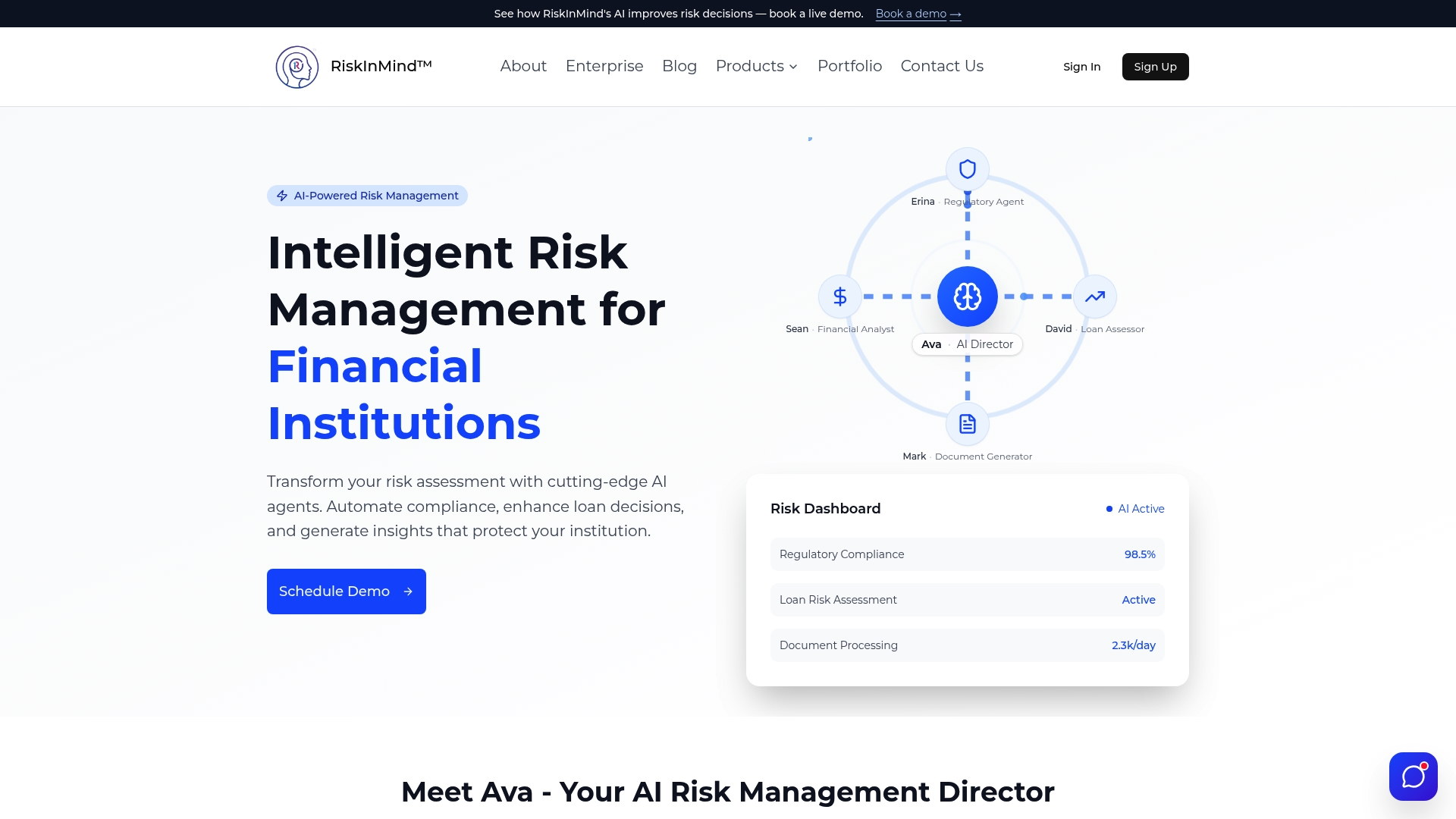
Riskinmind's suite of specialized AI agents, coordinated by a central AI director called Ava, maps regulatory rules to machine-checkable controls and maintains the evidence trail automatically as those checks run. Rather than a compliance officer manually cross-referencing a new rule against existing policy, an agent handles the mapping and flags where a gap exists.
The platform is built on SOC 2 certified, bank-grade security, with real-time processing delivering sub-half-second response times, so evidence generation and alerting happen inside the normal operational rhythm of the institution rather than as a separate batch process run overnight.
Typical outcomes financial institutions report include faster remediation cycles, audit evidence generated automatically rather than assembled by hand before an exam, and real-time dashboards that give a CRO or compliance lead a live view of control health instead of a quarterly snapshot.
What this looks like in daily use:
- A lending policy change triggers automatic re-mapping of underwriting checks tied to that policy
- Evidence for each check is hashed and stored the moment it's generated, not batched at month-end
- Dashboards surface pass/fail trends by framework so leadership sees drift before an examiner does
What Should Compliance Leaders Actually Do First?
Most teams over-plan and under-pilot. The better move is picking one critical control, privileged access is a strong candidate, wiring it to one system integration, and building a single dashboard that tracks it in real time. Run that pilot for a full quarter with clear success criteria defined up front: target MTTD, target MTTR, and a specific evidence-completeness percentage.
Capture audit evidence from the first day of the pilot, not after it proves out. Riskinmind's guidance on compliance program design reinforces the same point: programs that treat evidence as an afterthought spend far longer rebuilding trust with auditors than programs that bake it in from the start.
— Raj
See How Riskinmind Applies This to Your Institution
Riskinmind gives compliance and risk teams at credit unions, community banks, and lenders a working evidence pipeline instead of a project to build one from scratch. Its AI agents, coordinated by the AI director Ava, handle the rule-to-control mapping, continuous scanning, and evidence capture described throughout this piece, backed by SOC 2 certification and sub-half-second response times built for regulated financial environments.
If your team is still assembling audit evidence by hand or running monitoring on a quarterly cycle instead of a continuous one, a live look at the platform is the fastest way to see the gap. Visit the Riskinmind compliance solutions page to see how the agents apply to your specific control set, or head to the main platform page to request a demo and walk through your institution's current monitoring gaps with the team.
Sources
- Compliance Monitoring Programs | US EPA
- Regulations
- SEC press release (2024)
- The IIA — 2024 pulse report