
Regulation B compliance now requires financial institutions to operate under a materially revised framework: the CFPB's April 22, 2026 final rule eliminated the effects test (disparate-impact liability) from ECOA, narrowed the discouragement prohibition to statements of intent to discriminate, and barred for-profit creditors from using race, color, national origin, or sex as common characteristics in Special Purpose Credit Program eligibility. Adverse-action notice obligations, specificity requirements, and recordkeeping rules remain fully enforceable and are active examiner priorities.
Three actions your compliance team must take now:
- Audit every adverse-action notice template and AI model output mapping. Under § 1002.9, each notice must state specific principal reasons that reflect the factors actually considered. Generic checklist reasons pulled from Appendix C without verification are a top exam finding.
- Pause and review all active Special Purpose Credit Programs. The April 2026 amendments impose new eligibility restrictions on for-profit creditors. Any SPCP using race, color, national origin, or sex as a qualifying characteristic must be revised before the program continues operating.
- Update monitoring and recordkeeping schedules to reflect amended compliance dates. The 12 CFR Part 1002 regulatory text specifies effective and compliance dates for Subpart B changes; align your data-collection and reporting calendar to those dates now, not at year-end.
Automate Regulatory Model Risk Governance
Examine models against 32 qualitative criteria and resolve risk Tiers with pre-deployment checklists per OCC 2011-12 guidelines.
Key Takeaways
Regulation B compliance after the April 2026 amendments requires institutions to operate without the effects test, under a narrowed discouragement standard, with revised SPCP eligibility rules for for-profit creditors, and with the same fully enforceable adverse-action specificity obligations that have always been the core of examiner scrutiny.
| Point | Details |
|---|---|
| Effects test removed | The April 22, 2026 CFPB final rule eliminated disparate-impact liability from Reg B; discouragement now covers statements of intent only. |
| Adverse-action specificity | Notices must reflect the factors actually considered; Appendix C sample reasons are not a safe harbor when they do not match the model's actual logic. |
| SPCP eligibility restrictions | For-profit creditors may no longer use race, color, national origin, or sex as SPCP eligibility criteria; revise all active programs now. |
| Recordkeeping floors | Consumer adverse-action notices: 30 days; business credit notices (revenues under $1M): 12 months; SPCP plans: life of program plus 30 days. |
| Riskinmind | Riskinmind's platform provides version-controlled model explainability logs, adverse-action reason mapping, and audit-ready SPCP documentation aligned to current Reg B examiner standards. |
Table of Contents
- What does Reg B compliance actually cover?
- The nine prohibited bases and what the narrowed discouragement rule means for your team
- Adverse action notices: timing, content, and specificity requirements
- Special Purpose Credit Programs: what the 2026 amendments changed and how to stay compliant
- Subpart B: small-business lending data collection after the 2026 revisions
- What examiners look for and what you must retain
- Operational checklist: underwriting audits, model governance, and AI-specific steps
- The compliance gap most institutions are still ignoring
- Riskinmind gives compliance teams the traceability Reg B now demands
- Sources
What does Reg B compliance actually cover?
12 CFR Part 1002 applies to any creditor, defined as a person who regularly extends, renews, or continues credit, or who regularly arranges for the extension of credit. Coverage is broad by design. Consumer mortgages, auto loans, credit cards, and personal lines of credit fall squarely within scope, but so do commercial loans, agricultural credit, and small-business lending. Compliance teams focused exclusively on consumer retail lending frequently miss the application of Reg B to their commercial and small-business portfolios, which is itself a recurring exam finding.
A covered credit transaction is any extension of credit, including the application process, the terms offered, and the administration of an existing account. The regulation covers the full credit lifecycle, from marketing and solicitation through underwriting, pricing, servicing, and collection.
Common exclusions include transactions conducted entirely outside the United States, certain merchant cash advances (as revised under the 2026 Subpart B amendments), small-dollar loans meeting specific thresholds, and agricultural loans excluded from the small-business data-collection requirements. Confirming whether a product falls within an exclusion requires reading the current regulatory text and any applicable staff commentary, not relying on prior institutional practice.
Four definitions every compliance officer must have precise command of:
- Applicant: any person who requests or has received an extension of credit from a creditor, including guarantors and co-signers in certain contexts.
- Adverse action: a denial or revocation of credit, a change in terms of an existing account to the applicant's detriment, or a refusal to grant credit in substantially the amount or on substantially the terms requested.
- Discouragement: under the amended rule, conduct that constitutes a statement of intent to discriminate on a prohibited basis. The prior, broader standard that included practices with a discriminatory effect has been removed.
- Special Purpose Credit Program (SPCP): a credit program designed to benefit an economically disadvantaged class of persons, subject to specific eligibility and governance requirements under § 1002.8.
Pro Tip: When in doubt about whether a product or transaction is covered, consult the CFPB's official staff commentary on Regulation B, hosted by the Federal Reserve. Acting in good faith in conformity with the commentary provides a practical safe harbor against regulatory liability.
The nine prohibited bases and what the narrowed discouragement rule means for your team
ECOA and Reg B prohibit discrimination in any aspect of a credit transaction on the basis of:
- Race
- Color
- Religion
- National origin
- Sex (including gender identity and sexual orientation under current CFPB interpretation)
- Marital status
- Age (provided the applicant has the capacity to contract)
- Receipt of income from any public assistance program
- Exercise of any right under the Consumer Credit Protection Act
The April 2026 final rule made a structural change to how the discouragement prohibition operates. Previously, the regulation could be read to prohibit practices that had a discriminatory effect even without discriminatory intent, a standard known as the effects test or disparate-impact theory. The CFPB removed that standard from Reg B. Discouragement now focuses on statements that express an intent to discriminate, such as a loan officer telling an applicant that the institution does not lend to applicants of a particular national origin, or marketing copy that signals a preference for or against applicants based on a prohibited characteristic.
What this means operationally: your compliance team should review oral scripts used by loan officers and call-center staff, marketing materials (digital and print), and any third-party broker or referral agreements for language that could be read as expressing discriminatory intent. The removal of the effects test does not eliminate the need for fair lending analysis under other authorities, but it does change the Reg B-specific standard your institution is held to.
Red-flag scenarios to flag in your next script review:
- Loan officer scripts that reference neighborhood characteristics tied to race or national origin when explaining product availability
- Marketing materials that use imagery or language implying a preferred applicant profile based on a prohibited basis
- Third-party broker agreements that include steering language or volume incentives tied to applicant demographics
- Automated chatbot or digital application flows that present different product options based on zip code proxies for race
Remediation is straightforward once the language is identified: revise the script or material, document the change, and retrain affected staff. The harder work is building a systematic QA process so that new materials are reviewed before deployment rather than after an exam.
Adverse action notices: timing, content, and specificity requirements
Adverse-action notice obligations under Reg B are among the most frequently cited exam findings, and the specificity requirement is where most institutions fall short. § 1002.9 sets out the full framework.
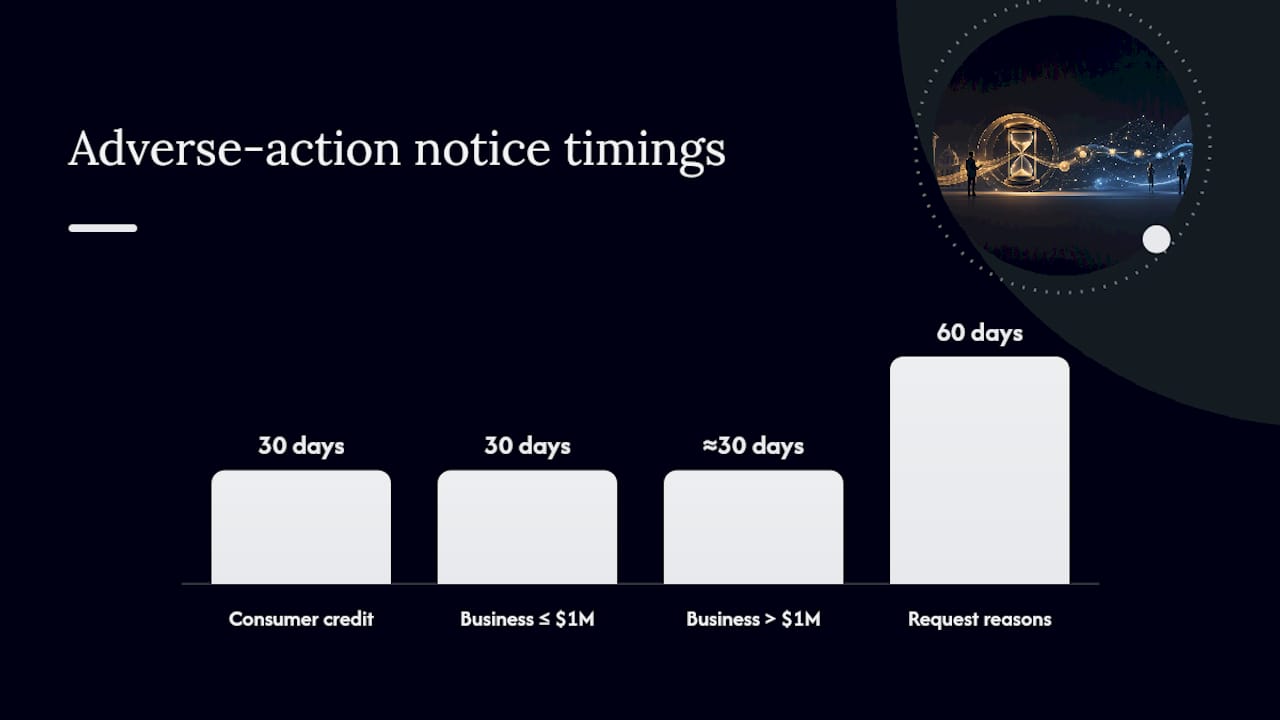
Timing. For consumer credit applications, a creditor must notify the applicant of adverse action within 30 days of receiving a completed application, or within 30 days of taking adverse action on an existing account. For business credit with gross revenues of $1 million or less, the same 30-day rule applies. For business credit with gross revenues exceeding $1 million, the creditor must notify within a reasonable time, which the regulation and commentary interpret as generally within 30 days but with more flexibility for complex commercial transactions.
Content. A compliant adverse-action notice must include:
- A statement of the action taken
- The name and address of the creditor
- A statement of the provisions of § 701(a) of ECOA (the anti-discrimination notice)
- The name and address of the federal agency that administers compliance with respect to the creditor
- Either the specific principal reasons for the adverse action or a disclosure of the applicant's right to request those reasons within 60 days
Specificity. This is the compliance pressure point. Reasons must relate to and accurately describe the factors actually considered or scored by the creditor. Selecting the "closest" reason from the Appendix C checklist without verifying that it reflects the actual decisioning logic is a compliance failure, not a safe harbor. The CFPB's 2023 circular on adverse-action notifications makes this explicit: creditors using complex or algorithmic models cannot rely on the sample forms unless those forms accurately reflect the principal reasons the model actually used.
Interplay with FCRA risk-based pricing notices. When a creditor denies credit or offers less favorable terms based in whole or in part on information in a consumer report, both a Reg B adverse-action notice and an FCRA adverse-action notice may be required. The FTC's guidance on consumer-report-based credit decisions clarifies when risk-based pricing notices are required separately and when combined forms satisfy both obligations. Combined forms are permissible when they meet the content requirements of both statutes; the key is ensuring the ECOA-specific language and the FCRA-specific language are both present and accurate.
Workflow checklist for AI-driven adverse-action notices:
- Map each model feature or score to a human-readable principal reason before the model goes into production
- Document the mapping in a version-controlled artifact tied to the model version
- Build a process to pull the top contributing factors from each decision and translate them into the specific principal reasons disclosed on the notice
- Confirm that the disclosed reasons match the factors the model actually weighted, not a post-hoc rationalization
- Review the mapping quarterly or whenever the model is retrained
Pro Tip: When a third-party vendor provides the underwriting decision, your institution remains responsible for the adverse-action notice. Require vendors to contractually provide the specific principal reasons driving each denial in a machine-readable format your team can map to compliant notice language. Audit that output at least annually.
The Appendix C sample forms (C-1 through C-10) are illustrative starting points, not compliance shortcuts. Form C-1 covers consumer credit; forms C-2 through C-10 address specific product types and business credit. Modify any form where the sample reasons do not match your institution's actual decisioning criteria.
Special Purpose Credit Programs: what the 2026 amendments changed and how to stay compliant
The April 2026 amendments imposed new restrictions on SPCPs operated by for-profit creditors. Under the revised rule, for-profit creditors may no longer use race, color, national origin, or sex as common characteristics defining SPCP eligibility. This is a direct reversal of prior guidance that had encouraged creditors to use those characteristics to design programs targeting underserved communities. The policy rationale, detailed in the CFPB's 2025 proposed rule materials, centers on the CFPB's view that ECOA's text does not authorize race-conscious eligibility criteria even in remedial programs operated by for-profit entities.
For compliance teams, the operational impact is immediate. Any SPCP currently using race, color, national origin, or sex as an eligibility criterion must be revised. The program may continue to target economically disadvantaged applicants using income, geography, credit history, or other permissible proxies, but the prohibited characteristics must be removed from the eligibility definition.
SPCP remediation checklist:
- Pull the current eligibility criteria for every active SPCP and flag any reference to race, color, national origin, or sex
- Engage legal counsel to assess whether the program can be restructured using permissible proxies that achieve a similar reach
- Revise the program's written plan to document the new eligibility criteria, the program's objectives, and the metrics used to assess whether the program is meeting those objectives
- Obtain board or senior management approval of the revised plan before relaunching the program
- Conduct an impact assessment: model the expected applicant pool under the revised criteria and confirm the program still reaches its intended beneficiaries
- Update recordkeeping to retain the prior plan, the revised plan, the impact assessment, and board approval documentation
- Set a monitoring schedule to track program outcomes quarterly and document results
Governance documentation is not optional. Examiners reviewing SPCPs will ask for the written plan, evidence of board oversight, and records showing the program is operating as designed. Institutions that cannot produce those records face the same exposure as institutions that never had a plan.
Subpart B: small-business lending data collection after the 2026 revisions
Regulation B's Subpart B requires covered financial institutions to collect and report data on small-business credit applications. The 2026 amendments revised the scope of covered transactions, adding exclusions for merchant cash advances, certain small-dollar loans, and agricultural loans. Compliance teams should re-examine their sample-selection logic to confirm that excluded product types are no longer included in the data-collection population.
The core data fields still required under Subpart B include application date, credit type, credit purpose, amount applied for, amount approved, action taken, action-taken date, census tract of the principal place of business, gross annual revenue, NAICS code, number of workers, time in business, and demographic information collected through the applicant self-identification process. Fields related to pricing and denial reasons that were part of earlier proposed requirements were not carried forward in the final amended rule.
| Compliance milestone | Deadline / status | Action required |
|---|---|---|
| Confirm covered lender threshold | Per amended 12 CFR Part 1002 Subpart B | Re-run origination volume counts against current thresholds |
| Remove excluded products from sample | Effective with 2026 amendments | Update data-collection system configuration |
| Validate remaining required data fields | Ongoing | Map system fields to current regulatory field list |
| Test data submission format | Per CFPB reporting specs | Run parallel test submissions before live reporting cycle |
| First reporting cycle under amended rule | Per CFPB compliance date in Federal Register | Confirm date with your regulatory counsel and build backward from it |
Institutions that were previously covered but fall below the revised thresholds after the 2026 amendments should document that determination and retain the analysis. Examiners may ask why a previously reporting institution stopped submitting data.
What examiners look for and what you must retain
Enforcement authority over ECOA and Reg B is distributed across agencies based on institution type. The CFPB supervises banks, credit unions, and nonbank creditors above the statutory asset threshold. The NCUA supervises federally chartered credit unions. The FTC retains authority over nonbank creditors not subject to CFPB supervision. State attorneys general can bring civil actions under ECOA independently of federal agency action.
NCUA examination guidance directs examiners to assess six areas: written policies and procedures, staff training records, sample loan file review, monitoring and testing programs, self-test documentation, and complaint-management records. An institution that has strong policies but cannot demonstrate that those policies are followed in practice will not receive credit for the policies.
Examiner focus areas under the 2026 amendments:
- Evidence that adverse-action notices reflect the actual decisioning logic of any algorithmic or AI-assisted model
- Documentation of SPCP eligibility criteria revisions and board approval
- Updated discouragement policies and evidence of script/marketing review
- Subpart B data-collection configuration changes and test submissions
Retention requirements and suggested periods:
| Record type | Regulatory basis | Suggested retention |
|---|---|---|
| Adverse-action notices (consumer credit) | 12 CFR § 1002.12 | 30 days from date of notice |
| Adverse-action notices (business credit, revenues ≤ $1M) | 12 CFR § 1002.12 | 12 months |
| SPCP written plan and board approval | 12 CFR § 1002.8 | Life of program plus 30 days |
| Self-test records (privileged) | 12 CFR § 1002.15 | 30 days after completion |
| Subpart B data-collection records | 12 CFR Part 1002 Subpart B | Per CFPB reporting cycle requirements |
| Model documentation and adverse-action mapping | Examiner expectation; no explicit Reg B period | Minimum 3 years; align with model risk management policy |
The compliance reporting workflow guidance your team uses should be updated to reflect these retention periods explicitly, with document-management system tags that trigger retention-period reviews automatically.
Good-faith compliance with the CFPB's official staff commentary provides a practical safe harbor. Where the regulation is ambiguous, document your interpretation, cite the relevant commentary section, and retain that analysis in your compliance file.
Operational checklist: underwriting audits, model governance, and AI-specific steps
Institutions using algorithmic underwriting face a compliance obligation that goes beyond policy: they must be able to trace every adverse-action reason back to a specific model feature or score that actually drove the decision. That traceability requirement is not aspirational; it is the standard the CFPB's 2023 circular applies to every creditor using a complex model.
End-to-end audit checklist:
- Build a model inventory. List every model used in credit decisioning, including third-party scores, bureau models, and internal scorecards. Record the model name, version, owner, last validation date, and the products it supports.
- Map decision flows. For each model, document the path from application data input to credit decision output, including any waterfalls, overrides, or human review steps.
- Trace input-data lineage. Identify every data element the model uses. Confirm that alternative data sources (rental payment history, utility data, bank transaction data) have a documented mapping to a human-readable adverse-action reason.
- Run counterfactual testing. For a sample of denied applications, test whether changing a single input variable would have changed the outcome. This surfaces the model's most influential factors and validates your adverse-action reason mapping.
- Audit adverse-action reason mapping. Compare the reasons disclosed on a sample of adverse-action notices against the model's actual top contributing factors for those decisions. Any mismatch is a compliance defect requiring immediate remediation.
- Review vendor contracts. Confirm that every third-party model vendor is contractually required to provide the specific principal reasons driving each denial in a format your institution can use to produce compliant notices.
Model governance template elements:
- Designated model owner (first-line accountability) and model risk management reviewer (second-line)
- Version-controlled model documentation including training data description, feature list, and performance metrics
- Explainability documentation: a plain-language description of the top factors the model uses and how they relate to credit risk
- Validation frequency: at minimum annually, and triggered by any material change to training data, feature set, or business use
- Change-control process: no model update goes to production without a documented impact assessment and compliance sign-off
- Regression testing: after any model update, re-run the adverse-action reason mapping audit before the updated model goes live
AI-specific steps for Reg B compliance:
When a model's outputs cannot be rendered specific, the institution has two options: either constrain the model's feature set to inputs that can be mapped to specific reasons, or supplement the model output with a human review step that produces a documented, specific reason. Neither option is painless, but both are preferable to disclosing generic reasons that do not reflect the actual decisioning logic.
Pro Tip: Never disclose the model's internal feature names or weights on an adverse-action notice. The obligation is to disclose the principal reasons in terms the applicant can understand and act on. "Insufficient cash flow relative to requested loan amount" satisfies the specificity requirement; "Feature_47_normalized_score below threshold" does not.

Pro Tip: Build your adverse-action reason library before a model goes into production, not after the first denial. A pre-production mapping exercise, reviewed by compliance and legal, takes a fraction of the time required to remediate a library built reactively under exam pressure.
For a structured approach to loan underwriting compliance checks, your model governance process should be integrated with the underwriting workflow from the earliest design stage, not bolted on as a documentation step after the model is deployed.
The compliance gap most institutions are still ignoring
The removal of the effects test from Reg B has generated significant commentary, but the more consequential operational challenge for most institutions is not the doctrinal change. It is the specificity gap in adverse-action notices produced by algorithmic models.
Compliance teams have spent years treating the Appendix C checklist as a safe harbor. It never was. The CFPB's 2023 circular made that explicit, and examiners have been citing specificity failures in AI-driven adverse-action notices with increasing frequency. The problem is structural: most machine learning models produce outputs that are not natively interpretable in the terms Reg B requires. A gradient-boosted model that weights 47 features does not naturally produce a "top three reasons" output in plain English. Translating that output into a compliant notice requires a deliberate, documented process that most institutions have not built.
The SPCP amendments add a second structural challenge. Institutions that designed SPCPs to use race or national origin as eligibility criteria did so in reliance on prior CFPB guidance that explicitly encouraged that approach. The April 2026 rule reverses that guidance for for-profit creditors. Institutions that have not yet revised their SPCP documentation are operating programs that are now out of compliance with the current rule, regardless of how well-intentioned the program design was.
The practical lesson is that Reg B compliance is not a documentation exercise. Compliance is built into the model, the workflow, and the governance structure, or it is not built at all. Institutions that treat it as a final review step before exam will find that the gap between their documentation and their actual practice is exactly what examiners are trained to find.
Riskinmind gives compliance teams the traceability Reg B now demands
Adverse-action specificity and model explainability are no longer aspirational standards. They are the specific criteria examiners use to assess whether your institution's AI-driven credit decisions meet Reg B requirements. Riskinmind's AI-powered compliance platform is built for exactly this gap: it maintains a model inventory with version-controlled explainability logs, maps model outputs to specific principal reasons in audit-ready format, and generates SPCP governance documentation that satisfies examiner documentation standards.
For compliance officers managing the April 2026 amendments, Riskinmind's platform connects adverse-action reason mapping directly to your underwriting workflow, so the notice your applicant receives reflects the factors your model actually used. The platform's AI solutions for portfolio managers include real-time risk dashboards, automated regulatory reporting, and a SOC 2-certified audit trail that holds up under CFPB, NCUA, and FTC examination. Request a demo at Riskinmind and see how the platform maps to your current Reg B compliance gaps in a single working session.
Sources
The sources below are the primary references for Reg B compliance work. Each entry notes where to find the most commonly needed provisions.
- 12 CFR Part 1002 - Equal Credit Opportunity Act (Regulation B) | Consumer Financial Protection Bureau
- CFPB Circular 2023-03: Adverse action notification requirements and the proper use of the CFPB’s sample forms provided in Regulation B
- Consumer Financial Protection Bureau’s Official Staff Commentary on Regulation B
- Consumer Compliance Requirements for Commercial Products and Services (NCUA) - Equal Credit Opportunity Act/Regulation B
- Using consumer reports for credit decisions: what to know about adverse action and risk-based pricing notices | Federal Trade Commission
Staying current: Monitor the CFPB's Federal Register notices and the agency's regulatory agenda for further interpretive guidance on the 2026 amendments. The 2026 financial institution compliance process guide and the regulatory change management checklist at Riskinmind are updated as agency guidance develops and provide a structured framework for tracking amendment-driven compliance tasks.
This article is general information, not a substitute for advice from a qualified financial advisor. Consult a qualified financial professional about your own circumstances before acting on anything here.