
Risk data aggregation is defined as the formalized process of gathering, defining, and processing risk-related data across a financial institution's business lines, legal entities, and instrument types to produce a consolidated, enterprise-wide view of exposures. This process sits at the center of sound risk management and regulatory compliance. Supervisory frameworks like BCBS 239 and the ECB's Risk Data Aggregation and Risk Reporting (RDARR) Guide set the global standard for how institutions must collect, govern, and report this data. Without a disciplined approach to aggregation, risk managers cannot produce the timely, accurate reports that boards and regulators demand, especially during periods of financial stress.
What is risk data aggregation and why does it matter?
Risk data aggregation is the formalized process of consolidating risk data from across every corner of a financial institution into a single, coherent picture of total exposure. That picture covers credit risk, market risk, liquidity risk, and increasingly, climate and ESG-related risks. The goal is not just data collection. The goal is enabling decision-makers to act on accurate, complete information at the speed that modern risk management requires.
Maintain 100% NCUA & OCC Audit Readiness
Monitor regulatory updates 24/7, check internal credit policies, and generate compliance trails with Erina (AI Regulatory Agent).
The practical stakes are high. A bank that cannot aggregate its counterparty exposures across business lines during a market shock cannot make sound capital allocation decisions. The 2008 financial crisis exposed exactly this weakness at major institutions worldwide. BCBS 239, published by the Basel Committee on Banking Supervision, emerged directly from that failure as a set of 14 principles designed to fix it.

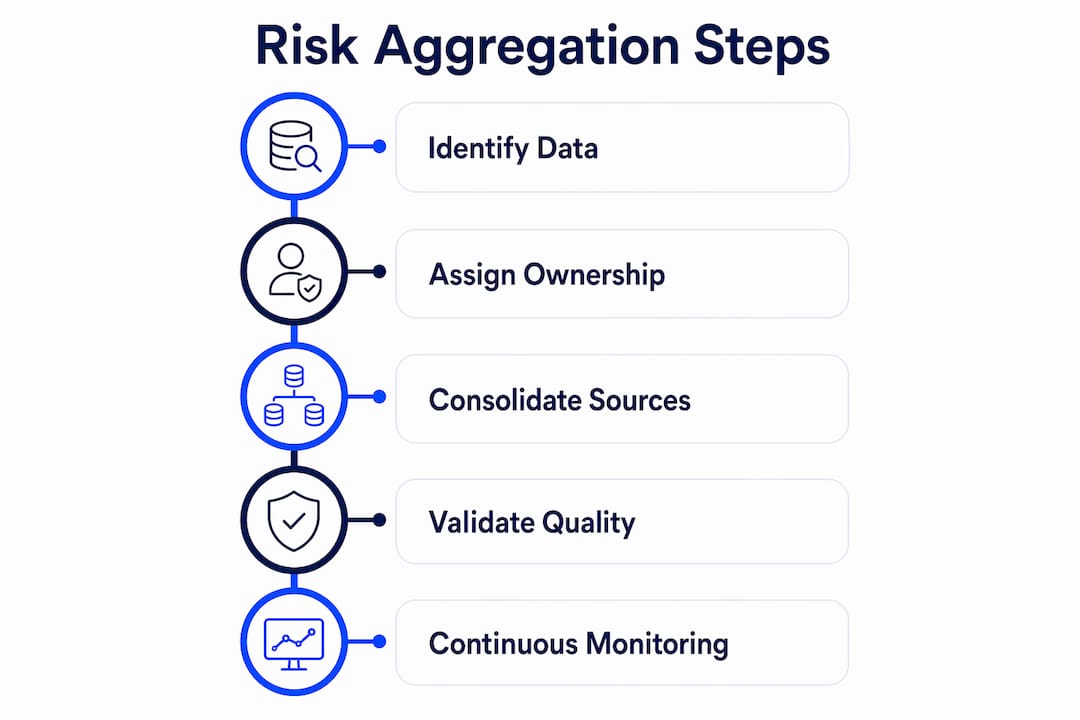
Understanding risk aggregation also means understanding what it is not. It is not simply pulling data into a spreadsheet. It requires defined data taxonomies, clear ownership, validated data flows, and systems capable of producing ad-hoc reports under stress conditions. Risk professionals who treat aggregation as a reporting exercise rather than a governance discipline consistently fall short of supervisory expectations.
What are the core principles and governance requirements?
BCBS 239 establishes the foundational governance requirements for risk data aggregation and risk reporting. The principles cover four broad areas: overarching governance and infrastructure, risk data aggregation capabilities, risk reporting practices, and supervisory review. Each principle carries direct accountability expectations for boards and senior management, not just data teams.
Boards and senior management must be actively involved in RDARR processes, supported by clearly documented governance frameworks, policies, and regular control testing. This is not a delegable function. Regulators treat board-level disengagement from data quality as a governance failure in its own right.
Effective governance structures include:
- Data ownership: Each data element must have a named owner accountable for its accuracy and completeness.
- Data stewardship: Stewards manage day-to-day quality controls and escalate issues through defined channels.
- Enterprise data governance frameworks: RDARR requirements must be embedded in the institution's broader data governance policy, not treated as a standalone compliance exercise.
- Regular control testing: Governance frameworks require periodic validation, not just documentation.
Sustained board-level buy-in, clear governance, and investments in data literacy are critical for effective RDARR capabilities and operational efficiencies. Institutions that treat governance as a checkbox exercise consistently underperform on supervisory assessments.
Pro Tip: Map every critical risk data element to a named data owner before building any aggregation workflow. Fragmented ownership is the leading cause of RDARR failure, and no technology investment fixes a governance gap.
Which data quality dimensions are essential for aggregation success?
Effective risk data aggregation requires four key dimensions of data quality controls: Accuracy, Integrity, Completeness, and Timeliness. These apply to both strategic risk data used in capital planning and operational data used in daily limit monitoring. Missing any one dimension compromises the entire aggregated output.
The four dimensions work as follows:
- Accuracy: Data must reflect the true economic position of the institution. Errors in source systems propagate through aggregation layers and distort risk reports at the portfolio level.
- Integrity: Data must remain consistent as it moves across systems, business lines, and legal entities. Breaks in data lineage are a primary source of integrity failures.
- Completeness: All relevant exposures must be captured. Gaps in coverage, particularly across off-balance-sheet items or newly acquired entities, create blind spots in the enterprise risk view.
- Timeliness: Data must be available when decisions need to be made. Stale data in a fast-moving credit environment is functionally equivalent to no data.
Data lineage tracking is the operational mechanism that ties these dimensions together. In fragmented IT environments, where data passes through multiple systems before reaching a risk reporting layer, lineage documentation becomes both technically complex and critically important. Institutions with poor lineage controls cannot demonstrate to supervisors that their aggregated figures are reliable.
Pro Tip: Build continuous monitoring into your data pipeline rather than relying on periodic reconciliation. Issues caught at the source cost a fraction of what they cost when discovered in a final risk report.
What challenges do financial institutions face in implementing aggregation?
Fragmented IT landscapes are the most common structural barrier to effective risk data aggregation. Many financial institutions operate legacy core banking systems alongside newer credit, treasury, and compliance platforms that were never designed to share data. The result is manual aggregation, where analysts extract data from multiple systems and reconcile it in spreadsheets before producing risk reports.
Manual compensating controls commonly implemented by financial institutions can become permanent burdens and should be managed with documented remediation plans. Supervisors treat long-standing manual workarounds as evidence of structural weakness, not acceptable practice. Institutions that rely on them without a clear path to automation face escalating audit scrutiny and operational risk.
Key challenges risk professionals encounter include:
- Siloed data ownership: When no single function owns the end-to-end data flow, quality gaps accumulate at every handoff point.
- Inconsistent data definitions: The same exposure may be classified differently across business lines, making aggregation unreliable without a common data dictionary.
- Inadequate stress testing readiness: Risk data aggregation must be flexible enough to produce accurate and timely ad-hoc reports under stress conditions. Many institutions discover this gap only when regulators request scenario-specific data.
- Management accountability gaps: Supervisory bodies consistently cite insufficient board and management involvement as a root cause of RDARR deficiencies.
Addressing these challenges requires a sequenced approach. Start with data inventory and lineage mapping. Then establish governance before deploying technology. Automation applied to poorly governed data accelerates errors rather than eliminating them. The path to reliable aggregation runs through people and process before it reaches systems.
How do regulatory frameworks shape aggregation practices in 2026?
BCBS 239 remains the primary global standard for risk data aggregation and risk reporting. Its 14 principles have been adopted by supervisors across the Basel Committee member jurisdictions and form the baseline expectation for systemically important banks. Compliance assessments consistently show that most institutions still fall short on data architecture and IT infrastructure principles.
The ECB's 2024 RDARR Guide tightens governance requirements by anchoring data quality accountability within management bodies and expanding scope to include ESG and stress scenario reporting. This is a material shift. Previously, sustainability data sat outside most RDARR frameworks. The ECB's guidance makes climate risk data a first-class citizen in the aggregation process.
| Regulatory Framework | Key Requirement | 2026 Focus Area |
|---|---|---|
| BCBS 239 | 14 principles covering governance, data quality, and reporting | IT architecture and ad-hoc reporting capability |
| ECB RDARR Guide | Management body accountability for data quality | ESG and climate risk data integration |
| Supervisory campaigns | Risk-based compliance with compensating controls | Remediation plans for manual workarounds |
The ECB's RDARR Guide also emphasizes integrating sustainability risks, including climate data, into risk data aggregation frameworks. For institutions operating in the EU, this is not optional. Supervisors are actively assessing whether climate-related exposures appear in aggregated risk reports with the same rigor as credit or market risk.
Supervisory expectations have evolved toward a risk-based approach where known data aggregation issues require compensating controls as temporary measures, with a clear focus on remediation. Institutions that document their gaps and show credible remediation plans receive more constructive supervisory engagement than those that deny or minimize known weaknesses.
What technologies and best practices improve aggregation efficiency?
Emerging technologies like AI promise improvements in risk data aggregation but are limited by the quality of the underlying data. Foundational data governance is a prerequisite for automation, not an afterthought. Institutions that deploy AI analytics on poorly governed data sources find that the technology surfaces inconsistencies faster but does not resolve them.
The practical technology priorities for risk data aggregation in 2026 include:
- Centralized data repositories: A single source of truth for risk data eliminates reconciliation overhead and reduces the risk of version conflicts across reporting layers.
- Automated data lineage tools: These track how data moves from source systems to risk reports, making it possible to identify and fix quality issues at the point of origin.
- API-based data integration: Replacing manual file transfers with real-time API connections reduces latency and eliminates a major source of data integrity failures.
- AI-assisted anomaly detection: Machine learning models can flag data quality issues in near real time, but only when trained on clean, well-labeled historical data.
Strong RDARR capabilities enable banks to reduce IT costs through automation and build agility in new product development. That operational benefit compounds over time. Institutions with mature aggregation frameworks can onboard new products or legal entities without rebuilding their data infrastructure from scratch.
Riskinmind's AI-powered platform applies these principles directly, using specialized AI agents for credit risk assessment, regulatory compliance, and portfolio monitoring. The platform's real-time processing capability addresses the timeliness dimension of data quality that manual aggregation consistently fails to meet. For risk professionals exploring how automation enhances aggregation, the architecture behind these tools reflects current best practice.
Key Takeaways
Effective risk data aggregation requires governance, data quality controls, and technology working together. No single element produces reliable results without the other two.
| Point | Details |
|---|---|
| Governance precedes technology | Establish data ownership and stewardship before deploying any aggregation system. |
| Four quality dimensions are non-negotiable | Accuracy, Integrity, Completeness, and Timeliness must all be met for aggregated data to be reliable. |
| Manual workarounds carry regulatory risk | Compensating controls require formal remediation plans, not indefinite acceptance. |
| Regulatory scope is expanding | BCBS 239 and ECB RDARR now include ESG and climate risk data as required aggregation inputs. |
| Stress readiness is a supervisory test | Aggregation systems must produce accurate ad-hoc reports under crisis conditions, not just in normal operations. |
Where most institutions get risk data aggregation wrong
Risk professionals often frame RDARR as a technology problem. After years of working with financial institutions on data governance, I am convinced it is primarily a leadership problem. The institutions that consistently pass supervisory assessments are not the ones with the most sophisticated data platforms. They are the ones where the board receives regular, substantive updates on data quality metrics and holds management accountable for remediation timelines.
The manual workaround trap is real and underappreciated. I have seen institutions run the same spreadsheet-based reconciliation process for five or more years, always with the intention of replacing it "next quarter." Supervisors have grown impatient with this pattern. The ECB's 2024 RDARR Guide makes clear that compensating controls are temporary by definition. Treating them as permanent is a governance failure, not a technical limitation.
The technology conversation also needs recalibration. AI-driven risk analytics can genuinely accelerate aggregation and improve anomaly detection. But without solid data foundations, AI-enabled risk analytics may obscure validation challenges rather than solve them. The institutions that get the most value from AI in risk management are the ones that invested in data quality and lineage documentation first.
My practical recommendation: run a stress test on your aggregation capabilities before regulators do. Request an ad-hoc report on a specific exposure type under a defined stress scenario and measure how long it takes to produce a result you trust. That exercise will tell you more about your RDARR maturity than any self-assessment framework.
— Raj
How Riskinmind supports risk data aggregation for financial institutions
Risk data aggregation is only as useful as the decisions it enables. Riskinmind's AI-powered platform is built for credit unions, community banks, and lenders that need accurate, real-time risk data without the overhead of manual aggregation processes.
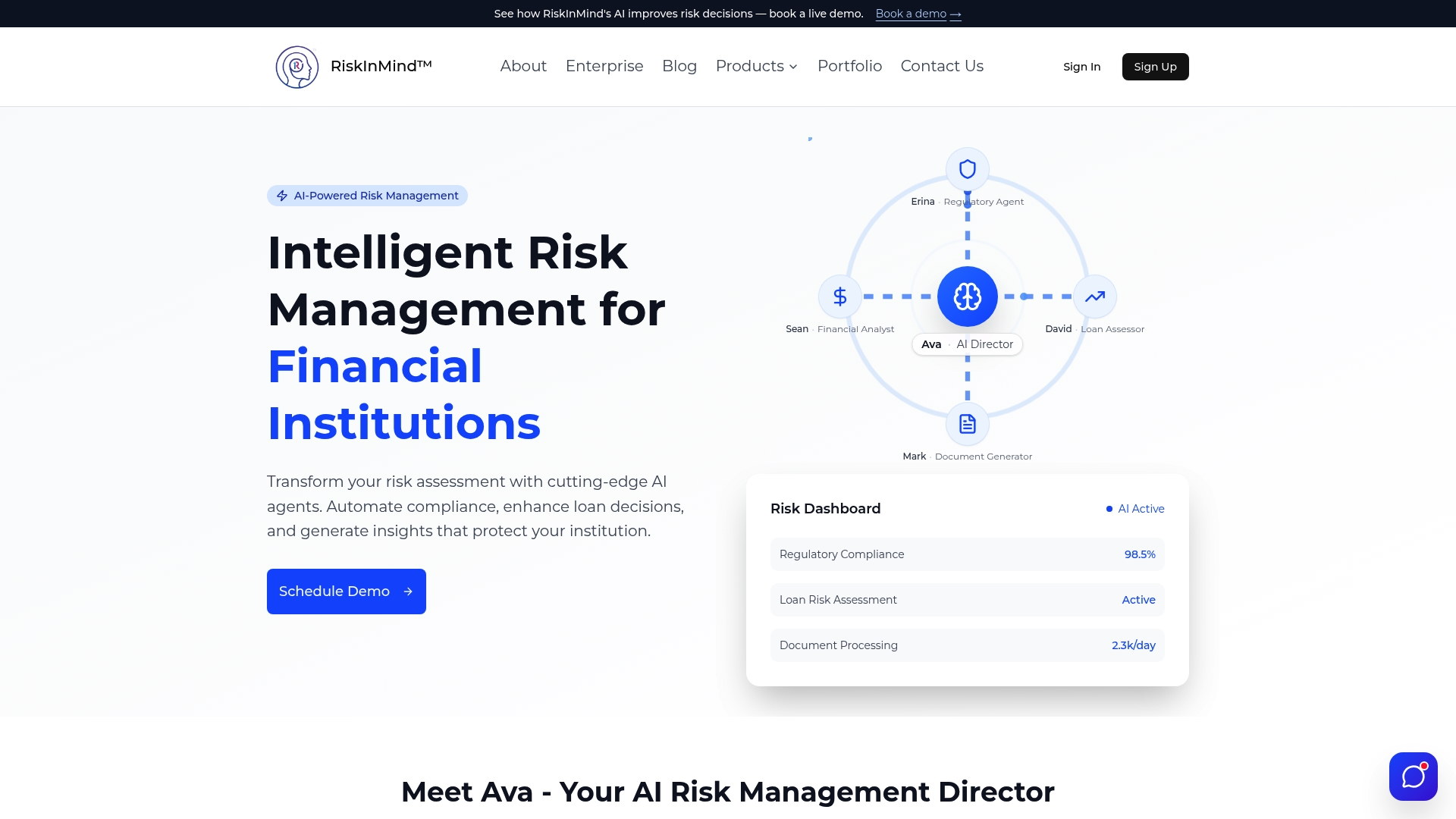
The loan application risk assessment tool automates credit risk data collection and scoring, feeding clean, validated data directly into portfolio monitoring workflows. For institutions managing commercial real estate exposure, the CRE loan risk predictor applies AI-driven analysis to aggregated property and borrower data. Risk professionals who want a starting point for credit risk exposure can use the free loan affordability calculator to benchmark individual loan risk against portfolio parameters. Riskinmind's SOC 2® certified platform processes risk data with response times under half a second, meeting the timeliness standard that BCBS 239 demands.
FAQ
What is risk data aggregation in simple terms?
Risk data aggregation is the process of collecting and consolidating risk-related data from across a financial institution's business lines and systems into a single, accurate enterprise-wide view. It enables risk managers to measure total exposure and produce reliable reports for internal decision-making and regulatory compliance.
What is BCBS 239 and why does it matter?
BCBS 239 is the Basel Committee on Banking Supervision's set of 14 principles governing risk data aggregation and risk reporting for systemically important banks. It establishes the global standard for data quality, governance, and reporting capability that supervisors use to assess institutional compliance.
What are the four data quality dimensions in risk data aggregation?
The four dimensions are Accuracy, Integrity, Completeness, and Timeliness. All four must be met for aggregated risk data to support sound decision-making and satisfy supervisory expectations under frameworks like BCBS 239 and the ECB RDARR Guide.
How does the ECB RDARR Guide differ from BCBS 239?
The ECB RDARR Guide builds on BCBS 239 by anchoring data quality accountability directly within management bodies and expanding the scope of required aggregation to include ESG and climate risk data. It applies specifically to institutions supervised under the European Central Bank's Single Supervisory Mechanism.
Can AI replace manual risk data aggregation processes?
AI can significantly reduce manual aggregation work, but only when the underlying data is well-governed and accurately labeled. Deploying AI on fragmented or poorly documented data sources accelerates the production of unreliable outputs rather than solving the root quality problem.