
A loan underwriting checklist is a structured tool that organizes every required document, risk assessment step, and compliance checkpoint needed to evaluate a borrower's creditworthiness and approve or decline a loan. In practice, it functions as the operational backbone of the underwriting process, reducing errors, preventing incomplete file submissions, and enforcing consistent decision quality across every loan type. The framework draws on the 5 Cs of credit (capacity, capital, collateral, conditions, and character), digital verification methods, and regulatory compliance gates. This guide translates those principles into a practitioner-focused checklist for loan officers and credit analysts working across mortgage, commercial, and consumer lending.
1. The core loan underwriting checklist structure
A well-designed credit underwriting documentation checklist follows a defined sequence: data collection, completeness and consistency verification, external checks, risk assessment, decisioning, and approval routing. Workflow consistency and compliance improve significantly when tasks are clearly assigned and exceptions are routed before final decisioning. Skipping steps or reordering them is the primary cause of conditions waterfalls, where underwriters issue round after round of document requests because the file was never complete at intake.
Maintain 100% NCUA & OCC Audit Readiness
Monitor regulatory updates 24/7, check internal credit policies, and generate compliance trails with Erina (AI Regulatory Agent).
The checklist should be organized into five phases: application intake, document completeness check, underwriting analysis, condition clearance, and final approval. Each phase has a defined owner, a set of required inputs, and a clear exit criterion before the file advances. This structure prevents the most common bottleneck in loan processing: the back-and-forth loop between loan officers and borrowers caused by missing or inconsistent documents.

2. Essential borrower documentation
Borrower file completeness is the first gate every underwriter must clear. Standard mortgage documentation includes government-issued ID, Social Security number, two-year address history, two years of W-2s, recent pay stubs, federal tax returns, bank statements covering 60 to 90 days, and a full credit report. Each document serves a specific verification purpose, and no single document is sufficient on its own.
For self-employed borrowers, the documentation requirements expand considerably. Loan officers must collect two years of personal and business tax returns, a year-to-date profit and loss statement, a business license or CPA letter confirming active operations, and in many cases a business operating agreement or partnership documents. These additional items exist because W-2 income is straightforward to verify, while self-employment income requires reconciliation across multiple sources to confirm stability and accuracy.
Document validity and cross-source consistency matter as much as document presence. A pay stub showing $8,500 per month that does not align with the W-2 or tax return is a red flag, not a minor discrepancy. Checklist design centered on coherence checks across borrower identity, income, and asset documents prevents evaluating inconsistent or potentially fabricated data before any risk scoring begins.
Pro Tip: Collect digital documents through verified portals or API-connected sources whenever possible. Digital submissions reduce manual re-keying errors and allow automated consistency checks that flag discrepancies before the file reaches the underwriter.
Key borrower documents by category:
- Identity: Government-issued photo ID, SSN, two-year address history
- Income: Two years of W-2s or 1099s, recent pay stubs, federal tax returns
- Assets: Bank statements (60 to 90 days), investment account statements, gift letters if applicable
- Employment: Employer contact information, two-year employment history, offer letter for new hires
- Self-employed additions: Business tax returns, profit and loss statement, business license
3. Applying the 5 Cs in checklist form
The 5 Cs of credit are not just an analytical framework. They are a checklist architecture. Each "C" maps directly to a set of required documents and verification steps that must be completed before an underwriting decision is valid.
Capacity is the borrower's ability to repay. Checklist items include income documentation, calculation of the debt-to-income (DTI) ratio, employment stability verification, and analysis of any income gaps or irregular earnings. A DTI above 43% triggers additional scrutiny in most conventional loan programs.
Capital refers to the borrower's own funds in the transaction. Checklist items include down payment source documentation, reserve verification (typically two to six months of mortgage payments), and confirmation that funds are not borrowed. Detailed borrower and property documentation builds the full underwriting package needed to assess capital adequacy.
Collateral secures the loan. Checklist items include a certified appraisal report, title search and title insurance commitment, flood zone determination, hazard insurance binder, and for commercial loans, an environmental assessment. Mortgage underwriting requires detailed property information including purchase price, property type, tax data, and insurance details.
Conditions address the loan's purpose and the broader economic context. Checklist items include a signed loan purpose statement, analysis of industry or market conditions for business loans, and property-specific risk factors such as location, type, and occupancy. For commercial real estate risk assessment, conditions analysis often requires market comparables and vacancy rate data.
Character reflects the borrower's credit history and payment behavior. Checklist items include a tri-merge credit report, review of derogatory marks (late payments, collections, judgments, bankruptcies), and for business loans, trade references or bank references. A pattern of on-time payments over 24 months carries more weight than a single high credit score.
4. Structuring the workflow to minimize delays
The loan underwriting workflow guide most loan officers follow treats the checklist as a static document. The more effective approach treats it as a live routing tool with defined handoff points and escalation rules. The underwriter recommends based on the 5 Cs, while a separate approval authority matrix signs off based on loan type, size, and risk tier. Conflating these two roles creates bottlenecks and undermines the integrity of the credit decision.
Workflow phases and their checklist requirements:
- Application intake: Collect all borrower documents, run initial completeness score, flag missing items before file assignment
- Document completeness check: Verify cross-source consistency, confirm document dates and validity, resolve discrepancies before underwriting begins
- Underwriting analysis: Apply 5 Cs framework, calculate DTI and loan-to-value (LTV), run automated credit scoring, document risk findings
- Condition clearance: Issue a single, complete conditions list rather than sequential requests, assign deadlines and responsible parties
- Final approval: Route to appropriate authority tier, confirm all conditions are cleared, generate approval or adverse action documentation
Pro Tip: Score file completeness at submission, not at underwriting assignment. An early completeness score that flags missing items before the file enters the queue eliminates the most common source of underwriting delays.
| Process step | Manual verification | Digital verification |
|---|---|---|
| Income verification | 5 to 7 business days | 1 to 2 days via API |
| Asset verification | 3 to 5 business days | Same day via Plaid |
| Identity check | 1 to 2 days | Minutes via KYC tools |
| Credit pull | Same day | Real-time automated |
Digital income and asset verification cuts verification timelines from over a week to one to two days, with direct API connectivity replacing manual PDF gathering entirely.
5. Compliance and regulatory checkpoints
Compliance is not a final step in the underwriting process. It is a thread woven through every phase of the checklist. Missing a single regulatory checkpoint can expose your institution to fair lending violations, examiner findings, or litigation.
Required compliance checklist items by phase:
- At intake: KYC identity verification, OFAC sanctions screening, Bank Secrecy Act (BSA) customer due diligence
- During underwriting: Fair lending review to confirm no disparate impact in pricing or approval decisions, documentation of any exceptions with written justification
- At adverse action: ECOA and FCRA adverse action notices must specify the reasons for denial and include consumer reporting agency disclosures. Timing and content rules are strict, and errors here carry significant legal exposure.
- At closing: Truth in Lending Act (TILA) disclosures, right of rescission notice for applicable transactions, flood insurance disclosure if the property is in a Special Flood Hazard Area
Audit logging at every checklist step is not optional. Regulators expect institutions to reconstruct any loan decision from the file alone. If a decision cannot be explained from the documentation, it cannot be defended in an examination.
Automation and AI in underwriting workflows improve audit trails and decision explainability, making live loan file reconstruction for examiners far more reliable than manual logging. Exception handling in the checklist should include a coded flag for any deviation from standard policy, with a required written justification field.
6. Leveraging digital tools and automation
Digital verification capability is as important as checklist content. Knowing which items are digitally verifiable determines how fast a file can move through the underwriting process steps without sacrificing accuracy.
Key automation capabilities to integrate into your checklist workflow:
- Income and asset verification: Plaid and similar API platforms connect directly to bank and payroll systems, delivering verified data without manual document requests
- Automated credit pulls: Real-time tri-merge credit reports eliminate manual ordering delays and reduce the risk of stale data
- AI-based risk scoring: Machine learning models assess probability of default using behavioral and financial data, supplementing traditional FICO analysis
- Document fraud detection: AI tools flag altered documents, mismatched metadata, and inconsistent formatting before the file reaches the underwriter. RiskInMind's document fraud detection capability addresses this directly within the underwriting workflow.
- Role-based approval routing: Automated workflows enforce the separation of recommendation and approval authority, routing files to the correct tier without manual intervention
Freddie Mac's conventional underwriting checklist uses staged document submissions under Early Rate-Lock and Standard Delivery options, demonstrating that even agency-level programs recognize the value of phased, structured document intake over single-batch submissions.
The caution with automation is explainability. Any AI-assisted decision that results in an adverse action must be explainable in plain language for the adverse action notice. Institutions that deploy black-box models without explainability layers face significant regulatory risk, regardless of model accuracy.
Key takeaways
A complete loan underwriting checklist requires structured phases, the 5 Cs framework, digital verification integration, and compliance checkpoints at every stage to produce defensible, efficient credit decisions.
| Point | Details |
|---|---|
| Phase-based structure | Organize the checklist into five phases: intake, completeness check, analysis, condition clearance, and approval. |
| 5 Cs as checklist architecture | Map each of the 5 Cs to specific documents and verification steps rather than treating them as abstract concepts. |
| Digital verification impact | Digital tools reduce income and asset verification from over a week to one to two days, directly improving decision speed. |
| Compliance at every phase | KYC, OFAC, fair lending, and adverse action requirements must be embedded throughout the checklist, not added at the end. |
| Separate recommendation from approval | Distinct authority tiers for recommendation and approval reduce bottlenecks and strengthen the integrity of credit decisions. |
Why most underwriting checklists fail before the file reaches the underwriter
The most common failure in checklist design is treating it as a document list rather than a data coherence framework. I have seen institutions with 40-item checklists still produce conditions-heavy files because no one verified that the income on the tax return matched the income on the pay stub before the file was assigned. The checklist had every document. The documents did not agree with each other.
The fix is to build reconciliation gates into the checklist before capacity analysis begins. Confirm that the borrower's stated identity matches across all documents. Confirm that income figures are consistent across W-2s, tax returns, and pay stubs within an acceptable variance. Confirm that asset balances are current and sourced. Only after those gates are cleared should the file advance to risk scoring.
The second failure is sequential condition issuance. Underwriters who issue conditions one at a time, waiting for each response before identifying the next issue, extend timelines unnecessarily and frustrate borrowers. A complete conditions list issued once, with assigned deadlines and responsible parties, is far more efficient and reflects better process discipline.
The third failure is treating compliance as a closing-table activity. Fair lending documentation, OFAC screening, and exception justifications belong in the file from the moment the application is received. Institutions that build compliance into the checklist from intake rather than retrofitting it at the end consistently perform better in regulatory examinations.
Automation helps with all three failures, but only if the underlying checklist logic is sound. Technology enforces the process you design. If the design has gaps, the automation will enforce those gaps at scale.
— Raj
How RiskInMind supports your underwriting checklist workflow
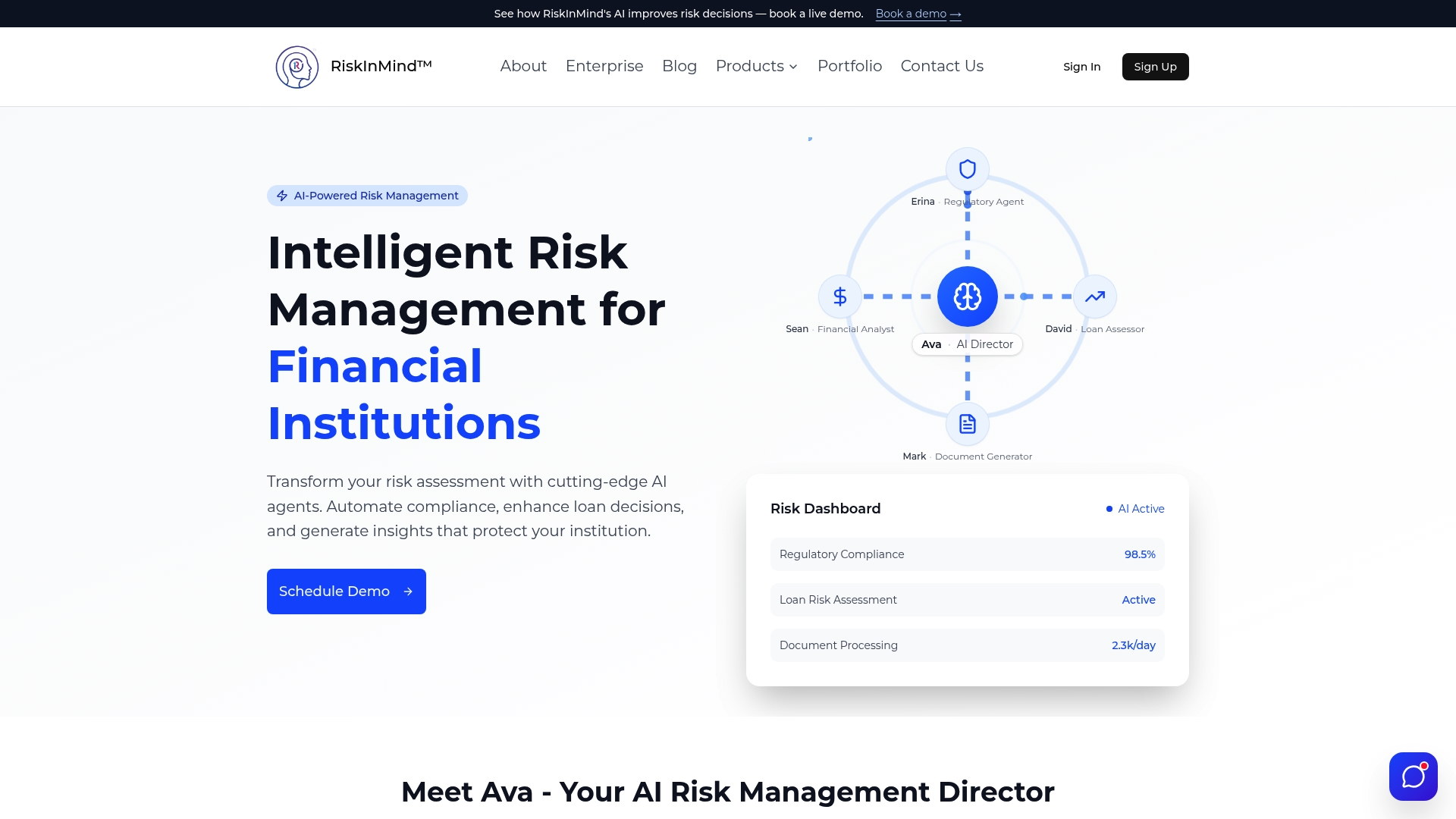
RiskInMind's AI-powered platform is built for exactly the kind of structured, checklist-driven underwriting workflow described in this guide. The AI Loan Assessor automates underwriting assessments, enforces 5 Cs analysis, and generates audit-ready decision documentation with every file. For commercial real estate portfolios, the CRE Loan Risk Predictor delivers property-level risk scoring that integrates directly into the collateral and conditions phases of your checklist. Both tools include exception handling, role-based approval routing, and compliance logging that satisfies examiner expectations without manual effort. Loan officers and credit analysts at community banks and credit unions use RiskInMind to reduce manual underwriting time and improve decision consistency across every loan type.
FAQ
What documents are required for a loan underwriting checklist?
A standard credit underwriting documentation checklist requires government-issued ID, two years of W-2s or tax returns, recent pay stubs, 60 to 90 days of bank statements, a full credit report, and property documentation for secured loans. Self-employed borrowers must also provide business tax returns and a profit and loss statement.
What are the 5 Cs of credit in underwriting?
The 5 Cs are capacity (ability to repay), capital (borrower funds), collateral (loan security), conditions (loan purpose and market context), and character (credit history). Each maps to specific checklist items and verification steps in the underwriting process.
How long does loan underwriting take?
Underwriting timelines depend heavily on verification method. Digital verification reduces income and asset checks to one to two days, while manual verification can take a week or more per step. A complete digital workflow can compress total underwriting time from several weeks to a few days.
What compliance steps belong in a loan underwriting checklist?
Required compliance steps include KYC identity verification and OFAC screening at intake, fair lending review during analysis, and ECOA and FCRA adverse action notices for any denial. TILA disclosures and flood insurance notices are required at closing for applicable transactions.
Why should recommendation and approval be separate in underwriting?
Separating recommendation and approval through a tiered authority matrix prevents conflicts of interest, distributes workload appropriately, and ensures that loan decisions receive independent review proportional to their risk level. This separation is a recognized best practice and is expected by most bank and credit union examiners.