
Data lineage in banking must demonstrate origin, every transformation applied, who authorized each change, and the controls that governed the process. Regulators accept a risk-based, evidence-backed scope rather than exhaustive manual documentation of every data element in the enterprise. What follows is a compliance-first roadmap: the standards that shape examiner expectations, the design choices that keep scope defensible, and the evidence artifacts that hold up during an exam.
TL;DR:
- Most banks should focus on critical data elements related to regulatory reports and risk models rather than attempting full enterprise-wide attribute-level mapping from the start.
- Automated lineage discovery paired with human validation, reconciliation, and change governance outputs credible evidence suited for examiners.
- Maintaining lineage accuracy requires integrating updates into change management, running regular reconciliations, and revisiting scope as reporting requirements evolve.
- Use of shared data dictionaries, dedicated data stewards, and automation for impact analysis are key to scaling effective lineage programs.
- External AI-backed platforms provide quick, audit-ready lineage evidence, ideal for tight deadlines or limited engineering capacity.
Automate Regulatory Model Risk Governance
Examine models against 32 qualitative criteria and resolve risk Tiers with pre-deployment checklists per OCC 2011-12 guidelines.
Table of Contents
- What data lineage means for banks and auditors
- Regulatory expectations and standards that drive lineage requirements
- Designing a risk-based lineage perimeter: scope, granularity, and CDE selection
- Technical approaches: automated discovery, metadata stores, and knowledge graphs
- Operationalizing lineage: governance, roles, controls, and change processes
- Lineage for models and AI: what model risk managers must capture
- Audit-readiness: deliverables, validation tests, and how to present lineage evidence
- Practical phased roadmap and KPIs for sustainable lineage
- Challenges and common pitfalls in implementing data lineage in banking environments
- Tools and technologies landscape: comparison of leading data lineage solutions for banking
- Best practices for maintaining and updating data lineage over time
- Case studies of successful data lineage implementation in banks
- Author perspective: practical trade-offs and what success looks like
- Presenting RiskInMind as an alternative: audit-ready lineage and risk automation
- Sources
- FAQ
What data lineage means for banks and auditors
Data lineage traces a data element from its point of origin, through every transformation it undergoes, to its final use in a regulatory report, risk model, or executive dashboard. For auditors, that trace is only useful when it comes with control metadata: who touched the data, when, under what authority, and what validation occurred at each step.
Banks generally work at two levels. System-level lineage maps which platforms and pipelines a data element passes through, useful for impact analysis when a system changes or fails. Attribute-level lineage tracks a specific field, say, a loan's risk rating, through every calculation and mapping it undergoes, which is what examiners request when testing a specific regulatory figure. Our related overview of risk reporting optimization covers how this traceability supports governance more broadly.
Auditors typically request:
- Immutable logs showing the timestamped movement of data between systems.
- Transformation code or business logic documentation for each calculation step.
- Reconciliations comparing source values to final reported figures.
- Sign-offs from data owners confirming a change was authorized and reviewed.
Without these artifacts, a lineage diagram is a claim, not evidence.
Regulatory expectations and standards that drive lineage requirements
Lineage requirements did not emerge from an abstract preference for tidy data. They trace directly to supervisory principles written after the 2008 financial crisis exposed how poorly many large banks could reconstruct their own risk exposures. The BCBS 239 principles for effective risk data aggregation and risk reporting require that banks aggregate and report risk data that is accurate, complete, timely, and adaptable to ad hoc requests, and that requirement is functionally impossible to demonstrate without a working lineage capability behind it.
The RDARR Guide and subsequent supervisory materials pushed this further by demanding attribute-level traceability rather than system-level summaries, a shift that drove a wave of remediation programs across banks that had previously documented lineage only at the platform level.
In the United States, interagency guidance on model risk management, jointly issued by the OCC, the Federal Reserve, and the FDIC, emphasizes a risk-based approach that aligns oversight intensity to a model's materiality and complexity, a principle that extends naturally to lineage scope for the data feeding those models.
Examiners evaluate acceptability on three dimensions:
- Whether the evidence produced actually reconciles source to output.
- Whether the scope decision has a documented, risk-based rationale.
- Whether governance around changes to lineage and data flows is demonstrable, not asserted.
Our risk data aggregation guide expands on how these principles translate into a governance program.
Designing a risk-based lineage perimeter: scope, granularity, and CDE selection
Mapping every data element in a bank's environment at full granularity is rarely achievable and almost never necessary. The defensible starting point is identifying critical data elements, the fields that feed regulatory reports, capital calculations, or credit decisions, and reserving attribute-level tracing for those alone.
A workable sequence looks like this:
- Inventory the regulatory reports and risk models that carry the highest supervisory and financial impact.
- Trace backward from each report's key figures to identify the CDEs that drive them.
- Classify remaining data elements by risk tier and apply system-level lineage rather than attribute-level tracing where the tier is lower.
- Document the rationale for each scope decision in a form an examiner can review without follow-up questions.
For elements outside the CDE list, many banks adopt a trusted-source or trusted-transform approach: once a source system or transformation logic has been validated as reliable, subsequent uses can reference that validation rather than re-proving it every time. This keeps the lineage program maintainable without abandoning rigor where it matters most.
Pro Tip: Start your CDE list from the regulatory reports themselves, not from a data dictionary. Working backward from what regulators read keeps the scope tied to actual risk.
Our guide on fixing risk data quality within a 90-day window walks through this prioritization in more operational detail.
Technical approaches: automated discovery, metadata stores, and knowledge graphs
Manual lineage documentation, built from interviews and static diagrams, tends to go stale the moment a pipeline changes, which is exactly why it fails audits months after being drawn. Automated discovery techniques, including ETL and query log parsing and metadata harvesting directly from production systems, produce lineage that reflects what the infrastructure is actually doing today rather than what a document claimed it did last year.
Metadata catalogs and knowledge graphs turn that harvested information into something usable: a queryable map of relationships between systems, fields, and transformations that supports impact analysis (what breaks if this field changes) and gives examiners a visual trail they can follow without a translator.
Automated lineage still needs human validation before it is exam-ready. Practical techniques include:
- Hash-based reconciliation comparing source values against transformed outputs to catch silent drift.
- Sampling transformation logic and recording specific test cases as evidence.
- Automated alerts triggered when metadata changes affect a critical data element.
Automated lineage paired with human review and reconciliation is what makes an algorithmic lineage path credible to examiners. EY's analysis of sustaining lineage value notes that automated output without change governance and review evidence rarely holds up on its own.
Manual annotation still has a place: unstructured data sources, legacy systems with no accessible logs, and judgmental adjustments made outside a system's normal workflow all require someone to document intent that automation cannot infer. Our piece on automation's role in financial compliance covers why production-derived lineage is generally preferable where it is feasible.
Operationalizing lineage: governance, roles, controls, and change processes
Lineage accuracy decays without ownership. Data owners are accountable for the business meaning and quality of a data element; data stewards manage day-to-day maintenance of lineage metadata; platform engineers keep the automated discovery tooling running against evolving pipelines; and model owners are responsible for the inputs and provenance behind any model built on that data.
Lineage capture belongs inside the software development lifecycle and change management process, not bolted on afterward. When a pipeline changes, an update to its lineage metadata should be a required step in the release checklist, not a quarterly cleanup task.
Ongoing control artifacts include:
- Scheduled reconciliations comparing lineage-traced values against independent calculations.
- Exception workflows that route discrepancies to a named owner with a resolution deadline.
- Audit trails documenting every material change to lineage metadata and who approved it.
Where lineage depends on vendor platforms or externally sourced data, third-party validation becomes part of the control set: supervisory guidance stresses prioritizing higher-risk vendor relationships for validation of both the model and the data feeding it.
Lineage for models and AI: what model risk managers must capture
Model risk management guidance treats the data feeding a model as inseparable from the model itself, which means lineage for model inputs and engineered features carries the same scrutiny as lineage for a regulatory report. A model that produces accurate outputs from poorly traced inputs is still a governance gap.
The practical checklist includes:
- An inventory of every input feeding the model, traced to its source system.
- Feature provenance documentation showing how raw inputs became derived variables.
- Version records for the datasets used in training and validation.
- Ongoing performance monitoring logs tied to specific data versions.
Interagency model risk guidance from the OCC, Federal Reserve, and FDIC informs how much oversight this scrutiny requires, scaling expectations to a model's materiality and complexity rather than applying a single standard to every model in the portfolio.
Pro Tip: Treat feature-engineering steps as CDEs in their own right. A derived risk score is only as defensible as the transformation logic that created it.
Audit-readiness: deliverables, validation tests, and how to present lineage evidence
Examiners rarely accept a lineage diagram alone. The minimum evidence set includes lineage maps tied to specific CDEs, the transformation logic or code behind each calculation, immutable logs of data movement, reconciliations proving source-to-output accuracy, and a history of exceptions and how they were resolved.
A practical way to organize evidence for an exam:
- Package lineage maps by regulatory report, not by system, so examiners can follow the trail they are actually testing.
- Attach reproducible reconciliation scripts rather than one-time spreadsheets, so a test can be rerun on demand.
- State scope and known limitations upfront, including any data elements still on a remediation timeline.
- Include the remediation plan and target date for any gap rather than waiting to be asked.
Common red flags include lineage that stops at the system level for a CDE that needs attribute-level detail, reconciliations that do not tie back to an underlying log, and undocumented manual adjustments. Preempting these with a clear, honestly scoped evidence package tends to shorten the exam cycle considerably.
Practical phased roadmap and KPIs for sustainable lineage
A phased build keeps the program funded and credible rather than stalling under its own scope.
- Phase 0, discovery: Identify the regulatory reports and models that matter most, and derive the CDE list from them.
- Phase 1, proof of concept: Deploy automated discovery against one high-value report, validate it with reconciliation and sampling, and codify the governance rules that worked.
- Phase 2, scale: Extend automated lineage across the full CDE list, embed lineage checks into change management, and retire manual documentation where automation now covers the gap.
Useful KPIs to track progress:
- CDE coverage percentage, the share of critical elements with validated lineage.
- Mean time to trace, how long it takes to reconstruct a data element's history on request.
- Audit exception volume, tracked over successive exam cycles.
- Percentage of lineage that is automated versus manually documented.
Starting with a single high-value report, as BCBS 239 implementation experience suggests, gives a program an early, demonstrable win that makes the business case for further funding far easier than a enterprise-wide proposal ever does. Lineage work also pairs naturally with broader data modernization efforts already underway, since the metadata infrastructure built for lineage tends to serve data quality and reporting automation as well.
Challenges and common pitfalls in implementing data lineage in banking environments
The most common failure mode is scope creep in the opposite direction of what governance intends: teams attempt enterprise-wide, attribute-level mapping from day one, exhaust budget and engineering time, and deliver partial coverage that satisfies no one. Legacy systems compound the problem, since many core banking platforms predate structured logging and require custom extraction work just to make automated discovery possible.
A second recurring issue is ownership drift. Lineage metadata that nobody is accountable for maintaining degrades within a few change cycles, leaving a program with a beautiful diagram that no longer matches production. Manual documentation is especially prone to this, since it depends on someone remembering to update a diagram after a pipeline change rather than the change itself triggering an update.
Siloed tooling is a third pitfall: different departments building separate lineage capabilities for risk reporting, model governance, and data quality, each with its own metadata format, creates duplicated effort and inconsistent answers to the same question depending on which team is asked. Advisory reviews of implementation experience across banks consistently point to a common remedy: appointing dedicated data stewards, building shared data dictionaries, and integrating lineage output directly with data quality controls rather than treating them as separate initiatives.
Underestimating validation effort is the last major trap. Automated discovery tools generate lineage quickly, but that output still needs reconciliation and human review before it is defensible in an exam, and skipping that step is the fastest way to have automated lineage rejected as evidence.

Tools and technologies landscape: comparison of leading data lineage solutions for banking
The lineage tooling market splits broadly into three categories. Enterprise data catalog platforms build lineage as one feature within a broader metadata management suite, useful for banks that need lineage alongside data quality scoring, business glossaries, and stewardship workflows in a single system. Dedicated lineage and observability tools focus narrowly on automated discovery from logs, queries, and ETL pipelines, generally offering faster time-to-value for teams that already have a metadata strategy elsewhere and just need traceability filled in. Open-source metadata frameworks give engineering teams full control over extraction logic and storage, at the cost of needing in-house resources to build and maintain the integrations.
Selection generally comes down to three questions: how much of the lineage can be harvested automatically from existing infrastructure versus how much requires custom connectors, how well the tool represents attribute-level detail rather than stopping at the system level, and whether the output format produces evidence an examiner can review without additional translation. A catalog that maps beautifully for internal data discovery but cannot produce a reconciliation-ready audit trail solves a different problem than the one compliance teams actually have.
Banks with heavy legacy infrastructure often find that no single tool covers the full environment, and end up combining an automated discovery layer for modern pipelines with manual annotation for the systems that predate structured logging, a hybrid approach that reflects the practical limits of the current tooling landscape rather than a failure of planning.
Best practices for maintaining and updating data lineage over time
Lineage that is accurate at launch and stale within six months provides no lasting audit value, so maintenance discipline matters as much as the initial build. The single most effective habit is tying lineage updates to the change management process itself: any pipeline, schema, or transformation change that touches a critical data element should trigger a lineage metadata update as part of the release, not as a follow-up task assigned later.
Scheduled reconciliation, run on a fixed cadence rather than only before an exam, catches drift while it is still small and traceable to a specific change. Automated alerts on metadata changes affecting CDEs give stewards a way to catch unintended breaks without manually reviewing every pipeline on a schedule.
Periodic re-validation of the CDE list itself matters too: regulatory reporting requirements shift, new models get deployed, and a CDE list built two years ago may no longer reflect where the actual risk concentration sits. Revisiting scope annually, or after any material change to reporting obligations, keeps the lineage program aligned with what examiners are currently testing rather than what they tested previously.
Finally, treating lineage documentation as a living artifact rather than a project deliverable changes the incentive structure for maintaining it. Programs that assign lineage maintenance to a dedicated steward with defined KPIs, rather than leaving it as an unowned byproduct of the original build, are the ones that stay defensible years after the initial rollout.
Case studies of successful data lineage implementation in banks
Supervisory implementation reviews across the industry point to a consistent pattern behind successful programs rather than a single dramatic overhaul. Banks that made durable progress tended to start with a narrow, high-value pilot, often a single regulatory report, and used that pilot to work out the scope rules, validation scripts, and governance structure before attempting to scale.

The common thread in these reviews is that improvement showed up wherever banks added structural pieces rather than more documentation: appointing dedicated data stewards accountable for lineage accuracy, building shared data dictionaries that gave a single definition to each CDE across departments, automating report generation so lineage output fed directly into regulatory submissions, and layering reconciliation frameworks on top of the automated discovery output rather than trusting it unchecked.
The lesson that carries across these implementation reviews is less about any single tool choice and more about sequencing: prove the model on one report, codify what worked, then scale the same pattern rather than reinventing governance for each new domain.
Author perspective: practical trade-offs and what success looks like
The banks that get lineage right are rarely the ones with the most exhaustive maps. They are the ones that picked a handful of critical data elements, proved traceability end to end, and built governance around that proof before expanding. Exhaustive mapping efforts tend to stall under their own weight and produce documentation nobody maintains past the first audit cycle.
Cross-functional sponsorship matters more than any single tool choice: a lineage program owned jointly by risk, technology, and compliance survives reorganizations that kill single-department initiatives. Automation reduces the long-term maintenance burden, but only when paired with the governance to keep it accurate, which is the trade-off worth internalizing before the first CDE is even selected.
— Raj
Presenting RiskInMind as an alternative: audit-ready lineage and risk automation
Building an in-house lineage program from scratch takes engineering time most compliance and risk teams do not have to spare, particularly when an exam cycle is approaching faster than a build roadmap allows.
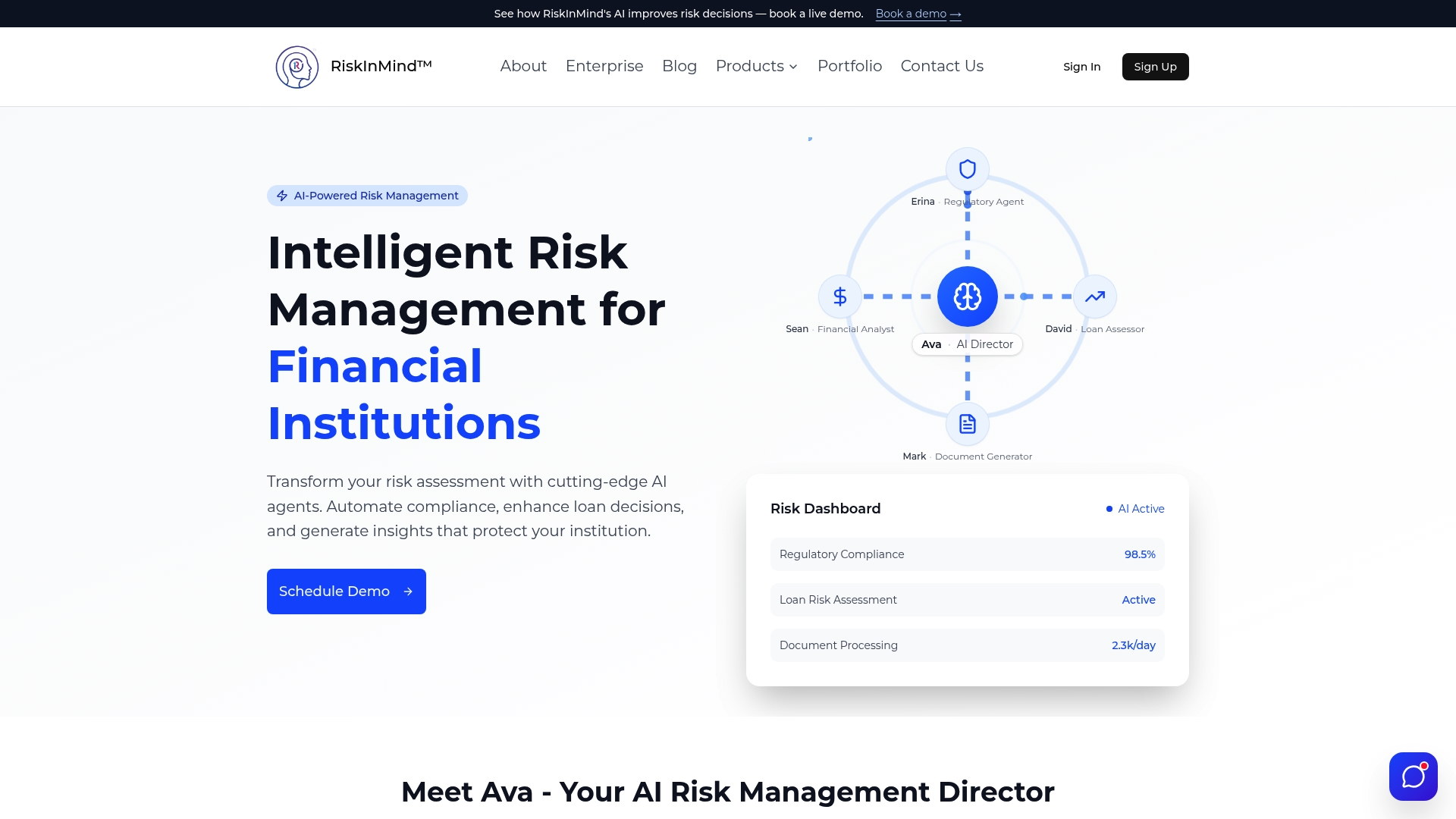
An AI-powered platform can help financial institutions produce audit-ready evidence without building an extensive lineage engineering function. Such platforms often coordinate multiple specialized AI agents to cover regulatory compliance, credit risk, and portfolio monitoring, generating granular audit trails and real-time dashboards for examiners. These solutions emphasize bank-grade security, SOC 2® aligned controls, and real-time processing with fast response times, ensuring lineage evidence reflects current data rather than a static snapshot.
For teams facing tight timelines or limited engineering headroom, a platform route can produce demoable evidence faster than a build effort starting from zero. Explore pricing across the Starter, Professional, and Enterprise plans or see the full platform capabilities to evaluate fit against your own roadmap.
This article is general information, not a substitute for advice from a qualified financial advisor. Consult a qualified financial professional about your own circumstances before acting on anything here.
Sources
- Deloitte whitepaper: The new frontiers of data lineage in banking
- Model Risk Management: Revised Guidance | OCC (2026)
FAQ
What is lineage in banking?
Lineage in banking is the documented trail showing where a data element originated, what transformations it went through, and who authorized each change before it reached a report or model. It gives auditors and regulators a way to verify that a reported figure can be traced back to its source with the controls that governed it intact.
What is an example of data lineage?
A typical example traces a loan's risk rating from the origination system, through a credit scoring transformation, into a portfolio risk model, and finally into a regulatory capital report, with each step logged and reconciled. That trail lets an examiner confirm the final reported figure matches its underlying source data.
Which tool is used for data lineage?
Banks generally choose between enterprise data catalog platforms that include lineage as one feature, dedicated automated lineage and observability tools, or open-source metadata frameworks, depending on existing infrastructure and available engineering resources. Some institutions also use AI-driven risk platforms that generate lineage and audit trails as part of a broader compliance and reporting workflow, such as RiskInMind.
What is an example of data lineage failing an audit?
A common failure is lineage that stops at the system level for a data element an examiner expects to see traced to the specific attribute, leaving no way to confirm which transformation produced the final figure. Another is a reconciliation that does not tie back to an underlying log, which leaves the claimed lineage unverifiable.