
The AI orchestration layer in banking is the runtime system that coordinates agents, core banking systems, and human decision-makers into a single governed execution path. It matters now because banks no longer need another chatbot; they need reliable, auditable automation across fragmented systems that regulators can inspect after the fact. Without orchestration, agentic AI stays a demo. With it, governance and speed become the same feature.
- Orchestration involves managing multiple AI agents and human reviewers within a live, event-native system that provides an immutable audit trail for compliance.
- Most patterns favor concurrent workflows for speed but increase costs and security boundaries, while sequential handoffs lower costs but add latency.
- Reliable orchestration requires a durable, fault-tolerant architecture with event streaming, model routing, and comprehensive observability, especially when integrating legacy systems.
- Embedding governance directly into the orchestration layer ensures auditability, role-based controls, and human gatekeeping for high-risk decisions, reducing compliance gaps.
- Initial pilots should focus on high-value, cross-silo workflows with built-in audit and governance, clear success metrics, and security controls from the start to enable future scaling.
Maintain 100% NCUA & OCC Audit Readiness
Monitor regulatory updates 24/7, check internal credit policies, and generate compliance trails with Erina (AI Regulatory Agent).
Table of Contents
- What Is the AI Orchestration Layer in Banking?
- How Do Multiagent Orchestration Patterns Work in Practice?
- What Architecture Do You Need to Run This Reliably?
- How Do You Embed Governance Into the Orchestration Substrate?
- Where Does Orchestration Deliver the Biggest Impact in Banking?
- What Should a First Orchestration Pilot Look Like?
- What Does a Compliance-First Orchestration Platform Look Like in Practice?
- Where Should Banks Put Their Orchestration Budget Next?
- Ready to Pilot Governed Orchestration in Your Institution?
- Sources
- FAQ
What Is the AI Orchestration Layer in Banking?
Orchestration is not integration, and it is not the model. Integration moves data between systems; the model reasons over inputs. The orchestration layer sits above both, deciding which agent acts, in what sequence, with what permissions, and what gets logged when it does. Forrester frames this shift as orchestration moving from chatbot interfaces into a core execution layer that runs entire customer and employee journeys across core banking, KYC/AML, and risk systems.
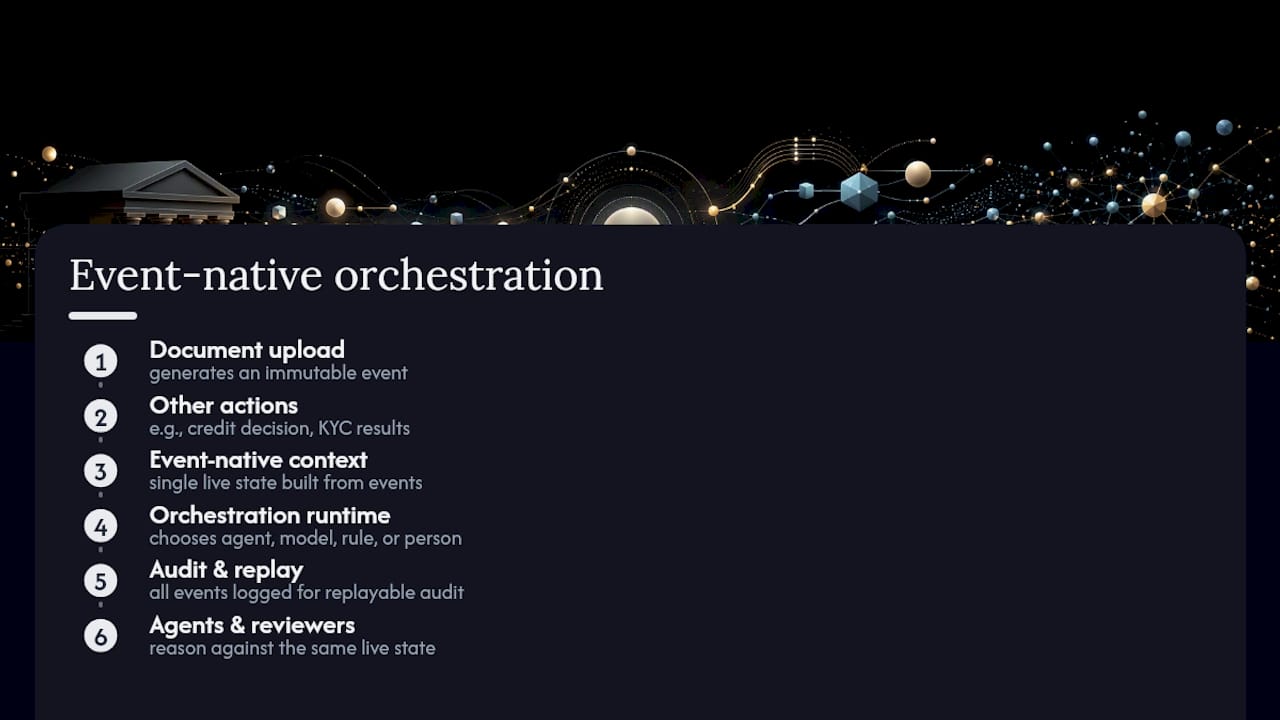
Underneath that layer sits what architects call an event-native substrate: a single live context built from immutable events rather than scattered database writes. Every action, from a document upload to a credit decision, becomes an event that can be replayed later for audit. XYB's platform architecture describes this event-native approach as the mechanism that lets agents and human reviewers reason against the same live state. The orchestration layer then manages agent runtime, interprets intent, and invokes the right decision, whether that decision comes from a model, a rule, or a person.
How Do Multiagent Orchestration Patterns Work in Practice?
Most banking workflows need more than one agent talking to itself. The pattern you choose determines cost, latency, and how much specialization you get in return. Microsoft's Azure Architecture Center documents the core patterns worth knowing:
- Single-agent: one agent handles the full task, suited to narrow jobs like drafting a routine disclosure letter.
- Fan-out/fan-in: several agents work a task in parallel, then a coordinator merges results, useful for scoring a loan application against credit, fraud, and compliance checks at once.
- Handoff: one agent passes a task to a specialist agent mid-workflow, common when a general intake agent routes a suspicious transaction to an AML specialist.
- Manager (or magnetic): a lead agent assigns and supervises subordinate agents, fitting complex case management where priorities shift as new data arrives.
Concurrent patterns raise throughput but also spike token consumption and infrastructure load, so the trade-off is speed against cost, not speed for free. Sequential handoffs cost less per run but add latency, since each step waits on the last. Multiagent designs also draw clearer security boundaries: a fraud agent never needs underwriting data, so splitting responsibilities limits what any single compromised agent can reach. Research on dynamic sub-agent creation shows that orchestrators spinning up specialized sub-agents on demand, rather than running one generalist model, tend to improve accuracy while giving teams a lever to tune cost against performance.
What Architecture Do You Need to Run This Reliably?
Agentic orchestration only works if the plumbing underneath it can hold state across long-running processes and survive failures without losing the audit trail. Four components carry most of that weight:
- Durable execution engine: manages long-running workflows, automatic retries, and instance state so a failed step resumes instead of restarting from scratch.
- Event streaming and lakehouse storage: change data capture pipelines (commonly Kafka-based) feed a lakehouse that holds the live context and doubles as an immutable, replayable audit trail.
- Model routing and tool invocation: a routing layer decides which model or tool handles a given step, based on cost, latency, or sensitivity of the task.
- Observability: LLM traces, token burn, and latency metrics need the same monitoring discipline banks already apply to core transaction systems.
Connectors to legacy core banking platforms remain the hardest part in practice, since most core systems were never built to expose event-level detail. Reference implementations like EvolutionAI show one workable path: coordinated agent roles paired with staged pipelines and living dashboards that keep legacy modernization work observable instead of opaque.
How Do You Embed Governance Into the Orchestration Substrate?
Governance bolted on after deployment rarely survives contact with an examiner. It has to live inside the substrate itself, where every agent action is already an inspectable event. Practitioners increasingly describe this as an "evidence control layer," where authorization, audit, and policy enforcement run at the same layer as execution rather than as a separate compliance step. Oracle's architecture guidance makes this case directly: governance-as-substrate beats governance-as-afterthought because you cannot retrofit auditability into a system that never logged its own reasoning.
Three runtime controls do most of the work:
- Immutable audit trails: every agent decision, prompt, and output gets logged in a way nothing downstream can quietly alter.
- Runtime identity and role-based policy: each agent carries its own identity and permission set, so a document-summarization agent physically cannot query core deposit balances.
- Feature-level restrictions: granular controls on which agents can call external models prevent sensitive data from leaving the institution's boundary.
High-risk actions, payments releases, credit decisions, sanctions hits, still need a deterministic human gate. Orchestration should route those cases to a person and hold the workflow open until a decision is logged, not auto-approve them for speed.
Pro Tip: Before any pilot goes live, run a replay test: capture a real input event, replay it through a sandboxed version of the orchestrator, and compare outputs and logs against the original run. If the two don't match behaviorally, you have a governance gap, not a performance issue.
Where Does Orchestration Deliver the Biggest Impact in Banking?
Four use cases consistently show measurable gains once orchestration replaces manual handoffs between systems and teams:
- Fraud triage: orchestrated agents pull transaction history, device data, and prior case notes into a single packet before an analyst opens the case, cutting prep time and raising analyst throughput per shift.
- AML and sanctions case handling: structured extraction agents pre-fill case narratives from raw alerts, improving mean time to disposition without changing who makes the final call.
- Loan underwriting drafts: orchestration assembles credit memo drafts from financials, bureau data, and policy checks, shortening time to decision while preserving the full audit trail an examiner would want to see.
- Legacy modernization: agent pipelines analyze and translate old codebases, with a human validator reviewing every generated change before it merges.
Each case follows the same underlying shape: agents handle assembly and drafting, humans keep the final judgment call, and the orchestration layer logs everything in between.
What Should a First Orchestration Pilot Look Like?
Scale comes later. The first pilot's job is proving governance and value together, not just automation speed.
- Pick one narrow, high-value workflow that crosses at least two silos, like data pipelines and a human analyst queue, with a clear KPI such as analyst hours saved or mean time to disposition.
- Protect the data path with a VPC or internally hosted model, plus feature-level controls that block agents from calling external APIs with sensitive fields.
- Instrument observability from day one: LLM traces, token usage, retry rates, and drift alerts, not added retroactively once something breaks.
- Build the governance gate before the demo, including decision gates, a replay test, and role-based access mapped to real job functions.
Pro Tip: Define success metrics before the pilot starts, not after results come in. A pilot that only measures "did the agent work" instead of "did it save the analyst time and pass an audit replay" will look successful and still fail the second the compliance team asks hard questions.
What Does a Compliance-First Orchestration Platform Look Like in Practice?
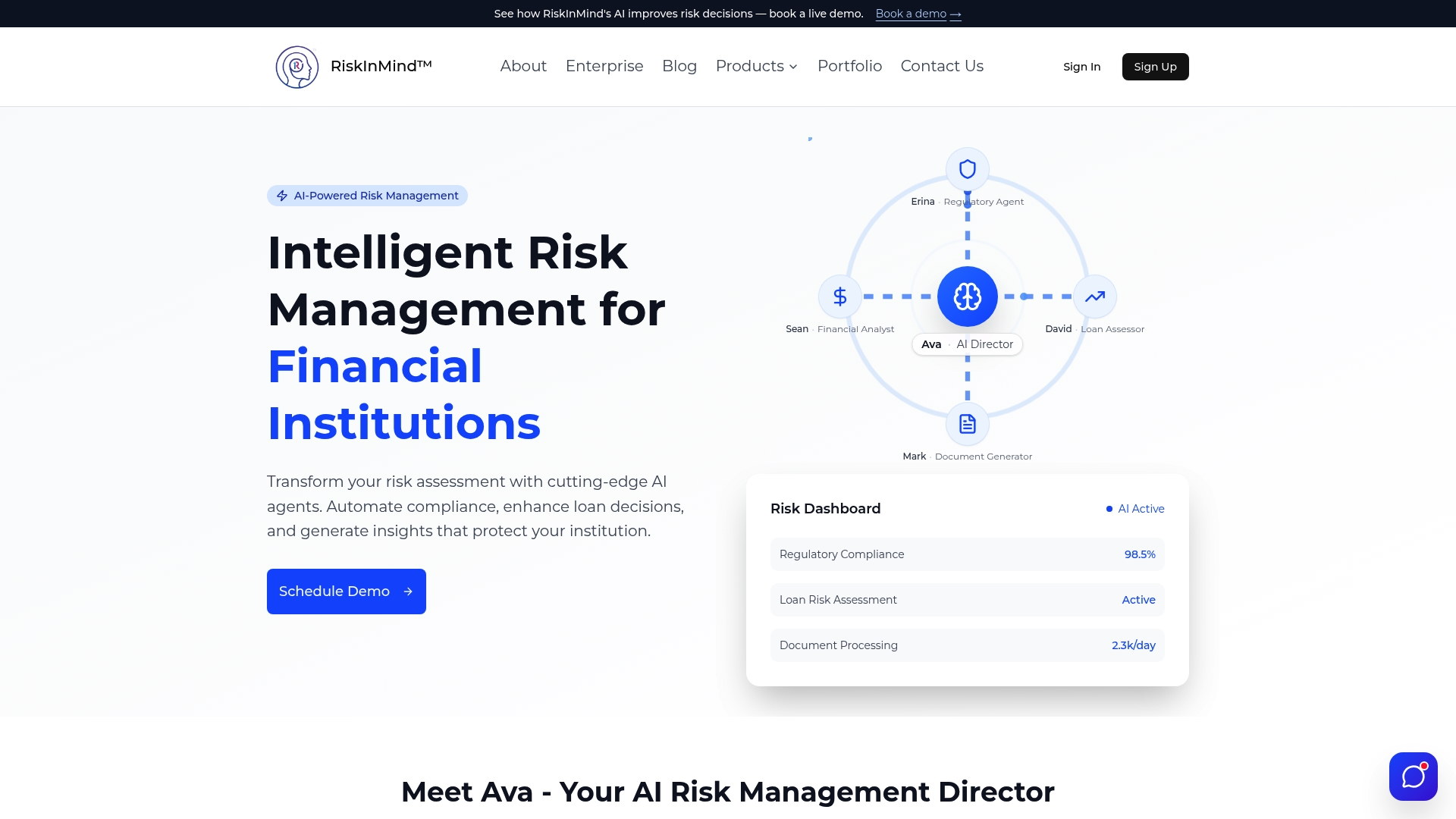
A platform example runs specialized AI agents, covering credit risk, regulatory compliance, and market analysis, under a central AI director who coordinates handoffs the way a manager pattern would in a general orchestration design. This platform is built around SOC 2 aligned controls, bank-grade security, and audit-ready reporting, so the governance controls described above are native to the substrate rather than layered on top. For a deeper technical look at how runtime compliance and agent coordination work together, read Riskinmind's guide to enterprise agent orchestration or its breakdown of governance-first AI loan underwriting.
Where Should Banks Put Their Orchestration Budget Next?
Fraud triage and loan underwriting drafts pay off first because the KPIs are obvious and the human gate stays firmly in place, which makes both easy to defend to a risk committee. The bigger mistake I see is treating governance as a phase two project. Bolt it on later and you will re-architect the whole substrate once an examiner asks for a replay you cannot produce. Build the audit trail and decision gates into the pilot from day one, and the harder cases (AML disposition, legacy modernization) get easier because the control pattern is already proven. Run these pilots as joint work between risk, engineering, and operations, not as an engineering side project risk signs off on later.
— Raj
Ready to Pilot Governed Orchestration in Your Institution?
Most orchestration vendors sell you the automation and leave the audit trail as an exercise for your compliance team. Riskinmind builds bank-grade security and SOC 2 aligned controls directly into the substrate, so every agent action, from Ava's routing decisions down to a single credit memo draft, stays inspectable and replayable without a separate compliance layer bolted on afterward.
If you're evaluating where orchestration fits your institution first, the Loan Application product line shows how underwriting drafts, audit trails, and decision gates work together in one workflow. For institutions comparing plan tiers, Starter, Professional, and Enterprise pricing is available to review before you commit to a pilot. The fastest next step is requesting a demo through the Riskinmind platform overview to see how a specific use case, fraud triage, AML disposition, or underwriting, would run inside a governed orchestration substrate.
Sources
For deeper technical grounding, consult Forrester's analysis of the orchestration layer, Microsoft's agent design patterns guide, AOrchestra's agentic orchestration research, and the OpenAI Cookbook's orchestration examples.
- The AI Orchestration Layer In Banking Is The New Battleground — Forrester
- AI agent design patterns — Microsoft Azure Architecture Center
- AOrchestra — agentic orchestration research (arXiv)
- EvolutionAI — reference implementation for banking modernization (GitHub)
FAQ
What Is AI Orchestration?
AI orchestration is the runtime layer that coordinates multiple AI agents, systems, and human reviewers into one governed workflow. In banking, Forrester describes it as the control point managing agent runtime, intent interpretation, and decision execution across core systems.
Which Banks Are Leading in AI Banking?
Leadership varies by use case rather than by a single ranking, with institutions differentiating on fraud triage speed, underwriting turnaround, and audit readiness. The clearest signal isn't which bank talks about AI the most, it's which ones can produce a full audit replay of an agent's decision on demand.
What Is the 30% Rule in AI?
If you've seen it referenced for a particular model or workflow threshold, treat it as vendor-specific rather than an industry standard.
What Is the Best AI Orchestration Platform?
The right platform depends on whether you need general-purpose orchestration or banking-specific governance built into the substrate. Riskinmind approaches this with specialized agents coordinated by its AI director, Ava, under SOC 2 aligned controls, which suits institutions that need audit trails and decision gates native to the platform rather than added later.
How Does AI Improve Banking Operations?
AI orchestration improves banking by replacing manual handoffs between fraud, compliance, and underwriting teams with agent-coordinated workflows that log every step. This cuts case prep time for analysts and shortens time to decision on loans, while keeping the audit trail regulators expect intact.