
AI agent orchestration is the control layer that plans, routes, and governs how multiple autonomous AI agents work together to complete a task. Its primary payoff for enterprises isn't speed alone; it's reliability. A well-built orchestration layer turns a collection of unpredictable AI agents into an auditable system, with the observability and human checkpoints that regulated industries require before letting autonomous systems touch production decisions.
TL;DR:
- Most enterprise orchestration platforms use a hybrid pattern combining centralized or hierarchical control with distributed or concurrent execution to balance accountability and scalability.
- Deterministic task routing is preferred for high-risk, regulated paths, while dynamic routing is reserved for exploratory, low-stakes workflows to manage unpredictability.
- Effective governance includes runtime policy enforcement, immutable audit logs, least-privilege tool access, and observability metrics like latency, success rate, and escalation frequency.
- The core operational cycle involves planning, routing, executing with checkpoints, observing performance, and adapting workflows based on real-time metrics.
- Building a governable system from the start prevents costly rebuilds and ensures consistent, auditable decisions, especially critical in regulated financial environments.
Maintain 100% NCUA & OCC Audit Readiness
Monitor regulatory updates 24/7, check internal credit policies, and generate compliance trails with Erina (AI Regulatory Agent).
Table of Contents
- What AI Agent Orchestration Means for Enterprises
- Core Orchestration Patterns and When to Use Each
- Building the Architecture: Routing, Memory, and Runtime Controls
- The Runtime Loop: How Orchestrated Agents Plan, Act, and Adapt
- Governance Controls Built for Autonomous Agents
- A Phased Blueprint for Enterprise Adoption
- Where Orchestration Delivers ROI in Financial Services
- RiskInMind's Approach to Governed Orchestration
- Why Governance Can't Be an Afterthought in Agentic Systems
- See Governed Orchestration Running in Production
- Sources
What AI Agent Orchestration Means for Enterprises
Orchestration sits above your individual agents and tools, deciding what runs, in what order, with what data, and under whose authority. It's the coordination and governance layer, not the agents themselves. A single chatbot answering questions is not orchestration. Ten specialized agents, each handling a discrete task like document extraction, credit scoring, or compliance checks, coordinated by a director that manages handoffs, retries, and audit trails, is orchestration.
That distinction separates it from classic workflow engines like Airflow or Camunda, which execute deterministic, pre-programmed steps. Agent orchestration has to handle non-deterministic reasoning: an agent might interpret a document differently on two runs, call a different tool, or need a human to weigh in mid-task. The orchestrator absorbs that unpredictability and still produces a consistent, traceable outcome.
Enterprises adopt orchestration for reasons that go well beyond raw throughput, though throughput matters. Databricks reports that organizations running multi-agent orchestration complete tasks significantly faster than teams relying on a single end-to-end agent. But speed without control is a liability in banking, lending, and insurance. The real drivers behind enterprise adoption tend to be:
- Reliability at scale: coordinated agents fail gracefully and retry intelligently instead of silently producing bad output.
- Auditability: every decision, handoff, and tool call gets logged, which matters when examiners ask how a credit decision was reached.
- Cost control: routing simple tasks to lightweight agents and reserving expensive reasoning models for complex cases.
- Regulatory alignment: frameworks like the NIST AI Risk Management Framework and its emerging Agentic AI Profile increasingly expect this kind of traceable governance built in.
Platforms built specifically for regulated finance, like RiskInMind, treat orchestration and compliance as the same engineering problem rather than bolting governance on afterward.
Core Orchestration Patterns and When to Use Each
Most production systems settle into one of six coordination patterns, and picking the wrong one is a common reason pilots stall before reaching production.
- Centralized orchestration: a single controller assigns tasks to subordinate agents and owns all state. This is the easiest pattern to audit and debug, which is exactly why regulated environments favor it, but the controller can become a bottleneck under heavy load.
- Distributed orchestration: agents communicate peer to peer without a central authority. It scales well and tolerates node failure, but tracing a decision after the fact gets harder because no single log holds the full story.
- Hierarchical orchestration: a director agent delegates to team-lead agents, which delegate further down. This mirrors how large human organizations work and suits complex, multi-department workflows like loan underwriting that touch credit, compliance, and fraud checks separately.
- Sequential orchestration: agents run in a strict pipeline, each one's output feeding the next. It fits linear approval flows, like intake, review, decision, but a stall anywhere in the chain halts everything downstream.
- Concurrent orchestration: multiple agents work the same problem in parallel, useful for tasks like enriching a loan file from five data sources simultaneously.
- Group chat or handoff orchestration: agents converse and pass control based on the evolving context, which suits open-ended research or negotiation tasks but is the hardest pattern to constrain and test.
JetBrains' architecture guidance notes that most production systems land on a hybrid: centralized or hierarchical control at the top, with distributed or concurrent execution underneath for scale. That hybrid approach gives you a single point of accountability without sacrificing parallel throughput, and it's the shape most enterprise-grade platforms converge on.
Building the Architecture: Routing, Memory, and Runtime Controls
Every production-grade orchestrator, regardless of vendor, needs five technical components working together. Skip one and the whole system becomes either too rigid to be useful or too unpredictable to trust.
The task routing engine decides which agent handles which subtask. Deterministic rules (if the document is a W2, route to the tax-data agent) are easy to audit but brittle. Dynamic, LLM-driven routing adapts to novel inputs but introduces the very unpredictability governance teams worry about. Most mature systems use deterministic routing for known, high-risk paths and reserve dynamic routing for exploratory or low-stakes work.
Memory and state tiers give agents context without forcing them to relitigate the same facts on every call. Short-term memory holds the current task's working context. Episodic memory retains recent interaction history, useful when a human interrupts a workflow and returns to it hours later. Long-term memory stores institutional knowledge, like a lender's underwriting policy, that persists across every run.
Tool connectors and sandboxing govern what an agent can actually touch. Least-privilege access, where an agent only gets the exact API scopes and data fields its task requires, is the single most effective guardrail against an agent doing something it wasn't asked to do. Microsoft's agent design pattern documentation frames this as a first-class architectural decision, not an afterthought bolted on after deployment.
Runtime controls enforce boundaries while the system is live: timeouts that kill a hung agent, retry policies that cap how many times a failed call gets reattempted, confidence thresholds that route uncertain outputs to a human, and policy-as-code rules that block a non-compliant action before it executes rather than flagging it in a report the next morning.
Pro Tip: Build your confidence thresholds around the cost of a false positive, not the cost of a false negative. In underwriting, a system that escalates too aggressively to human review is annoying. One that approves a bad loan autonomously is expensive.
Observability ties it all together with distributed tracing across every agent hop, per-agent performance metrics, and immutable audit trails. ComplyEdge, an open-source runtime compliance engine, demonstrates that policy checks can run at low p99 latencies while still blocking non-compliant actions in real time, proof that governance and speed aren't actually opposed to each other.
- Task routing: deterministic for regulated paths, dynamic for exploratory work
- Memory tiers: short-term, episodic, and long-term, each serving a different context need
- Least-privilege tool access with sandboxed execution
- Runtime enforcement: timeouts, retries, confidence gates, policy-as-code
- Full-stack observability: tracing, metrics, and tamper-evident logs
The Runtime Loop: How Orchestrated Agents Plan, Act, and Adapt
Underneath every orchestration platform runs the same operational cycle: plan, route, execute, observe, adapt. Understanding this loop is what lets an engineering team debug a failure instead of just restarting the pipeline and hoping.
The plan stage decomposes a high-level objective (approve or decline this loan application) into a task queue of discrete steps: pull credit data, verify income, run fraud checks, generate a decision memo. The orchestrator then routes each task to the agent best suited for it, enforcing a handoff schema so the receiving agent gets structured input rather than a loose blob of text it has to reinterpret.
Execution is where most of the visible work happens, and it's also where validation checkpoints matter most. A checkpoint after each agent's output, comparing it against expected schema and confidence thresholds, catches a malformed response before it propagates three steps downstream. When a task fails, the system needs a defined retry and fallback strategy: retry with the same agent, escalate to a more capable model, or hand off to a human reviewer. Silent partial failures, where an agent returns an incomplete answer that looks complete, are one of the most common and hardest-to-catch failure modes in production multi-agent systems. State corruption, where two agents write conflicting updates to shared memory, is the other.
The observe and adapt stages close the loop. Good orchestrators instrument a small set of metrics that actually predict problems before they become incidents:
- p99 latency per agent and per end-to-end workflow
- Task success rate, broken out by agent and by task type
- Cost per execution, since a runaway retry loop on an expensive model can burn budget fast
- Human escalation rate, which tells you whether your confidence thresholds are calibrated correctly
MIT Technology Review's coverage of agent orchestration points out that the real value shows up when agents work substeps in parallel, like literature search, test generation, and code writing, and the orchestrator manages the dependencies between them. The same principle applies directly to underwriting: credit pull, fraud check, and document verification can run concurrently, with the orchestrator holding the dependency graph and reconciling results before the final decision step.
Governance Controls Built for Autonomous Agents
Autonomy changes an enterprise's risk profile in ways traditional software governance wasn't built to handle. An agent that can call tools, write to databases, or trigger downstream actions can also misinterpret a goal, or amplify a small error across dozens of automated calls before anyone notices. The Agentic AI Risk-Management Standards Profile from Berkeley's CLTC frames this plainly: governance measures need to scale with the degree of agency a system has, not apply a flat checklist to every deployment.
The practical answer is combining preventative and detective controls, and treating them as equally important rather than as a first line of defense plus an afterthought. Preventative controls, like tool access limits and policy-as-code rules that block a request outright, stop bad actions before they happen. Detective controls, like continuous monitoring and anomaly detection, catch what slips through and give a compliance team the evidence to investigate. EY's analysis of agentic risk categories recommends exactly this pairing, along with adaptive responsibility assignments so it's always clear who owns an escalation when an agent's confidence drops below threshold.
Runtime policy enforcement beats post-hoc scanning for any workflow that can trigger a high-impact action. Reviewing an agent's decisions after the fact tells you what already went wrong; a policy-as-code engine sitting in the hot path stops the wrong action from executing at all. That's the distinction ComplyEdge demonstrates: deterministic rules evaluated in milliseconds, with legal citations attached to each block, rather than a quarterly audit finding the violation months later.
Effective agentic governance in a financial institution typically includes:
- Defined human intervention points at every stage where an agent's action is irreversible or above a risk threshold
- A model and tool supply chain inventory (sometimes called an AI SBOM) so you know exactly what's running and where it came from
- Immutable audit logs covering every agent decision, handoff, and tool call
- A governance review cadence, not a one-time sign-off, since agent behavior can drift as models update or data patterns shift
Pro Tip: Assign a named human owner to every escalation category before you launch, not after the first incident. "Someone on the compliance team" is not an owner; a specific role with SLA accountability is.
Riskinmind's work on regulatory compliance automation covers how these controls translate into day-to-day operations for banks and credit unions specifically.
A Phased Blueprint for Enterprise Adoption
Moving orchestration from a proof of concept to governed production works best as a staged process, and skipping a phase to move faster almost always costs more time later fixing what broke.
- Assessment and risk scoping: pick a candidate workflow with clear success criteria and bounded risk, like document triage rather than final credit decisions, for your first deployment.
- Architecture and pattern selection: choose your orchestration pattern, define memory tiers, and map out which governance controls apply before writing production code.
- Sandboxing and adversarial testing: stress-test the system with edge cases and adversarial inputs in an isolated environment, and integrate compliance checks before any live data touches it.
- Pilot with strict runtime controls: launch to a limited scope with tight confidence thresholds, aggressive human escalation, and full observability turned on from day one.
- Staged rollout and governance cadence: expand scope incrementally, loosening thresholds only as the data supports it, with a recurring governance review built into the calendar rather than treated as a launch-day formality.
Pro Tip: Resist the urge to widen your pilot's scope before you've reviewed at least one full governance cycle of logs. The failure modes that matter most in agentic systems tend to show up in week three, not day one.
Riskinmind's advanced risk management strategies guide walks through this phased approach in more detail for institutions building their first governed agentic deployment.
Where Orchestration Delivers ROI in Financial Services
Automated underwriting is the clearest example: separate agents check credit history, verify income documentation, screen for fraud indicators, and each decision point writes to an audit trail before a human underwriter reviews exceptions flagged by confidence thresholds. That structure, compared to a monolithic legacy loan origination system, is explored in Riskinmind's comparison of AI-driven underwriting against manual and legacy LOS workflows.
Compliance workflows benefit similarly. Runtime enforcement checks a transaction or disclosure against regulatory rules before it processes, not after, with every check logged as evidence for examiners.
Document ingestion, triage, and remediation form a third pattern: one agent classifies incoming documents, another flags missing or inconsistent data, and a human approves any remediation action before it's applied. Integration points matter here as much as the agent logic itself: connections to your loan origination system, data warehouse, identity and access management layer, and audit repository determine whether the orchestration layer actually fits into how your institution already operates, or becomes another disconnected tool nobody trusts.
RiskInMind's Approach to Governed Orchestration
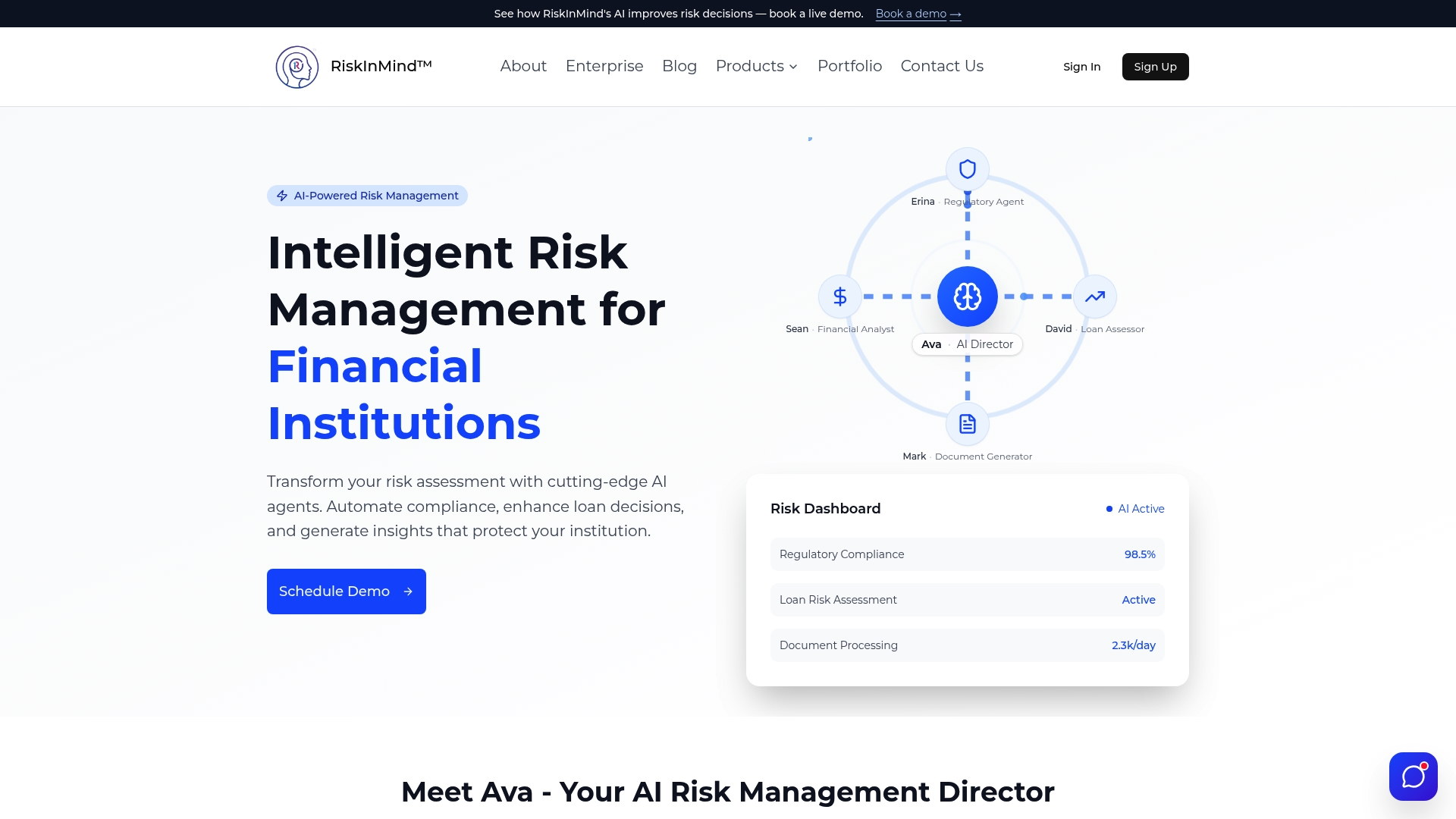
Riskinmind built its platform around a central AI director, Ava, that coordinates a suite of specialized agents covering credit risk, regulatory compliance, and market analysis, the hierarchical pattern discussed earlier applied directly to financial risk management. The platform runs on SOC 2® certified, bank-grade security infrastructure with response times under half a second, built specifically for the auditability and reliability standards this article covers.

Institutions evaluating orchestration platforms should look for the same proof points discussed throughout this guide: documented governance controls, runtime policy enforcement rather than after-the-fact reporting, and observability that produces an audit trail regulators can actually follow. Case studies and client results from institutions running Ava in production are available directly through Riskinmind's platform demos.
Why Governance Can't Be an Afterthought in Agentic Systems
The orchestration frameworks getting the most attention right now optimize heavily for speed and flexibility, and that's the wrong priority order for financial services. A lending institution doesn't need the fastest possible agent pipeline; it needs one that produces the same defensible decision every time an examiner asks how a specific loan got approved or declined.
What surprises a lot of engineering leaders coming into this space is how much of the hard work isn't the AI at all. It's the boring infrastructure: the audit logging, the retry policies, the confidence thresholds calibrated against real cost data instead of guesswork. Teams that treat governance as a compliance checkbox bolted onto a finished system tend to rebuild that system within a year. Teams that build policy-as-code and human checkpoints into the architecture from day one rarely have to.
The lesson from watching agentic deployments succeed and fail in regulated environments is that autonomy and control aren't a trade-off you have to accept. The institutions getting real ROI from multi-agent systems are the ones that invested in the control layer first and let the agents' capabilities grow into that structure, not the other way around.
— Raj
See Governed Orchestration Running in Production
Riskinmind is the direct path to what this guide describes: enterprise orchestration with governance built into the architecture rather than added after a pilot exposes a gap. Where a generic agent framework leaves you assembling routing logic, memory tiers, and compliance checks yourself, Ava coordinates specialized credit, compliance, and market-analysis agents out of the box, with SOC 2® certified infrastructure and sub-second response times already in place.
A pilot with Riskinmind typically starts with one bounded workflow, often underwriting or document triage, run alongside your existing process so you can compare decisions and audit trails directly. When evaluating a demo, check for runtime policy enforcement (not just post-hoc reporting), full audit logging on every agent action, and clear escalation paths to human reviewers. If you're weighing this against sticking with a manual or legacy loan origination system, see how AI-driven underwriting compares to manual and legacy LOS workflows and request a walkthrough tailored to your institution's risk profile.
Sources
- AI agent orchestration (Databricks blog)
- ComplyEdge (runtime compliance engine for AI agents)
- Agentic AI Risk-Management Standards Profile (CLTC/Berkeley)
- Agentic AI risk categories: how to manage three key risks | EY
- AI agent orchestration (JetBrains pages)