
Third-party risk management (TPRM) is the structured process by which U.S. financial institutions identify, assess, monitor, and mitigate risks arising from relationships with external vendors, service providers, and partners — and under FDIC guidance, boards and senior management bear ultimate responsibility for those risks as if the activity were performed in-house. Regulatory scrutiny is intensifying, cyber exposure through vendor channels is expanding, and concentration risk in critical service providers has become a systemic concern. Three signals define the current environment:
- Regulatory accountability: The FDIC, OCC, and Federal Reserve treat third-party activities as extensions of the institution's own operations, with examiners reviewing TPRM frameworks as part of normal supervisory cycles.
- Assessment frequency: Structured programs require at least annual reassessments, plus event-driven reviews when material changes occur.
- AI relevance: According to KPMG, regulatory compliance and cyber risk are the leading drivers of TPRM investment, with spending concentrated on risk assessment and TPRM tooling.
Automate Regulatory Model Risk Governance
Examine models against 32 qualitative criteria and resolve risk Tiers with pre-deployment checklists per OCC 2011-12 guidelines.
Table of Contents
- What Is Third-Party Risk Management and Why Does the Lifecycle Matter?
- Who Is Responsible and What U.S. Regulators Expect
- The Main Types of Third-Party Risk U.S. Financial Institutions Face
- How to Assess, Score, and Tier Vendor Risk
- What to Collect During Diligence and the Contract Clauses That Reduce Risk
- Ongoing Monitoring: KPIs, Dashboards, and When to Reassess
- How AI and Automation Are Changing TPRM
- Realistic Timeline, Staffing, and Cost Considerations
- What to Do When a Vendor Incident or Termination Occurs
- Actionable Checklist and Evidence Templates You Can Reuse
- Key Takeaways
- The Gap Between TPRM Theory and What Actually Gets Done
- Riskinmind: SOC 2®-Certified AI for Financial Institution TPRM
- Useful Sources for Deeper Reading
What Is Third-Party Risk Management and Why Does the Lifecycle Matter?
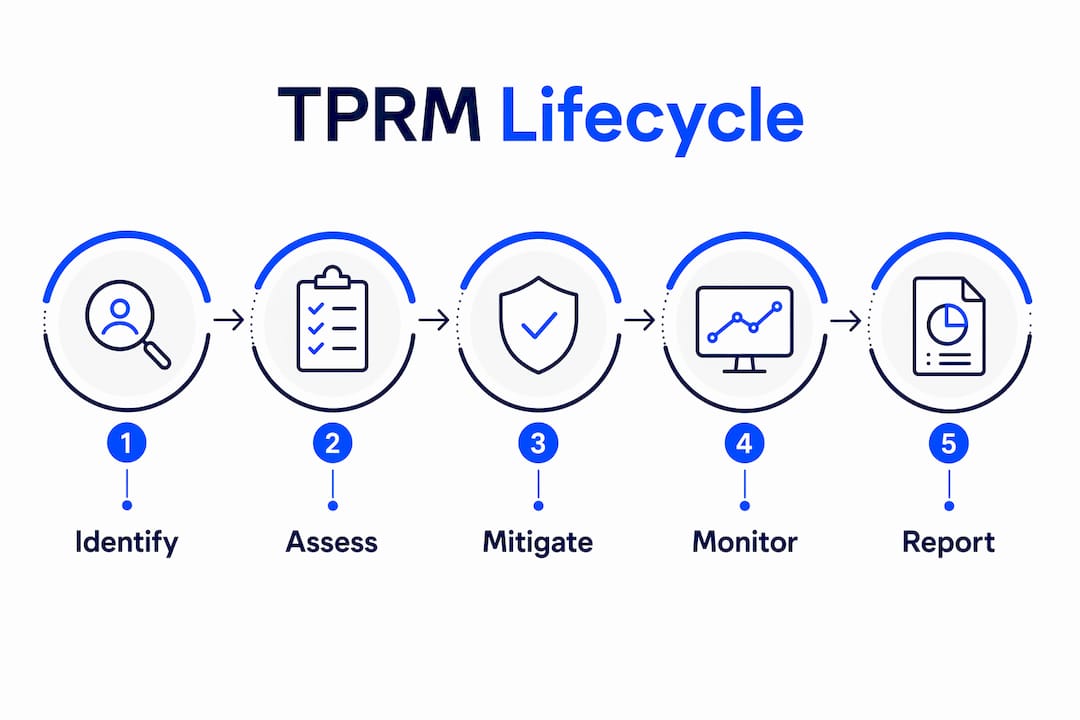
TPRM is most effective when treated as a continuous lifecycle discipline rather than a procurement checkbox. Mature programs structure seven stages from sourcing to offboarding, capturing post-onboarding risks and machine-to-machine access exposures that a one-time review misses entirely.
The stages, and the cross-functional inputs each requires:
- Sourcing and selection: Business owners define need; procurement and legal set baseline standards.
- Intake and onboarding: Risk and compliance collect inherent risk inputs; IT maps access scope.
- Inherent risk scoring: Risk team assigns criticality and data-sensitivity scores before any diligence begins.
- Assessment and due diligence: Security, legal, and compliance review SOC reports, financials, and subprocessor chains.
- Contract structuring: Legal and risk negotiate SLAs, audit rights, and breach notification timelines.
- Continuous monitoring: Risk operations track KPIs, financial health signals, and security posture on an ongoing basis.
- Termination and offboarding: IT, legal, and risk jointly verify access revocation, data return, and contract close-out.
| Lifecycle Stage | Primary Owner | Key Output |
|---|---|---|
| Sourcing / Selection | Procurement, Business Owner | Approved vendor shortlist |
| Inherent Risk Scoring | Risk / Compliance | Risk tier assignment |
| Due Diligence | Security, Legal, Risk | Diligence evidence file |
| Contract Structuring | Legal, Risk | Executed contract with risk clauses |
| Continuous Monitoring | Risk Operations | KPI dashboard, monitoring log |
| Offboarding | IT, Legal, Risk | Access revocation confirmation |
Who Is Responsible and What U.S. Regulators Expect
U.S. regulatory guidance is unambiguous: boards and senior management retain ultimate accountability for third-party risks, with no delegation to a vendor or a compliance team that removes that responsibility. The FDIC's four-element framework — risk assessment, due diligence, contract structuring, and ongoing oversight — forms the baseline examiners use when evaluating a program's maturity.
Minimum governance components a program must document:
- A board-approved TPRM policy with defined scope, risk appetite, and escalation thresholds.
- Assigned roles and responsibilities across the three lines of defense.
- A board reporting cadence that includes concentration metrics, overdue assessments, and material incidents.
- Escalation paths from business owners to senior management and, where required, to regulators.
During exams, supervisors commonly flag weak inherent risk scoring, missing due diligence for legacy vendors, and board reports that lack actionable metrics. Gartner's governance research finds that successful programs adopt centralized or federated governance models with clear escalation thresholds, rather than fully decentralized approaches that leave business units operating without consistent standards.

The Main Types of Third-Party Risk U.S. Financial Institutions Face
Risk categories in vendor relationships are not uniform, and triage depends on understanding which category dominates a given relationship.
- Cyber and data protection: Unauthorized access, data breaches, and machine-to-machine credential exposure — particularly acute where a vendor has direct system integration.
- Operational and business continuity: Vendor outages or capacity failures that impair the institution's own service delivery or processing.
- Concentration and systemic risk: Over-reliance on a single provider for a critical function, creating a single point of failure with no viable substitute.
- Compliance, legal, and consumer protection: Vendor practices that expose the institution to regulatory violations, fair-lending findings, or consumer harm.
- Reputational and strategic risk: Vendor misconduct, financial instability, or ESG failures that reflect on the institution's own brand and strategic direction.
Third-party relationships do not transfer regulatory obligations — they multiply the institution's exposure surface. Every vendor with access to customer data or critical systems is, in effect, an extension of the institution's own risk posture.
How to Assess, Score, and Tier Vendor Risk
Effective third-party risk assessment starts with two inputs before any questionnaire is sent: business criticality and data sensitivity. Without those anchors, scoring produces noise rather than a defensible risk tier.
The practical method follows three steps:
- Define inherent risk inputs: Business criticality (revenue impact, operational dependency), data sensitivity (PII, financial data, regulated data), vendor financial stability, access scope (read-only vs. privileged), and sub-service provider chains.
- Map controls to inherent risk: Collect evidence — SOC 2 reports, penetration test results, insurance certificates — and assess whether vendor controls reduce the inherent score materially.
- Calculate residual risk and assign a tier: Residual risk drives the depth of diligence and monitoring frequency required.
| Risk Tier | Inherent Score Range | Due Diligence Required | Monitoring Frequency |
|---|---|---|---|
| Low | 1–3 | Self-attestation questionnaire | Annual |
| Medium | 4 | SOC 2 Type II, financials | Semi-annual |
| High | — | Full diligence package + on-site review | Quarterly |
| Critical | — | Full package + board notification | Continuous |
What to Collect During Diligence and the Contract Clauses That Reduce Risk
Due diligence evidence that materially supports residual risk reduction:
- SOC 2 Type II reports (current, within 12 months)
- Audited financials or financial health indicators
- Penetration testing results and remediation evidence
- Cyber liability and errors-and-omissions insurance certificates
- Subprocessor and fourth-party lists with access diagrams
- Business continuity and disaster recovery plans with tested recovery time objectives
Contract clauses that carry real risk-mitigation weight:
- SLAs with defined uptime, response times, and financial penalties for breach
- Audit rights allowing the institution to inspect or commission third-party audits
- Breach notification timelines aligned with state and federal requirements
- Data handling, return, and destruction obligations at contract end
- Termination-for-cause rights without penalty when a vendor fails a material obligation
- Indemnification provisions covering regulatory fines arising from vendor failures
Pro Tip: A signed contract is not a technical control. Audit rights are only valuable if exercised. Build a schedule to request updated SOC reports, verify insurance renewals, and confirm subprocessor changes at least annually — do not wait for the next assessment cycle.
Ongoing Monitoring: KPIs, Dashboards, and When to Reassess
Continuous monitoring converts TPRM from a periodic compliance exercise into an operational risk function. Key KPIs worth tracking:
- Percentage of critical and high-tier vendors on continuous monitoring
- Time-to-remediate open findings by severity
- Overdue assessment count by business unit
- Concentration metrics: percentage of critical functions dependent on a single provider
Dashboard views should be role-differentiated. Board and audit committee views need concentration metrics and overdue assessment counts. CRO and risk committee views need finding severity trends and remediation velocity. Business owner views need their own vendor status, upcoming renewals, and open action items.
Triggers for event-driven reassessment include contract renewals, new service additions, security incidents at the vendor, material changes in the vendor's financial condition, and regulatory actions against the vendor. Annual reassessment is the floor, not the ceiling.
How AI and Automation Are Changing TPRM
AI changes the economics of TPRM by reducing the manual labor in evidence collection, scoring, and monitoring without reducing the quality of the underlying analysis. Practical use cases already deployed at mature programs include:
- Automated document extraction from SOC reports, financials, and contracts
- Continuous risk scoring using real-time signals rather than point-in-time questionnaires
- Anomaly detection in vendor behavior and access patterns
- Natural-language contract parsing to flag missing or non-standard clauses
High-quality, standardized vendor data is the single biggest enabler of confident TPRM decisions and effective AI models — institutions that treat vendor data as a strategic asset gain a compounding advantage as their programs mature.
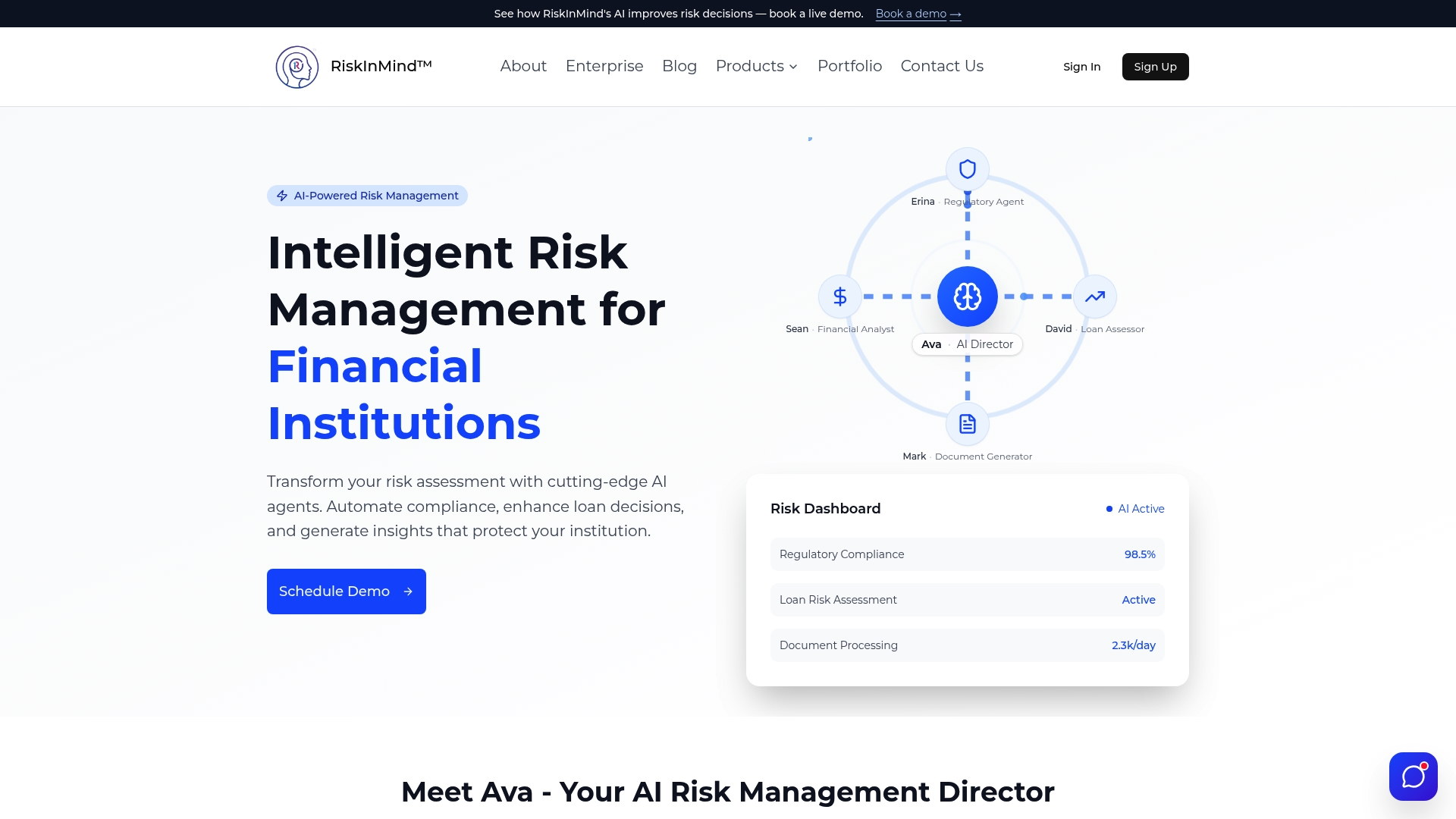
Riskinmind's platform illustrates this architecture directly. A central AI director, Ava, coordinates specialized AI agents covering regulatory compliance, credit risk, and market analysis, processing risk signals in real time with response times under half a second. The platform carries SOC 2® certification and maintains full audit trails, which means the automation output is exam-ready without additional manual documentation. For risk leaders exploring AI-driven risk management, that combination of speed, auditability, and agent coordination addresses the two most common objections to automation: trust and traceability.
Realistic Timeline, Staffing, and Cost Considerations
| Phase | Timeline | Milestone | Primary Owner |
|---|---|---|---|
| Pilot | Months 1–3 | Inventory critical vendors, baseline scoring | Program Owner, Risk |
| Expand | Months 4 | Full vendor population tiered, diligence files complete | Risk, Legal, Security |
| Integrate | Months 7 | Continuous monitoring live, ERM integration active | Risk Ops, Data Engineering |
Core roles a program requires: a program owner with authority to enforce standards, vendor managers embedded in business units, security reviewers for technical diligence, legal for contract negotiations, procurement for sourcing controls, and data engineering if building or integrating a tooling platform.
Cost drivers vary significantly by institution size. Tooling licenses, managed services for discrete diligence tasks, staff time for assessments, and integration work with core banking systems all contribute. KPMG's survey data shows spending concentrated on risk assessment and TPRM tools, reflecting the shift toward automation. Community banks and credit unions often find that a SaaS platform with pre-built workflows reduces both implementation time and ongoing staff burden compared to building from scratch.
What to Do When a Vendor Incident or Termination Occurs
Incident playbook:
- Detect: Identify the incident through monitoring alerts, vendor notification, or internal discovery.
- Contain: Suspend or restrict vendor access pending investigation; preserve logs and evidence.
- Notify: Alert internal stakeholders — CRO, legal, IT security — and assess whether regulatory notification is required.
- Remediate: Work with the vendor on root cause and corrective action; document all steps.
- Escalate: Report to regulators when the incident meets notification thresholds under applicable state or federal requirements.
Offboarding checklist:
- Revoke all system credentials, API keys, and privileged access on or before the termination date.
- Confirm data return or destruction in writing, with a certificate of destruction where required.
- Close out the contract formally and retain all diligence files per your records retention schedule.
- Verify that machine-to-machine integrations and service accounts are deactivated — not just the human user accounts.
Pro Tip: Stale credentials are the most common residual exposure after a vendor relationship ends. Machine identity management — API keys, service accounts, and automated pipelines — requires a separate revocation checklist from the standard user access review.
Actionable Checklist and Evidence Templates You Can Reuse
Onboarding evidence checklist:
- Completed vendor intake form (business criticality, data sensitivity, access scope)
- Inherent risk score with scoring rationale documented
- SOC 2 Type II report (dated within 12 months)
- Subprocessor list and fourth-party access diagram
- Business continuity plan with tested RTO/RPO
Periodic assessment items:
- Updated SOC report or bridge letter
- Renewed insurance certificates
- Penetration test results from the prior 12 months
- Open finding remediation status
Monitoring log fields:
- Vendor name, tier, and assigned owner
- Last assessment date and next scheduled date
- Open findings count by severity
- Concentration flag (yes/no) and substitute availability rating
| Template | Key Fields | Storage Tag |
|---|---|---|
| Vendor Intake Form | Criticality, sensitivity, access scope, owner | Vendor ID + "INTAKE" |
| Risk Scoring Entry | Inherent score, control gaps, residual tier | Vendor ID + "SCORE" |
| Contract Clause Tracker | SLA terms, audit rights, breach notice period | Vendor ID + "CONTRACT" |
| Monitoring Log | KPI values, finding status, reassessment trigger | Vendor ID + "MONITOR" |
Tag every evidence file with the vendor ID and document type so audit retrieval takes minutes, not days.
Key Takeaways
Effective TPRM at U.S. financial institutions requires a structured lifecycle, board-level governance, and continuous monitoring — not a one-time vendor questionnaire.
| Point | Details |
|---|---|
| Board accountability is non-negotiable | FDIC guidance holds boards and senior management responsible for third-party risks as if performed in-house. |
| Lifecycle discipline reduces residual risk | Organizing TPRM across seven stages from sourcing to offboarding captures post-onboarding and machine-identity exposures. |
| Tier vendors by criticality and sensitivity | Scoring inherent risk before diligence begins ensures high-tier vendors receive proportionate scrutiny and monitoring frequency. |
| Contracts are not controls | Audit rights, breach notification timelines, and data-destruction clauses only reduce risk when actively verified and enforced. |
| Riskinmind accelerates the program | Riskinmind's SOC 2®-certified AI platform automates evidence collection, continuous scoring, and audit-ready reporting for financial institutions. |
The Gap Between TPRM Theory and What Actually Gets Done
Most TPRM programs fail not because the framework is wrong but because execution collapses between the policy document and the vendor manager's inbox. The first 90 days of a program build should focus on two things only: inventorying critical vendors and getting inherent risk scores documented. Everything else — questionnaires, contract reviews, monitoring dashboards — depends on knowing which vendors actually matter.
The second pitfall is treating the signed contract as the end of the risk management process. Contracts define obligations; they do not enforce them. The institutions that perform best in regulatory exams are the ones that have verification evidence: updated SOC reports, insurance renewal confirmations, and documented follow-up on open findings. That paper trail is what separates a mature program from a policy binder.
Machine identity is the most underestimated exposure in the entire lifecycle. When a vendor relationship ends, human credentials get revoked. API keys, service accounts, and automated data pipelines frequently do not. Building a separate machine-identity revocation checklist into every offboarding is not optional — it is the control that closes the gap regulators are increasingly asking about. Riskinmind's audit trail and agent-coordination architecture address exactly this kind of systemic blind spot, giving risk leaders documented evidence that access and monitoring controls were applied consistently across the vendor population.
Riskinmind: SOC 2®-Certified AI for Financial Institution TPRM
Financial institutions that want to move from manual spreadsheet-based programs to continuous, audit-ready vendor oversight have a concrete option in Riskinmind. The platform's AI director, Ava, coordinates specialized agents for regulatory compliance, credit risk, and market analysis, delivering real-time risk scoring with response times under half a second — a meaningful contrast to quarterly point-in-time assessments that leave exposure windows open for months.
Riskinmind carries SOC 2® certification and bank-grade security controls, which means the platform's outputs are exam-ready without additional manual documentation. For community banks, credit unions, and regional lenders managing a growing vendor population under tightening regulatory scrutiny, that combination of speed, auditability, and automated risk assessment is the practical path to a program that scales. Request a demo at riskinmind.ai to see how the platform handles due diligence automation, continuous monitoring, and board-ready reporting in a single workflow.
Useful Sources for Deeper Reading
Authoritative references for regulatory language, frameworks, and implementation guidance:
- FDIC Guidance for Managing Third-Party Risk — Primary regulatory source for U.S. bank TPRM requirements, board accountability, and the four-element risk management process.
- Gartner: Third-Party Risk Management (TPRM) — Lifecycle frameworks, governance models, and maturity benchmarks.
- KPMG 2026 Global Third-Party Risk Management Survey — Investment drivers, ERM integration rates, and AI adoption data.
- Thomson Reuters: Third-Party Risk Management Overview — Practical overview of regulatory expectations across OCC, Federal Reserve, and FDIC.
- Basel Committee: Principles for the Sound Management of Third-Party Risk — International principles for bank TPSP arrangements; useful for institutions with cross-border vendor relationships.
- Mitratech: The Third-Party Vendor Risk Management Lifecycle — Stage-by-stage lifecycle reference with template guidance.
- NHI Management Group: Third-Party Risk Management Glossary — Practitioner-focused glossary covering machine identity, offboarding failures, and credential management.
This article is general information for educational purposes. Confirm current regulatory requirements with your primary regulator or qualified legal counsel for your institution's specific situation.
Recommended
- Step by Step Risk Assessment for Financial Institutions | RiskInMind
- Model Risk Management: A Practical Guide for Financial Institutions | RiskInMind
- Risk Management Documentation Standards for Financial Institutions | RiskInMind
- Risk Technology Integration Checklist for Financial Institutions | RiskInMind