
Covenant monitoring automation applies configurable rules, data extraction, and continuous testing to replace manual covenant tracking, cutting the time it takes to detect a breach from weeks to days or hours. Its primary value lies in near real-time breach detection paired with an exam-ready audit trail that satisfies examiner documentation standards. The sections below explain the operational workflow, supervisory expectations, and provide a practical checklist for launching a pilot.
TL;DR:
- Automation reduces detection time for covenant breaches from weeks to hours, especially important given the large backlog of maturing loans in 2025.
- Core capabilities include configurable rules, automated financial data ingestion, and a full audit trail linking test results to source documents.
- Successful pilot programs should focus on a consistent loan segment, clearly define KPIs such as false positives and detection speed, and plan phased expansion.
- Data security is critical, requiring encryption, strict access controls, and vendor certifications like SOC 2, especially when financials are processed externally.
- Integration challenges include reconciling legacy systems' data formats, limited API access, and ensuring contract-specific covenant definitions are properly mapped.
Maintain 100% NCUA & OCC Audit Readiness
Monitor regulatory updates 24/7, check internal credit policies, and generate compliance trails with Erina (AI Regulatory Agent).
Table of Contents
- What covenant monitoring automation is: capabilities and scope
- Why manual covenant monitoring fails and why automation is necessary
- Canonical workflow and technical components of an automated covenant monitoring system
- Regulatory and examiner expectations in covenant monitoring programs
- How to implement: a pilot checklist and KPIs that matter
- How an enterprise AI platform puts this checklist into practice
- Data security and privacy considerations in covenant monitoring automation
- Integration challenges with existing loan management systems
- Common pitfalls and how to avoid them in covenant automation deployments
- Case studies or real-world examples demonstrating ROI and impact
- Future trends and innovations in covenant monitoring automation
- Trade-offs worth weighing before automating
- Get started with RiskInMind
- FAQ
- Sources
What covenant monitoring automation is: capabilities and scope
Covenant monitoring automation refers to software-driven processes that continuously test financial and non-financial covenants against loan-specific thresholds, replacing periodic manual spreadsheet reviews with ongoing, systematized checks. A mature system combines configurable rule sets, loan-level threshold mapping, automated data ingestion, financial statement extraction and spreading, validation logic, and a documented evidence trail that ties every test back to its source data.
Institutions evaluating a platform typically look for these core capabilities:
- Configurable covenant rules that map to each loan agreement's specific thresholds and definitions.
- Automated ingestion of borrower financials, rent rolls, and compliance certificates from multiple formats.
- Financial spreading and ratio calculation that follows a consistent, auditable methodology.
- Evidence retention that links each test result to the underlying document and calculation.
Common covenant tests include debt service coverage ratio (DSCR), leverage ratios, fixed charge coverage, and reporting deadline compliance, each requiring its own threshold logic and escalation path.
Why manual covenant monitoring fails and why automation is necessary
Manual covenant tracking tends to break down at scale. A portfolio manager juggling hundreds of commercial loans, each with different covenant definitions, reporting cadences, and document formats, cannot reliably catch every late submission or miscalculated ratio using spreadsheets alone. Borrower financials arrive in inconsistent formats, loan officers apply slightly different spreading conventions, and exceptions pile up faster than staff can review them.
The consequences compound quickly. A missed breach delays workout response, invites examiner criticism during a review of loan portfolio risk management practices, and leaves credit files with gaps that are difficult to reconstruct after the fact. The OCC's lending and loan portfolio risk management guidance highlights that institutions should track trends in covenant defaults and delinquencies, and notes that underwriting and monitoring functions can be automated where appropriate controls exist.
A significant portion of commercial and multifamily mortgage balances mature in 2025, according to the Mortgage Bankers Association. That concentration of maturities raises the stakes for catching covenant deterioration early, since refinancing conversations depend on a borrower's documented compliance history.
Three metrics tend to reveal whether a monitoring program is keeping pace:
- Time-to-detect: how long a breach sits undetected after it occurs.
- Percentage of loans monitored through automated testing versus manual review.
- Size of the exception backlog awaiting analyst disposition.
Canonical workflow and technical components of an automated covenant monitoring system
A well-built automated covenant monitoring program follows five distinct stages, and understanding each one helps institutions separate genuine capability from marketing language when evaluating vendors.
- Document and data ingestion. Financial statements, compliance certificates, and rent rolls arrive through APIs, secure borrower portals, or monitored email intake, with validation checks confirming completeness and format before any data moves downstream.
- Extraction and financial spreading. Intelligent document processing pulls line items into a canonical data model, applying consistent spreading rules so a DSCR calculation means the same thing across every loan in the portfolio.
- Calculation and mapping. Each covenant is matched to its contract-specific definition and threshold, including any negotiated waivers or cure periods that alter standard pass or fail logic.
- Evaluation and disposition. The system applies pass or fail logic, routes exceptions to a named owner, and triggers escalation rules when a breach crosses a severity threshold.
- Alerting, case management, and audit trail. Every test result, source document, and analyst decision gets logged and retained for the period examiners expect to review.
Pro Tip: Store the calculation methodology alongside each test result, not just the outcome, so an examiner can trace a pass or fail back to the exact inputs and formula used.
The OCC's Commercial Real Estate Lending handbook describes common covenant types such as debt yield and loan-to-value limits, and expects loan policies to set clear underwriting and monitoring standards that an automated workflow must be able to reproduce consistently.
Regulatory and examiner expectations in covenant monitoring programs
Examiners do not evaluate covenant monitoring automation as a technology choice. They evaluate whether the resulting program meets long-standing supervisory expectations for risk identification, measurement, and control. The Federal Reserve's policy statement on prudent commercial real estate loan accommodations and workouts directs institutions to maintain updated borrower financial and collateral information and to monitor loans in a way that supports sound workout decisions.
Supervisory materials tied to that same guidance, including the SR 23-5 attachment, emphasize internal controls, documented workout policies, and an ongoing credit risk review function for accommodated loans. A monitoring program built to satisfy these expectations needs to demonstrate several trust signals during an exam:
- Reproducible covenant tests that produce the same result when rerun against the same inputs.
- Management information system (MIS) reporting that surfaces portfolio-level trends to senior management and the board.
- Audit logs that tie every test to its source document and timestamp.
- Security and control certifications, such as SOC 2, that support data integrity claims.
Automation maps naturally to these expectations because every test, exception, and escalation generates a timestamped record, which examiners can review as workpapers rather than requesting reconstructed history from loan officers.
How to implement: a pilot checklist and KPIs that matter
Launching covenant monitoring automation works best as a scoped pilot rather than a portfolio-wide rollout, since early data quality issues are easier to fix in a contained segment.
- Choose a pilot segment. Pick a loan category with consistent covenant structures, such as a CRE subportfolio, and define a sample size large enough to surface edge cases without overwhelming the team.
- Map data sources. Identify which systems hold borrower financials, rent rolls, and compliance certificates, then build the canonical mapping and validation rules that reconcile against the core banking or loan origination system.
- Define exception routing. Assign named owners for each exception type, set a service level agreement for response time, and establish when a case escalates to a credit officer.
- Set KPIs and acceptance criteria. Track time-to-detect, percentage of loans under automated coverage, false positive rate, and audit completeness, with target ranges defined before the pilot starts so success is measurable.
- Plan the rollout cadence. Expand in phases, monitor for model drift, and revisit threshold definitions as loan agreements and covenant structures evolve.
Pro Tip: Define rollback conditions before the pilot begins, such as an unacceptable false positive rate, so the team has a clear exit path if the first segment underperforms.
Our model drift monitoring guidance covers the governance practices that keep an automated program accurate as portfolios and loan terms shift over time.
How an enterprise AI platform puts this checklist into practice
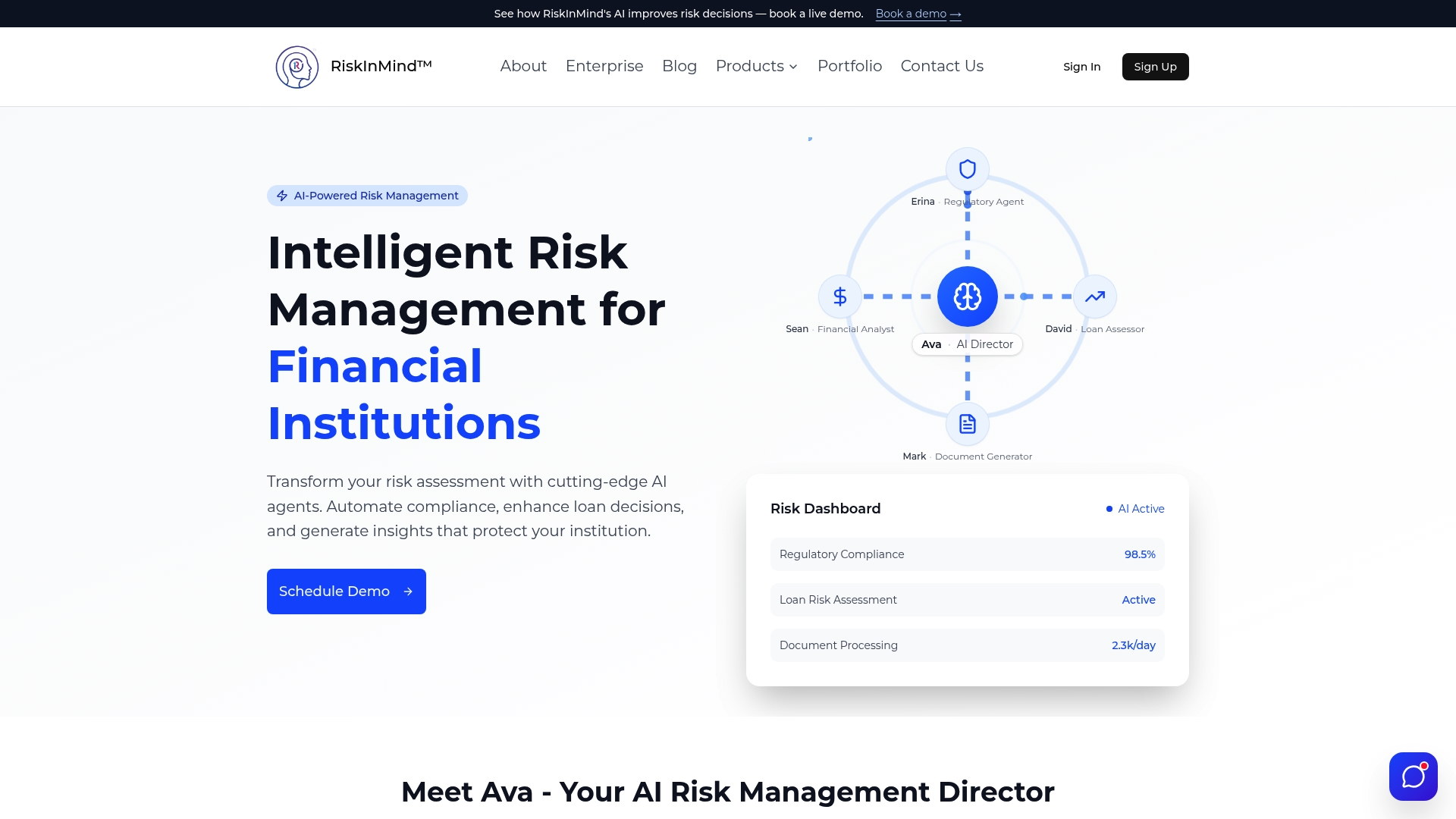
We built our platform around specialized AI agents, coordinated by a central AI director we call Ava, that handle document ingestion, extraction, covenant testing, and audit logging as a connected workflow rather than disconnected tools. The architecture runs with aligned security controls and rapid processing, providing risk teams an auditable evidence trail at every step. Readers ready to scope a pilot can review our compliance testing program approach for a closer look at methodology.
Data security and privacy considerations in covenant monitoring automation
Covenant monitoring systems handle sensitive borrower financials, so data security questions deserve the same scrutiny as the monitoring logic itself. Financial statements, tax returns, and rent rolls flowing through an automated pipeline create multiple points where data could be exposed if encryption, access controls, or retention policies are weak.
Institutions evaluating a platform should ask where data is processed and stored, whether it leaves the institution's own environment or a third party's infrastructure, and how long records are retained after a loan is paid off or charged off. Third-party data exposure is a particular concern when a vendor routes borrower financials through external large language models for extraction, since that introduces a dependency the institution cannot fully audit.
Control frameworks such as SOC 2® give institutions a documented basis for confirming that access controls, encryption, and change management practices meet an independent standard, which matters both for vendor due diligence and for examiner conversations about third-party risk. Role-based access, so that only authorized credit officers and compliance staff can view full borrower files, should be standard regardless of which platform an institution chooses.

Our SOC 2 audit trail design for AI loan underwriting covers how governance-first controls apply to automated lending workflows, including the retention and access questions that come up most often during vendor evaluation.
Integration challenges with existing loan management systems
Covenant monitoring automation rarely operates in isolation. It needs to pull data from a core banking platform, a loan origination system, and often a separate document management tool, and reconcile all three into a single canonical record for each loan. Institutions running older loan management systems frequently find that field definitions do not match cleanly, a covenant threshold stored in one system may use a different ratio convention than the automation platform expects.

API availability is the first practical hurdle. Some legacy loan management systems expose limited or no API access, forcing institutions to rely on batch file exports or manual data entry bridges, which reintroduce the same error risk automation is meant to eliminate. Reconciliation logic has to account for timing differences too, since a covenant test run against stale core banking data produces an inaccurate result even when the automation itself works correctly.
Data mapping is the second challenge. Loan agreements often define covenants with contract-specific language, a fixed charge coverage ratio calculated one way in a 2019 loan agreement and a different way in a 2024 agreement, and an integration has to preserve that nuance rather than forcing every loan into a single generic template.
Institutions that plan for a phased integration, starting with a single loan segment and expanding once reconciliation rules are validated, avoid the common trap of building a system-wide integration before confirming the underlying data is clean.
Common pitfalls and how to avoid them in covenant automation deployments
Several recurring mistakes show up across covenant automation deployments, and most trace back to treating automation as a one-time technology install rather than an ongoing operational program.
Skipping data validation is the most frequent pitfall. Teams sometimes connect a data source and assume extraction accuracy without spot-checking results against manually spread financials, which lets errors propagate silently into covenant test results. Building a validation step into the pilot, comparing automated spreads against a manual sample, catches these issues before they reach production scale.

Under-resourcing exception handling is another common gap. Automation reduces the volume of routine testing, but it does not eliminate the need for a credit officer to review flagged exceptions, and institutions that fail to assign clear ownership and response SLAs end up with the same backlog problem automation was meant to solve.
Treating covenant definitions as generic rather than contract-specific causes downstream accuracy problems, since a single leverage ratio formula applied uniformly across a portfolio with varied loan agreements produces false positives and false negatives alike.
Finally, neglecting model governance after initial deployment leaves a program vulnerable to drift as covenant structures, accounting standards, and loan mixes evolve. Our model drift monitoring resource walks through the maintenance cadence that keeps test logic aligned with a changing portfolio.
Case studies or real-world examples demonstrating ROI and impact
Measuring the return on covenant monitoring automation comes down to tracking the same operational metrics before and after deployment: time-to-detect a breach, percentage of the portfolio under automated coverage, and the size of the exception backlog. A portfolio that previously relied on quarterly manual reviews and shifts to continuous automated testing typically sees breach detection move from a matter of weeks to a matter of days, since the system flags a threshold crossing as soon as updated financials are ingested rather than waiting for the next scheduled review cycle.
The GAO's review of bank supervision and risk monitoring practices underscores why this speed matters: examiners expect institutions to maintain accurate documentation and management information systems capable of identifying portfolio trends such as covenant defaults and credit deterioration as they emerge, not after the fact. An institution that can show a documented, reproducible test history for every loan in a segment demonstrates exactly the kind of control environment examiners are evaluating.
For institutions weighing where to prioritize automation first, portfolio-level analytics tools such as our CRE loan predictor help identify which loan segments carry the highest concentration risk, so pilot scope aligns with where covenant deterioration is most likely to surface. Institutions with concentrated commercial real estate exposure, particularly given the maturity wall facing the market, stand to see the clearest operational payoff from prioritizing those segments first.
Future trends and innovations in covenant monitoring automation
Covenant monitoring automation is moving toward tighter integration between extraction, testing, and portfolio-level risk analysis, rather than treating each as a separate step. Machine learning models are increasingly applied to document extraction accuracy, learning from correction patterns over time so that spreading accuracy improves as more borrower financials pass through the system.
Large language models are changing how institutions handle unstructured covenant language in loan agreements, a function previously requiring manual contract review to identify unusual threshold definitions or waiver clauses now benefits from models trained to parse legal and financial text alongside numerical data. This matters most for portfolios with heterogeneous loan documentation, where generic rule templates miss contract-specific nuances.
Predictive risk scoring is also extending beyond simple pass or fail covenant testing toward early warning indicators that flag deteriorating trends before a covenant is technically breached, giving credit officers a longer runway to engage a borrower proactively. Coordinated AI agent architectures, where specialized models handle ingestion, extraction, and risk assessment under unified orchestration, represent the direction most enterprise platforms are heading, since no single model handles the full range of document types and risk logic a covenant program requires.
Institutions evaluating new capabilities should weigh how a platform's roadmap aligns with examiner expectations for explainability, since a model that cannot show its work during an exam creates more risk than it resolves.
Trade-offs worth weighing before automating
Automation earns its value fastest on high-volume, standardized covenant tests. It earns less on highly negotiated loan agreements where human judgment still matters. Treat audit trails and exception ownership as governance decisions, not afterthoughts.
— Raj
Get started with RiskInMind
We built our platform around specialized AI agents and strong security measures, providing financial institutions a direct path to exam-ready covenant monitoring without third-party data exposure.
Compare our Starter, Professional, and Enterprise plans and request a pilot scoped to your highest-priority loan segment.
FAQ
What is covenant monitoring?
Covenant monitoring is the ongoing process of checking whether a borrower continues to meet the financial and non-financial conditions set in a loan agreement, such as maintaining a minimum debt service coverage ratio or submitting financials on time. It protects the lender's ability to intervene early if a borrower's financial position deteriorates.
What are the three types of covenants?
Loan covenants generally fall into three categories: affirmative covenants, which require the borrower to take specific actions such as submitting financial statements; negative covenants, which restrict actions like taking on additional debt; and financial covenants, which set measurable thresholds such as leverage or coverage ratios. Each type requires a different monitoring approach.
What are the disadvantages of covenants?
Covenants can limit a borrower's operational flexibility, since restrictions on additional debt or asset sales may constrain normal business decisions even when the borrower's underlying financial health is sound. For lenders, poorly defined or inconsistently monitored covenants can create a false sense of security if testing is unreliable or infrequent.
What is loan covenant monitoring?
Loan covenant monitoring is the practice of regularly testing a borrower's compliance with the specific financial and reporting conditions written into a loan agreement. It typically involves collecting updated financial statements, calculating required ratios, and documenting the result as evidence for internal risk management and examiner review.
Sources
- Policy statement on prudent commercial real estate loan accommodations and workouts (Federal Reserve)
- Lending and loan portfolio risk management (Comptroller's Handbook)