
Start with a small, examiner-ready AI pilot governed by board-approved policy and controls aligned to NCUA, NIST, and COSO expectations. Waiting for a perfect enterprise rollout costs more in staff hours than a scoped pilot ever will, and examiners increasingly expect to see a governance record, not a wish list.
Before you touch a vendor contract, get these five items in motion:
- Board approves an AI/automation policy, including risk appetite and escalation triggers.
- Pick one narrow pilot (document processing or fraud alerts work well) with a fixed evaluation window.
- Run vendor due diligence before any data leaves your walls.
- Confirm data protections: encryption, access limits, and a documented data inventory.
- Build the audit trail from day one, not after the exam notice arrives.
Automate Regulatory Model Risk Governance
Examine models against 32 qualitative criteria and resolve risk Tiers with pre-deployment checklists per OCC 2011-12 guidelines.
That sequence keeps you aligned with the supervisory posture regulators have already signaled for NCUA-supervised institutions, while giving your team something concrete to show an examiner in month three rather than a slide deck of intentions.
Key Takeaways
Credit union risk automation succeeds when a board-approved pilot, examiner-aligned controls, and vendor due diligence come before any full-scale AI deployment.
| Point | Details |
|---|---|
| Start small and scoped | Run a pilot on one low-risk use case like document automation before expanding. |
| Align with regulator expectations | Map policies and controls to NCUA, NIST, CISA, and COSO guidance from day one. |
| Vet vendors before data sharing | Confirm SOC 2® attestations, model provenance, and explainability capability pre-contract. |
| Build audit trails early | Immutable logs and documented validation schedules save remediation time at exam. |
| Consider Riskinmind for evaluation | The platform's model inventory, audit reporting, and human-in-the-loop controls map directly to examiner checklist items. |
Where to Read the Original Guidance
- NCUA: defines examiner expectations for AI oversight.
- NIST: technical governance and lifecycle risk controls.
- CISA: AI data supply-chain security practices.
- U.S. Department of the Treasury: sector-wide AI risk priorities.
- FinCEN: deepfake fraud red flags.
- COSO: enterprise risk framework applied to AI governance.
- AIEOG deliverables via FSSCC: cross-sector AI adoption tools.
This article is general information, not a substitute for advice from a qualified financial advisor. Consult a qualified financial professional about your own circumstances before acting on anything here.
Table of Contents
- Credit Union Risk Automation and What Regulators Expect
- Which Credit Union AI Use Cases Should You Automate First?
- How Do You Vet AI Vendors Before Signing a Contract?
- What Data and Model Risk Controls Actually Matter?
- What's a Realistic Rollout Timeline and Budget?
- How an Enterprise AI Risk Platform Applies These Controls
- Getting Started With Riskinmind for Automated Risk Oversight
- Sources
Credit Union Risk Automation and What Regulators Expect
The NCUA doesn't have a separate rulebook for artificial intelligence. It evaluates AI-driven automation through its existing supervisory lens: safety and soundness, legal compliance, internal controls, and ongoing monitoring. That means an automated underwriting model gets judged the same way a manual underwriting process does, plus a layer of scrutiny on the vendor relationship behind it.
Two federal technical agencies fill in the operational detail NCUA doesn't spell out. NIST publishes governance and lifecycle risk-management resources credit unions can adopt directly, while CISA covers deployment security, including how to protect model weights and secure the APIs connecting your core system to a vendor's AI engine.
Regulatory checklist to have on file before your first pilot:
- Written AI/automation policy approved by the board
- Model inventory listing every automated tool, its purpose, and its owner
- Validation schedule with defined performance thresholds
- Documentation trail: decisions, overrides, and exceptions
COSO's enterprise risk management framework adds the missing piece most credit unions skip: board-level risk appetite for AI specifically, not just IT's sign-off. A model can be technically sound and still violate your institution's stated risk tolerance if nobody defined that tolerance first.
Which Credit Union AI Use Cases Should You Automate First?
Not every use case deserves equal priority. Rank them by how examiner-friendly the outcome is and how much member-facing risk it carries.
- Fraud detection and synthetic identity screening: catches document tampering and deepfake-assisted applications faster than manual review; watch for false positives that frustrate legitimate members, and track your detection rate as the first success metric. FinCEN's alert on deepfake-enabled fraud makes this a near-term priority for any institution processing digital applications.
- Automated underwriting and credit scoring: cuts decision time significantly but carries the highest bias and explainability exposure. Save this for after your first pilot proves out governance.
- Portfolio monitoring and early-warning signals: flags delinquency trends before they show up in quarterly reports; data drift is the main risk to watch.
- AML and transaction monitoring: reduces manual alert review volume; requires tight tuning to avoid alert fatigue.
- Document automation and regulatory reporting: the safest starting point. Low member-facing risk, immediate time savings, and a clean audit trail almost by default.
Document automation and portfolio monitoring make the strongest first pilots. Underwriting and AML monitoring belong in phase two, once your governance muscle is proven.
How Do You Vet AI Vendors Before Signing a Contract?
Vendor risk is where most credit unions get exposed, largely because AI vendor evaluation still gets treated like a standard software purchase. It shouldn't be. The Treasury's analysis of AI in financial services flags vendor concentration and model explainability as two of the sector's top unresolved risks, and both surface first at the contract stage.
Work through this sequence before signing anything:
- Request SOC 2® or ISO attestations, and confirm data residency terms match your institution's regulatory footprint.
- Ask for model provenance: what data trained it, and how the vendor sources and validates that training data.
- Verify explainability capability. If the vendor can't produce a plain-language reason for a given output, an examiner won't accept it either.
- Review the vendor's incident response plan and patching cadence, plus any sub-processors touching your data.
- Get the audit-log format in writing before go-live, not after your first exam request.
Once diligence clears, the contract itself needs specific language: audit access rights, advance notice of material model changes, data-use limits, indemnity language covering regulatory breaches, and clear data-return terms at termination.
Pro Tip: Ask vendors for a sample audit report and a recent model-performance drift log before you sign, not after. A vendor that hesitates to share either is telling you something about their own internal controls.
Riskinmind's overview of AI risk management best practices walks through additional checklist detail worth reviewing alongside your legal team.
What Data and Model Risk Controls Actually Matter?
Bias, data drift, and explainability gaps are the three failure modes unique to AI that a traditional risk framework wasn't built to catch. Controls need to address all three, not just the data security layer credit unions already know how to build.

On the data side: encryption at rest and in transit, role-based access controls, data minimization, and lineage tracking so you can trace any output back to its source inputs. CISA's AI data security guidance specifically warns about maliciously modified training data entering the supply chain undetected, which is why lineage documentation matters as much as encryption.
On the model side, maintain a tiered model inventory (high-stakes models get validated more often), set drift-detection thresholds, and require explainability reports for anything touching a lending or member-facing decision.
Controls checklist for exam readiness:
- Human-in-the-loop review for any high-stakes automated decision
- Immutable audit logs that can't be edited after the fact
- Adversarial testing ("red-teaming") on a defined schedule
- Documented performance thresholds tied to automatic escalation
Riskinmind's guide to financial risk assessment methods and models breaks down validation frequency benchmarks in more depth if you're building this out from scratch.
What's a Realistic Rollout Timeline and Budget?
A three-phase rollout keeps scope manageable and gives your board natural checkpoints for go/no-go decisions, typically spanning several weeks to a few months per phase, covering activities such as piloting, validating, and scaling use cases.
Track detection or accuracy improvement, false-positive reduction, processing time saved, and staff hours reclaimed. An honest cost/ROI check should also factor in what an unprepared exam costs you in remediation hours, since EY's analysis of credit union AI adoption points to data readiness and staff training gaps, not technology limits, as the real reason most rollouts stall past the pilot stage.
Budget for these three phases:
- Pilot phase: staff time for oversight, minimal new infrastructure cost.
- Validation phase: model testing resources and documentation build-out.
- Scale phase: integration work with your core system and expanded license costs.
Riskinmind's breakdown of AI-powered risk intelligence for credit unions covers where member-facing versus back-office priorities tend to diverge during this scaling phase.
How an Enterprise AI Risk Platform Applies These Controls
A platform built specifically for this environment should show its work in ways your examiners can actually verify, not just claim compliance in a sales deck.
- Maintains a live model inventory with version history and validation status for every deployed AI agent.
- Produces audit-ready reports formatted for examiner review, not raw system logs.
- Runs human-in-the-loop checkpoints on high-stakes outputs like credit memos and underwriting decisions.
- Provides real-time dashboards so risk officers see drift or anomaly flags before quarterly review, not after.
- Documents third-party data lineage, addressing the exact supply-chain concern CISA and Treasury both flag.
Each of those maps directly to the checklist items covered above: NCUA's internal-controls expectation, NIST's lifecycle governance model, CISA's supply-chain guidance, and COSO's board-oversight requirement all show up as specific product features rather than abstract policy language.
Readers evaluating this category of tool should request a live pilot walkthrough before assuming any platform's audit-trail claims match their institution's specific exam history.
A Note From the Field
Two warnings worth repeating: don't skip the model inventory step to save time, and never deploy member-facing AI without an explainability report your board has actually reviewed and approved.
Getting Started With Riskinmind for Automated Risk Oversight
Riskinmind is the platform to evaluate when your goal is an audit-ready pilot rather than a multi-year AI overhaul. The platform's AI agents work under a central director, Ava, to handle credit risk assessment, regulatory monitoring, and document automation while producing the model inventory, validation records, and audit trails examiners actually ask for.
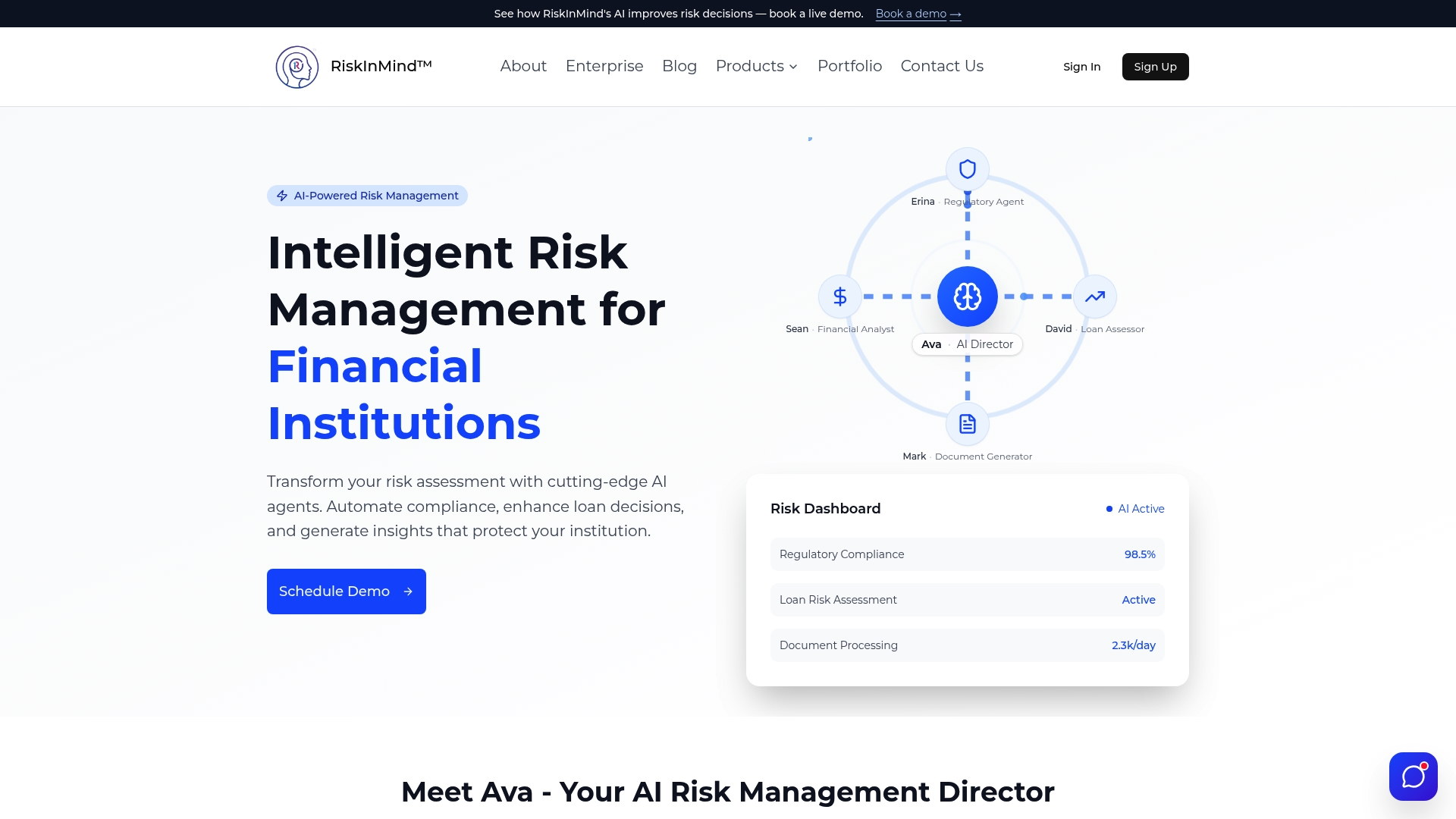
The platform runs on SOC 2® certified, bank-grade security infrastructure with sub-half-second response times, which matters when your compliance team needs real-time dashboards, not end-of-quarter batch reports. A pilot typically starts with one use case, mapped to the phases above, and produces documentation your risk committee can present at the next board meeting.
Riskinmind doesn't replace your own vendor due diligence process. Run the checklist from this article against any platform, including this one, before committing member data to it. Visit Riskinmind to request a demo scoped to your institution's first pilot, or explore the compliance officer solutions page to see how the workflows map to your specific reporting obligations.
Sources
- Artificial Intelligence (AI) | NCUA
- Artificial intelligence (AI) | NIST
- Artificial Intelligence in Financial Services | U.S. Department of the Treasury
- Deploying AI Systems Securely | CISA
- Fraud Schemes Involving Deepfake Media Targeting Financial Institutions | FinCEN
- Realize the Full Potential of Artificial Intelligence: Applying the COSO Framework and Principles