
Regulatory pressure, economic volatility, and an accelerating wave of AI adoption are forcing credit unions and community banks to rethink how they identify, measure, and respond to financial risk. Credit risk mitigation in community banks requires layering traditional metrics with new tools and local intelligence, a reality that demands both technical rigor and strategic foresight from today's financial leaders. The institutions that outperform in 2026 are not simply the ones with the most capital or the most sophisticated technology. They are the ones that combine proven risk controls with data-driven intelligence, sound governance, and a culture that treats risk management as a living discipline rather than a compliance checkbox.
Table of Contents
- Establishing effective credit risk controls
- Managing concentration and systemic risk
- Leveraging AI and model governance for risk mitigation
- Stress testing, scenario analysis, and pricing strategies
- Why real financial risk mitigation is about people, not just processes
- Supercharge your risk mitigation with advanced AI tools
- Frequently asked questions
Automate Regulatory Model Risk Governance
Examine models against 32 qualitative criteria and resolve risk Tiers with pre-deployment checklists per OCC 2011-12 guidelines.
Key Takeaways
| Point | Details |
|---|---|
| Layered risk controls | Combining traditional underwriting, covenants, and monitoring forms the foundation of strong credit risk management. |
| AI boosts governance | Using AI for monitoring and analysis enhances risk detection, but only with rigorous model controls and due diligence. |
| Concentration risk vigilance | Setting and maintaining board-approved limits for sector exposures prevents systemic threats to the institution. |
| Stress test regularly | Frequent scenario-based analysis with tools like CECL and OCC benchmarks reveals vulnerabilities and guides prudent pricing. |
Establishing effective credit risk controls
Effective credit risk controls are the bedrock of sound risk management. If your institution does not have a disciplined, layered approach to credit risk, every other strategy you deploy is built on sand. The challenge is that what worked five years ago is no longer sufficient. Modern underwriting at well-run credit unions blends traditional credit scores with local market intelligence, cash flow analysis, and scenario-based projections that account for sector-specific volatility.
Credit risk controls blend metrics with local intelligence, covenants, and active monitoring, and each of these components plays a distinct role. Covenants, for example, are not just legal boilerplate. They function as early warning mechanisms, requiring borrowers to maintain specific financial ratios and triggering review processes before a loan deteriorates into a loss. Collateral and personal guarantees remain indispensable, especially in commercial portfolios where asset values fluctuate with sector conditions.
Diversification across sectors and geographies is equally critical. A portfolio concentrated in a single industry or zip code carries compounding systemic risk that can materialize faster than any quarterly review cycle can catch. Banking security features and portfolio monitoring tools now allow institutions to track exposure drift in near real time, reducing the window between a trigger event and a management response.
Key credit risk controls to maintain and strengthen:
- Modern underwriting: Combine credit scores, debt service coverage ratios, and local economic data
- Covenant structures: Set financial ratio thresholds with automatic review triggers
- Collateral and guarantees: Require appropriate security for commercial and CRE exposures
- Sector and geographic diversification: Limit single-industry or single-market concentration
- Active portfolio monitoring: Use automated alerts for delinquency, covenant breaches, and rating migrations
AI tools are transforming how institutions execute these controls. Platforms built on AI risk management strategies can process loan-level data across an entire portfolio in seconds, flagging anomalies and generating risk ratings that would take a team of analysts days to produce manually.
"The most resilient community banks are not just using more data. They are using the right data, in the right context, with the right human judgment applied at the right moment."
Pro Tip: For commercial real estate exposures specifically, purpose-built CRE loan risk assessment tools provide loan-level predictive scoring that integrates local market factors traditional models often miss.
Managing concentration and systemic risk
Beyond core credit risk, concentration and systemic exposures can threaten even well-run institutions. Concentration risk, broadly defined, occurs when a portfolio's exposure to any single borrower, sector, geography, or product line is large enough that adverse performance in that segment could materially impair the institution's financial condition.

Concentration risk management strategies require proactive limits and ongoing monitoring, and the NCUA has been unambiguous about this expectation. Institutions should establish board-approved exposure limits, typically flagging any concentration that reaches or exceeds 100% of net worth, and require documented risk rationale for any exception.
A practical approach to managing concentration risk involves five sequential steps:
- Identify concentrations: Map all exposures by borrower, sector, geography, and product type
- Quantify impact: Stress-test each concentration under adverse scenarios to estimate potential loss
- Set board-approved limits: Establish hard caps, soft triggers, and escalation protocols for each category
- Monitor continuously: Use data warehousing and portfolio analytics to track exposure drift between formal reviews
- Mitigate actively: When limits are approached, reduce new originations in the affected segment, seek participations out, or purchase credit protection
Data warehousing is often the missing link in concentration management at smaller institutions. Without a unified data environment that aggregates loan data across systems, exposures can accumulate in ways that are invisible to any single department. Institutions using concentration risk management frameworks supported by AI-enabled reporting platforms gain a material advantage: they can generate consolidated exposure views on demand rather than waiting for month-end reconciliations.
| Concentration type | Common threshold trigger | Recommended action |
|---|---|---|
| Single borrower | 15% of net worth | Immediate board notification |
| Single sector | 100% of net worth | Limit new originations, stress test |
| Geographic cluster | 50% of portfolio | Diversify via participations |
| Product type (e.g., CRE) | 300% of risk-based capital | Formal mitigation plan required |
Key stat: Institutions that implement automated concentration monitoring reduce their average response time to a limit breach by more than 60%, according to industry benchmarking data, meaning the difference between a manageable exposure and a material loss often comes down to how fast you see the problem.
Leveraging AI and model governance for risk mitigation
With more data and complexity entering the risk environment, institutions are turning to AI and digital tools, but this expansion brings its own governance challenges. The NCUA has clarified its posture clearly: AI governance frameworks such as NIST, COSO, and Treasury guidance apply, no new regulations are being created, but existing safety and soundness standards absolutely govern how institutions deploy AI tools.
Model risk governance, specifically the standards established under SR 11-7, requires institutions to maintain a model inventory, conduct independent validation, and document assumptions for every model used in credit decisions. This framework applies equally to AI and machine learning models, which introduces real complexity because many AI models are harder to explain than traditional scorecards.
Key considerations for AI governance in credit unions and community banks:
- Model inventory: Catalog every AI tool used in credit, compliance, and portfolio monitoring
- Vendor due diligence: Evaluate third-party AI providers on data security, model explainability, and regulatory alignment
- Performance monitoring: Track model accuracy over time and validate against realized outcomes quarterly
- AI concentration risk: Avoid over-reliance on a single vendor or platform, which can create systemic fragility
- Explainability: Ensure that any AI-driven adverse action can be documented and communicated to regulators and borrowers
| Factor | Traditional models | AI/ML models |
|---|---|---|
| Explainability | High | Variable (requires SHAP/LIME tools) |
| Predictive accuracy | Moderate | Higher with sufficient data |
| Regulatory maturity | Established | Evolving guidance |
| Governance complexity | Lower | Higher; requires ongoing validation |
Pro Tip: Review your institution's AI risk posture against AI risk management best practices before onboarding any new vendor. A structured evaluation framework will reduce both regulatory and operational risk during implementation.
For institutions seeking a more advanced AI risk strategy, the goal is not just adopting AI but governing it with the same rigor applied to any other critical business system.
Stress testing, scenario analysis, and pricing strategies
Once controls and governance are in place, institutions need a forward view. Stress testing and pricing strategies refine your risk response by exposing vulnerabilities before they become losses. The CECL standard, now fully in effect for most community institutions, requires institutions to estimate lifetime expected credit losses, which makes robust scenario analysis not just a best practice but a regulatory requirement.
A well-structured stress testing program follows a disciplined sequence:
- Define scenarios: Include baseline, adverse, and severely adverse projections for credit, rate, and liquidity risks
- Apply rate shocks: Use parallel rate shocks (+100bp, +200bp, +300bp) to model net interest income (NII) and economic value of equity (EVE) impacts
- Stress sector exposures: Layer in sector-specific slumps (e.g., commercial real estate corrections, agricultural downturns)
- Benchmark against OCC medians: OCC IRR statistics provide NII/EVE scenario impacts by bank size, giving institutions a credible external benchmark for their own policy limits
- Integrate into pricing: Use stress test findings to calibrate risk-based loan pricing, ensuring that higher-risk segments carry spreads that adequately compensate for projected loss under stress conditions
| Rate shock scenario | Typical NII impact (community banks) | EVE impact range |
|---|---|---|
| +100 basis points | +1% to +3% | Minimal |
| +200 basis points | +2% to +5% | Moderate negative |
| +300 basis points | Flat to negative | Significant negative |
| -100 basis points | Negative | Mixed |
"Stress testing without integration into pricing is theater. The real discipline is in adjusting what you charge today based on what you see tomorrow."
For institutions still building or refining their CECL methodology, reviewing the CECL preparation guide provides a structured starting point that aligns with regulatory expectations. Institutions further along in implementation can also benchmark their approach against CECL implementation status data from peer community banks and credit unions to identify gaps. Technology platforms that automate scenario modeling reduce the manual workload substantially and improve the consistency of outputs across reporting periods.
Why real financial risk mitigation is about people, not just processes
Here is an uncomfortable truth that gets underplayed in most risk management conversations: even a technically perfect framework fails without staff buy-in and sound human judgment. We have seen institutions deploy sophisticated AI platforms, build detailed policy manuals, and pass examiner review, only to watch risk accumulate in portfolios because front-line lenders and relationship managers were never genuinely integrated into the risk culture.
Local relationship management uncovers risks that no algorithm reliably catches. A borrower's business has been quietly losing its anchor tenant for six months. A guarantor's health has deteriorated. A sector is shifting in ways that local knowledge signals well before it appears in financial statements. These are the signals that experienced staff, properly trained and properly motivated, surface before they become problems.
Our perspective, informed by real-world AI insights across credit union deployments, is that the most durable risk cultures invest deliberately in communication between technology teams and business-line risk owners. AI surfaces the data. People surface the context. Neither works as well alone.
Supercharge your risk mitigation with advanced AI tools
Ready to put these strategies into action? RiskInMind's AI-powered risk management platform is built specifically for credit unions, community banks, and lenders, automating credit risk assessment, stress testing, concentration monitoring, and regulatory compliance within a single SOC 2® certified environment.
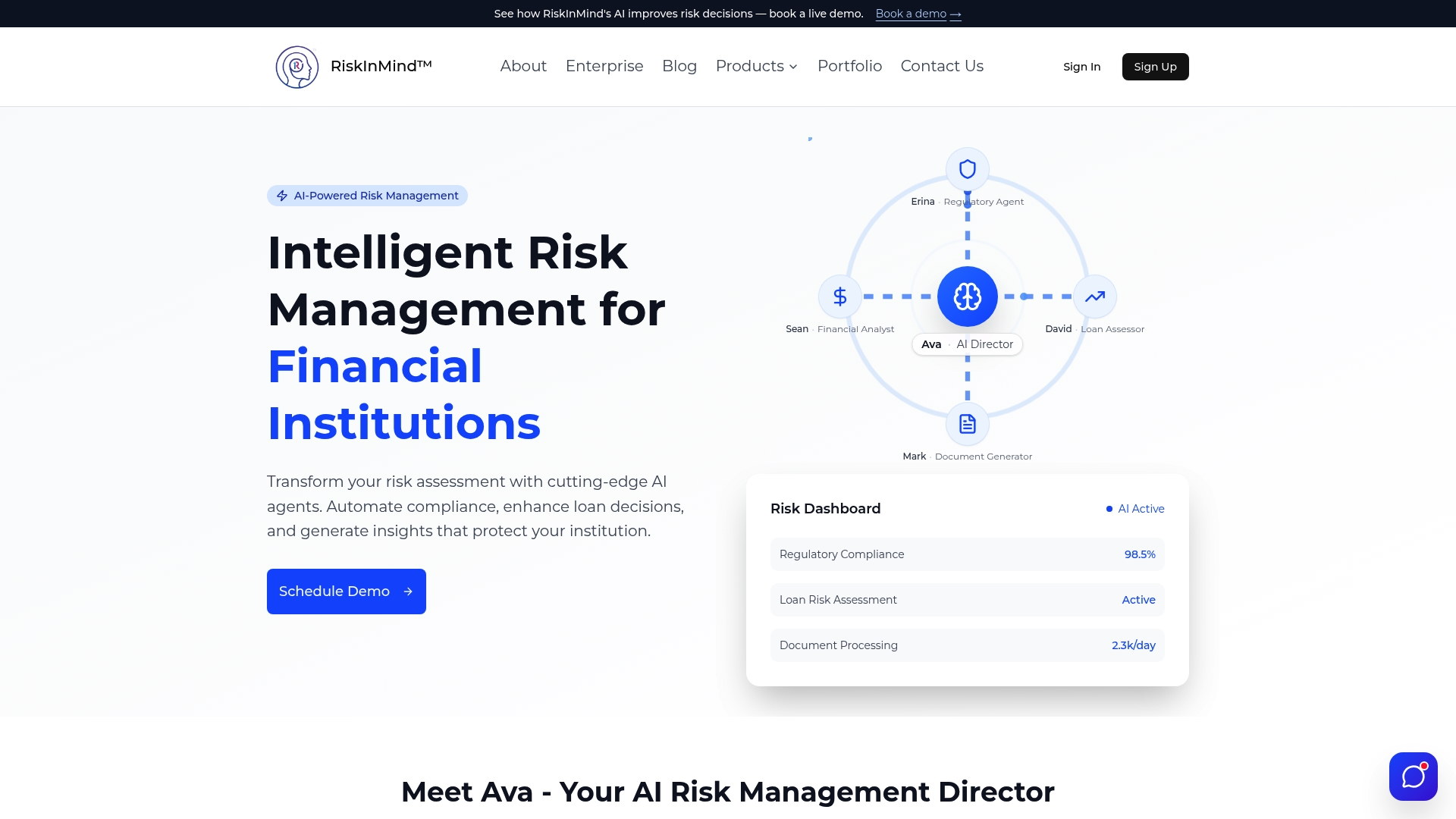
Ava, RiskInMind's central AI director, coordinates a suite of specialized agents that handle everything from CRE loan risk prediction to real-time regulatory alignment via the AI regulatory risk agent. With response times under half a second and bank-grade security, the platform transforms the manual, time-intensive processes described in this article into streamlined, auditable workflows. Schedule a demo and see how institutions like yours are using AI to do more with less, without compromising on accuracy or compliance.
Frequently asked questions
What are the most effective ways for credit unions to mitigate credit risk?
The most effective approaches are multi-layered, combining robust underwriting, collateral, portfolio diversification, covenants, and active monitoring, with AI tools increasingly enhancing both speed and accuracy across each layer.
How can small financial institutions use AI for risk management safely?
By following NIST/COSO/Treasury frameworks and conducting rigorous vendor due diligence, small institutions can deploy AI securely while maintaining the model governance standards required under existing safety and soundness expectations.
What is the recommended limit for concentration risk in credit unions?
Board-approved limits are typically set for any exposure exceeding 100% of net worth, and exceptions must be justified with a documented risk rationale and approved at the board level.
What stress testing methods are used in community banks for risk analysis?
Scenario analysis using CECL and IRR models is standard practice, with institutions benchmarking results against OCC IRR statistics to validate policy limits and identify outlier exposures by asset size.
Recommended
- Risk management for credit unions: frameworks and AI solutions | RiskInMind
- Stopping the Next 1st Choice: How RiskinMind.ai Helps Credit Unions Catch Trouble Before Failure | RiskInMind
- Transforming Credit Union Growth with AI-Powered Risk Intelligence | RiskInMind
- Before Regulators Step In: Stopping Yonkers‑Style Failures with RiskInMind | RiskInMind
- US Treasury veröffentlicht Financial Services AI Risk Management Framework: Was Finanzinstitute jetzt konkret tun müssen