
Model drift monitoring means tracking a model's live performance and its key input and output distributions in production so you catch and prioritize only the changes that move business KPIs. The single highest priority: instrument model-level performance wherever ground truth allows it, and treat distributional checks on features and predictions as proxies for the stretches when labels lag or never arrive. Get prediction and feature logging running against a fixed baseline before you touch a single statistical test.
- Monitoring should prioritize model performance signals tied directly to business KPIs, as input distribution changes may not impact accuracy or outcomes.
- Different drift types require specific detection methods: feature drift uses distance metrics, while label and concept drift rely on performance monitoring once outcomes are available.
- Setting thresholds based on historical data and bootstrap confidence intervals improves alert accuracy, preventing alarm fatigue in high-volume scoring systems.
- Logging comprehensive telemetry, including model versions, feature vectors, timestamps, and ground-truth links, is essential before deploying detection methods.
- Enterprise platforms integrating drift monitoring with governance standards ensure auditability, enabling regulators to see clear risk actions rather than isolated scripts.
Automate Regulatory Model Risk Governance
Examine models against 32 qualitative criteria and resolve risk Tiers with pre-deployment checklists per OCC 2011-12 guidelines.
Table of Contents
- What Is Model Drift Monitoring and Why Rank Signals This Way?
- Types of Drift Practitioners Must Know
- How Drift Gets Detected: Tests, Detectors, and Proxy Signals
- Which Metrics and KPIs to Watch, and How to Rank Them
- Telemetry and Logging Checklist for Reliable Monitoring
- Alerting, Thresholds, and the Triage Workflow
- Response Strategies: When to Retrain, Roll Back, or Update Online
- Implementation Patterns: Choosing Tools by Your Real Constraints
- RiskInMind's View on Governance and Enterprise-Grade Monitoring
- Lessons From Building a Drift Program, and a 30/90/180-Day Plan
- How RiskInMind Operationalizes Model Drift and Model Risk
- Sources
What Is Model Drift Monitoring and Why Rank Signals This Way?
Financial institutions running credit models, fraud scoring, or portfolio risk tools face a specific problem: the world the model was trained on stops matching the world it scores today. A recession changes borrower behavior. A new loan product changes the input mix. A regulatory change alters how labels get assigned. Model drift monitoring is the discipline of watching for these shifts systematically, rather than discovering them three quarters later in a delinquency spike.
The priority ordering matters more than the tooling choice. A 2024 arXiv paper on model-risk centric monitoring argues that tracking the model's actual performance gives a more grounded, directly actionable signal than watching input distributions alone, and tying drift metrics explicitly to business KPIs keeps monitoring focused on changes that matter rather than every statistical wobble. Data drift can occur without hurting accuracy at all. Concept drift can quietly wreck a model's calibration while every feature distribution looks stable. That is why the priority is model-level performance first, with distribution checks doing the work only when ground truth is delayed or absent.
Types of Drift Practitioners Must Know
Not every "drift" alert points to the same underlying problem, and the fix for one type can be useless against another. Classifying what you are seeing is the first triage step.
- Feature or data drift: the statistical properties of model inputs shift, such as average loan size increasing after a product launch, without any change to how inputs relate to outcomes.
- Label drift: the distribution of the target variable itself changes, for instance default rates rising across an entire portfolio during a downturn, independent of any individual borrower's risk profile.
- Concept drift: the relationship between inputs and target changes. The same income and credit score that predicted low risk in 2023 might predict differently in 2026 because underwriting standards or macro conditions shifted.
- Prediction or serving drift: the model's output distribution moves, often the first visible symptom of either data or concept drift, and it can also trigger feedback loops when the model's own decisions change the population it later sees.
Feature drift usually calls for distance metrics between reference and current input windows. Label and concept drift call for supervised performance detectors once outcomes arrive, since distribution tests on inputs alone will not surface a change in the input-output relationship. Prediction drift is often the fastest early warning of the other three and deserves near-continuous monitoring even before labels catch up. A taxonomy of drift detection strategies published in Frontiers in Artificial Intelligence makes a related point worth internalizing: match the detector design to whether you're working supervised or unsupervised, because a loss-based detector built for labeled feedback tends to underperform when applied to unsupervised anomaly monitoring.
How Drift Gets Detected: Tests, Detectors, and Proxy Signals
Detection splits into three practical families, and most mature monitoring stacks run all three in parallel rather than picking one.
Statistical tests and distance metrics compare a reference window against a current window of feature or prediction values. The Kolmogorov-Smirnov (KS) test and chi-square test work well for detecting whether a distribution has shifted at all. Population Stability Index (PSI), Jensen-Shannon (JS) divergence, and Wasserstein distance quantify how much it shifted, which matters for setting graduated alert severity rather than a binary flag. A DataCamp tutorial on data and model drift recommends these four as first-line checks precisely because they're cheap to compute on modest samples and don't require labeled outcomes.
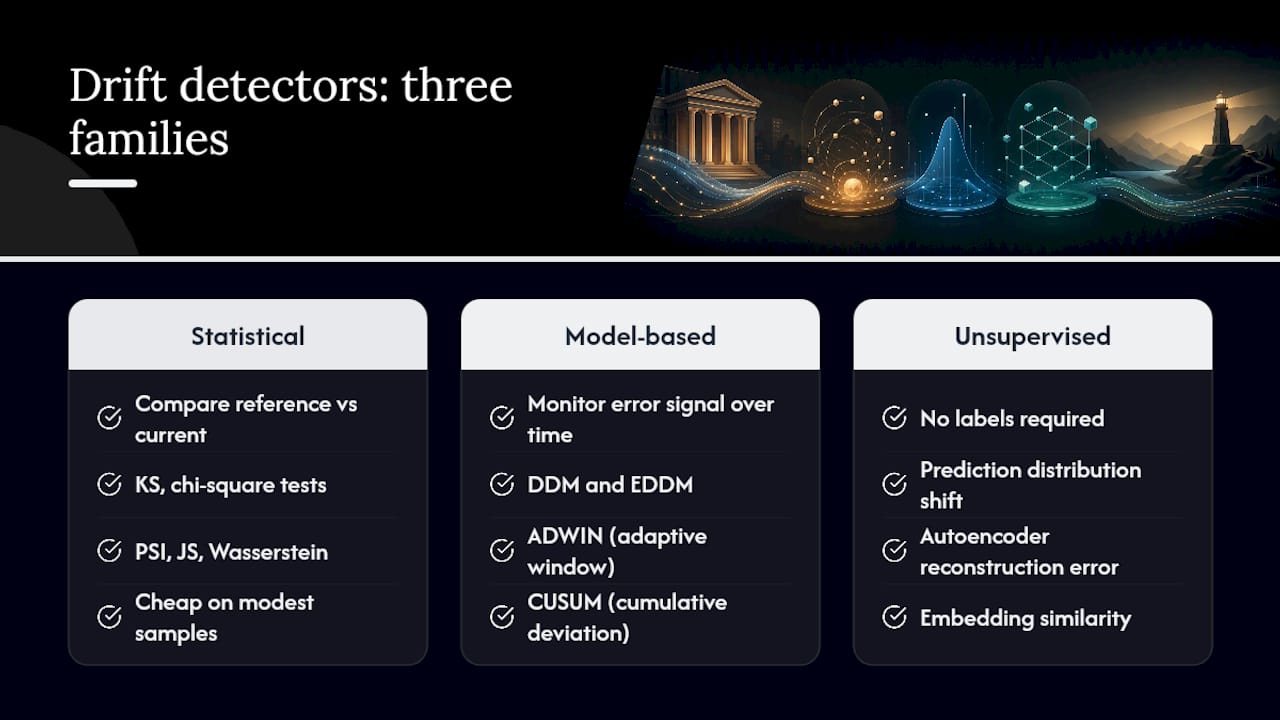
Model-based detectors watch the error signal itself over time. DDM (Drift Detection Method) and EDDM (Early Drift Detection Method) monitor the error rate and its variance, flagging when performance degrades beyond a statistical bound. ADWIN maintains an adaptive sliding window and shrinks it automatically when it detects a change point, which makes it useful for streaming settings where the drift's onset speed is unknown. CUSUM tracks cumulative deviation from an expected error rate and catches gradual drift that a single-window test might miss.
Unsupervised proxy signals fill the gap when ground truth is delayed by weeks or months, which is the normal state of affairs for credit risk models waiting on loan performance data. Prediction distribution shift, autoencoder reconstruction error, and embedding similarity all give you a read on "something changed" without needing a single confirmed label.
Statistic callout: Detector benchmarking work using a leave-one-dataset-out cross-validation protocol found that hyperparameters tuned on one dataset often overfit to that dataset's specific drift pattern, according to recent evaluation research. Tune detector thresholds across multiple historical scenarios, not just your most recent incident.
The trade-off across all three families: sensitivity versus false alarm rate. A detector tuned to catch every small wobble in a high-volume scoring system will page your on-call engineer daily. Widen the window or raise the threshold, and you risk missing the early signal of a real concept shift.
Which Metrics and KPIs to Watch, and How to Rank Them
A monitoring dashboard with forty charts is not a monitoring strategy. Rank signals by how directly they connect to a business outcome, then set cadence accordingly.
Core model metrics, checked daily to weekly depending on volume:
- Accuracy, precision, recall, and AUC for classification models like default or fraud scoring.
- Calibration drift, meaning whether a predicted 5% default probability still corresponds to an actual 5% default rate.
- MAE or RMSE for regression outputs such as loss forecasts or exposure estimates.
Data and attribution metrics, checked continuously or in near-real-time for high-throughput systems:
- PSI and the fraction of features showing significant drift, giving you a portfolio-level read on input health.
- Prediction distribution shift, often the earliest visible sign of trouble.
- Feature-attribution drift, measured with SHAP values or ranked with NDCG to see whether the importance ordering of features has changed even when raw distributions look stable. Amazon's SageMaker Model Monitor system documents this attribution-based approach as a production-grade complement to raw distribution checks.
Prioritization comes down to a simple filter: does this signal, if it fires, change what a risk officer or loan committee decides? Feature drift in a rarely used input variable rarely justifies a page at 2 a.m. A calibration drift in a CECL loss-reserve model does, because it flows straight into a regulatory filing.
Telemetry and Logging Checklist for Reliable Monitoring
Every detection method above depends on data you didn't think to log until the day you needed it. Build the logging layer before the detection layer, not after.
- Inputs and outputs: log the full feature vector, the raw prediction, and the confidence or probability score for every inference.
- Model version: tag every prediction with the exact model version and, ideally, the training data snapshot it came from.
- Timestamp and request ID: enable joins across systems and reconstruction of the exact sequence of events during an incident.
- Environment tag: distinguish staging, canary, and production traffic so a test run never contaminates your drift baseline.
- Ground-truth linkage: build a label queue that maps predictions to outcomes as they arrive, even when that lag runs 60 to 180 days for a loan performance label.
For the ground-truth gap specifically, prioritize labeling for the slices that matter most to business risk, and route uncertain predictions to human review rather than waiting for full-batch label arrival. Retention policy needs its own thought: keep enough history to rebuild a meaningful baseline, mask or tokenize PII in the logged feature set, and version your schema so a field rename three months from now doesn't silently break your comparison window.
Pro Tip: Store a frozen "reference" snapshot of your training distribution the moment a model goes live, separate from your rolling production logs. Comparing current data against last month's data instead of the true baseline lets slow drift sneak past every threshold you set.
Alerting, Thresholds, and the Triage Workflow
A drift alert that fires every day trains your team to ignore it, which defeats the entire purpose of monitoring model drift in the first place.
- Set thresholds against a defined baseline window, not an arbitrary round number, and use bootstrap resampling to establish a confidence interval around "normal" variation before you decide what counts as abnormal.
- Tune threshold sensitivity on a holdout dataset that includes at least one known historical drift event, so the threshold reflects a real incident rather than a guess.
- Choose batch versus streaming cadence deliberately. High-frequency streaming checks on low-volume portfolios generate noise; daily batch checks on high-throughput fraud scoring can miss a fast-moving attack pattern.
- When an alert fires, verify data integrity first. A schema change or an upstream pipeline bug produces the exact same PSI spike as genuine drift.
- Reproduce the signal on specific slices (geography, product line, vintage) before escalating, since an aggregate metric can hide a problem concentrated in one segment.
- Correlate the timing against known external events: a rate change, a new underwriting policy, a seasonal pattern.
- Escalate to retraining only once you've confirmed the drift is real and connects to a business KPI, not before.
Response Strategies: When to Retrain, Roll Back, or Update Online
Detecting drift is half the job. What you do next determines whether monitoring actually reduces model risk or just generates dashboards nobody acts on.
- Retrain when concept drift is confirmed and severe enough to move a business KPI, and when you have enough fresh labeled data to build a model that's genuinely better, not just different.
- Roll back to a prior model version when the drift traces to a bad deployment, a data pipeline bug, or a recent model update rather than genuine environmental change.
- Update online or incrementally using a sliding window retraining approach, ensemble rotation across model vintages, or warm-start retraining when full retraining is too slow for the pace of drift you're seeing.
- Selectively disable a model or feature for a specific segment when drift is isolated to that slice and a fallback rule or simpler model can hold the line while you investigate.
Safe deployment discipline matters as much as the decision itself. Run any retrained or updated model through canary or A/B evaluation against a holdout slice before full rollout, and define rollback triggers in advance rather than deciding on the fly during an incident. Prioritize labeling effort toward the segments most likely to drive a retraining decision, since exhaustive labeling across an entire portfolio is rarely worth the cost or the delay.
Pro Tip: Keep your last two production model versions warm and ready to serve traffic. A rollback that requires a fresh deployment pipeline run under incident pressure adds risk exactly when you're trying to remove it.
Implementation Patterns: Choosing Tools by Your Real Constraints
Tool choice should follow your constraints, not the other way around. Three broad categories cover most situations.
- Lightweight libraries for batch checks suit teams running periodic reports on moderate data volumes. Open-source tools such as Evidently generate visual drift reports and support both batch and streaming checks, making them a solid starting point before committing to heavier infrastructure.
- Pipeline-integrated monitors sit inside your existing feature store or streaming bus and run checks as data flows through, which suits teams already invested in a mature MLOps pipeline.
- Managed cloud monitors trade flexibility for lower operational burden, useful when your team doesn't want to own detector maintenance directly.
Wherever you land, insert monitoring jobs at the same point you log predictions, route alerts through the same on-call system as your other production incidents, and make every drift report reproducible from raw logged data rather than a one-off notebook run.
RiskInMind's View on Governance and Enterprise-Grade Monitoring
Drift metrics mean little in a regulated institution unless they connect to a documented model risk framework and an audit trail a regulator can follow. A PSI spike on a credit model is not just a data science observation; it's an event that a risk committee needs to see, timestamp, and act on within a governance process, tied back to model risk management standards rather than left in an engineer's dashboard.
Piecemeal monitoring scripts scattered across notebooks and cron jobs create exactly the kind of undocumented, unauditable process examiners flag first. Centralizing drift signals inside a governed platform, with real-time dashboards and a clear chain of custody from alert to remediation, turns monitoring into evidence rather than an afterthought.
Institutions running more than a handful of production models, or operating under active examiner scrutiny, tend to outgrow spreadsheet-and-script monitoring fast. That's the point at which an integrated platform earns its cost over stitched-together tooling.
Lessons From Building a Drift Program, and a 30/90/180-Day Plan
Three things tend to separate teams that catch drift early from teams that find out from a delinquency report: instrument logging before you need it, filter every alert through business impact before acting on it, and automate labeling for your highest-risk segments rather than waiting on full-batch ground truth.
A practical rollout: in the first 30 days, get prediction and feature logging live against a frozen baseline. By 90 days, add model-performance detectors for any segment with fast-arriving labels and distributional proxies everywhere else. By 180 days, connect alerts to a documented triage and retraining workflow, with thresholds tuned against at least one real historical drift event rather than guesswork.
— Raj
How RiskInMind Operationalizes Model Drift and Model Risk
Most institutions don't need another dashboard. They need drift signals that walk straight into an audit file with a timestamp, a decision, and a name attached. An enterprise model risk management solution integrates drift detection, credit risk assessment, and regulatory reporting into a single governed system, replacing fragmented disconnected scripts.
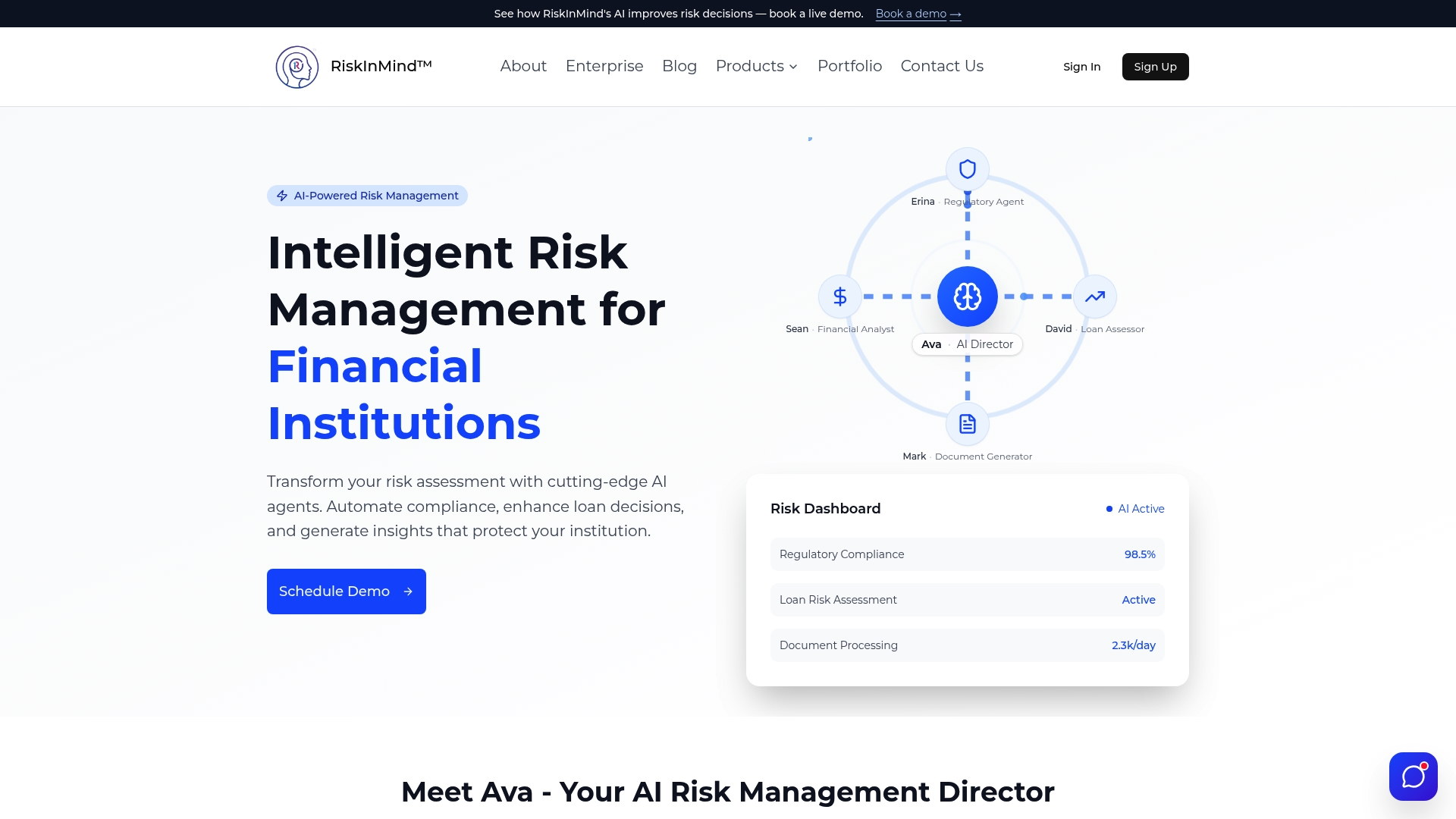
The platform processes scoring and monitoring events in real time and operates under SOC 2 certification and bank-grade security to meet stringent monitoring and underwriting standards. A suite of specialized AI agents coordinated by a central director monitors credit risk, compliance, and market signals in parallel, streamlining the generation of PSI reports and performance dashboards. For lenders running active loan portfolios, the loan application tools bring drift-aware underwriting and audit-ready documentation into a single workflow, and the peer benchmarking tools give portfolio teams a comparative read on whether their drift is idiosyncratic or industry-wide. Request a demo to see how your institution's monitoring workflow would map onto the platform.
Sources
- arXiv:2503.06606
- Frontiers in Artificial Intelligence: Concept drift and unsupervised drift detection survey
- Amazon SageMaker Model Monitor (system design and lessons)
- Evidently: data drift and model monitoring documentation