
IRRBB monitoring is the bank's ongoing program to measure economic-value and earnings sensitivity to interest-rate moves, maintain model governance, and report results to management and supervisors. A credible program covers both economic value of equity (EVE) and net interest income (NII) sensitivity, runs on validated models with documented assumptions, and produces results that satisfy supervisory outlier tests (SOTs). Anything less leaves gaps that examiners will find first.
TL;DR:
- Regular validation and documentation of models are essential to meet supervisory standards and avoid gaps examiners will identify.
- Combining short-term NII sensitivity measures with long-term EVE and PV01 metrics provides a comprehensive view of IRRBB risks.
- Applying prescribed interest-rate shocks and clearly linking results to hedging and limit decisions is critical for effective governance.
- Strong data quality controls, reconciliation, and audit trails are vital for reliable monitoring and regulatory compliance.
- Automated platforms can enhance efficiency by providing real-time dashboards, flagging assumption drift, and streamlining audit-ready reporting.
Automate Regulatory Model Risk Governance
Examine models against 32 qualitative criteria and resolve risk Tiers with pre-deployment checklists per OCC 2011-12 guidelines.
Table of Contents
- What IRRBB Monitoring Actually Covers
- Choosing Between EVE, PV01, EVaR, and NII Measures
- Regulatory Expectations Behind Every Monitoring Program
- Building the Data and MIS Backbone
- Where Behavioral Assumptions Break Down
- Turning Prescribed Shocks Into Governance Action
- The KPIs That Belong on Every IRRBB Dashboard
- Where Automation Fits Into an IRRBB Monitoring Program
- Prioritizing the Next 90 Days
- See How Riskinmind Handles the Monitoring Grind
- Sources
- FAQ
What IRRBB Monitoring Actually Covers
Interest Rate Risk in the Banking Book refers to the current or prospective risk to a bank's capital and earnings from adverse rate movements affecting banking-book positions, as opposed to the trading book. The Basel Committee's application guidance places IRRBB under Pillar 2, which means it is managed through supervisory review and internal capital adequacy rather than a standardized capital charge like market risk in the trading book. That distinction shapes everything downstream: monitoring, not a formula, becomes the primary control.
Governance follows a predictable chain. The governing body sets risk appetite and tolerance, the asset/liability committee (ALCO) executes within those limits, and senior management reports results upward. Basel's revised IRR Principles call for reporting to the governing body at least semiannually, with more frequent updates when exposures are elevated or markets move fast.
- Governing body: sets appetite, reviews semiannual (or more frequent) reports
- ALCO: owns day-to-day hedging and limit management
- Senior management: escalates breaches and validates model changes
Choosing Between EVE, PV01, EVaR, and NII Measures
No single number tells the whole IRRBB story. Basel's framework explicitly recommends pairing two measurement families: earnings-based measures for near-term income exposure and economic-value measures for long-run balance-sheet sensitivity, according to the Committee's application guidance on SRP98.
EVE and PV01 capture how a shock to rates changes the present value of assets minus liabilities. EVE is typically expressed as a percentage of Tier 1 capital, while PV01 measures dollar sensitivity to a one basis point move, useful for quick limit checks and hedge sizing.
NII-based measures track earnings sensitivity over a 12 to 36 month horizon, which is the window most boards actually care about when budgeting.
EVaR and scenario-based approaches (Monte Carlo or historical simulation) add distributional insight beyond static shocks, at the cost of heavier computation and more assumptions to validate.
Statistic Callout: Basel guidance frames NII measures as the short-to-medium horizon lens and EVE/PV01/EVaR as the structural, long-horizon lens. A program that runs only one misses half the picture.
- Use PV01 for daily/weekly limit monitoring
- Use EVE as % of equity for board-level structural exposure
- Use NII sensitivity for budget and earnings-at-risk conversations
- Reserve EVaR/Monte Carlo for deep-dive stress reviews, not routine reporting
Regulatory Expectations Behind Every Monitoring Program
Supervisors do not just want numbers. They want proof of process. The Basel Committee's revised IRR Principles organize expectations around identification, measurement, monitoring, control, and reporting, each with its own documentation trail.
Two mechanics matter most in practice. First, prescribed interest-rate shock scenarios, standardized parallel and non-parallel shifts that every bank must apply to both EVE and NII. Second, the supervisory outlier test, which flags institutions whose EVE decline under the most severe shock exceeds a defined share of Tier 1 capital, prompting closer supervisory attention.
- Identify all material IRRBB sources across the balance sheet, including off-balance-sheet items
- Apply prescribed shocks to both EVE and NII, not just one measure
- Maintain independent model validation separate from the team that builds the models
- Expect supervisor data requests and follow-up when SOT thresholds are breached
The European Banking Authority's guidelines on IRRBB and CSRBB reinforce this with a data-intensive supervisory model, using heatmaps to flag behavioral assumptions and hedging strategies for extra review. Model governance is not a compliance checkbox here; it is the thing examiners test first.
Building the Data and MIS Backbone
Monitoring is only as reliable as the data feeding it. Weak reconciliation between the general ledger and the IRRBB engine is the single most common finding in supervisory reviews, and it is entirely preventable with the right controls.
- Data inputs: on and off-balance-sheet cash flows, repricing dates, product-level metadata (rate type, optionality, contractual maturity)
- MIS features: automated reconciliation, timestamped lineage, full audit trails, and ALCO-ready output formats
- Controls: data quality checks before every model run, exception workflows for breaks, and formal sign-off on any model or assumption change
- Reporting cadence: daily or weekly operational flags for limit breaches, monthly management packages, and semiannual ALCO and regulatory summaries
Pro Tip: Gate every model run behind a data-quality checkpoint. A single stale repricing date in a large mortgage book can shift EVE results enough to trigger a false SOT breach, and chasing that error after the fact costs far more than catching it before the run.
Strong risk data governance practices turn this from a quarterly scramble into a routine process, which matters when examiners ask for a full audit trail on short notice.

Where Behavioral Assumptions Break Down
Non-maturity deposits (NMDs) are the single most scrutinized assumption in any IRRBB model, and for good reason. Assigning the wrong stability or pass-through rate to checking and savings balances can swing EVE results more than any interest-rate shock itself.
The EBA's supervisory heatmap names NMD behavioral assumptions and hedging strategy as priority review areas across the industry. Off-the-shelf models rarely fit a specific balance sheet, and banks are expected to justify NMD and commercial-margin assumptions against their own depositor behavior, not industry defaults, according to Regnology's overview of IRRBB practice.
Statistic Callout: Supervisors treat NMD stability and pass-through assumptions as the top scrutiny item in IRRBB model reviews, ahead of shock calibration itself.
- Benchmark NMD assumptions against peer data and your own historical rate cycles
- Backtest commercial margin and spread assumptions at least annually
- Revalue prepayment and CPR assumptions whenever rate regimes shift materially
- Document every assumption outside historical ranges with independent sign-off
Turning Prescribed Shocks Into Governance Action
Running the shocks is the easy part. Converting results into decisions is where programs succeed or fail.
- Apply the standard shock set, parallel up/down and non-parallel steepener, flattener, short-rate up, and short-rate down, to both EVE and NII per the BIS IRR Principles
- Revalue consistently, using the same cash-flow and discounting conventions across every scenario to keep comparisons valid
- Translate breaches into limits, feeding SOT results directly into hedging decisions, ALCO discussion, and capital planning inputs
- Set a two-tier schedule: routine shock monitoring monthly or quarterly, with deeper Monte Carlo or historical stress reviews at least annually or after major rate moves
Skipping step three is the most common failure. Banks run the shocks, file the report, and never close the loop back to hedging or limit-setting.
The KPIs That Belong on Every IRRBB Dashboard
A dashboard earns its place only if it drives action, not just observation.
- Core KPIs: PV01, EVE change as a percentage of Tier 1 equity, NII sensitivity under each prescribed shock, EVaR at key percentiles
- Dashboard elements: trend lines over rolling quarters, an NMD stability heatmap by product, and concentration views by maturity bucket and product type
- Automated alerts: threshold-based triggers with defined escalation paths, and a data-quality gate that blocks a model run until reconciliation passes
- ALCO-ready reports: shock results side by side with limits, assumption changes since the last cycle, and any pending validation findings
Getting this right often comes down to risk data aggregation that can pull granular, product-level data without manual reconciliation delaying the report.
Where Automation Fits Into an IRRBB Monitoring Program
Manual spreadsheets struggle to keep pace with monthly shock runs, NMD backtesting, and audit-ready reporting all at once. AI-powered platforms can pair specialized agents, coordinated by a central AI director, with SOC 2 certified infrastructure to automate the repetitive parts of the workflow.
- AI agents for credit risk, compliance, and portfolio monitoring that share a common data layer
- Real-time dashboards built for board and ALCO reporting cycles
- Automated document and regulatory reporting output for audit trails
Automation helps flag assumption drift and surface model changes for review faster than a quarterly manual check would. When evaluating any platform, ask specifically what it does for behavioral assumption testing, not just shock calculation.
Prioritizing the Next 90 Days
Start with data and MIS hygiene before touching models. Run the prescribed shocks, validate NMD assumptions against your own history, and set automated alerts for PV01 and EVE breaches. Use any vendor demo to test audit export and ALCO-ready reporting directly.
— Raj
See How Riskinmind Handles the Monitoring Grind
Some solutions replace the spreadsheet chase behind IRRBB monitoring with automated data aggregation, model checks, and reporting that stays audit-ready between exam cycles.
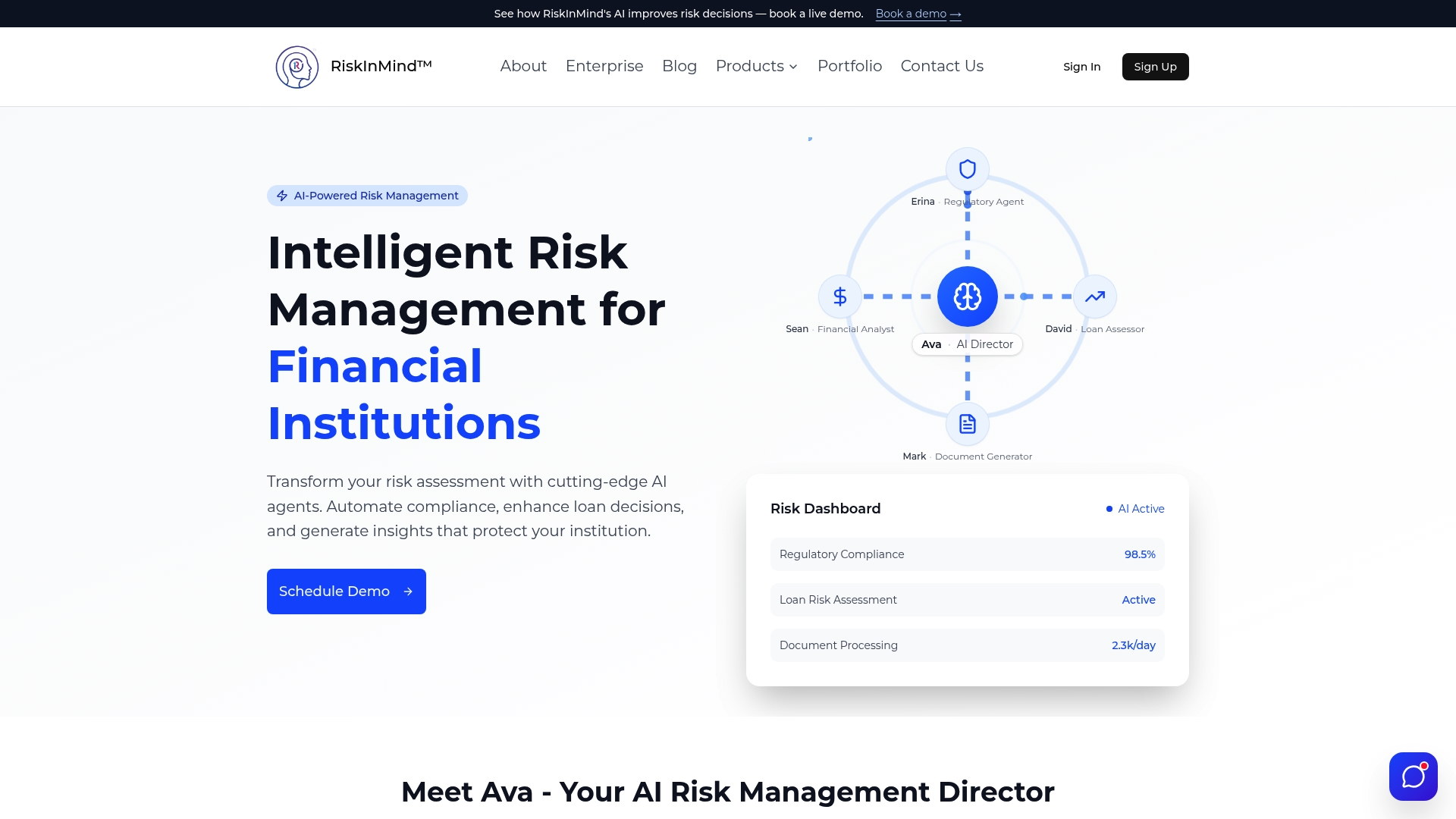
Instead of stitching together core-system exports, third-party rate shock tools, and a separate ALCO deck every cycle, risk teams may get one connected view: dashboards built for board reporting, AI agents that flag assumption drift, and document automation for the regulatory reporting package. If you are evaluating this kind of platform, ask three things in the demo: what core system connectors it supports, whether it keeps validation logs for every model change, and what an actual ALCO-ready export looks like. See how peer benchmarking and risk analysis works against your own portfolio, and schedule a walkthrough to check whether it fits your monitoring cycle.
This article is general information, not a substitute for advice from a qualified financial advisor. Consult a qualified financial professional about your own circumstances before acting on anything here.
FAQ
What Does IRRBB Stand For?
IRRBB stands for Interest Rate Risk in the Banking Book, the risk to a bank's capital and earnings from adverse interest-rate movements affecting banking-book positions, as defined in BIS application guidance.
Is IRRBB Considered Market Risk?
IRRBB is related to market risk in that both involve rate sensitivity, but Basel treats it separately from trading-book market risk and manages it under Pillar 2 rather than a standardized capital charge.
How Is IRRBB Calculated?
Banks calculate IRRBB using complementary measures: PV01 and EVE for economic-value sensitivity, NII sensitivity for earnings over a 12 to 36 month horizon, and EVaR or scenario simulations for distributional views, following the BIS SRP98 framework.
What Is the Supervisory Outlier Test in IRRBB?
The supervisory outlier test flags banks whose EVE decline under the most severe prescribed shock exceeds a defined share of Tier 1 capital, triggering closer supervisory review under the BCBS IRR Principles.
How Often Should Banks Report IRRBB to Their Board?
Basel's IRR Principles call for reporting to the governing body at least semiannually, with more frequent reporting expected when exposures are elevated or markets are volatile.