
Effective regulatory change monitoring identifies new and pending rules, triages them by impact, and routes findings into a controlled change process with testing, approvals, and documentation. It is not a passive newsletter subscription. The first operational step: assign a named owner or team and connect one primary feed, such as the Unified Agenda on RegInfo.gov or an agency's rulemaking page, before adding tools like RiskInMind to scale the process.
TL;DR:
- A regulatory change monitoring program must assign specific ownership and connect to primary feeds like the Unified Agenda before scaling with tools like RiskInMind.
- Prioritization depends on scoring rules by significance, affected business lines, tiers based on deadlines, and estimated effort, with escalation to legal for policy questions.
- Impact assessments should be stored with evidence and linked to the rule's RIN for traceability, and impact qualification requires clear criteria for urgency and materiality.
- A structured change management process with documented governance, testing, communication, and retained evidence is essential to avoid operational and regulatory risks.
- AI-assisted monitoring can significantly reduce cycle time, but human review is crucial for legal weight and complex impact assessments, with platforms like RiskInMind streamlining documentation.
Maintain 100% NCUA & OCC Audit Readiness
Monitor regulatory updates 24/7, check internal credit policies, and generate compliance trails with Erina (AI Regulatory Agent).
Table of Contents
- What Is Regulatory Change Monitoring, and Why Does It Matter?
- Core Components of a Monitoring Program
- How Do You Prioritize and Assess Impact Fast?
- Feeding Monitoring Into Controlled Change Management
- Who Owns the Program, and How Do You Measure It?
- Why AI-Assisted Monitoring Shortens the Cycle
- Turn Monitoring Into a Faster, Documented Change Cycle
- Where to Keep Watching
- Sources
What Is Regulatory Change Monitoring, and Why Does It Matter?
Regulatory change monitoring is the ongoing practice of identifying, tracking, and evaluating rule changes before they become compliance failures. It is distinct from change management, which governs how your institution actually implements the resulting policy, system, or control update. Monitoring feeds change management; it doesn't replace it.
Done well, monitoring produces three outcomes every examiner wants to see: timely alerts on relevant developments, clear ownership for each item, and an audit trail showing how your institution responded. Skip this discipline and you inherit two-way risk: missed deadlines that draw supervisory findings, and rushed implementations that introduce operational errors.
Two federal sources anchor most programs:
- RegInfo.gov's Unified Agenda lists planned federal rulemaking, giving you forward visibility months before a rule reaches the Federal Register.
- The Federal Register publishes proposed and final rules, the stage where obligations become concrete and enforceable.
Core Components of a Monitoring Program
A monitoring program breaks into five functional modules, each with a clear handoff to the next.
- Horizon scanning and source catalog. Build a maintained list of federal, state, and industry sources feeding your program. This is where new items enter the pipeline.
- Ingestion and metadata tagging. Normalize incoming items with tags for jurisdiction, business line, and rule stage so triage staff aren't reading raw text cold.
- Automated triage with manual review gates. Let rules-based filters or AI relevance scoring do first-pass sorting, but route anything above a materiality threshold to a human reviewer.
- Impact assessment and RACI assignment. Each flagged item gets a template covering affected products, estimated cost, and a named responsible party.
- Evidence capture and retention. Store the assessment, decision, and eventual implementation record together, since examiners will ask for this chain during audits.
Pro Tip: Tag each incoming item with its Unified Agenda RIN when one exists. That single identifier lets you trace a rule from proposed stage through final text without re-searching the topic from scratch.
How Do You Prioritize and Assess Impact Fast?
Most programs fail not from missing rules but from failing to rank them consistently once found. A repeatable rubric solves that.
- Score regulatory significance on a simple scale: does this create a new obligation, modify an existing one, or merely clarify interpretation?
- Identify affected business lines and estimate financial or legal exposure in plain terms your leadership can act on.
- Assign a tier. Urgent items carry hard compliance deadlines under 90 days; high items need action within a quarter; medium and low items go into the next planning cycle.
- Estimate remediation effort and map it to an implementation sprint or a documented SLA, following the same discipline Diligent recommends for realistic timeline planning.
- Escalate policy-level questions to legal or regulatory affairs immediately. Don't let a triage analyst make a judgment call that belongs with counsel.
Feeding Monitoring Into Controlled Change Management
Once an item clears impact assessment, it needs to enter the same change pipeline that governs every other system or policy update, not a parallel fast track built for speed. The FFIEC IT Examination Handbook defines change management as planning, governance approval, testing, and implementation, and warns that unauthorized or untested changes threaten confidentiality, integrity, availability, and resilience. That standard applies whether the change originates from a software patch or a new consumer disclosure rule.
Build your checklist around these gates:
- Documented governance approval before implementation begins.
- A written test plan with defined pass criteria and a rollback path.
- A communication protocol for affected business units and, where relevant, customers.
- Retained evidence: the original impact assessment, test results, and sign-off records.
Pro Tip: Borrow the FFIEC's patch-management logic directly. If your team decides not to act on a lower-priority regulatory signal right away, document the reasoning and route it through senior review, as recommended for unpatched vulnerabilities. Our regulatory change management checklist walks through this handoff in more detail.
Who Owns the Program, and How Do You Measure It?
A monitoring program needs named roles, not a shared inbox. Assign a monitoring owner who runs triage, a legal reviewer for interpretation questions, a control owner for each affected process, a change manager who shepherds approved items through implementation, and an evidence custodian who keeps the audit trail intact.
Track these metrics monthly:
- Time-to-triage, from item discovery to initial scoring.
- Time-to-impact-assessment, from triage to a completed template.
- Percent assigned, meaning no item sits without a named owner.
- Remediation SLA adherence against the tiers you defined during prioritization.
- Audit completeness, checked through periodic tabletop exercises that simulate an examiner request.
Report these figures on a standing dashboard your board or examiners can review without a special request, an approach our piece on regulatory reporting for financial institutions covers in more depth.
Why AI-Assisted Monitoring Shortens the Cycle
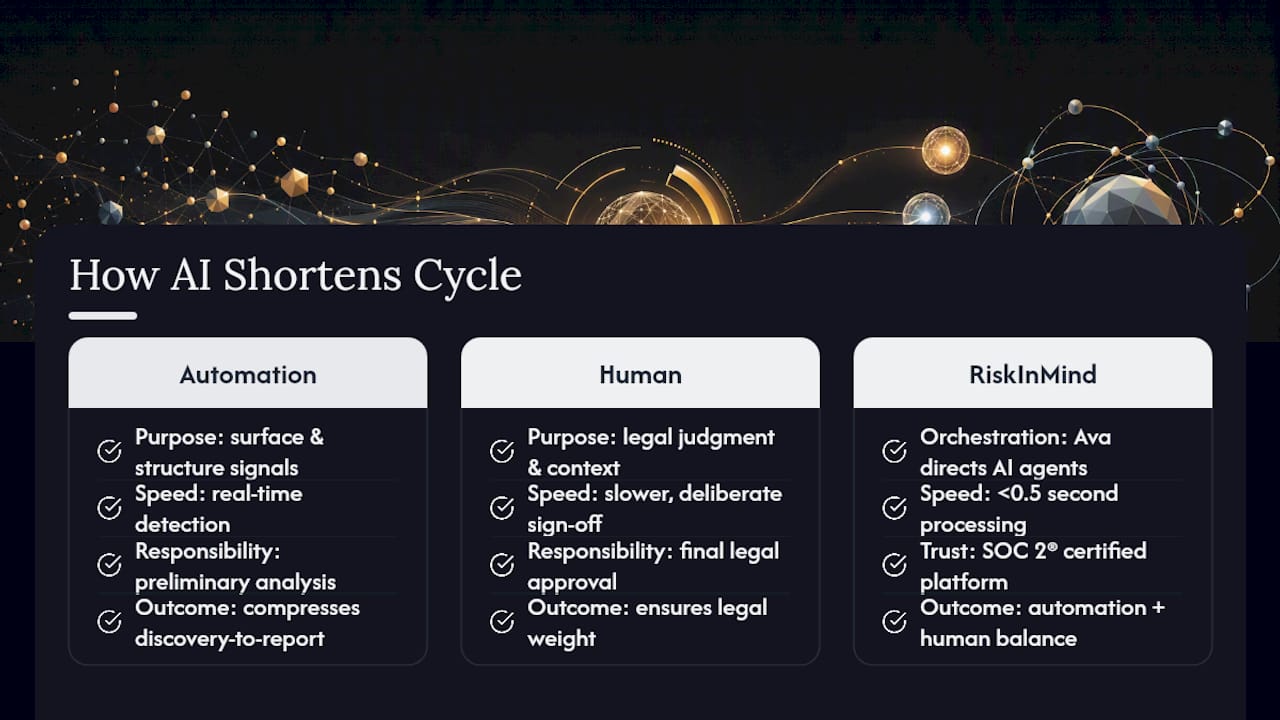
Automated agents can compress the distance between a new rule appearing and a documented impact assessment landing on a control owner's desk, provided a human still signs off on anything with real legal weight. That balance, speed from automation, judgment from people, is where most programs actually break down.
RiskInMind's platform applies this directly: specialized AI agents work under a central director, Ava, to surface and structure regulatory signals, backed by SOC 2® certification and real-time processing under half a second.,, and.
— Raj
Turn Monitoring Into a Faster, Documented Change Cycle
Riskinmind gives compliance teams something a manual tracking spreadsheet never can: a single pipeline where a regulatory signal, its impact assessment, and its eventual approved change all live together, evidence intact. Instead of juggling a monitoring tool, a separate ticketing system, and a manual audit binder, your team works from one connected record.
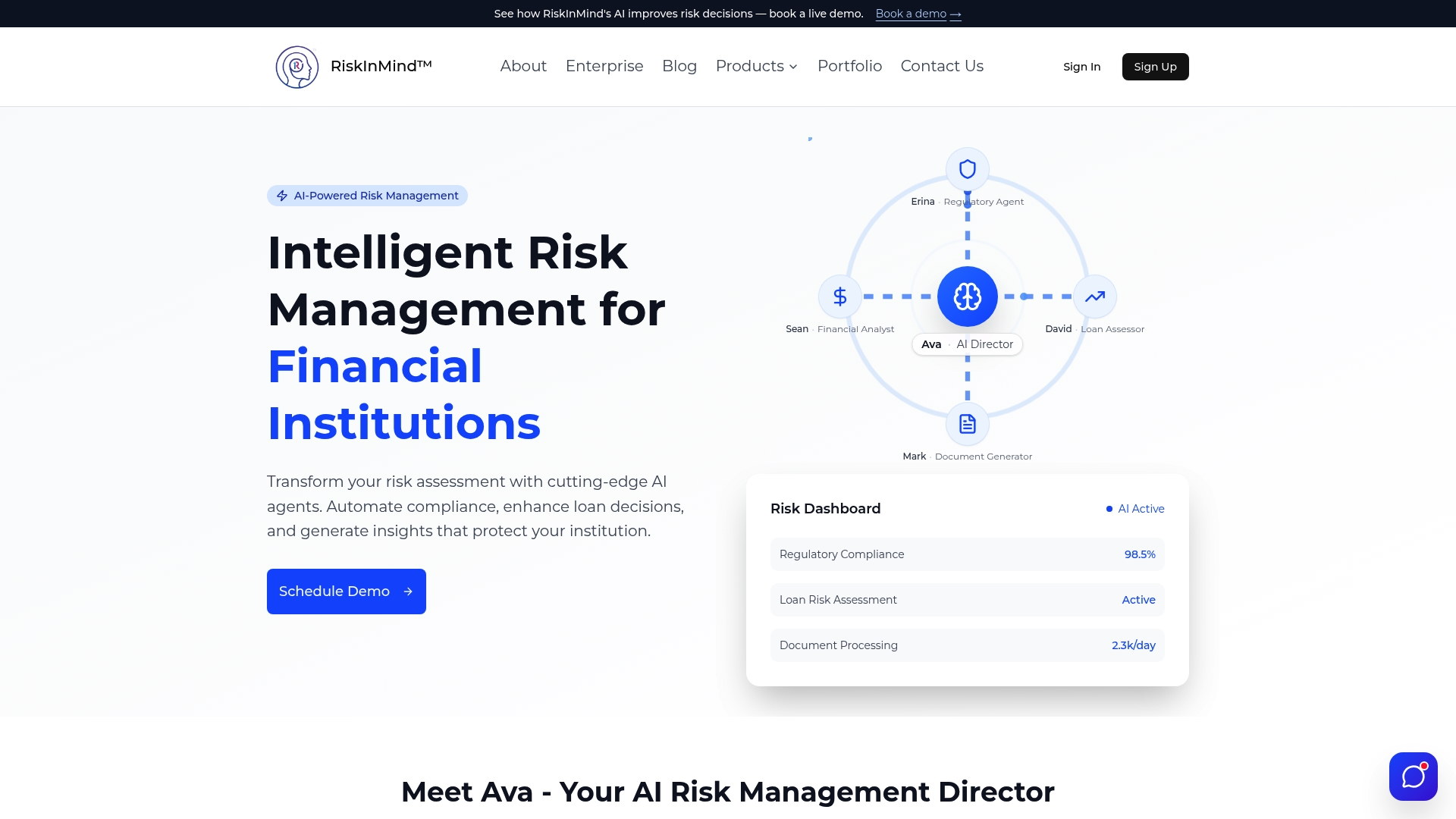
A pilot typically starts small: connect one or two high-volume sources, let RiskInMind's AI agents handle first-pass triage and obligation extraction, and route flagged items into your existing approval workflow. Early adopters see faster triage turnaround and a cleaner audit trail almost immediately, since every step, from signal to sign-off, gets logged automatically. If your institution handles loan underwriting alongside compliance monitoring, our loan application platform shows how the same AI agent architecture applies across risk functions. Request a demo to see how your specific regulatory feeds would map into the pipeline.
Where to Keep Watching
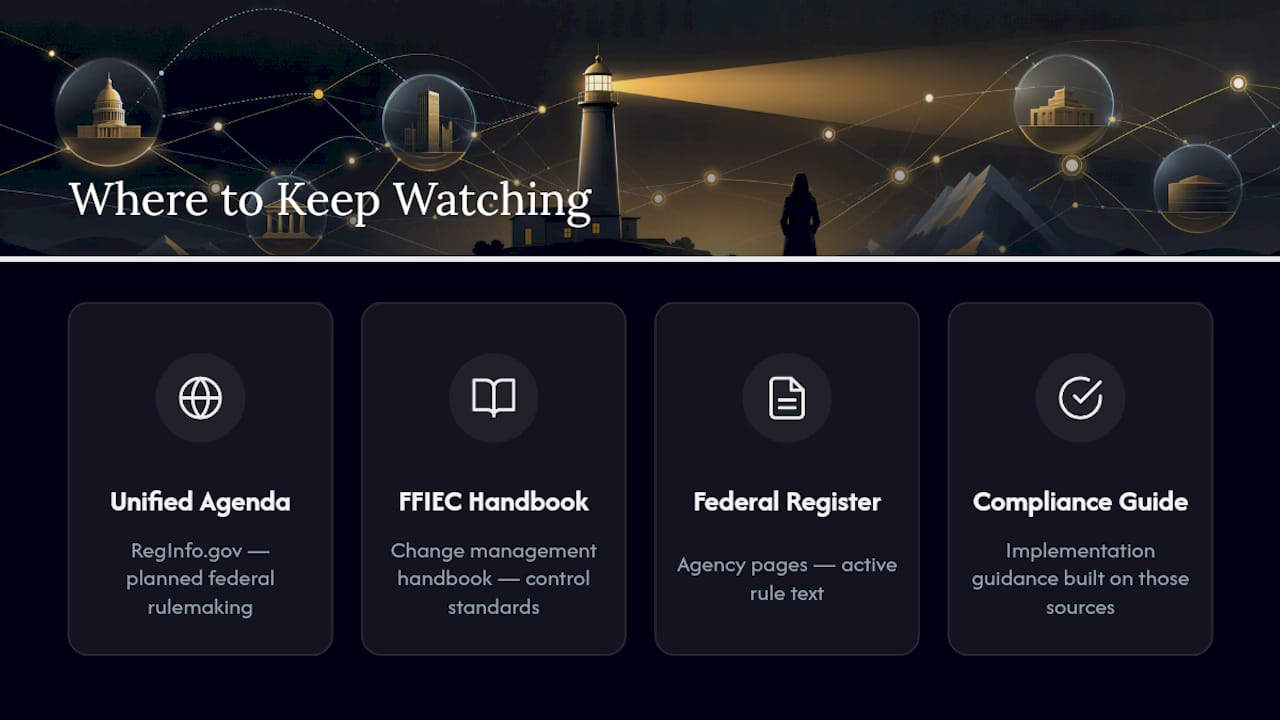
Bookmark these for ongoing coverage: RegInfo.gov's Unified Agenda for planned federal rulemaking, the FFIEC change management handbook for control integration standards, and agency Federal Register pages for active rule text. For implementation guidance built around these sources, our compliance checks guide offers practical next steps.
Sources
Coverage gaps usually come from monitoring too narrow a slice of the regulatory ecosystem, not from missing a single big rule. A complete program tracks four tiers of signal.
- FFIEC IT Examination Handbook InfoBase - VII.B Change Management
- Current Unified Agenda of Regulatory and Deregulatory Actions
Unified Agenda entries include titles, timetables, priority categories, and RINs that let you follow a specific rulemaking across agencies and publication stages. Treat Agenda entries as planning signals rather than final obligations; confirmation comes only when the same item appears in the Federal Register. Set feed frequency by source volatility: daily pulls for agency dockets, weekly for state registers, and monthly reviews of the Agenda itself, since it updates on a predictable cycle rather than continuously.