
The borrower creditworthiness evaluation process produces one non-negotiable output: a stand-alone, standardized credit approval document containing an evidence-backed initial risk rating, prepared before any loan is originated, renewed, or worked out. Both the OCC and NCUA supervisory frameworks treat this document as the minimum evidence of a defensible approval decision. Your first three executable steps: collect verified financials and credit bureau reports, calculate the debt-service coverage ratio (DSCR) and debt-to-income ratio (DTI) following supervisory guidance, and record the assigned risk rating alongside the top three risk drivers with specific evidentiary justification. Under ASC 326 (CECL), that rating feeds directly into your expected credit loss model, so inaccuracy at origination compounds into provisioning error at every subsequent reporting period. Platforms like Riskinmind can automate document ingestion and credit memo drafting, but the analytical judgment behind the rating remains yours.
Table of Contents
- How the 5 Cs map to evidence and metrics in practice
- Step-by-step borrower evaluation workflow from intake to approval
- Risk-rating frameworks and US regulatory expectations you need to satisfy
- Quantitative models, stress testing, and how layered risks amplify default probability
- What a compliant credit approval document must contain
- Ongoing monitoring, re-rating triggers, and CECL implications
- How AI and automation can accelerate evaluation without sacrificing exam readiness
- Underwriting checklist and sample credit memo snippet
- Key Takeaways
- The case for investing in rating validation before scaling automation
- Riskinmind cuts credit memo time without cutting corners
- Authoritative sources for further reading and exam preparation
Automate Regulatory Model Risk Governance
Examine models against 32 qualitative criteria and resolve risk Tiers with pre-deployment checklists per OCC 2011-12 guidelines.
How the 5 Cs map to evidence and metrics in practice
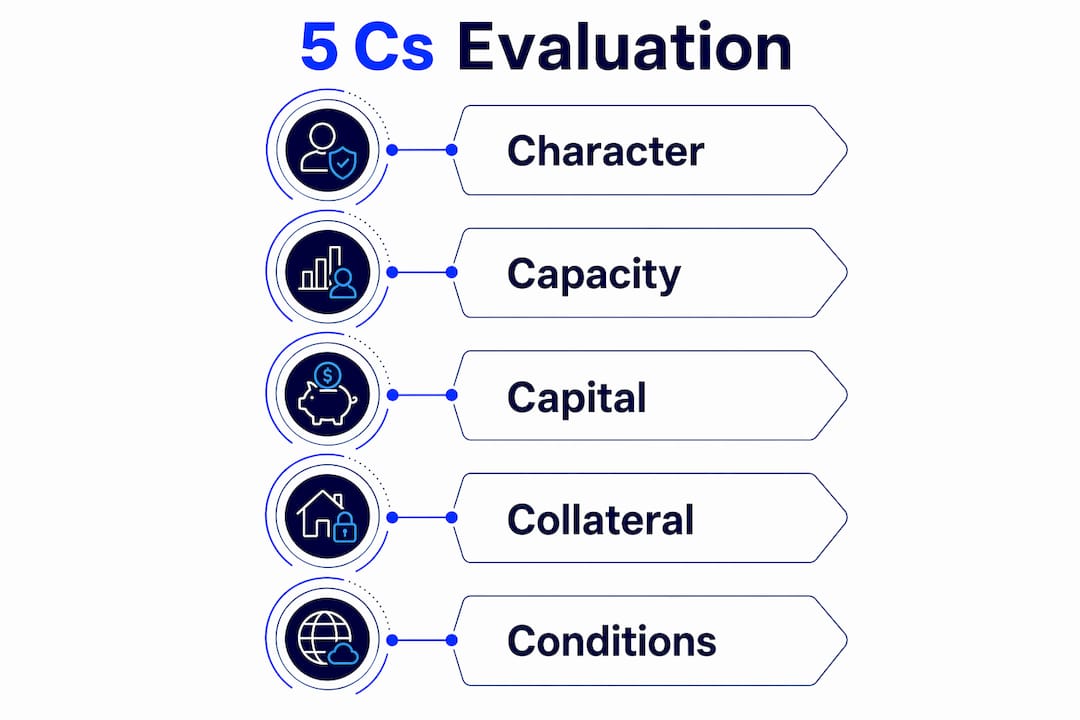
The 5 Cs framework places Character, Capacity, Capital, Collateral, and Conditions at the center of every creditworthiness assessment. Each C demands specific evidence, not a narrative impression.
- Character: Pull tri-merge credit reports, review 12–24 months of payment history across housing, installment, and revolving accounts in that priority order, and document any derogatory items with a written borrower explanation. Per HUD guidance, past credit performance is the single most useful predictor of future repayment behavior.
- Capacity: Calculate DTI as total monthly debt obligations divided by gross monthly income. For commercial borrowers, calculate DSCR as net operating income divided by total annual debt service; low DSCR levels warrant heightened scrutiny. For self-employed or commission-based borrowers, use 12–24 months of tax returns rather than stated income.
- Capital: Assess liquid reserves, equity contribution, and net worth relative to the loan amount. A minimum threshold of post-closing cash reserves is expected for retail borrowers with thin credit histories.
- Collateral: Obtain a current independent appraisal and calculate loan-to-value (LTV). For commercial real estate, document vacancy rates, lease terms, and cap rate assumptions.
- Conditions: Evaluate loan purpose, industry sector, local economic conditions, and interest rate environment. A rate-sensitive borrower in a contracting sector carries compounding exposure.
Strong capital can partially offset thin cash flow in some structures, but compensating factors must be documented explicitly, not assumed. The credit approval document must show which C is deficient, which factor compensates, and why the net risk remains acceptable.
Step-by-step borrower evaluation workflow from intake to approval
A repeatable credit evaluation workflow moves through five stages, each with defined outputs.
- Intake and KYC screening. Collect the loan application, government-issued ID, and initial financial disclosures. Run OFAC, CAIVRS, and fraud-indicator checks before investing analysis time. Flag any identity discrepancies immediately.
- Verification and financial analysis. Obtain credit bureau reports, three years of tax returns (or audited financials for corporate borrowers), and interim P&L statements. HUD 4155.1 requires lenders to verify identity, income source, and employment, and to document any compensating factors used. Calculate DSCR, DTI, and LTV at this stage.
- Risk assessment and scoring. Assign a preliminary risk rating using your institution's approved scale. Combine model output with analyst judgment; document any override with a written rationale. Run at least one stress scenario before finalizing the rating.
- Credit memo and approval package. Compile the stand-alone credit approval document with all required exhibits: financial schedules, ratio calculations, collateral appraisal, guarantor analysis, and the risk rating rationale. The NCUA examiner guide specifies that this document must explain financial trends, stress test results, and the basis for the assigned rating.
- Decision, conditions, and booking. Record the approval or denial with conditions precedent. For denials, retain the file per applicable adverse-action rules. For approvals, set covenant monitoring triggers before booking.
Required documents by borrower type:
- Individual/retail: Two years of W-2s or tax returns, recent pay stubs, tri-merge credit report, bank statements (2–3 months), government ID.
- Small business: Three years of business tax returns, interim P&L, business bank statements, personal returns for all owners above 20% ownership, business credit report.
- Corporate: Three years of audited or reviewed financials, interim financials, corporate credit report, organizational documents, guarantor financials.
Use Riskinmind's business loan qualifier to run an initial capacity screen before committing to full underwriting.
Risk-rating frameworks and US regulatory expectations you need to satisfy
Assigning a risk rating is not a checkbox. The rating must be tied to specific evidence, and that linkage must survive examiner scrutiny.
- Most US institutions use a pass/special mention/substandard/doubtful/loss scale aligned with interagency definitions, though internal scales with finer pass-grade granularity are common and encouraged for CECL segmentation.
- The rating justification in the credit approval document must reference payment history, liquidity position, leverage ratios, and stress test outcomes, not just a composite score.
- Interagency guidance requires a board-approved written credit risk review policy, annual review of that policy, and periodic testing of ratings against actual portfolio performance.
- Rating authority must be clearly assigned: who can approve at each risk grade, who reviews overrides, and where the final rating appears in the credit file.
"Banks should maintain a written credit risk review policy approved by the board and implement regular testing of risk ratings to ensure accuracy relative to portfolio performance and regulatory expectations." — Federal Reserve / Interagency Guidance on Credit Risk Review Systems
The OCC links rating accuracy directly to capital adequacy and CECL reserve integrity, making accurate "pass" ratings as consequential as identifying problem loans.
Quantitative models, stress testing, and how layered risks amplify default probability
Credit scoring models and automated outputs are tools, not verdicts. Any model-generated score must be validated against actual default experience, and analyst overrides require documented rationale. Riskinmind's risk scoring guide covers validation frameworks in detail.

Key ratios and interpretation guidance:
| Ratio | Formula | Caution Threshold |
|---|---|---|
| DTI (retail) | Monthly debt / gross monthly income | High DTI levels |
| DSCR (commercial) | Net operating income / annual debt service | Low DSCR levels |
| LTV | Loan amount / appraised value | High LTV levels |
| Leverage (C&I) | Total debt / EBITDA | High leverage levels |
| Liquidity reserve | Liquid assets / monthly obligations | Low liquidity reserve levels |
Stress scenarios should test revenue declines, interest rate shocks, and vacancy increases within ranges typical for credit risk assessment. Run each scenario independently, then combine the two most adverse to reveal cumulative exposure.
Fannie Mae's selling guide specifically warns that lenders must assess the "cumulative effect" of layered risks because several marginal factors together can push a loan into a materially higher delinquency probability band. A borrower with a 42% DTI, 78% LTV, and variable income is not three separate moderate risks; the combination is qualitatively different.
Pro Tip: Build a layering flag into your underwriting checklist: if a borrower triggers two or more marginal thresholds simultaneously (e.g., DTI above 40% and DSCR below 1.25x), require a second-level review and a written cumulative-risk narrative before approval.
What a compliant credit approval document must contain
The credit memo is the evidentiary record of your decision. Examiners treat a thin or missing memo as evidence of weak credit culture, regardless of loan performance.
Required sections:
- Executive summary: loan purpose, amount, term, borrower identity, and single-line approval recommendation with conditions.
- Borrower background: ownership structure, industry, years in operation, and management assessment.
- 5 Cs analysis: evidence and metrics for each C, with explicit compensating factor documentation where applicable.
- Financial analysis: three years of historical financials, trend commentary, DSCR and DTI calculations, and comparison to industry benchmarks.
- Stress test results: at least one adverse scenario with the impact on DSCR or DTI quantified.
- Collateral analysis: appraisal summary, LTV, and collateral adequacy relative to exposure.
- Risk rating and rationale: the assigned rating, the scale definition, and the specific evidence supporting the rating.
- Conditions precedent and covenants: financial maintenance covenants, reporting requirements, and any approval conditions that must be satisfied before funding.
Evidence checklist:
- Verified financial statements (note whether tax return, reviewed, or audited)
- Personal and business tax returns (three years minimum)
- Tri-merge or business credit bureau extract
- Independent collateral appraisal
- Guarantor financial statements and credit reports
- Legal documents (entity formation, operating agreements)
- Written borrower explanations for any derogatory items
Document the quality and source of every financial statement. A tax return and a borrower-prepared P&L carry different evidentiary weight, and examiners expect you to distinguish them.
Ongoing monitoring, re-rating triggers, and CECL implications
Monitoring frequency should scale with risk grade and exposure size. Pass-rated credits with exposures below your institution's materiality threshold may warrant annual review; special mention and classified credits require semi-annual or quarterly review, with event-driven re-rating as conditions change.
Re-rating triggers to monitor:
- Covenant breach or technical default
- Missed or late payment (30+ days)
- Material adverse change in financial condition (revenue decline exceeding stress scenario)
- Negative external credit event (new litigation, tax lien, CAIVRS match)
- Significant deterioration in collateral value
Portfolio-level validation matters as much as individual accuracy. The OCC flags institutions where systemic rating inaccuracies exceed 5% of reviewed credits or 3% of total portfolio volume. When inaccuracies cluster in a particular segment or vintage, the distortion flows directly into CECL loss estimates, potentially understating reserves and overstating capital. Riskinmind's portfolio monitoring alerts can flag covenant breaches and rating drift in near real time, reducing the lag between a credit event and a formal re-rating action.
How AI and automation can accelerate evaluation without sacrificing exam readiness
Automation delivers the most value at the highest-volume, lowest-judgment stages of the workflow: document ingestion, ratio calculation, credit memo drafting, and watchlist population. Human judgment remains non-negotiable for rating assignment, override decisions, and cumulative-risk assessment.
- Document ingestion and fraud detection: AI can extract financial data from tax returns and bank statements, flag inconsistencies, and surface potential document fraud before an analyst invests underwriting time.
- DSCR/DTI auto-calculation: Automated ratio engines reduce arithmetic error and free analysts to focus on interpretation rather than spreadsheet mechanics.
- Credit memo drafting: Large language model agents can generate a structured first-draft memo from verified inputs, which an analyst then reviews, annotates, and approves. Riskinmind's platform, coordinated by its central AI director Ava, handles this workflow with SOC 2® certified security and sub-half-second response times.
- Portfolio watchlist automation: Automated covenant monitoring and alert routing reduce the risk of a re-rating trigger going unnoticed between review cycles.
Controls are not optional. Every automated output must carry an audit trail showing the input data, the model version, and the analyst who reviewed and approved the result. Overrides must be documented with a written rationale. The model risk management discipline that applies to internal scoring models applies equally to third-party AI tools: validate outputs against realized performance, set tolerance thresholds, and review model behavior after any significant portfolio shift.
Underwriting checklist and sample credit memo snippet
Minimum file requirements before approval (all borrower types):
- Completed and signed loan application
- Government-issued ID (verified)
- Credit bureau report (tri-merge for retail; business + personal for small business)
- Three years of tax returns or audited financials
- Interim P&L and balance sheet (within 90 days)
- DSCR and DTI calculations with supporting schedules
- Collateral appraisal (independent, current)
- Written explanation for any derogatory credit items
- Stress test results (at least one adverse scenario)
- Signed risk rating with evidentiary justification
For retail borrowers, add: recent pay stubs, two months of bank statements, and housing payment verification for the prior 12 months. For corporate borrowers, add: audited financials, organizational documents, and guarantor packages for all material guarantors. A practical loan underwriting checklist can anchor your institution's standard.
Sample credit memo executive summary and rating rationale:
Executive Summary: ABC Manufacturing LLC requests a $1.2M term loan to refinance existing equipment debt. DSCR of 1.31x (FY2024 actuals) and DTI of 38% are within policy. Collateral LTV of 62% provides adequate coverage. Risk rating: Pass-3. Primary risk drivers: (1) customer concentration (top two clients represent 61% of revenue), (2) variable-rate exposure on existing line, (3) thin liquidity reserve of 2.1 months. Stress scenario (15% revenue decline): DSCR falls to 1.09x, remaining above 1.0x. Approval recommended subject to annual financial reporting covenant and borrowing base certificate.
Adjust the checklist for review frequency: retail borrowers at annual; small business at semi-annual if classified; corporate at quarterly for any special mention or below.
Key Takeaways
A defensible borrower creditworthiness evaluation process requires a stand-alone credit approval document, an evidence-backed risk rating, and a board-approved policy with annual validation, all linked to CECL provisioning accuracy.
| Point | Details |
|---|---|
| Credit memo is mandatory | Every approval requires a stand-alone document with DSCR, DTI, stress results, and an explicit risk rating rationale. |
| Layered risks compound exposure | Fannie Mae requires assessment of the cumulative effect of multiple marginal risk factors, not each in isolation. |
| Rating accuracy drives CECL | OCC links inaccurate pass ratings to distorted reserves; keep systemic inaccuracy below examiner thresholds. |
| Board-approved policy is required | Interagency guidance mandates a written, annually reviewed credit risk policy with periodic rating validation. |
| Riskinmind automates repeatable tasks | Riskinmind's SOC 2® certified platform handles credit memo drafting, ratio calculation, and portfolio monitoring while preserving audit-ready human oversight. |
The case for investing in rating validation before scaling automation
The industry conversation around AI in lending tends to focus on speed: faster approvals, shorter cycle times, lower origination costs. Those gains are real. But the more consequential near-term shift is the growing examiner emphasis on rating validation, and most institutions are not ready for it.
Examiners are increasingly treating rating accuracy as a systemic risk indicator, not just a file-quality issue. When a portfolio carries a cluster of misrated pass credits, the CECL model built on those ratings will understate expected losses, and the capital held against them will be insufficient. The correction, when it comes, is abrupt. Institutions that invest in back-testing rating accuracy against realized default and loss data now, before expanding automated approvals, will absorb that correction gradually rather than in a single provisioning event.
The practical recommendation: before your institution scales any automated underwriting workflow, build the validation pipeline first. Define your acceptable inaccuracy threshold, establish a back-testing cadence tied to your credit review cycle, and document the methodology in your board-approved policy. Automation that runs ahead of validation is a liability, not an asset.
Riskinmind cuts credit memo time without cutting corners
Credit analysts at community banks and credit unions spend a disproportionate share of their day on tasks that add process, not judgment: formatting memos, recalculating ratios, populating watchlists. Riskinmind is built to absorb that work.
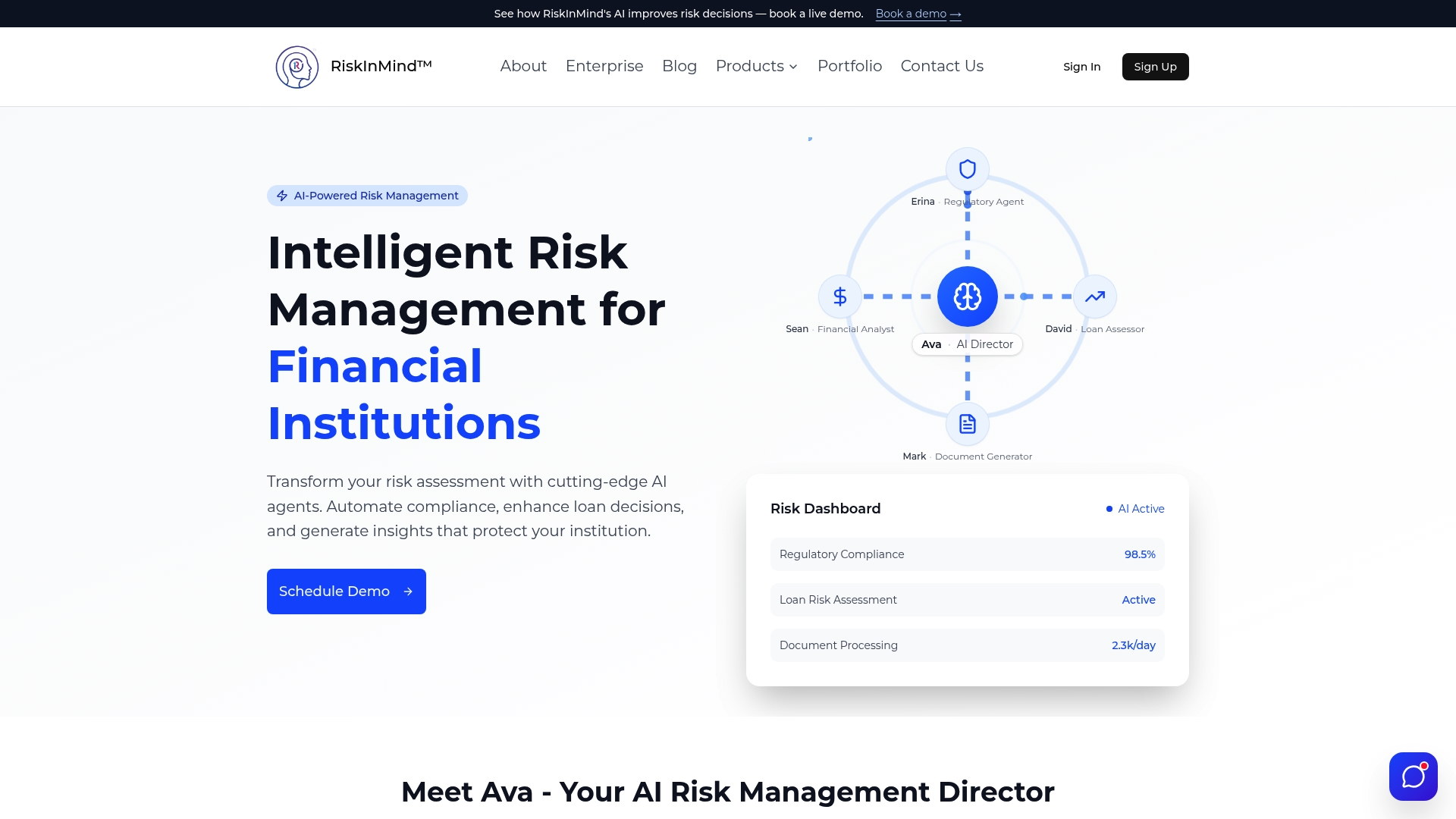
The platform's AI agents, coordinated by Ava, generate structured credit memos from verified inputs, run DSCR and DTI calculations automatically, and surface portfolio watchlist alerts before a covenant breach becomes a surprise. The CRE loan predictor adds scenario-based stress analysis for commercial real estate exposures. Every output carries a full audit trail, and the platform holds SOC 2® certification with bank-grade security, so your exam-readiness posture stays intact. For institutions comparing this approach against legacy manual workflows, the AI vs. manual underwriting comparison lays out the operational tradeoffs directly.
Schedule a demo at riskinmind.ai to see how the platform fits your current credit evaluation workflow.
Authoritative sources for further reading and exam preparation
- NCUA Examiner Guide: Financial Analysis and Credit Approval Document — Primary supervisory standard for credit approval document content and financial analysis requirements at credit unions.
- OCC Comptroller's Handbook: Rating Credit Risk — Definitive OCC guidance on risk-rating scales, rating accuracy, and CECL/capital implications.
- Federal Reserve: Interagency Guidance on Credit Risk Review Systems — Governance requirements for board-approved credit risk policy and periodic rating validation.
- Fannie Mae Selling Guide: Comprehensive Risk Assessment — Practical template guidance on evaluating cumulative layered risks in residential and conforming loan underwriting.
- HUD 4155.1: Mortgage Credit Analysis — FHA underwriting standards covering credit report review, documentation requirements, and compensating factor rules.
- HUD 4155.1 Section C: Borrower Credit Analysis — Detailed credit history analysis guidelines including delinquency documentation and non-traditional credit evaluation.
- Basel Committee on Banking Supervision: Sound Credit Risk Assessment and Valuation for Loans (BCBS 126) — International supervisory principles on loan classification, provisioning methodology, and board governance of credit risk; foundational for institutions subject to Basel-aligned capital rules.