
What is credit exposure management, and why does it matter?
Credit exposure management is the structured process of identifying, measuring, monitoring, and controlling the financial risk a lender or institution faces when a borrower or counterparty fails to meet its obligations. At its core, it answers one question: if this counterparty stopped paying today, how much would we lose? That answer shapes everything from loan pricing to capital allocation to regulatory compliance.
The discipline sits at the intersection of credit risk and market risk, particularly for institutions with derivatives portfolios where exposure fluctuates daily with market movements. Under Basel III frameworks, institutions must hold capital commensurate with their measured exposures, making accurate quantification a regulatory obligation, not just a management preference.
Automate Regulatory Model Risk Governance
Examine models against 32 qualitative criteria and resolve risk Tiers with pre-deployment checklists per OCC 2011-12 guidelines.
- Defines the maximum potential loss from a borrower or counterparty default
- Covers both on-balance-sheet exposures (loans, bonds) and off-balance-sheet instruments (derivatives, commitments)
- Supports compliance with capital adequacy standards including Basel's SA-CCR methodology
- Drives risk-based pricing, limit setting, and portfolio diversification decisions
- Protects institutional solvency by preventing undetected concentration risk
How credit exposure management works within financial institutions
The operational lifecycle of exposure management runs from origination through ongoing monitoring to resolution. When a credit relationship begins, the institution measures current exposure using mark-to-market valuations for derivatives or outstanding balances for loans. For derivatives, current exposure equals the positive mark-to-market value of the contract, since only positive values represent a loss if the counterparty defaults.

Beyond today's snapshot, institutions also calculate Potential Future Exposure (PFE), which quantifies how large an exposure could grow over the remaining life of a contract. Banks quantify CCR daily using PFE calibrated to current market conditions, predominantly through Monte Carlo simulations run at a high confidence level such as 95% or 99%. This forward-looking metric is what makes derivatives exposure management fundamentally different from managing a fixed loan book.
Under the Basel SA-CCR framework, EAD is calculated as 1.4 times the sum of replacement cost and potential future exposure. That 1.4 alpha multiplier provides a capital buffer above the institution's best estimate of exposure, recognizing that models carry inherent uncertainty.
- Mark-to-market (MtM): Captures today's positive contract value as current exposure
- Potential Future Exposure (PFE): Projects maximum exposure at a given confidence level over future horizons
- Exposure at Default (EAD): Calculated under the Basel SA-CCR as 1.4 times the sum of replacement cost and potential future exposure, this is the primary input for capital calculations
- Limit monitoring: Compares measured exposures against pre-approved counterparty and portfolio limits
- Reporting cycle: Delivers aggregated exposure data to senior management and risk committees
What are the core components of an effective exposure management framework?
A well-constructed framework combines measurement models, mitigation tools, governance structures, and reporting infrastructure. No single metric captures the full picture of counterparty credit risk (CCR), so institutions deploy complementary measures covering both current and stressed market conditions.
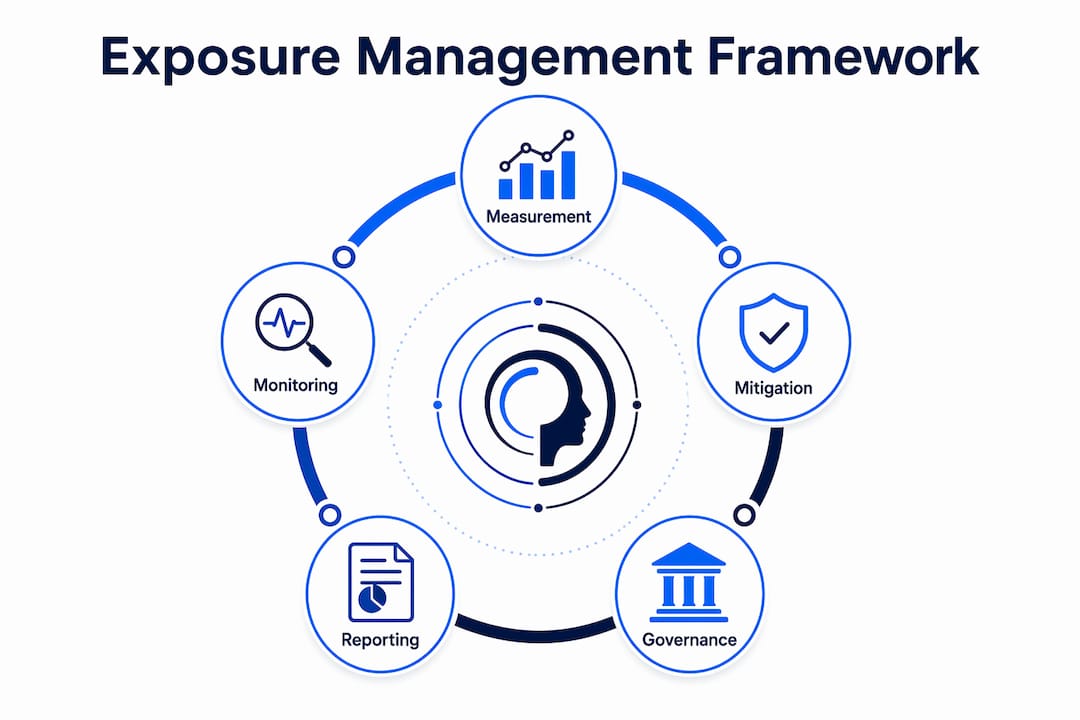
Credit risk mitigants, including margining, collateral, guarantees, and contractual covenants, are the primary tools for reducing net exposure. Margin is the most direct mechanism: when a counterparty's position moves against them, a margin call forces them to post additional collateral, keeping the net exposure within agreed bounds. Overreliance on collateral alone, however, creates its own risks, particularly when collateral is illiquid or hard to value under stress.
Dynamic models that simulate path-dependent drawdowns for revolving credit lines capture exposure at default more accurately than static drawn amounts. A borrower with a large revolving facility may have drawn only a portion today, but could draw the full commitment before defaulting. Static nominal values miss that risk entirely.
- Exposure measurement models: MtM, PFE, Expected Credit Exposure (ECE), and stress-based metrics
- Credit risk mitigants: Margining, collateral agreements, netting arrangements, guarantees
- Limit framework: Counterparty-level, sector-level, and portfolio-level limits tied to risk appetite
- Stress testing: Scenario analyses assessing exposure under adverse market conditions
- Data quality controls: Accurate, timely inputs to credit scoring models and MIS systems
- Reporting infrastructure: Aggregated exposure dashboards for senior management and regulators
How does credit exposure management fit into broader financial risk control?
CCR is not a standalone discipline. It blends credit risk with market risk, since the size of a derivatives exposure depends directly on market movements, and with liquidity risk, since margin calls can create sudden funding demands. Constructing an effective CCR management framework requires integrating techniques across credit, market, operational, and liquidity risk disciplines.
Governance is where many institutions fall short. The Archegos Capital Management default in 2021 exposed broad weaknesses in due diligence, risk measurement, and oversight, particularly for high-leverage counterparties with opaque business activities. Sound CCR governance demands that risk measurement be integrated with decision-making authority, not siloed in a reporting function that cannot act on what it sees.
Regulators require independent control functions to avoid conflicts of interest between credit origination and risk oversight. That separation, often called the second line of defense, ensures that the team setting exposure limits is not the same team generating the revenue from those exposures.
- Interaction with market risk: derivatives exposure fluctuates with interest rates, FX, and equity prices
- Interaction with liquidity risk: collateral calls and margin requirements create funding pressure
- Risk appetite enforcement: exposure limits translate board-approved risk tolerances into operational controls
- Independent oversight: second-line risk functions review and challenge first-line exposure decisions
- Senior management reporting: regular CCR reports enable leadership to understand current exposure magnitude and future trajectory
How credit exposure management integrates with systems and operations
Effective exposure management depends on real-time data flowing between loan origination systems, collateral management platforms, and limit monitoring tools. A credit decision made at origination must immediately update the institution's aggregate exposure to that counterparty across all products and booking entities. Fragmented systems that batch-process overnight create dangerous blind spots, particularly in volatile markets where exposures can shift materially within hours.
Article 287(2) CRR requires institutions using internal models to establish an independent control unit responsible for the design and implementation of CCR management systems, including daily reporting. That daily cadence is the operational minimum; institutions with complex derivatives books often require intraday updates.
Pro Tip: Aggregate all credit exposures to a single borrower across every product, entity, and booking location before comparing against limits. A counterparty that appears within limits on each individual desk may be significantly over-limit on a consolidated basis.
- Loan origination systems feed initial exposure data into limit monitoring infrastructure
- Collateral management platforms track posted margin and available collateral in real time
- Netting agreements must be legally confirmed in each counterparty's jurisdiction before providing capital relief
- Independent risk units validate data inputs and challenge model assumptions
- Management information systems aggregate on- and off-balance-sheet exposures for reporting
How credit exposure data supports business decisions
Exposure management is not purely defensive. The data it generates directly informs pricing, portfolio construction, and capital planning. Effective credit exposure management supports risk-based pricing, portfolio diversification, and regulatory capital optimization, allowing lenders to grow sustainably rather than reactively.
When a relationship manager proposes a new credit facility, the exposure management function provides the marginal impact on counterparty limits, sector concentrations, and capital consumption. That analysis shapes whether the deal proceeds, at what price, and with what structural protections. Institutions that treat exposure management as a back-office compliance function miss the competitive advantage it provides in pricing accuracy and capital efficiency.
Credit risk assessment also feeds directly into regulatory capital models, where more accurate exposure measurement translates into more precise capital allocation. Under internal models approaches, institutions that demonstrate rigorous PFE methodologies may qualify for lower capital requirements than those relying on standardized approaches.
- Risk-based pricing: exposure data calibrates loan spreads to reflect actual counterparty risk
- Portfolio diversification: concentration analysis identifies over-exposure to sectors, geographies, or single names
- Regulatory capital planning: EAD and PFE inputs drive risk-weighted asset calculations
- Credit limit setting: exposure metrics determine appropriate facility sizes for each counterparty
- Strategic growth decisions: aggregate exposure headroom guides new business origination priorities
Monitoring techniques and operational controls
Continuous monitoring is what converts a well-designed framework into actual risk control. Limit tracking dashboards display real-time utilization against approved counterparty and portfolio limits, with automated alerts when exposures approach or breach thresholds. Watchlists flag counterparties showing early signs of credit deterioration, triggering more frequent reviews before a default becomes imminent.
Exception reporting captures every instance where an exposure exceeds a limit, requiring documented management approval and escalation. Without that discipline, limit frameworks become advisory rather than binding. The Basel Principles for credit risk management are explicit: information systems must aggregate credit exposures to individual borrowers and report exceptions on a meaningful and timely basis.
Stress testing and scenario analysis round out the monitoring toolkit. A comprehensive stress program tests exposures under macroeconomic downturns, market dislocations, and idiosyncratic counterparty shocks, then compares results against risk limits and capital buffers. Wrong-way risk, where counterparty default probability and exposure increase simultaneously, requires dedicated scenario design because standard PFE models may not capture that correlation.
- Limit dashboards: real-time utilization tracking against counterparty and portfolio limits
- Automated alerts: notifications when exposures approach defined thresholds
- Watchlists: early identification of distressed counterparties for intensified monitoring
- Exception reporting: documented escalation for every limit breach
- Stress testing: macroeconomic and idiosyncratic scenarios to test portfolio resilience
- Periodic credit reviews: reassessment of counterparty ratings and limit appropriateness
Best practices for managing credit exposure effectively
The most effective credit exposure programs share several characteristics that separate sound practice from compliance-minimum approaches. Clear credit policies aligned with a documented risk appetite statement give front-line staff unambiguous guidance on acceptable exposure levels by product, sector, and counterparty type. Without that clarity, limit frameworks tend to drift under commercial pressure.
Portfolio diversification is the most reliable structural protection against concentration losses. A bank with a significant portion of its loan portfolio concentrated in a single sector faces disproportionate damage if that sector deteriorates, regardless of how well individual credits were underwritten. Trade credit insurance and credit default swaps provide additional tools for transferring concentrated exposures without restructuring the underlying lending relationships.
AI-driven active model management now enables institutions to predict and prevent credit risk drift, moving from reactive monitoring to genuinely proactive exposure control. Continuous model validation, including bias detection and performance tracking against realized defaults, keeps scoring models calibrated as borrower behavior and market conditions evolve. Riskinmind's platform applies machine learning to credit exposure monitoring, delivering real-time risk insights that support both regulatory compliance and lending decisions.
- Establish documented credit policies tied to a board-approved risk appetite statement
- Diversify portfolios across sectors, geographies, and counterparty types to limit concentration
- Validate exposure models continuously, not just at initial deployment
- Maintain independent risk oversight separate from credit origination functions
- Use complementary metrics, including PFE, stress exposure, and current MtM, rather than relying on a single measure
- Integrate AI-driven analytics for proactive identification of emerging credit deterioration
Pro Tip: Competitive market pressure tends to erode collateral and margin standards over time, masking true exposure levels. Audit your margining practices against original credit approval terms at least annually to detect standard drift before it becomes a systemic problem.
Advanced frameworks and emerging challenges in credit exposure management
The governance architecture for CCR has grown considerably more sophisticated since the 2008 financial crisis, driven by Basel III, the SA-CCR methodology, and supervisory guidance from bodies including the ECB and BIS. Article 286(1) CRR requires institutions to maintain a CCR management framework covering policies, processes, and systems for identification, measurement, management, approval, and internal reporting, with active involvement from the management body and senior leadership.
The distinction between current exposure and PFE matters most for derivatives portfolios, where exposure is inherently asymmetric. Only positive mark-to-market values represent risk to the lender; negative values mean the institution owes the counterparty, not the reverse. A swap that starts at zero value can become a material uncollateralized claim years later if rates move significantly, which is precisely why PFE modeling over the full life of the contract is indispensable.
Wrong-way risk represents one of the more technically demanding challenges in CCR. General wrong-way risk arises when counterparty default probability correlates with broad market risk factors; specific wrong-way risk occurs when a counterparty's default probability is directly linked to the value of the exposure itself, as when a bank holds a credit default swap written by the same entity it is hedging. Both forms require dedicated identification, measurement, and limit frameworks beyond standard PFE approaches.
Riskinmind's AI platform addresses the proactive monitoring gap that reactive systems leave open. By applying neural networks and large language models to portfolio data, the platform's specialized AI agents continuously scan for credit deterioration signals, concentration buildup, and model drift, delivering alerts and risk summaries through a real-time dashboard. For credit unions, community banks, and lenders operating under tightening regulatory scrutiny, that capability translates directly into earlier intervention and better-documented compliance.
- Basel SA-CCR replaced the Current Exposure Method and Standardized Method for derivatives EAD calculation
- CCR governance under CRR requires independent control units with daily reporting responsibilities
- Wrong-way risk frameworks must address both general and specific correlation between exposure and default probability
- Competitive pressure on margining standards can mask true exposure levels across the industry
- AI-driven continuous validation combats model drift and bias in credit scoring systems
- Advanced AI risk strategies are reshaping how institutions anticipate and respond to emerging credit risks
How Riskinmind supports your credit exposure management program

Riskinmind's AI-powered platform gives financial institutions the real-time analytics, automated monitoring, and governance documentation that modern credit exposure management demands. From loan application risk evaluation to portfolio-level concentration analysis, the platform's specialized AI agents work under the direction of Ava, Riskinmind's central AI director, to deliver sub-second risk insights with SOC 2® certified security. Whether you are a CRO at a community bank or a risk manager at a credit union, Riskinmind translates complex exposure data into decisions you can act on.
Key Takeaways
Credit exposure management requires integrated measurement, independent governance, and proactive monitoring to protect institutional capital and meet regulatory standards.
| Point | Details |
|---|---|
| EAD formula under SA-CCR | Basel sets EAD at 1.4 times the sum of replacement cost and potential future exposure for derivatives. |
| PFE drives limit design | Potential Future Exposure, modeled via Monte Carlo simulation, must anchor counterparty limit frameworks. |
| Independent oversight is mandatory | Regulators require a second-line control function separate from credit origination to avoid conflicts of interest. |
| AI enables proactive monitoring | Machine learning models detect credit drift and concentration buildup before defaults materialize. |
| Diversification limits concentration loss | Portfolio diversification across sectors and geographies remains the most reliable structural protection against concentrated losses. |