
Collateral risk is the set of exposures that arise when pledged assets fail to protect lenders because of price moves, liquidity constraints, legal enforceability gaps, operational breakdowns, concentration, rehypothecation chains, or counterparty linkage. The principal types of collateral risk are: market/valuation risk, liquidity risk, valuation/model risk, legal/enforceability risk, concentration risk, rehypothecation/re-use risk, wrong-way (correlation) risk, settlement/replacement risk, and counterparty/issuer quality risk. Each type can erode coverage independently, but the most damaging losses occur when two or more interact simultaneously. This guide maps every risk type to measurable metrics, a prioritization matrix, and concrete mitigations grounded in U.S. regulatory practice.
Table of Contents
Automate Regulatory Model Risk Governance
Examine models against 32 qualitative criteria and resolve risk Tiers with pre-deployment checklists per OCC 2011-12 guidelines.
- What are the main types of collateral risk, and how do they differ?
- What factors change collateral risk, and what do real failures look like?
- How do you measure collateral risk? Metrics, formulas, and worked examples
- How to build a collateral-risk matrix for prioritizing exposures
- What controls reduce collateral risk most effectively?
- What operational failures actually create collateral losses?
- How should you stress test a collateral portfolio?
- What U.S. legal and regulatory issues affect collateral enforceability?
- What does a practical collateral monitoring program look like?
- How does AI-enabled automation close common collateral-risk gaps?
- Key Takeaways
- The collateral-risk workstreams that actually move the needle
- Riskinmind gives risk teams real-time collateral visibility without the manual overhead
- Authoritative sources and further reading
What are the main types of collateral risk, and how do they differ?
Understanding collateral risk starts with a clean taxonomy. Without consistent definitions across business units, a portfolio that looks adequately covered on one desk can be dangerously exposed on another. The nine risk types below form the working classification most practitioners and supervisors recognize.

Market/price (valuation) risk
Market risk is the most familiar type: the pledged asset loses value between the last mark and the moment a lender needs to liquidate it. Equities, corporate bonds, and commercial real estate are most exposed because their prices can move sharply in short windows. A lender holding corporate bonds as collateral on a leveraged loan may find that a credit-spread widening event cuts the bond's market value significantly before a margin call can be issued and settled.

Liquidity risk
Even a well-priced asset creates exposure if it cannot be sold quickly at that price. Liquidity and volatility differ by collateral class: cash and government securities are most liquid, while securitizations and physical assets are harder to liquidate under stress. A lender holding asset-backed securities as collateral may face a bid-ask spread that widens from 50 basis points to several hundred during a market dislocation, making the nominal coverage ratio meaningless.
Valuation/model risk
When market prices are unavailable or stale, institutions rely on models. Model risk arises when those models use outdated assumptions, incorrect inputs, or methodologies that diverge across teams. Commercial real estate appraisals, for example, can lag market conditions by six to twelve months. Consistent model governance and validation cycles are the primary controls here.
Legal/enforceability risk
A security interest that looks valid on paper may be unenforceable in practice. Improperly perfected liens under UCC Article 9, missing subordination agreements, or cross-border collateral held in a jurisdiction with different insolvency rules can all delay or eliminate recovery. The gap between nominal and functional enforceability is one of the most underestimated sources of collateral loss.
Concentration risk
Concentration risk occurs when a portfolio's collateral pool is dominated by a single issuer, sector, or asset class. A credit union holding commercial real estate collateral across a single metropolitan market faces correlated price declines if that market softens. Concentration amplifies every other risk type: a liquidity event in one sector hits a concentrated portfolio far harder than a diversified one.
Rehypothecation/re-use risk
Rehypothecation allows a collateral receiver to reuse pledged assets as collateral in its own transactions. Multi-tier reuse creates systemic exposure: a failure at a downstream counterparty can cascade into losses that single-tier coverage ratios do not reveal. Ghost positions, where the same asset is counted as collateral in multiple chains simultaneously, are the most dangerous manifestation.
Wrong-way (correlation) risk
Wrong-way risk occurs when collateral value is positively correlated with the counterparty's credit quality, so both deteriorate together at the moment of default. A bank accepting equity shares of the borrowing company as collateral is the textbook example: the borrower's distress drives down the share price at precisely the moment the lender needs to liquidate. Dynamic correlation monitoring is the only reliable early-warning tool.
Settlement/replacement risk
Settlement risk is the exposure that arises when a counterparty fails to deliver collateral or cash on the agreed date. The lender is then unsecured for the settlement period and must replace the position at current market prices, which may be adverse. Longer settlement cycles (T+2 vs. same-day) and cross-border transactions with different market conventions amplify this exposure.
Counterparty/issuer quality risk
Taking collateral shifts credit risk from the borrower to the issuer of the collateral asset. A lender accepting corporate bonds as collateral is now exposed to the bond issuer's credit quality. If the issuer and the borrower are in the same industry or have a financial relationship, this creates a form of wrong-way risk at the issuer level.
Collateral class characteristics: quick reference
| Collateral Class | Typical Liquidity | Typical Volatility | Haircut Range (Indicative) |
|---|---|---|---|
| Cash (domestic currency) | Very high | Negligible | 0% |
| Government securities (short-term) | High | Low | 1%–5% |
| Government securities (long-term) | High | Moderate | 5%–10% |
| Investment-grade corporate bonds | Moderate | Moderate | 10%–20% |
| High-yield corporate bonds | Low–Moderate | High | 20%–35% |
| Listed equities | Moderate | High | 25% |
| Securitizations (agency MBS) | Moderate | Moderate | 10%–20% |
| Non-agency ABS/CMBS | Low | High | 30%–50% |
| Commercial real estate | Very low | Moderate–High | 30%–50% |
| Physical assets (equipment, inventory) | Very low | Variable | — |
What factors change collateral risk, and what do real failures look like?
Collateral risk is not static. Several factors shift it continuously, and recognizing them early is what separates a proactive collateral program from a reactive one.
Primary risk factors to monitor:
- Market volatility spikes that compress bid-ask spreads and widen haircut requirements
- Liquidity evaporation in specific asset classes during credit-market dislocations
- Model staleness when appraisals or pricing models are not refreshed at appropriate intervals
- Legal and registration differences across states or jurisdictions affecting lien perfection speed
- Issuer or sector concentration that creates correlated drawdowns across the collateral pool
- Settlement cycle changes (such as the U.S. move to T+1 equity settlement) that alter replacement-cost windows
- Rehypothecation chains that obscure the true beneficial ownership of pledged assets
- Currency mismatches between the loan denomination and the collateral's pricing currency
Real-world examples where these factors produced shortfalls:
-
Commercial real estate appraisal lag. A community bank extended a construction loan with an appraisal completed at peak market conditions. When the local office market softened, the appraisal was 18 months old and overstated value by roughly 25%. The bank's coverage ratio appeared adequate until a default forced liquidation at actual market prices.
-
Corporate bond collateral during a credit-spread event. A lender accepted investment-grade corporate bonds as collateral on a leveraged credit facility. A sector-wide ratings downgrade widened spreads by 300 basis points over two weeks, reducing the bond's market value below the margin threshold before a call could be issued and settled.
-
Rehypothecation chain collapse. A securities financing transaction involved three tiers of collateral reuse. When the second-tier counterparty failed to return assets, the original pledgor and the ultimate receiver both claimed the same securities, creating a legal dispute that delayed recovery by several months.
-
Wrong-way risk in a single-name equity pledge. A lender accepted shares of the borrowing company as collateral. When the borrower's financial condition deteriorated, the share price fell in parallel, reducing collateral value at the exact moment the lender needed it most.
-
Settlement failure on cross-border collateral. A U.S. lender accepted foreign sovereign bonds held in a non-U.S. custodian. A settlement dispute delayed delivery by five business days, leaving the lender unsecured during a period of market volatility.
-
Concentration in a single metropolitan CRE market. A credit union's collateral pool was concentrated in retail commercial properties in one city. A local economic shock drove simultaneous declines across the entire pool, eliminating the diversification benefit the institution had assumed.
Early-warning signals for collateral review meetings:
- Any collateral class showing a price decline greater than 5% in a rolling 30-day window
- Bid-ask spreads widening beyond historical norms for a given asset class
- Appraisal or model valuation dates older than the institution's policy threshold
- Concentration in any single issuer or sector exceeding the approved limit
- Counterparty credit rating downgrades affecting either the borrower or the collateral issuer
- Settlement failures or delays in the prior reporting period
- Rehypothecation utilization approaching the approved limit
How do you measure collateral risk? Metrics, formulas, and worked examples
Effective collateral risk analysis requires translating qualitative concerns into numbers that governance committees can act on. The core metrics are loan-to-value ratio, haircut, collateral coverage ratio, margin ratio, and replacement cost.
Core metric formulas
Loan-to-Value (LTV): LTV = (Loan Outstanding / Collateral Market Value) × 100
Haircut: Haircut = ((Collateral Market Value − Collateral Lending Value) / Collateral Market Value) × 100
Collateral Coverage Ratio (CCR): CCR = Collateral Lending Value / Loan Outstanding
Margin Ratio: Margin Ratio = Collateral Market Value / Loan Outstanding
Replacement Cost (for settlement risk): Replacement Cost = Current Market Price − Original Contract Price (positive values represent exposure)
Mark-to-market vs. mark-to-model
Mark-to-market valuation uses observable market prices and is the standard for liquid assets such as government securities and listed equities. Mark-to-model is necessary for illiquid assets, including non-agency ABS, commercial real estate, and private credit instruments, where no active secondary market exists. The tradeoff is accuracy versus timeliness: mark-to-market is objective but can be volatile; mark-to-model is smoother but introduces model risk. OSFI guidance for IRB institutions instructs firms to document revaluation frequency and inspection procedures explicitly, with early-warning indicators tied to action requirements. U.S. supervisors hold similar expectations under their model risk management guidance.
Revaluation frequency should match asset liquidity: daily for equities and government bonds, weekly for investment-grade corporate bonds, monthly or event-triggered for commercial real estate and physical assets.
Worked example 1: Corporate bond LTV and haircut
A lender extends a $1,000,000 credit facility. The borrower pledges investment-grade corporate bonds with a current market value of $1,250,000. The institution applies a 20% haircut.
- Collateral Lending Value = $1,250,000 × (1 − 0.20) = $1,000,000
- LTV = ($1,000,000 / $1,250,000) × 100 = 80%
- CCR = $1,000,000 / $1,000,000 = 1.00 (100%)
If bond prices fall 15%, the market value drops to $1,062,500. The new lending value is $1,062,500 × 0.80 = $850,000, and CCR falls to 85%. A margin call is triggered if the institution's policy threshold is 100% CCR.
Worked example 2: Repo margin call
A repo counterparty delivers $10,000,000 in Treasury bonds against a $9,500,000 cash advance (initial margin ratio: 105.3%). Bond prices fall 3%, reducing market value to $9,700,000. The new margin ratio is $9,700,000 / $9,500,000 = 102.1%, below the 105% maintenance threshold. A margin call of approximately $276,000 in additional collateral is required to restore the ratio.
Metric reference table
| Metric | Formula | Key Inputs | Typical Policy Range |
|---|---|---|---|
| LTV | Loan / Collateral MV × 100 | Loan balance, market value | 60%–80% (real estate); 70%–80% (securities) |
| Haircut | (MV − Lending Value) / MV × 100 | Market value, lending value | 0%–60% depending on asset class |
| CCR | Lending Value / Loan Outstanding | Lending value, loan balance | Minimum 100%; target 110%–120% |
| Margin Ratio | Collateral MV / Loan Outstanding | Market value, loan balance | 102%–110% (repo); higher for illiquid |
| Replacement Cost | Current Price − Contract Price | Current and contract prices | Positive = exposure; negative = in-the-money |
How to build a collateral-risk matrix for prioritizing exposures
A collateral-risk matrix converts the nine risk types into a ranked action list. The ISO 31000 framework supports this approach by combining qualitative and quantitative techniques and emphasizing iterative, documented assessment. The matrix scores each exposure on two dimensions: likelihood (1–5) and impact (1–5), producing a risk score from 1 to 25.
Scoring guidelines:
- Likelihood 1: Remote; no historical precedent in the portfolio
- Likelihood 3: Possible; has occurred in comparable portfolios in the past five years
- Likelihood 5: Likely; current market or counterparty conditions make occurrence probable within 12 months
- Impact 1: Minimal; coverage ratio remains above 120% even under stress
- Impact 3: Moderate; coverage ratio falls to 100%–110% under stress, requiring a margin call
- Impact 5: Severe; coverage ratio falls below 100%, creating an unsecured exposure
Converting metrics to matrix scores:
- An LTV above 80% on a real estate loan maps to Likelihood 3–4 and Impact 3–4.
- A CCR below 110% with concentration above 25% in a single sector maps to Likelihood 4 and Impact 4 (score: 16), triggering immediate review.
- A rehypothecation utilization above 80% of the approved limit maps to Likelihood 3 and Impact 5 (score: 15), requiring escalation to the CRO.
Prioritization rules:
- Score 20–25: Immediate remediation; escalate to CRO and board risk committee within 24 hours.
- Score 12–19: Elevated monitoring; weekly review and documented action plan within five business days.
- Score 6–11: Standard monitoring; include in monthly collateral review report.
- Score 1–5: Acceptable; document and review quarterly.
A structured risk-assessment approach ensures that matrix scores are applied consistently across obligors, portfolios, and enterprise-level aggregations, rather than varying by analyst judgment.
Example matrix walkthrough:
A community bank holds a $5,000,000 commercial real estate loan. The collateral is a single office building in one metropolitan market (concentration risk: high), appraised 14 months ago (model staleness: moderate), with a current estimated LTV of 78%. Scoring: Likelihood 4 (stale appraisal + concentrated market), Impact 4 (LTV near policy ceiling). Risk score: 16. Action: order a new appraisal within 30 days, place on weekly monitoring, and document the exception.
What controls reduce collateral risk most effectively?
Effective collateral risk management rests on three core pillars: mark-to-market valuation, haircuts, and collateral coverage ratios. Each pillar requires a documented policy, a system configuration, and a governance owner.
Valuation policy and revaluation frequency: Define the valuation method (mark-to-market or mark-to-model) for each collateral class, the revaluation frequency, and the triggers for out-of-cycle revaluation (rating downgrade, price decline threshold, borrower financial event). The policy owner is typically the Chief Risk Officer or a designated Collateral Valuation Committee.
Dynamic haircuts: Haircuts should not be static. They should increase when market volatility rises, when liquidity in a collateral class deteriorates, or when a borrower's credit quality declines. The Bank of England's collateral management framework notes that haircut policy varies by institution and purpose, and that taking collateral shifts credit risk from the borrower to the issuer of the pledged asset. Institutions should review haircut schedules at least quarterly and after any significant market event.
Margining and variation margin: Establish initial margin requirements and variation margin thresholds for each collateral class and counterparty type. Define the margin call process: who issues the call, the response window (typically one business day), and the escalation path if the call is not met.
Concentration limits: Set limits by issuer (e.g., no single issuer exceeding 10% of total collateral value), by sector (e.g., no single sector exceeding 25%), and by asset class. Review and approve exceptions at the CRO level, with board reporting for persistent breaches.
Rehypothecation limits: Cap rehypothecation utilization as a percentage of total collateral received. Require automated settlement reconciliation to detect ghost positions. Limit rehypothecation chains to a defined number of tiers.
Legal documentation: Use Credit Support Annexes (CSAs) for derivatives collateral. For lending, require perfected first-priority liens under UCC Article 9, with lien searches conducted at origination and periodically thereafter. Document subordination agreements and cross-collateralization arrangements explicitly.
Settlement guarantees and insurance: For high-value or illiquid collateral, consider settlement guarantees from a third-party custodian. Credit wraps or insurance may be appropriate for physical assets where liquidation timelines are long and uncertain.
Governance roles: The Collateral Valuation Committee approves haircut schedules. The CRO or a designated deputy signs off on exceptions. The back office or a dedicated collateral management team runs daily reconciliation. Internal audit reviews the entire process annually.
Pro Tip: Automate haircut calculations and margin call issuance within your collateral management system. Manual processes introduce a delay of hours to days between a price move and a margin call, during which the institution carries unhedged exposure. Automation removes that window and creates an auditable record of every action.
What operational failures actually create collateral losses?
Operational failures like stale valuations, settlement failures, incorrect lien perfection, and fraud can produce collateral shortfalls even when nominal coverage appears sufficient. These are not edge cases; they are among the most common sources of realized collateral loss in lending portfolios.
Frequent failure modes:
- Stale or missing valuations: A collateral position is not revalued after a market event, so the coverage ratio in the system overstates actual protection. The error is discovered only at default or audit.
- Failed settlement: A counterparty fails to deliver collateral on the agreed date, leaving the lender unsecured during the settlement gap.
- Incorrect lien perfection: A UCC financing statement is filed in the wrong jurisdiction, names the debtor incorrectly, or is not renewed before expiration, rendering the lien unperfected and subordinate to other creditors.
- Document fraud: Borrowers submit tampered appraisals, falsified title documents, or altered financial statements to inflate collateral values. Document tampering is a growing operational risk in both commercial and consumer lending.
- Missed margin calls: A margin call is issued but not tracked to resolution, and the counterparty's failure to post additional collateral goes undetected for several days.
- Reconciliation gaps: The front-office collateral ledger and the back-office settlement system show different positions, masking a shortfall until month-end reconciliation.
Three short case examples:
-
A lender's UCC financing statement on equipment collateral expired after five years and was not renewed. When the borrower filed for bankruptcy, the lender's claim was treated as unsecured, subordinate to a competing creditor who had filed a valid lien.
-
A commercial real estate lender's appraisal management system failed to flag a property for revaluation after a local market downturn. The property's book value remained at the original appraisal figure for 16 months, overstating coverage by an estimated 20%.
-
A securities lending desk issued a margin call but did not route it through the automated tracking system. The counterparty did not respond, and the failure was not escalated for four business days, during which the collateral's market value declined further.
Operational controls checklist:
- Daily automated reconciliation between the front-office collateral ledger and the settlement/custody system
- Automated alerts for any collateral position not revalued within the policy-defined window
- Dual-signature authorization for collateral substitutions and exceptions above defined thresholds
- Automated UCC expiration tracking with renewal alerts 90 days before the five-year expiration
- Automated document fraud detection for appraisals, title documents, and financial statements at origination
- Margin call tracking system with automated escalation if a call is not resolved within one business day
- Monthly reconciliation of rehypothecation positions against counterparty confirmations
How should you stress test a collateral portfolio?
Stress testing reveals vulnerabilities that standard coverage ratios miss, particularly when multiple risk types interact simultaneously. Regular stress testing that models correlation shocks between collateral value and counterparty health is a top differentiator for resilient collateral programs.
The logic of collateral stress tests:
A well-designed stress test applies joint shocks rather than single-factor shocks. A 20% decline in corporate bond prices is manageable if counterparties remain solvent and liquidity is available. The same price decline combined with a counterparty credit event and a liquidity freeze in the secondary market is a fundamentally different scenario, one that can convert a covered position into a significant unsecured exposure within days.
Practical scenario set:
- Scenario 1 (Market shock): 30% decline in listed equity collateral values combined with a 20% repricing of investment-grade corporate bonds. Assess percent shortfall by collateral class and aggregate capital cushion required.
- Scenario 2 (Liquidity freeze): Secondary market for non-agency ABS and CMBS becomes effectively illiquid for 30 days. Assess time-to-liquidate estimates and the cost of holding unsecured exposure during that window.
- Scenario 3 (Single-sector collapse): A sector representing 25% of the collateral pool (e.g., office commercial real estate) experiences a 35% value decline. Assess concentration impact and identify obligors where coverage falls below 100%.
- Scenario 4 (Wrong-way risk): A counterparty's credit rating is downgraded two notches simultaneously with a 15% decline in the collateral it has pledged (which is in the same sector as its business). Assess combined exposure.
- Scenario 5 (Rehypothecation chain failure): A second-tier counterparty in a rehypothecation chain fails to return assets. Assess the number of positions affected and the time required to resolve competing claims.
Governance outputs from a stress run:
- Percent shortfall by collateral class, expressed as a dollar amount and as a percentage of total collateral value
- Time-to-liquidate estimates for each collateral class under the stress scenario
- Capital cushion required to absorb the shortfall without breaching regulatory minimums
- Obligor-level list of positions where coverage falls below 100% under any scenario
Governance cadence and sign-off:
Full portfolio stress tests should run quarterly, with targeted tests after any significant market event or counterparty credit event. Results should be reviewed by the CRO and presented to the board risk committee at least annually. The ISO 31000 framework emphasizes iterative, documented risk assessment, which applies directly to stress-test design and the documentation of scenario assumptions and outputs.
What U.S. legal and regulatory issues affect collateral enforceability?
Legal enforceability on paper may differ from functional enforceability during a stress event. Perfecting liens and accounting for jurisdictional time-lags in recovery assumptions are essential model inputs, not optional refinements.
UCC Article 9 and lien perfection:
For most personal property collateral in the United States, UCC Article 9 governs the creation and perfection of security interests. Perfection typically requires filing a UCC-1 financing statement in the correct jurisdiction (generally the debtor's state of organization for entities). Common errors include filing in the wrong state, using an incorrect legal name for the debtor, and failing to renew the filing before the five-year expiration. An unperfected lien is subordinate to a bankruptcy trustee's strong-arm powers under 11 U.S.C. § 544, effectively rendering the lender unsecured.
Bankruptcy stay and recovery timing:
When a borrower files for bankruptcy, the automatic stay under 11 U.S.C. § 362 halts most collection and enforcement actions, including collateral liquidation. Relief from stay requires a court motion and can take 60–180 days or longer in contested cases. Recovery-timing assumptions in coverage models should reflect this delay, not assume immediate liquidation at current market prices. Certain financial contracts (repos, swaps, securities lending) benefit from safe harbor provisions under the Bankruptcy Code that exempt them from the automatic stay, but these protections are specific to qualifying instruments and counterparties.
Cross-border collateral:
Foreign collateral held in non-U.S. custodians introduces additional enforceability risk. Recognition of U.S. security interests in foreign jurisdictions varies, and insolvency proceedings in the collateral's home jurisdiction may take precedence. Recovery timelines for cross-border collateral should be modeled conservatively, with legal counsel input on the specific jurisdiction.
Regulatory expectations:
U.S. bank supervisors expect documented collateral management policies that address valuation methodology, revaluation frequency, and early-warning indicators. The OSFI collateral management principles for IRB institutions, while Canadian in origin, are widely referenced as an industry benchmark and align closely with U.S. supervisory expectations for advanced approaches institutions. Recordkeeping requirements under U.S. banking regulations require that collateral documentation, lien perfection evidence, and valuation records be retained and accessible for examination.
Legal checklist for collateral documentation:
- Confirm documentation type: pledge agreement (debtor retains title) vs. title transfer (lender takes title)
- Verify UCC-1 filing jurisdiction, debtor legal name, and collateral description
- Conduct lien searches at origination and at defined intervals (annually for high-value collateral)
- Set UCC renewal calendar alerts 90 days before five-year expiration
- Model time-to-foreclosure or time-to-liquidation by collateral class and jurisdiction, including bankruptcy stay assumptions
- Add legal and administrative cost buffers (attorney fees, court costs, custodian fees) to recovery estimates
- For cross-border collateral, obtain legal opinion on enforceability in the collateral's home jurisdiction
What does a practical collateral monitoring program look like?
Monitoring is where collateral risk management either holds or fails. A well-designed program produces live visibility into coverage, concentration, and exceptions, rather than discovering problems at month-end reconciliation.
Core monitoring outputs:
- Live collateral coverage dashboards showing real-time LTV and CCR by obligor, portfolio, and enterprise
- Daily margin and movement reports summarizing collateral received, returned, and substituted
- Concentration heatmaps by issuer, sector, and asset class, updated at least daily
- Stale-price alerts triggered when any collateral position has not been revalued within the policy window
- Settlement-exception logs tracking failed deliveries and their resolution status
Essential collateral management system (CMS) capabilities:
Effective risk process automation in a CMS requires real-time pricing feeds from authoritative sources (Bloomberg, ICE Data Services, or equivalent), automated haircut engines that apply current haircut schedules without manual intervention, exception routing that escalates breaches to the appropriate owner, settlement reconciliation against custodian and counterparty records, and audit-ready reporting that satisfies examiner and internal audit requirements.
Monitoring checklist by cadence:
Daily:
- Reconcile collateral ledger against custody and settlement records
- Review stale-price alerts and resolve or escalate
- Issue and track margin calls; confirm resolution
- Review settlement-exception log
Weekly:
- Review concentration heatmaps against approved limits
- Assess any collateral positions approaching policy thresholds (LTV, CCR, concentration)
- Review rehypothecation utilization against approved limits
Monthly:
- Full portfolio collateral review report to CRO and front office
- Review and update haircut schedules for any collateral class with changed market conditions
- Assess model valuation assumptions for mark-to-model positions
- Report to board risk committee on any material exceptions or threshold breaches
Report recipients: Front office receives daily margin and movement reports. Risk management receives daily exception logs and weekly concentration reports. The CRO receives the monthly portfolio review and any immediate escalations. Internal audit receives quarterly access to the full monitoring record for independent review.
How does AI-enabled automation close common collateral-risk gaps?
Practitioners view collateral risk as a subtype of process risk, and the most successful mitigation strategies integrate automated fraud detection and real-time dashboards to remove human error from the equation. Combining qualitative judgment with AI-generated quantitative assessments yields higher sensitivity to market changes than static historical models alone.
Core automation benefits:
- Standardized mark-to-market: Automated pricing feeds eliminate the manual data-entry errors and timing gaps that produce stale valuations. Every position is marked at the same point in time, removing interpretive differences between business units.
- Automated haircut and margin engines: Rules-based engines apply current haircut schedules and issue margin calls without human delay. The audit trail is complete and timestamped.
- Real-time reconciliation: Automated matching of front-office and back-office records detects ghost positions and settlement failures within minutes rather than days.
- Automated document fraud detection: AI-powered document fraud detection identifies tampered appraisals, altered title documents, and falsified financial statements at origination, before the collateral is accepted.
- Faster margin calls: Automated systems issue margin calls within minutes of a threshold breach, compared to hours or days in manual processes. That speed difference is material during fast-moving market events.
Before and after: a reconciliation example
In a manual collateral management environment, end-of-day reconciliation between the front-office ledger and the custody system typically requires several hours of analyst time, with discrepancies resolved the following morning. An automated CMS with real-time feeds can complete the same reconciliation continuously throughout the day, surfacing exceptions immediately. The operational benefit is not just speed; it is the elimination of the overnight window during which an undetected shortfall can grow.
Security and compliance:
Automation supports auditability by creating a complete, timestamped record of every valuation, margin call, and exception. For institutions subject to U.S. banking examination, this record satisfies examiner expectations for documentation and traceability. SOC 2® certification for a CMS platform provides independent assurance that the system's security and availability controls meet established standards.
Pro Tip: When evaluating a collateral management system, require a demonstration of the wrong-way risk detection capability specifically. Many platforms handle standard margin calls well but lack the dynamic correlation monitoring needed to surface hidden issuer-counterparty linkages before a stress event. That gap is where the largest losses tend to originate.
Riskinmind's platform addresses several of the most common collateral-risk gaps directly: its AI agents handle real-time document fraud detection, automated valuation, and live risk dashboards, while its SOC 2® certification and audit-ready reporting support examiner-ready recordkeeping. Portfolio managers evaluating CMS options can review Riskinmind's portfolio monitoring capabilities alongside their current system's gap assessment.
Key Takeaways
Collateral risk is a multi-dimensional exposure that requires a consistent taxonomy, quantitative metrics, and automated controls to manage effectively across a lending portfolio.
| Point | Details |
|---|---|
| Nine distinct risk types | Market, liquidity, model, legal, concentration, rehypothecation, wrong-way, settlement, and counterparty risks each require separate controls. |
| Three core measurement pillars | Mark-to-market valuation, dynamic haircuts, and collateral coverage ratios are the foundation of any collateral risk program. |
| Risk matrix prioritization | Score each exposure on likelihood (1–5) and impact (1–5); any score of 16 or above with CCR below 110% requires immediate review. |
| Legal enforceability is a model input | UCC lien perfection errors and bankruptcy stay timing must be built into recovery assumptions, not treated as administrative details. |
| Riskinmind for automation | Riskinmind's AI platform automates document fraud detection, real-time valuation, and margin call issuance, closing the operational gaps where most collateral losses originate. |
The collateral-risk workstreams that actually move the needle
Most risk teams approach collateral risk as a documentation exercise: update the policy, file the UCC statements, set the haircuts, and move on. The problem is that the highest-impact failures rarely come from missing policy language. They come from the gap between what the policy says and what the system actually does at 3:00 PM on a volatile trading day.
The workstreams that produce the most durable risk reduction are, in order: first, operational fixes that close the reconciliation and margin-call latency gaps; second, valuation policy enforcement that ensures every position is marked at the correct frequency and triggers an exception when it is not; and third, concentration remediation that reduces the correlated-loss exposure that amplifies every other risk type. Legal documentation review matters, but it is a one-time correction with a long shelf life once completed correctly. Operational and valuation gaps, by contrast, regenerate daily.
The escalation threshold to the board or capital planning committee is straightforward: any stress scenario that produces a portfolio-level CCR below 100%, or any single obligor exposure where the coverage shortfall exceeds a defined dollar threshold relative to capital, warrants board-level visibility. The specific thresholds should be set in the institution's risk appetite statement, but the principle is that the board should see the tail, not just the average.
Riskinmind gives risk teams real-time collateral visibility without the manual overhead
Credit and portfolio teams that have mapped their collateral-risk taxonomy and built their matrix still face a daily operational challenge: keeping every position marked, every margin call issued on time, and every document verified without adding headcount. Riskinmind's AI-powered platform handles automated valuation, document fraud detection, real-time risk dashboards, and audit-ready reporting in a single SOC 2® certified environment, purpose-built for credit unions, community banks, and lenders.
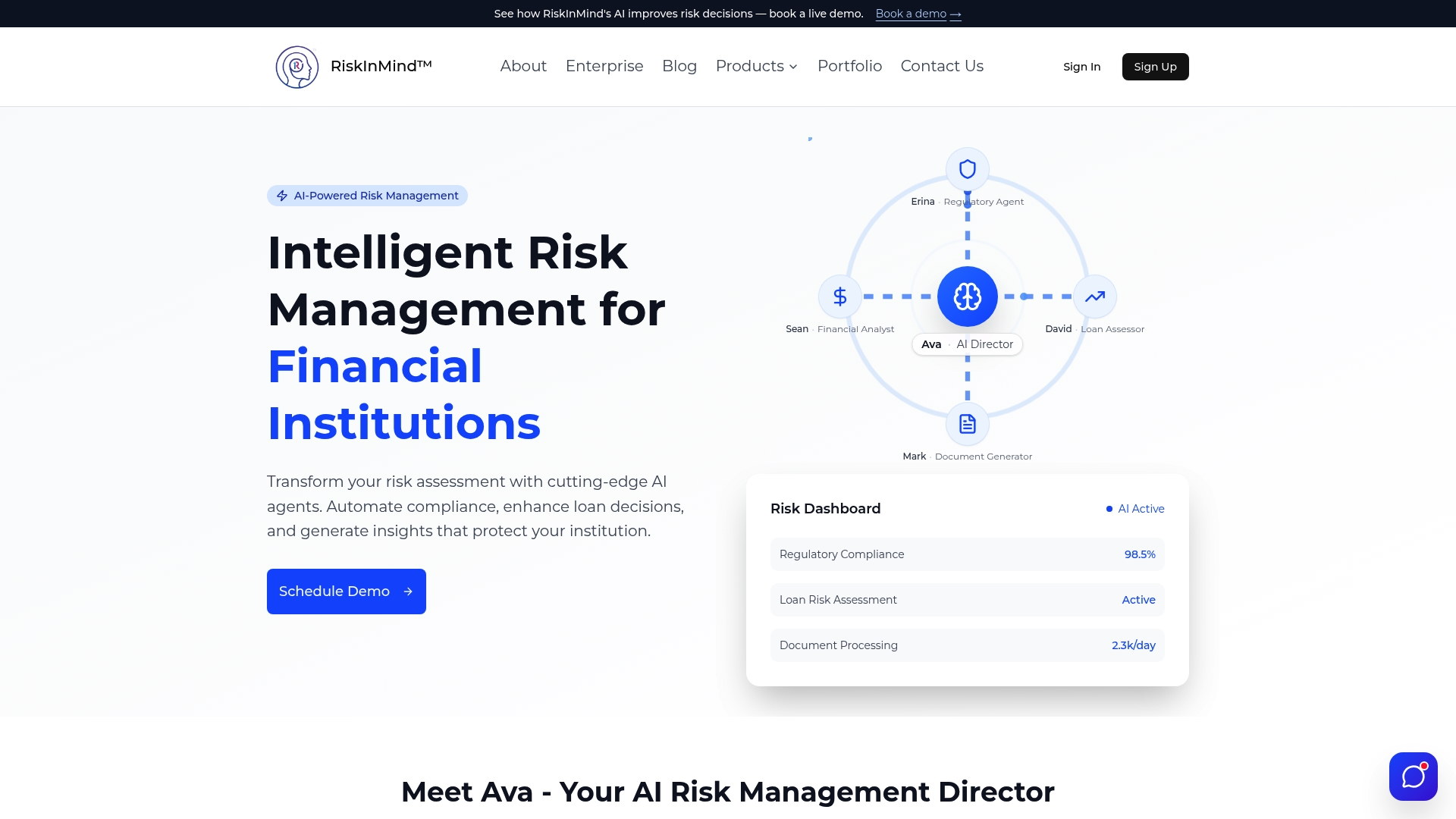
The platform's specialized AI agents, coordinated by Ava, cover credit risk assessment, regulatory compliance, and market analysis simultaneously, with response times under half a second. For teams ready to close the operational gaps identified in this guide, the loan application workflow is a practical starting point for evaluating how automated collateral assessment integrates with your existing underwriting process. Request a demo to see the dashboards and fraud detection capabilities in a live environment.
Authoritative sources and further reading
The following sources informed this guide and are recommended for policy drafting, stress-test design, and valuation convention development.
-
OSFI Collateral Management Principles for IRB Institutions — The most detailed supervisory framework for collateral valuation policy, revaluation frequency, and early-warning indicators. Widely referenced as an industry benchmark by U.S. practitioners, particularly for advanced approaches institutions. Best used for drafting valuation policy and defining revaluation triggers.
-
Bank of England: Collateral Management in Central Bank Policy Operations — Authoritative treatment of haircut methodology, eligible collateral frameworks, and the mechanics of margin calls. Best used for stress-test design and haircut calibration.
-
ISO 31000:2018 Risk Management — The international standard for risk governance, covering risk criteria definition, iterative assessment, and treatment selection. Best used for matrix design, governance structure, and stress-test documentation requirements.
-
ECB Risk Mitigation Framework — Explains the three financial risk types (credit, market, liquidity) that collateral frameworks must address and describes the Eurosystem's risk control measures. Useful for understanding the theoretical underpinning of haircut and margin policy.
-
Emumoney Collateral Risk Overview — A practical taxonomy anchor covering all nine collateral-risk types with concise definitions. Best used as a quick-reference companion to this guide and for onboarding new team members to the risk classification framework.
-
Wikipedia: Collateral Management — Provides a useful practitioner overview of collateral classes, liquidity characteristics, and the mechanics of margin and haircut policy. Best used as a reference for collateral-class characteristics tables.
Consult internal legal counsel for jurisdiction-specific lien perfection requirements, UCC filing procedures, and recovery-timing assumptions before finalizing coverage models or collateral policy documentation.