
Risk mitigation is one of the most misunderstood concepts in financial risk management. Many professionals conflate it with risk avoidance, assuming that the goal is simply to eliminate threats before they materialize. In reality, financial institutions operate in an environment where most risks cannot be fully removed: credit cycles turn, regulatory environments shift, operational systems fail, and model assumptions drift. True risk mitigation means reducing the likelihood and impact of risks you cannot fully escape, and embedding that reduction into everyday decisions, controls, and culture rather than treating it as a compliance checkbox.
Table of Contents
- Defining risk mitigation: More than risk avoidance
- Core elements: From identification to implementation
- Risk mitigation in action: Controls, KRIs, and monitoring
- Model risk: Special case for mitigation frameworks
- Why effective risk mitigation is more art than science
- How RiskInMind powers modern risk mitigation
- Frequently asked questions
Automate Regulatory Model Risk Governance
Examine models against 32 qualitative criteria and resolve risk Tiers with pre-deployment checklists per OCC 2011-12 guidelines.
Key Takeaways
| Point | Details |
|---|---|
| Mitigation over avoidance | Risk mitigation means reducing the effect or likelihood of risks you cannot completely avoid. |
| Operational controls matter | Financial regulators assess how well your controls actually reduce risk, not just how good they look on paper. |
| Continuous monitoring | Ongoing risk monitoring with KRIs and responsive controls outperforms periodic reviews. |
| Proportionality is key | Effective mitigation matches the intensity of controls to the severity of each risk. |
Defining risk mitigation: More than risk avoidance
The technical definition matters here, and it is worth being precise. [Risk mitigation reduces likelihood or impact] rather than eliminating threats outright, and it applies specifically in situations where avoiding the risk entirely is not feasible. This distinction separates mitigation from other risk response strategies: risk avoidance means changing plans to sidestep an exposure altogether, risk sharing (or transfer) pushes some of the impact to a third party such as an insurer or counterparty, and mitigation is what you do when neither avoidance nor transfer fully addresses what remains.
Consider a concrete example. A credit union cannot avoid the risk of member loan defaults by simply refusing to lend. That would eliminate its core business. Instead, it mitigates that risk through underwriting standards, collateral requirements, loan concentration limits, and loss reserves. Each of those controls reduces either the probability of default or the financial impact when defaults occur.
"Risk mitigation is not about achieving a risk-free environment. It is about ensuring that the risks you accept are managed to a level consistent with your risk appetite and your institution's capacity to absorb loss."
Regulatory agencies reinforce this framing. Examiners do not expect institutions to have zero risk. They expect evidence of effective controls, documented in procedures that are actually functioning, not merely written. An outdated policy manual with no operational footprint is not mitigation. It is paperwork. Understanding this distinction is the foundation for designing risk mitigation strategies for credit unions that hold up under examination.
Key characteristics that define true risk mitigation in the financial sector:
- It is proportional: controls are calibrated to the severity and likelihood of the risk, not applied uniformly across all exposures.
- It is operational: mitigation actions are embedded in daily workflows, approval processes, and monitoring routines.
- It is evidence-based: regulators and boards require documented proof that controls are functioning as designed.
- It is iterative: as risks evolve, mitigation strategies must be updated to remain effective.
Pro Tip: When building your mitigation inventory, map each control to a specific risk event, not just a risk category. A control mapped to "credit risk" tells an examiner very little. A control mapped to "unexpected increase in commercial real estate (CRE) delinquencies in markets with declining occupancy rates" tells a precise story about your institution's risk awareness.
Core elements: From identification to implementation
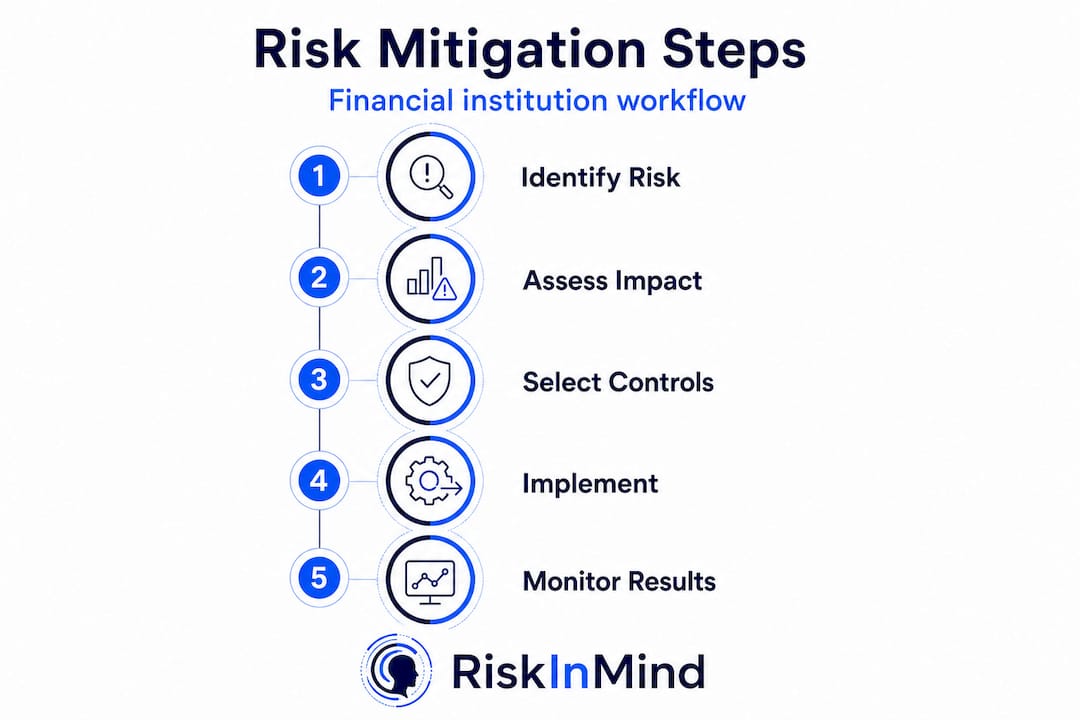
The mitigation lifecycle in financial institutions follows a structured sequence that begins well before any control is deployed. COSO's ERM guidance is explicit that mitigation must function as concrete action aligned to strategy, not just documentation sitting in a risk register. The steps below reflect that expectation.
- Identify the risk. Use structured methods: scenario analysis, historical loss data, vendor risk assessments, and regulatory guidance to surface material threats. Risk identification should be ongoing, not limited to the annual ERM cycle.
- Assess likelihood and impact. Quantify where possible. For risks with limited historical data, use qualitative scoring tied to defined scales, and document the rationale carefully.
- Select the appropriate response. Determine whether the risk should be avoided, shared, accepted, or mitigated. For most operational and credit risks in community banks and credit unions, mitigation is the primary response.
- Design and implement controls. Controls must be specific, assigned to an owner, and integrated into existing processes rather than bolted on as separate activities.
- Monitor control effectiveness. Testing schedules, control self-assessments, and internal audit coverage all contribute to ongoing assurance that controls are working.
- Update continuously. Risks change. A mitigation strategy designed for a stable rate environment may be inadequate when rates are rising sharply or when economic conditions shift.
The proportionality principle is critical at step four. Institutions that apply the same level of control rigor to a $50,000 unsecured personal loan portfolio as they do to a $200 million CRE concentration are misallocating resources. Control intensity should match risk materiality.
Reviewing established ERM frameworks for financial institutions provides useful benchmarks for calibrating your mitigation lifecycle against industry best practice. Many community banks and credit unions benefit from cross-referencing their internal frameworks against published guidance, particularly as they scale or face examination scrutiny.
| Lifecycle stage | Primary owner | Key output |
|---|---|---|
| Risk identification | Business lines and risk teams | Risk register entries |
| Risk assessment | Risk management and finance | Likelihood/impact scores |
| Control design | Risk and compliance | Control specifications |
| Implementation | Operations and business lines | Documented workflows |
| Monitoring | Internal audit and risk | Testing results and KRI reports |
| Continuous update | ERM function | Updated risk profile |
Referencing proven frameworks and AI solutions for credit unions specifically can accelerate how quickly your institution moves from identification to implementation, particularly when AI-assisted risk assessment tools automate the scoring and mapping steps.
Risk mitigation in action: Controls, KRIs, and monitoring
The practical expression of risk mitigation sits in three interconnected areas: the controls themselves, the key risk indicators (KRIs) that signal when those controls may be failing, and the monitoring programs that tie both together.
Controls in banking and credit union contexts generally fall into three types:
- Preventive controls stop risk events before they occur. Examples include dual authorization for high-value wire transfers, automated underwriting rules that reject loans outside approved parameters, and segregation of duties in the accounting function.
- Detective controls identify risk events or control failures after they happen. Transaction monitoring systems for Bank Secrecy Act (BSA) and anti-money laundering (AML) compliance are the most prominent example, flagging suspicious patterns for further review.
- Corrective controls address the consequences of a risk event. Incident response procedures, loan workout programs, and regulatory remediation plans all fall in this category.
NCUA's 2026 supervisory priorities make clear that regulators expect evidence of effective, risk-based controls, particularly in compliance and AML contexts. Written policies that are not supported by operational controls, staff training, and tested procedures will not satisfy examiners. This expectation applies across BSA compliance, interest rate risk management, and credit concentration oversight.
KRIs are the quantitative layer that gives mitigation programs early warning capability. According to the EBA Methodological Guide, KRIs function as ratios or metrics intended to signal rising risk before exposures reach critical levels, making them foundational to measurable and auditable mitigation programs. A KRI for credit risk might track the rolling 90-day delinquency rate in a specific loan segment. A KRI for operational risk might monitor the number of unresolved audit findings by severity. When a KRI breaches a defined threshold, it triggers a formal response rather than waiting for the next quarterly review.
| Control type | Example in practice | Regulatory relevance |
|---|---|---|
| Preventive | Automated loan decision rules | Credit risk appetite compliance |
| Detective | AML transaction monitoring | BSA/AML regulatory compliance |
| Corrective | Loan workout and modification program | Credit loss mitigation |
| Monitoring | KRI dashboard with threshold alerts | Ongoing supervisory expectations |
The shift from periodic review to continuous monitoring is significant. Institutions that rely on quarterly risk committee reports to assess mitigation effectiveness are operating with a substantial lag. By the time a trend is visible in a quarterly report, the exposure may have already grown beyond comfortable bounds. Real-time or near-real-time monitoring, supported by technology platforms, allows risk teams to spot deteriorating KRIs and escalate mitigation responses before losses materialize.

Pro Tip: Structure your KRI dashboard so each indicator has a defined owner, a yellow-flag threshold that prompts review, and a red-flag threshold that triggers a mandatory escalation to senior management or the board risk committee. Ambiguity about when to act is itself a risk.
Investing in streamlining risk analysis for compliance ensures that your monitoring infrastructure keeps pace with the volume and complexity of risks your institution faces.
Model risk: Special case for mitigation frameworks
Model risk deserves separate treatment because it does not fit neatly into the standard credit or operational risk categories, yet it touches almost every material decision a financial institution makes. Every time a loan pricing model, a credit scoring algorithm, a stress testing framework, or an interest rate risk model produces output that influences a decision, model risk is present.
OSFI Guideline E-23 articulates the current standard: model risk management (MRM) frameworks must define policies and procedures for identifying, assessing, managing, monitoring, and reporting model risk, with the intensity of oversight scaled to the materiality and complexity of each model. A simple spreadsheet tool used for one-off calculations carries far lower model risk than a machine learning credit scoring model used across the entire loan portfolio.
The core stages of a sound MRM framework follow a recognizable structure:
- Model inventory and classification. Every model in use must be documented, with its purpose, inputs, outputs, and the business decisions it influences clearly described. Classification by materiality determines the level of oversight applied.
- Model validation. Independent validation assesses whether a model is conceptually sound, whether it performs as intended across different conditions, and whether its limitations are understood by the users who rely on it.
- Model approval and governance. Material models should require formal approval before deployment, with clearly defined authority levels and documentation requirements.
- Ongoing monitoring. Model performance should be tracked against defined benchmarks after deployment. Drift in predictive accuracy, changes in the data environment, or shifts in the economic context can all degrade model performance over time.
- Model retirement or redevelopment. Institutions need explicit criteria for when a model should be retired, replaced, or significantly recalibrated.
"Model risk mitigation is not a validation exercise conducted once at deployment. It is a continuous governance discipline that adapts to changing conditions and learns from model performance data."
The proportionality principle is as important in MRM as it is in general risk mitigation. Applying the same validation rigor to a low-use internal reporting model as to a high-volume credit decisioning model wastes resources and obscures the areas of genuine concern.
Understanding current model risk management guidance is essential as regulatory expectations continue to evolve, especially as AI and machine learning models enter the credit decisioning space. Institutions that are also building out broader quantitative capabilities will find that risk analytics in finance provides a useful foundation for connecting model governance to overall portfolio risk analysis.
Why effective risk mitigation is more art than science
Frameworks, policies, control inventories, and KRI dashboards are necessary. They are not sufficient. The most common failure mode we observe in financial institution risk programs is not a missing policy or an incomplete risk register. It is the gap between what is written and what actually happens at the operational level, day after day.
Risk culture is the invisible infrastructure of effective mitigation. When a loan officer understands not just the underwriting rules but why those rules exist and what could go wrong when they are bent, that officer becomes a risk control in themselves. When a compliance team learns from a near-miss transaction that almost passed through AML monitoring without a flag, and uses that incident to recalibrate detection thresholds before a loss occurs, that is mitigation working at its highest effectiveness.
Near-miss analysis is chronically underused in financial institution risk programs. Institutions typically investigate incidents after losses occur. Far fewer build formal processes to capture, analyze, and act on events where the controls almost failed. The signal in a near miss is often cleaner than the signal in an actual loss, because you can study what happened before the outcome became irreversible.
Institutions that invest in AI risk management best practices are discovering that technology can surface near-miss patterns that human reviewers miss, particularly when monitoring large transaction volumes or complex portfolio signals. But technology amplifies culture; it does not replace it. An institution with weak risk culture will use better tools to process risk data faster and still arrive at the wrong conclusions.
Our perspective is direct: regulatory compliance is the floor, not the ceiling. The institutions that achieve genuine mitigation effectiveness are those that treat every incident, near-miss, and control exception as learning material, and that build communication channels where frontline staff feel accountable for risk outcomes, not just checklist completion.
How RiskInMind powers modern risk mitigation
Operationalizing risk mitigation across loan portfolios, compliance programs, and model governance frameworks requires more than a policy update. It requires tools that work at the speed and scale of your institution's actual risk environment.
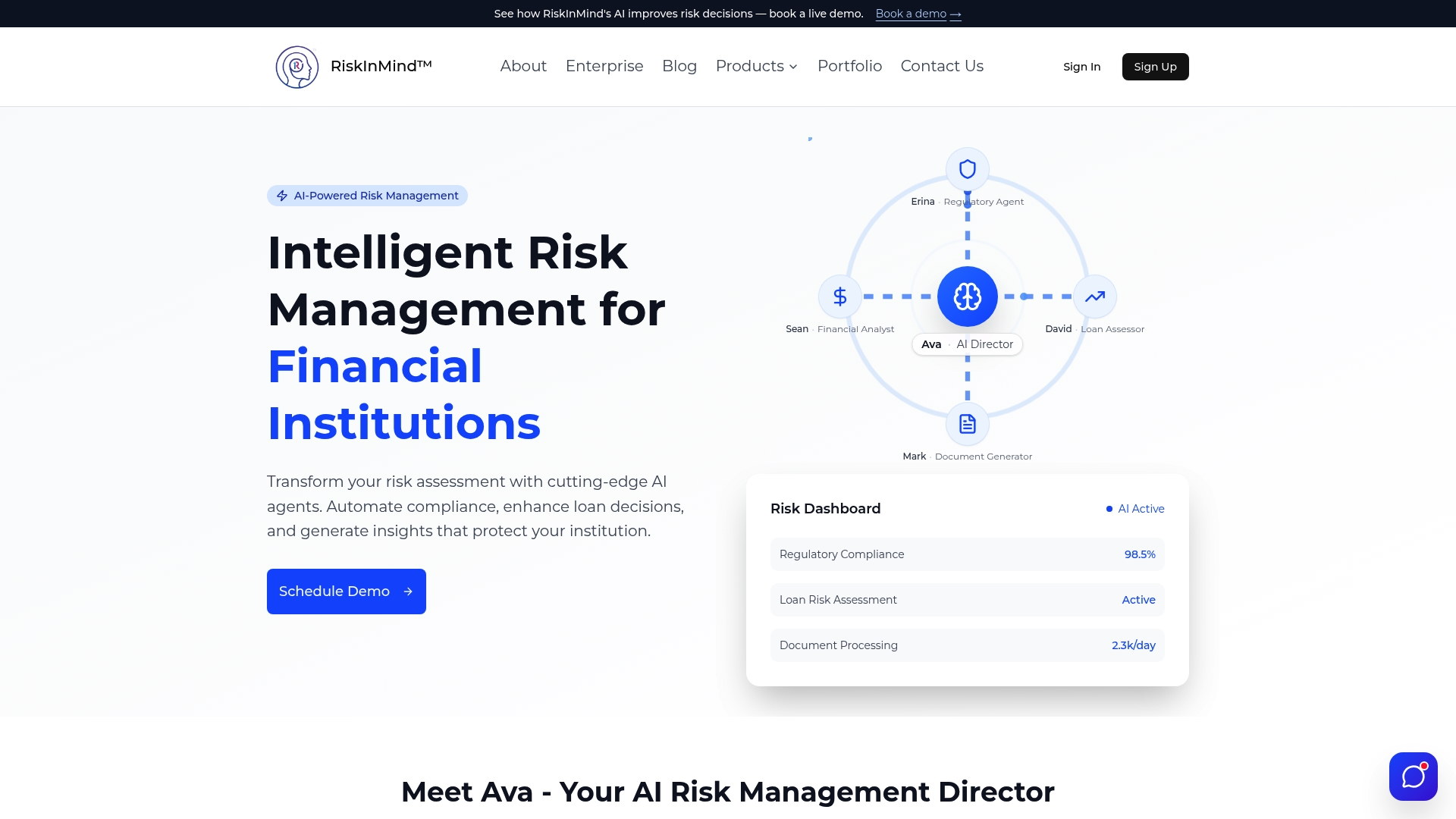
RiskInMind's AI-powered platform is purpose-built for financial institutions that need to close the gap between written mitigation plans and real-time risk control. Ava, our central AI director, coordinates a suite of specialized agents covering credit risk, regulatory compliance, and market analysis, delivering sub-second risk assessments that keep pace with your decision cycles. Our AI loan application risk analysis tool automates the underwriting risk layer, while the CRE loan risk predictor brings quantitative discipline to one of the highest-concentration risks in community banking. For cash flow and fraud pattern analysis, our bank statement analysis tools deliver detective-control capabilities at scale. SOC 2® certified and built for regulatory scrutiny, RiskInMind turns mitigation from documentation into demonstrable, auditable action.
Frequently asked questions
How is risk mitigation different from risk avoidance?
Risk mitigation reduces the impact or likelihood of risks that cannot be avoided, while risk avoidance seeks to eliminate exposure to the risk entirely. When avoidance is not feasible, as is the case for most core banking risks, mitigation addresses consequences when risks can't be eliminated.
What are examples of effective risk mitigation controls for banks?
Effective controls include automated transaction monitoring for AML compliance, dual control for wire transfers, and regular model risk validation processes. Regulators require evidence of AML/CFT controls that are operational, tested, and documented, not just described in policy.
How do key risk indicators (KRIs) support mitigation?
KRIs provide early warning signals so institutions can act before risk exposures escalate to loss events. KRIs are ratios intended as early warnings for monitoring risks, giving risk teams time to respond rather than react.
Why do regulators emphasize proportionality in risk mitigation?
Proportionality ensures that mitigation controls are as rigorous as the risk's size and impact require, preventing both excessive overhead on low-risk exposures and insufficient oversight on material ones. MRM frameworks require controls to match the institution's risk level and model complexity.