
Alternative data underwriting is the practice of scoring credit risk with non-traditional inputs, cash-flow transactions, rent, utility, and telecom payment histories, alongside or instead of a conventional credit file, and the Interagency Statement on the Use of Alternative Data in Credit Underwriting confirms it can sharpen accuracy and reach thin-file borrowers, provided your institution runs it through a tested, monitored compliance program. That is the whole verdict. The rest of this guide is how to act on it responsibly.
Three benefits show up consistently in the field: broader inclusion for consumers with sparse credit files, sharper visibility into actual cash-flow capacity rather than a static score, and faster decisions on files that would otherwise stall. Three risks travel with those benefits: fair-lending exposure if a variable acts as a proxy for a protected class, data quality problems from inconsistent vendor feeds, and privacy or FCRA obligations tied to consumer permissioning. Our recommendation for risk teams: run a bounded pilot, built on a documented validation plan, before touching production volume.
- Top benefits: inclusion gains for thin-file applicants, better cash-flow visibility, faster underwriting decisions
- Top risks: disparate-impact exposure, data quality and drift, privacy/FCRA compliance gaps
- Next step: launch a controlled pilot with bias testing and a documented validation plan before scaling
Automate Regulatory Model Risk Governance
Examine models against 32 qualitative criteria and resolve risk Tiers with pre-deployment checklists per OCC 2011-12 guidelines.
Key Takeaways
Alternative data underwriting works when a tested, monitored compliance program governs every model before it touches production volume.
| Point | Details |
|---|---|
| Start with cash-flow data | Bank transaction signals carry lower consumer-protection risk than nonfinancial proxies and improve repayment-capacity visibility. |
| Follow the Interagency Statement | Build testing, monitoring, and documentation into your compliance program from day one, not after an exam. |
| Validate before scaling | Run holdout backtests, disparate-impact checks, and uplift analysis before moving past a pilot. |
| Plan for data forfeiture | Confirm what protective signal you lose when replacing traditional inputs with new data sources. |
| Riskinmind operationalizes governance | Riskinmind's platform pairs data connectors and validation modules with SOC 2 controls and audit-ready reporting for staged rollouts. |
Table of Contents
- What Counts as Alternative Data in Credit Underwriting?
- Where Alternative Data Improves Underwriting Outcomes
- What Regulatory Guidance Requires Before You Deploy
- How Do You Validate an Alternative Data Model?
- Running a Pilot: From Prototype to Production
- What Are the Biggest Risks and How Do You Mitigate Them?
- Why Alternative Data Underwriting Is Harder Than It Looks
- Best Practices for Integrating Alternative Data Into Your Models
- What Successful Alternative Data Programs Look Like in Practice
- How Riskinmind Supports Compliant Alternative Data Adoption
- Frequently Asked Questions
- Sources
What Counts as Alternative Data in Credit Underwriting?
Alternative data covers any signal outside the traditional credit bureau file that helps predict repayment or fraud risk. The Consumer Financial Protection Bureau and interagency regulators group it loosely into categories that risk teams should evaluate on their own merits rather than treating as one monolith.
- Cash-flow and bank transaction data: checking-account inflows, outflows, and balance volatility that reveal real repayment capacity, not just a credit score snapshot.
- Rent and utility payments: consistent on-time rent or utility payments that never reach a bureau file but demonstrate payment discipline.
- Telecom and device metadata: phone bill payment history and device-level signals used in some fraud and thin-file scoring models.
- Platform and marketplace transaction data: gig-economy or e-commerce sales history that substitutes for a business's missing tax returns.
- Psychometrics and behavioral signals: survey-based or app-behavior data used cautiously, mostly in emerging-market lending.
- Public records and attestations: employment verification, education records, and licensing data that corroborate income claims.
A checking-account deposit pattern showing steady payroll inflows, for instance, maps directly to repayment capacity in a way a thin bureau file cannot. Plaid's cash-flow underwriting research shows this kind of transaction data can also flag income volatility that a static score misses entirely.
Pro Tip: Confirm consumer opt-in and data provenance before a single record enters your model pipeline. If you can't trace where a data point came from and whether the consumer permissioned it, you can't defend it in an exam.
Where Alternative Data Improves Underwriting Outcomes
The clearest wins show up in five use cases: thin-file consumer credit, small-business cash-flow underwriting, second-look programs for previously declined applicants, fraud detection on document and identity signals, and pricing or servicing personalization based on real payment behavior.
- Thin-file consumers gain a scoreable profile instead of an automatic decline.
- Small businesses get evaluated on actual deposit activity instead of incomplete tax documentation.
- Second-look programs reopen files that failed a traditional score alone.
- Fraud teams catch document and identity inconsistencies earlier in the pipeline.
- Pricing and servicing teams tailor terms to real cash-flow patterns rather than a stale score.
Metric to track: IFC's 2026 practitioner research finds that combining multiple alternative data sources generally lifts predictive performance over single-source models, particularly for underserved segments.
A typical second-look pilot takes applicants declined on bureau score alone, reruns them through a cash-flow model, and measures approval-rate lift against a holdout group, giving your team a clean, auditable KPI before any full rollout.
What Regulatory Guidance Requires Before You Deploy
Four bodies of law govern this space, and none of them are optional footnotes. Fair lending statutes require that any variable, however predictive, not function as a proxy for race, sex, or another protected class. The Fair Credit Reporting Act governs consumer disclosure and dispute rights when data feeds a credit decision. The Equal Credit Opportunity Act sets adverse-action notice requirements. The Gramm-Leach-Bliley Act governs how you secure and share the data itself.
The Interagency Statement, issued jointly by the federal banking agencies, is the anchor document here.
The statement acknowledges that alternative data, cash-flow information especially, can improve the speed and accuracy of credit decisions and expand access for consumers who lack a thick credit file. It also makes clear that firms must implement testing, ongoing monitoring, and compliance controls consistent with existing consumer protection law before scaling use.
The FDIC's summary of the same guidance reinforces that regulators expect a compliance program sized to the actual risk the data introduces, not a one-size-fits-all checklist.
Build your checklist around these items:
- Legal and regulatory analysis of each proposed data source against fair lending and FCRA
- Model governance updates documenting variable selection and rationale
- A complete audit trail from data ingestion through decision output
- Adverse-action notice language updated to reflect new variables
- Vendor due diligence covering data provenance and security posture
- Consumer disclosure and permissioning flows built into the application journey
Pro Tip: Loop in supervisory counsel before your first production decision, not after an exam flags it. A brief pre-launch conversation with your examiner-in-charge, or a formal supervisory inquiry, costs far less than retrofitting compliance after the fact. Our compliance testing program guide walks through how to structure that ongoing testing cadence.
How Do You Validate an Alternative Data Model?
Validation is where most alternative-data programs succeed or fail in front of examiners. Five tests belong in every validation plan: holdout and backtest performance against a control group, demographic parity and disparate-impact ratio checks, counterfactual fairness testing on borderline decisions, uplift measurement from second-look programs, and ongoing feature stability monitoring for data drift.
Transaction and cash-flow signals need specific feature engineering before they're model-ready. Common transformations include rolling 90-day aggregation windows on deposit inflows, volatility measures on account balances, and income-to-obligation ratios calculated from recurring payment patterns. FinRegLab's research on alternative data underwriting confirms these transaction-based features are consistently strong predictors across both consumer and small-business models.
Report to examiners with these metrics: predictive lift over your baseline model, AUC improvement, population stability index (PSI) for drift detection, and disparate-impact ratios segmented by protected class.
Set a monitoring cadence of at least quarterly for high-volume portfolios, with immediate re-validation triggered by any PSI threshold breach. Our guide to credit risk modeling approaches covers backtest design in more depth if you're building this validation framework from scratch.
Running a Pilot: From Prototype to Production
A disciplined pilot answers one question: does this data source improve decisions enough to justify the compliance overhead? Structure it as follows.
- Establish data access and consumer consent flows before touching a single application.
- Define your cohort and minimum sample size, generally several thousand applications, for a statistically meaningful lift measurement.
- Set success criteria and KPIs up front: approval-rate lift, default-rate change, disparate-impact ratio thresholds.
- Build a holdout group and monitoring dashboard that runs in parallel with production decisions.
- Define escalation triggers that pause the pilot automatically if bias metrics breach threshold.
- Vendor due diligence: verify data provenance, SOC 2 or equivalent security certification, FCRA reporting status, service-level agreements for data freshness, and contractual exit terms.
- Budget three to six months for a meaningful pilot cycle, not weeks.
Pro Tip: Undersized pilots produce noise, not signal. If your sample can't detect a meaningful lift at your institution's typical approval volume, extend the test window before drawing conclusions.
What Are the Biggest Risks and How Do You Mitigate Them?
Five risks recur across alternative-data deployments, each with a specific control.
- Privacy exposure → strict consent capture and minimal data retention windows.
- Disparate impact → robust bias testing plus constrained feature sets that exclude proxy variables.
- Data accuracy → vendor-level data quality audits and reconciliation against known-good records.
- Vendor concentration → multi-source sourcing strategy and a documented exit plan if a provider fails an audit.
- Model drift → continuous monitoring with automatic re-validation triggers.
Swiss Re's research on alternative data principles raises a risk that's easy to overlook: predictive accuracy alone doesn't justify a data swap. Firms need to ask what protective signal gets forfeited when a new variable replaces an older one, and watch for anti-selection where riskier applicants cluster around the new model's blind spots.
If systemic bias or a material model failure surfaces, the escalation protocol should be immediate: freeze new decisions on the affected model, notify compliance and legal within 24 hours, and begin remediation before resuming production use.
Pro Tip: Keep every model version, validation report, and decision log in one auditable trail. Examiners rarely fault a documented judgment call, but they will flag a gap in the record.
Why Alternative Data Underwriting Is Harder Than It Looks
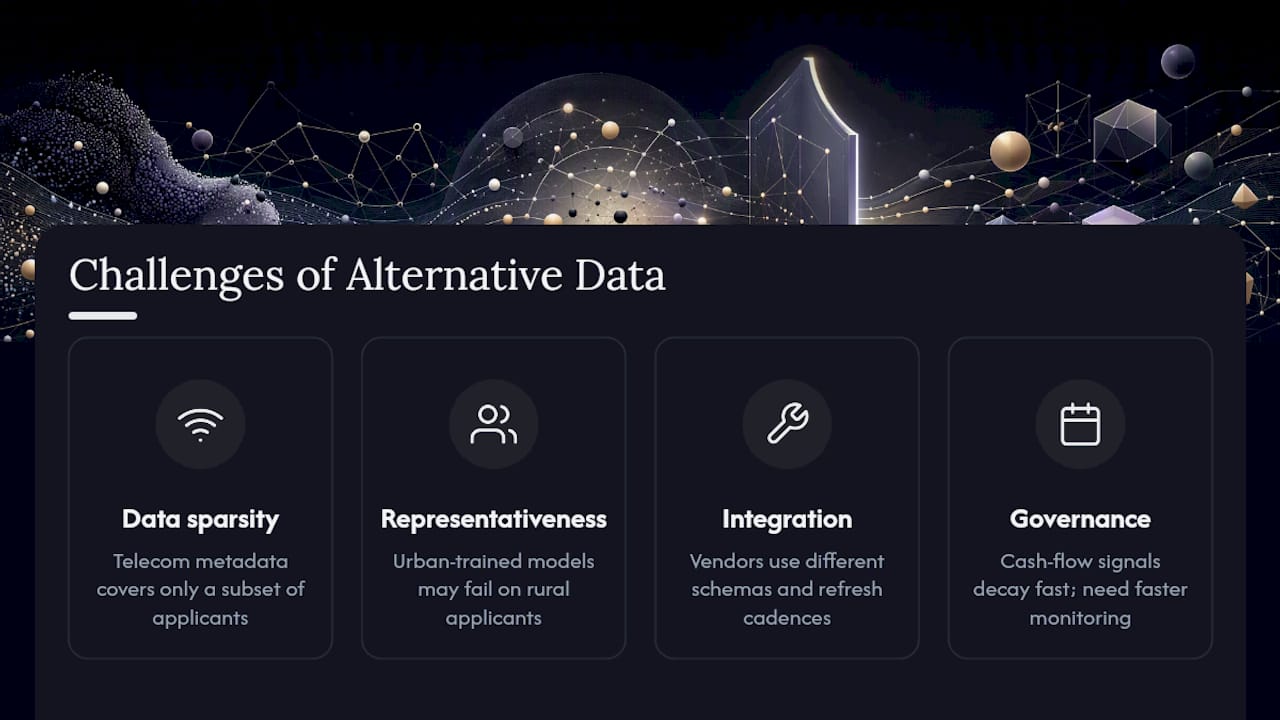
Data sparsity is the first obstacle risk teams underestimate. Many alternative sources, telecom metadata especially, only exist for a subset of applicants, which means your model needs a fallback path for consumers who lack even the alternative signal.
Representativeness compounds that problem. A cash-flow model trained on urban banking customers may not generalize to rural applicants who bank differently or use cash more heavily. The Congressional Research Service's overview of alternative data flags this as a live regulatory concern: a model that performs well in aggregate can still produce uneven outcomes across geography or demographic segment.
Integration complexity is the operational drag that slows most programs down. Alternative data vendors rarely share a common schema, refresh cadence, or data-quality standard, so your engineering team ends up building custom ingestion and normalization logic for each source. That work is invisible in a proof-of-concept demo and very visible once you try to scale past a pilot.
There's also a governance dimension that's easy to miss: alternative data ages differently than a credit score. A transaction pattern from six months ago may no longer reflect an applicant's current situation, particularly for gig workers or seasonal small businesses. Static credit files decay slowly. Cash-flow signals decay fast, which means your monitoring cadence needs to match the actual volatility of the underlying data, not a calendar convenience like quarterly review.
None of these challenges argue against adoption. They argue for sequencing: validate data quality and representativeness before you invest in production-grade feature engineering, not after.
Best Practices for Integrating Alternative Data Into Your Models
Start with a data map, not a model. Before writing a single feature, document every proposed data source, its refresh frequency, its coverage gaps, and its legal basis for use. That map becomes your audit trail later and forces early conversations about consent and provenance.
Feature engineering for cash-flow data benefits from stability over cleverness. Rolling aggregation windows, 30, 60, and 90 days, tend to outperform single-point snapshots because they smooth out payroll timing noise and one-off transactions. Income-to-obligation ratios calculated from recurring debits give a cleaner repayment-capacity signal than raw transaction counts.
Treat traditional credit data as a complement, not a replacement. IFC's 2026 report on alternative data and AI for financial inclusion finds that most practitioners run hybrid models, keeping a traditional bureau check as a red-flag layer even when alternative data drives the primary score. That structure gives you a fallback when alternative signals are sparse or unreliable for a given applicant.
Build your pipeline with explainability baked in from the start rather than retrofitted for an exam. A model that can show which specific cash-flow feature drove a decline is far easier to defend, and far easier to correct, than a black-box score. Our breakdown of machine learning in credit assessment covers explainability tooling in more depth for teams building this internally.
What Successful Alternative Data Programs Look Like in Practice
Second-look programs are the most replicable success pattern in the industry. A lender takes applicants declined on a traditional score, reruns them through a cash-flow model using bank transaction data, and approves a meaningful share who would otherwise have been turned away, with default rates tracked closely against the original applicant pool. Plaid's cash-flow underwriting resource documents this pattern as one of the most common entry points for institutions new to alternative data, precisely because it runs in parallel with existing underwriting rather than replacing it outright.
Small-business lending shows a similar pattern. Businesses that can't produce two years of clean tax returns, common among newer or seasonal operations, get evaluated instead on deposit account activity: revenue consistency, seasonal patterns, and existing debt service already visible in the bank feed. That shifts the underwriting conversation from "do you have the paperwork" to "can we see the cash flow," which is often a more honest question for a three-year-old business.

Credit unions adopting AI-powered underwriting platforms report similar gains in speed and reach when alternative data is layered onto existing scoring frameworks rather than bolted on as an afterthought. Our case coverage of credit union growth through AI-powered risk intelligence walks through what that layering looks like operationally. The common thread across every successful case: alternative data expanded who got evaluated, not just who got approved, and every one of them ran a documented pilot before scaling.
A Publisher's Take on Operationalizing Alternative Data
At Riskinmind, we've built our platform around the assumption that alternative-data models fail on governance before they fail on math. That means staged rollout, second-look gating, continuous drift monitoring, and SOC 2-backed controls running underneath every model our AI agents deploy, not layered on after the fact.
How Riskinmind Supports Compliant Alternative Data Adoption
Standing up a compliant alternative-data program from scratch means building data connectors, bias-testing infrastructure, and audit-ready reporting before you underwrite a single loan, work that can take most internal teams a year or more to get production-ready. Riskinmind's platform ships with that infrastructure already built.
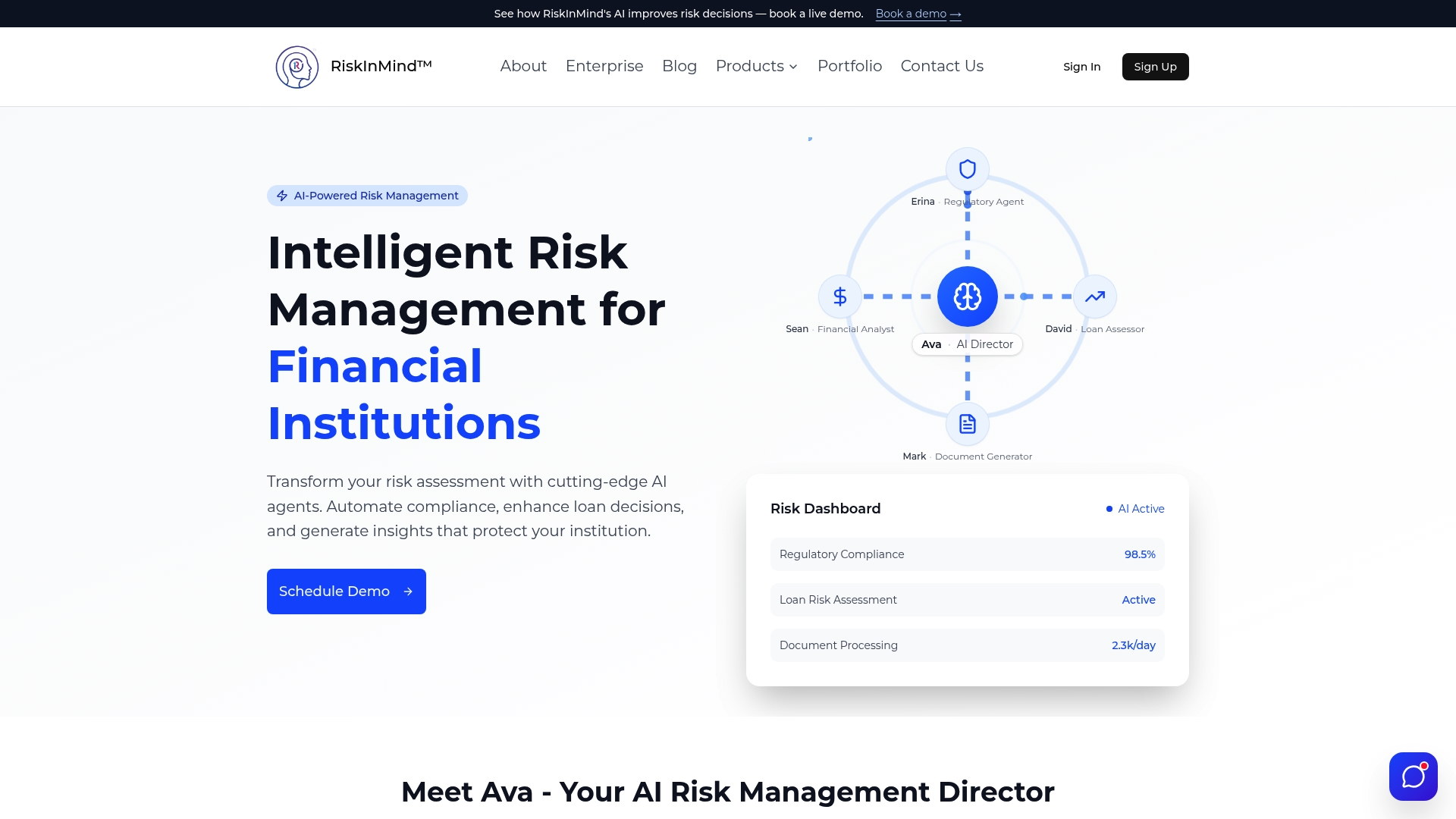
The platform connects cash-flow and transaction data sources directly into underwriting workflows, runs model validation modules with built-in disparate-impact and holdout testing, and generates explainability output your examiners can actually read. Every decision path stays logged for audit, backed by SOC 2 certification and real-time processing under half a second per decision. Ava, our central AI director, coordinates specialized agents for credit risk, compliance, and portfolio monitoring so your team isn't managing three disconnected tools during a pilot.
If you're weighing a cash-flow underwriting pilot or want to see how second-look gating works inside a live dashboard, the loan application platform is the right place to start, and our CRE loan risk predictor shows the same governance pattern applied to commercial portfolios. Request a demo to walk through your specific data sources before you commit to a build timeline.
Frequently Asked Questions
Is alternative data underwriting legal for U.S. lenders? Yes, when used consistently with fair lending law, the FCRA, and ECOA. The Interagency Statement confirms regulators support its use provided institutions maintain testing, monitoring, and compliance controls.
What's the difference between alternative data and cashflow underwriting? Cashflow underwriting is one specific application of alternative data, using bank transaction history to assess repayment capacity. Alternative data underwriting is the broader category that also includes rent, utility, telecom, and platform data.
Do consumers need to consent to alternative data use? Most cash-flow data requires consumer permissioning, typically through bank-linking consent flows. Public records and certain attestation data may not require explicit opt-in, but provenance and legal basis should always be documented.
How long does a typical pilot take? Plan for three to six months to reach a statistically meaningful sample and complete a full validation cycle, including bias testing and holdout comparison against your existing model.
Can alternative data replace traditional credit scores entirely? Rarely in practice. Most institutions run hybrid models that keep a traditional credit check as a red-flag layer alongside alternative-data scoring, particularly for applicants where alternative signals are sparse.
This article is general information, not a substitute for advice from a qualified financial advisor. Consult a qualified financial professional about your own circumstances before acting on anything here.
Sources
- Interagency Statement on the Use of Alternative Data in Credit Underwriting (Federal Reserve PDF)
- FDIC: Interagency Statement on the Use of Alternative Data in Credit Underwriting (speech/summary)
- Congress
- FinRegLab: The use of alternative data in underwriting credit
- IFC: Cracking the credit code — alternative data and AI for financial inclusion (2026)