
Machine learning models can reduce non-performing loans by 15 to 25% compared to traditional statistical approaches, a gap that carries serious consequences for any institution still relying on legacy scorecards. Credit unions and community banks face mounting pressure to sharpen model accuracy, meet evolving regulatory expectations, and compete with larger lenders that have already deployed advanced AI tools. This article covers what credit risk modeling means in practice, how traditional and AI-powered frameworks differ, which variables and metrics actually drive model performance, and what steps you can take to implement these approaches effectively within your institution.
Automate Regulatory Model Risk Governance
Examine models against 32 qualitative criteria and resolve risk Tiers with pre-deployment checklists per OCC 2011-12 guidelines.
Table of Contents
- Defining credit risk modeling
- Traditional vs modern credit risk modeling approaches
- Key drivers of credit risk: Data, variables, and performance metrics
- Regulatory priorities and practical implementation
- Beyond metrics: Hard-won lessons in credit risk modeling
- Advance your credit risk modeling with AI-powered solutions
- Frequently asked questions
Key Takeaways
| Point | Details |
|---|---|
| Modern AI models | AI-powered approaches drive sharper, more accurate credit risk prediction than traditional methods. |
| Core drivers matter | Financial ratios, industry, location, and loan type are key variables for effective modeling. |
| Regulatory compliance | Risk models must be validated, stress-tested, and explainable for regulatory approval. |
| Practical implementation | Combining advanced analytics with sound risk management practices delivers the best results. |
Defining credit risk modeling
Credit risk modeling is the process of using quantitative methods to estimate the likelihood that a borrower will fail to meet their repayment obligations. At its core, a credit risk model converts borrower data, loan characteristics, and macroeconomic context into a probability or expected loss figure that informs lending decisions. For credit unions and community banks, these models are not optional infrastructure; they are the analytical foundation for safer loan portfolios, accurate loss reserving, and regulatory compliance.
The field has historically operated in two broad camps: traditional statistical models and modern AI-based approaches. Traditional models, such as logistic regression and linear discriminant analysis, rely on a limited set of structured inputs and produce interpretable outputs. They were the industry standard for decades because they were auditable and aligned with early regulatory guidance. However, ML models outperform logistic regression across nearly every accuracy benchmark when applied to real-world loan portfolios.
Modern AI models, including gradient boosting, random forests, and neural networks, can process thousands of variables simultaneously, detect non-linear relationships, and adapt as new data arrives. For institutions exploring this shift, AI-powered growth for credit unions demonstrates how these gains translate directly into portfolio performance.
Here is what credit risk models are typically used for:
- Evaluating loan applications and setting approval thresholds
- Pricing risk through interest rate adjustments and fee structures
- Estimating expected credit losses for regulatory capital and CECL reporting
- Monitoring existing portfolios for early warning signals
- Supporting stress-testing and scenario analysis required by examiners
Pro Tip: If your institution is still using a single scorecard for all loan types, consider segmenting models by product or borrower class. A model built for auto loans will perform poorly when applied to commercial real estate, even if the underlying algorithm is sophisticated.
Getting the definition right matters because it shapes every downstream decision about model design, data sourcing, and governance. Credit risk modeling is not simply a scoring exercise; it is a structured risk management discipline with direct consequences for capital allocation and portfolio health.
Traditional vs modern credit risk modeling approaches
The foundational framework in traditional credit risk modeling is the PD-LGD-EAD structure. Probability of Default (PD) estimates the chance a borrower defaults over a specified horizon. Loss Given Default (LGD) measures the portion of exposure lost if default occurs. Exposure at Default (EAD) captures the outstanding balance at the time of default. Multiply these three together and you get Expected Loss, the cornerstone of credit pricing and capital planning.

This framework remains relevant and is embedded in regulatory guidance across Basel III and domestic supervisory standards. However, it carries well-documented limitations. PD and LGD are often estimated independently, despite strong empirical evidence that they move together during economic stress. A borrower who defaults during a recession is also more likely to generate a higher loss rate, yet classic models treat these as separate, uncorrelated estimates.
Emerging cash-flow and neural network models address this directly. Rather than estimating PD, LGD, and EAD separately, these models predict loss distributions holistically, capturing the correlation structure that traditional frameworks miss. The practical result is a model that performs better in tail scenarios, precisely when accurate estimation matters most.
"The shift from event-driven PD-LGD-EAD models to integrated loss models represents more than a technical upgrade. It reflects a fundamentally different understanding of how credit losses accumulate over time."
| Feature | Traditional PD-LGD-EAD | Modern AI or cash-flow models |
|---|---|---|
| Variable capacity | Low (dozens) | High (thousands) |
| Non-linear relationships | No | Yes |
| PD-LGD correlation | Not modeled | Captured directly |
| Real-time updating | Rare | Standard |
| Regulatory familiarity | High | Growing |
| Explainability | Strong | Requires SHAP or LIME tools |
For institutions producing credit documentation alongside model outputs, our credit risk memo generator automates structured narrative outputs that align with both traditional and AI-driven model frameworks. The transition from traditional to modern approaches does not require abandoning existing governance structures; it requires extending them to accommodate greater model complexity and faster data cycles.
Key drivers of credit risk: Data, variables, and performance metrics
A credit risk model is only as good as the inputs it processes. Empirical research consistently identifies three categories of variables as the most influential predictors of default: financial ratios, borrower industry and geographic location, and loan type and structure.
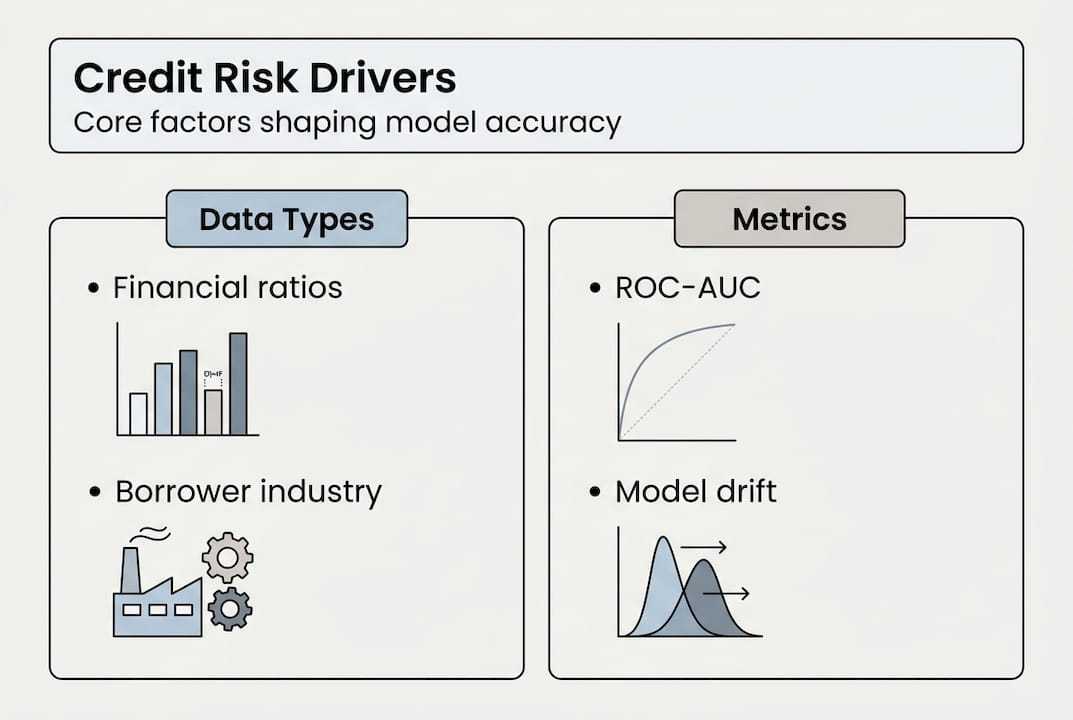
Financial ratios such as debt-to-income, current ratio, and return on assets provide the clearest signal of a borrower's repayment capacity. Industry sector matters because cyclical industries carry systematically higher default rates during downturns. Geographic location captures local economic conditions, real estate market health, and employment trends that borrower-level financials may not fully reflect.
Key input variables used in high-performing credit risk models include:
- Debt-to-income ratio and liquidity coverage metrics
- Profitability indicators such as operating margin and net income trend
- Industry classification and economic sector sensitivity
- Geographic market indicators and local unemployment rates
- Loan product type, term structure, and collateral quality
- Payment history and delinquency patterns over rolling time windows
Once a model is built, performance measurement determines whether it is fit for use. The primary metrics are:
| Metric | What it measures | Acceptable threshold |
|---|---|---|
| ROC-AUC | Overall discrimination ability | Above 0.75 for deployment |
| Gini coefficient | Rank-ordering power | Above 0.50 preferred |
| KS statistic | Max separation between default and non-default | Above 0.30 |
| F1 score | Balance between precision and recall | Context-dependent |
XGBoost, a popular gradient boosting algorithm, achieves ROC-AUC scores of 0.914 in structured lending datasets, compared to logistic regression benchmarks near 0.80. That gap is not trivial. It translates directly into fewer misclassified loans, lower provisioning errors, and better regulatory documentation.
Many institutions still rely heavily on FICO scores as a primary input, but understanding FICO score limitations is essential for building models that capture the full risk picture. For commercial real estate portfolios specifically, our CRE loan risk predictor applies these multi-variable frameworks to property-level risk assessment in real time.
Pro Tip: Validate your model on out-of-time samples, not just out-of-sample holdouts. A model trained on 2022 to 2024 data may look strong on a random holdout but fail badly when applied to 2025 and 2026 economic conditions. Temporal validation is the honest test.
Regulatory priorities and practical implementation
Regulators at the Federal Reserve, BIS, and ECB share a consistent message: AI enables real-time credit modeling, but requires robust governance and explainability to meet supervisory standards. Model risk management, often governed by SR 11-7 guidance in the United States, requires institutions to document model development, validate assumptions, and stress-test outputs under adverse scenarios.
Explainability is not just a regulatory checkbox. It shapes how credit decisions are communicated to borrowers, how examiners evaluate model soundness, and how your risk team trusts the outputs they act on daily. A model that produces accurate predictions but cannot explain why it flagged a specific loan is a liability in any supervisory review.
Here is a practical implementation checklist for credit unions and community banks:
- Define model scope: Specify the loan type, borrower segment, and time horizon the model is designed to address before selecting algorithms.
- Audit your data: Identify gaps in historical performance data, check for systemic bias in variable selection, and establish data quality standards.
- Select explainable AI tools: Use frameworks such as SHAP (SHapley Additive exPlanations) to produce variable contribution outputs that satisfy examiner requests.
- Build validation into the workflow: Independent model validation should occur before deployment and on a scheduled basis, ideally annually or after significant portfolio shifts.
- Stress-test regularly: Apply adverse economic scenarios to model outputs and document results for examiner review and CECL reserve estimation. Our approach to CECL model estimation integrates stress scenarios directly into portfolio loss projections.
- Monitor model drift: Set thresholds for performance degradation and trigger re-estimation when discrimination metrics fall below acceptable levels.
For institutions that have seen credit deterioration accelerate before controls caught it, the case study behind preventing credit union failure illustrates exactly what real-time monitoring can prevent.
Beyond metrics: Hard-won lessons in credit risk modeling
After working with financial institutions across the credit spectrum, we have observed a consistent pattern: the institutions that struggle most with credit risk modeling are not the ones using the wrong algorithms. They are the ones that treat model deployment as the finish line rather than the starting point.
The real challenge is not achieving a high ROC-AUC at launch. It is maintaining model reliability as borrower behavior shifts, economic conditions change, and your loan portfolio evolves. Models trained on pre-2020 data failed systematically during the pandemic because the underlying risk relationships changed faster than validation cycles could catch. That lesson still applies.
What most risk professionals underestimate is the compounding cost of model drift. A model that degrades by two percentage points in discrimination each quarter will become dangerously unreliable within a year, often without triggering any obvious alert. The institutions managing emerging subprime risks most effectively are those with continuous monitoring built into their model governance, not just annual validation cycles.
AI can drive dramatic accuracy gains, but human judgment remains essential for interpreting outputs in context. The best credit risk modeling programs blend advanced analytics with experienced risk management teams who understand when a model signal reflects real risk and when it reflects a data anomaly.
Advance your credit risk modeling with AI-powered solutions
The gap between institutions using modern AI-powered credit risk models and those still relying on legacy approaches is widening, and the consequences show up directly in portfolio performance and regulatory readiness.

RiskInMind's platform gives your team real-time risk analytics, explainable AI outputs, and automated documentation tools built for the regulatory demands credit unions and community banks face in 2026. Our AI loan application and AI loan assessor tools integrate directly into your existing workflow, delivering sub-half-second risk assessments backed by SOC 2® certified infrastructure. Explore the full RiskInMind solutions suite and see how your institution can move from reactive credit management to proactive, model-driven risk leadership.
Frequently asked questions
How do AI models outperform traditional credit risk models?
AI models process far more variables and capture non-linear relationships that logistic regression misses, achieving ROC-AUC scores of 0.914 versus approximately 0.80 for traditional approaches, resulting in fewer misclassified loans and more accurate loss estimates.
What are the main regulatory requirements for credit risk modeling?
Regulators require robust model validation, stress-testing under adverse scenarios, and explainable outputs that satisfy supervisory review, aligned with Federal Reserve SR 11-7 guidance and BIS standards.
Which data variables are most influential in credit risk modeling?
Financial ratios, borrower industry, and geographic location consistently rank as the strongest predictors of default across loan types and economic cycles.
How can credit unions and community banks implement AI-powered risk models?
Start by defining model scope, auditing your data infrastructure, and selecting explainable AI tools that align with your regulatory obligations and portfolio complexity before moving to full deployment.
Recommended
- Emerging Risks In Subprime Unsecured Lending Based On Latest Credit Insights | RiskInMind
- CRE Loan Risk Predictor - AI Commercial Real Estate Analysis | RiskInMind
- Transforming Credit Union Growth with AI-Powered Risk Intelligence | RiskInMind
- How Smarter Risk Management Can Help Prevent the Domino Effect of Loan Defaults | RiskInMind
- How Lenders Assess Risk – Key Steps for Kiwis