
Advanced underwriting is defined as a specialized, data-driven evaluation process that combines deterministic rules engines, machine learning models, and structured governance to assess complex insurance and credit risks with precision. For risk analysts and accountants at credit unions, community banks, and lending institutions, understanding this process is no longer optional. Regulatory frameworks like the NAIC Model Bulletin and state laws such as Colorado SB 21-169 now require documented, auditable decision logic at every step. Advanced underwriting delivers exactly that: faster decisions, defensible audit trails, and more accurate premium or credit pricing from the first application touchpoint.
What is advanced underwriting and how does it differ from standard underwriting?
Advanced underwriting goes beyond the binary approve-or-decline logic of standard underwriting. Standard underwriting relies on manual review of a limited data set, typically credit scores, income verification, and basic health disclosures. Advanced underwriting integrates multiple data layers, including electronic health records, third-party data aggregators, behavioral signals, and predictive risk scores, to produce a granular risk profile for each applicant.
Automate Regulatory Model Risk Governance
Examine models against 32 qualitative criteria and resolve risk Tiers with pre-deployment checklists per OCC 2011-12 guidelines.
The core distinction is precision. Standard underwriting applies broad risk bands. Advanced underwriting applies individualized risk scoring, which means premiums and policy terms reflect the actual risk of a specific applicant rather than a population average. This matters for loss ratio management across multi-state portfolios, where inconsistent risk selection erodes profitability over time.

Advanced underwriting also operates within a formal governance architecture. Every decision component, from eligibility rules to ML model versions, is documented and versioned. That documentation is what makes the process defensible under regulatory exam, which is a requirement that standard underwriting workflows rarely satisfy at the same level of rigor.
How does the advanced underwriting process work?
The advanced underwriting process follows a structured, layered workflow. Each layer feeds the next, and the output of the full sequence determines the final decision.
-
Data intake. The system captures structured applicant data: demographics, financial disclosures, medical history flags, and third-party data pulls. Advanced underwriting tools assess the 20 most common medical disclosures upfront, covering approximately 80% of medical loadings and term changes that would otherwise surface post-application. Catching these disclosures early reduces re-underwriting cycles and improves quote accuracy.
-
Rules engine evaluation. A deterministic rules engine applies eligibility criteria and pricing rules. These rules are explicit, reproducible, and preferred by regulators because they produce explainable, auditable decisions that can be traced back to a specific input and rule version.
-
Machine learning risk scoring. Embedded ML models score the applicant for risk probability, fraud likelihood, and pricing optimization. These models operate inside the rules engine framework, not independently, which preserves governance integrity.
-
Governance layer. Regulatory logic applies state-specific rules, NAIC compliance checks, and audit trail generation. Every decision is logged with its data inputs, model version, and rationale.
-
Decision output. The system produces one of three outcomes: auto-bind (straight-through processing), referral to a human underwriter, or decline. Qualified applicants receive decisions within minutes; complex cases referred for human review typically resolve within 1–3 business days.
Modern automated systems achieve straight-through processing rates between 60% and 85% for mid-market carriers, depending on rules complexity and ML integration depth. That range represents a significant reduction in manual review volume and associated labor costs.
Pro Tip: Map your current STP rate before implementing any advanced underwriting system. That baseline number tells you exactly where automation is adding value and where human referral bottlenecks persist.
What types of advanced underwriting techniques exist?
Three primary techniques define the advanced underwriting category. Each serves a different risk profile and product type.
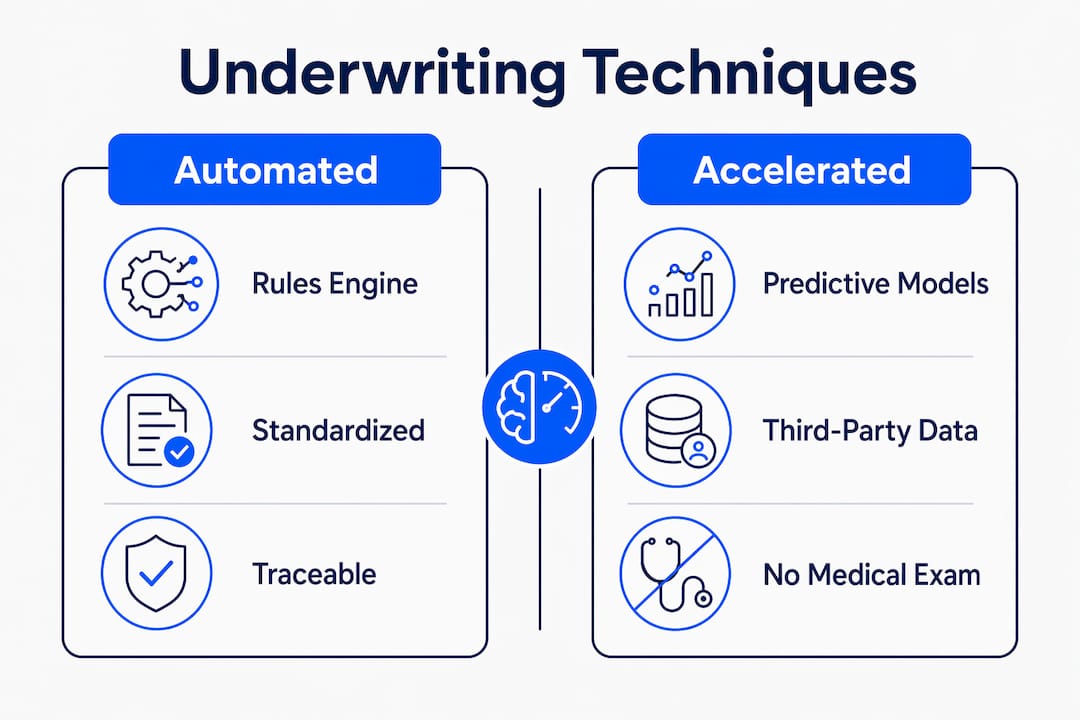
Automated underwriting uses a deterministic rules engine as its core decisioning mechanism. Rules are written by underwriters and actuaries, then coded into the system. The process is fully transparent: every decision traces back to a specific rule. This technique works best for standardized products where risk parameters are well-defined and regulatory scrutiny is high.
Accelerated underwriting replaces traditional medical exams with predictive models and third-party data sources, including prescription drug databases, motor vehicle records, and credit-based insurance scores. Applicants who meet defined risk thresholds receive offers without a paramedical exam. This technique reduces time-to-decision and improves the applicant experience, particularly for term life and disability products.
Hybrid underwriting combines deterministic rules with embedded ML risk scoring inside a business rules management system (BRMS). The BRMS governs the overall decision flow while ML models handle probabilistic risk assessment within defined boundaries. Hybrid systems balance explainability with predictive accuracy, making them the preferred architecture for carriers operating under active regulatory oversight.
The table below summarizes the key distinctions:
| Technique | Core mechanism | Best use case | Explainability |
|---|---|---|---|
| Automated underwriting | Deterministic rules engine | Standardized products, high-volume | High |
| Accelerated underwriting | Predictive models plus third-party data | Term life, disability, no-exam products | Medium |
| Hybrid underwriting | BRMS with embedded ML models | Complex risk, regulated environments | High |
Simplified issue products occupy a separate category. They use minimal underwriting questions and no medical exam, accepting higher risk in exchange for speed. Accelerated underwriting, by contrast, uses rich data to offer competitive rates to low-risk applicants while still maintaining actuarial discipline. The distinction matters when you are evaluating product design for a specific market segment.
For financial professionals interested in how automated underwriting techniques apply specifically to lending and credit decisions, the mechanics translate directly from insurance to credit risk assessment.
What are the benefits and challenges of advanced underwriting?
Advanced underwriting delivers measurable improvements across four dimensions: speed, accuracy, transparency, and portfolio consistency.
Benefits:
- Faster decisions. Automated and accelerated techniques reduce decision time from weeks to minutes for qualified applicants, improving conversion rates and adviser satisfaction.
- Improved risk accuracy. Granular data inputs and ML scoring produce more precise risk classifications, which reduces adverse selection and improves loss ratios.
- Higher STP rates. Carriers using advanced systems process 60%–85% of applications without human intervention, freeing underwriters to focus on genuinely complex cases.
- Better quote precision. Advanced underwriting significantly improves initial premium accuracy and reduces non-progressed applications, which builds adviser and client trust in the quote process.
- Consistent loss ratios. Underwriting automation maintains consistent loss ratios across multi-state portfolios by applying standardized rules and ML models to every application.
Challenges:
- Governance complexity. Every model version, data source, and rule change requires documentation. Maintaining that audit trail at scale demands dedicated governance infrastructure.
- Regulatory compliance. Frameworks like the NAIC Model Bulletin require carriers to document AI inputs, human overrides, and model versions. Recent regulatory frameworks are redefining underwriting governance, requiring detailed documentation at every decision point.
- Data quality dependency. ML models are only as accurate as the data they consume. Poor data hygiene produces unreliable risk scores and increases the rate of human referrals.
- Human oversight requirements. Fully automated systems still require human review for edge cases, appeals, and regulatory exceptions. Removing human judgment entirely creates compliance exposure.
"The underwriting checklist is a critical governance artifact. It details data sources, AI model versions, and decision rationale, and it is what keeps every decision defensible under regulatory audit."
The industry is moving toward hybrid models precisely because they resolve the tension between automation speed and regulatory accountability. A hybrid architecture lets you automate the high-volume, low-complexity cases while preserving human judgment for the cases that genuinely require it.
Pro Tip: Treat your underwriting model as a versioned software artifact. Every rule change or model update should trigger a version increment and a corresponding update to your governance documentation before the change goes live.
How is advanced underwriting applied in financial risk assessment?
Advanced underwriting outputs feed directly into financial risk management decisions across three areas: premium setting, portfolio monitoring, and regulatory reporting.
Premium setting and loss ratio management. Risk scores generated by advanced underwriting systems give actuaries a more granular basis for premium calculation. Instead of relying on broad demographic bands, pricing models can reflect individual risk factors with statistical precision. This reduces the cross-subsidization problem where low-risk applicants overpay and high-risk applicants underpay, which is a primary driver of adverse selection in poorly priced books.
Regulatory reporting and audit trails. Insurance carriers treat the underwriting checklist as a critical governance artifact that documents all decision data to remain defensible under audit. For risk analysts preparing for regulatory exams, this documentation is the difference between a clean exam and a material finding. Every data source, model version, and decision rationale must be traceable.
Portfolio monitoring and credit risk. Advanced underwriting techniques apply equally to credit underwriting in lending. Risk scores and predictive analytics inform credit limit decisions, loan pricing, and portfolio concentration limits. The same governance principles that apply in insurance, versioned models, documented overrides, and explainable decisions, apply in credit risk management under frameworks like the Federal Reserve's SR 11-7 guidance on model risk management.
The table below shows how advanced underwriting outputs map to financial risk management functions:
| Underwriting output | Financial risk application | Governance requirement |
|---|---|---|
| Individual risk score | Premium pricing, credit limit setting | Model version documentation |
| STP decision | Portfolio throughput, cost per decision | Audit trail with rule trace |
| Human referral flag | Complex case review, exception management | Override documentation |
| Decline rationale | Adverse action notice, regulatory reporting | Documented decision logic |
For financial professionals building the case for AI in loan underwriting, the governance architecture of advanced underwriting provides the template. The same principles of versioned models, explainable decisions, and documented overrides apply directly to credit risk workflows.
Understanding explainable AI in risk management is the next logical step for any analyst working to align underwriting technology with regulatory expectations.
The case for keeping humans in the loop
Advanced underwriting has fundamentally changed how financial institutions price risk and manage portfolios. The efficiency gains are real. The accuracy improvements are measurable. But the most important shift I have observed over the past several years is not technical. It is cultural.
Financial institutions that treat advanced underwriting as a pure automation exercise consistently run into governance problems. They automate the easy cases, reduce headcount, and then discover that their model documentation is insufficient when a regulator asks for a decision trace on a specific application. The audit trail was never built properly because no one owned it.
The institutions that get this right treat the governance layer as the product, not the automation. They invest in versioned rule libraries, documented model inputs, and clear human override protocols before they deploy any ML model into a live decisioning environment. That sequencing matters more than the sophistication of the model itself.
Transparency and explainability are not compliance burdens. They are competitive advantages. A carrier or lender that can explain every decision to a regulator, an adviser, or an applicant builds trust that translates into lower dispute rates and faster regulatory exams. The technology is a means to that end, not the end itself.
For risk analysts and accountants, the practical implication is this: your value in an advanced underwriting environment is not in reviewing routine cases. It is in designing the governance architecture, validating model outputs, and interpreting the edge cases that automation cannot handle. That is where judgment still matters, and it always will.
— Raj
How Riskinmind supports advanced underwriting decisions
Riskinmind's AI-powered platform is built for the governance and accuracy demands that advanced underwriting requires. The CRE Loan Risk Predictor delivers AI-driven risk analysis for commercial real estate loans, producing risk scores and decision rationale that meet audit trail requirements. The AI Credit Card Analyzer applies the same rigor to credit card portfolio risk assessment, giving analysts a defensible basis for underwriting and pricing decisions.
Riskinmind processes decisions in under half a second, maintains SOC 2® certification, and produces documented, explainable outputs at every step. For financial institutions that need to align underwriting speed with regulatory accountability, the platform provides the infrastructure to do both without compromise.
FAQ
What is the advanced underwriting definition in insurance?
Advanced underwriting is a specialized evaluation process that uses deterministic rules engines, machine learning models, and structured governance to assess complex insurance risks and produce individualized policy terms. It differs from standard underwriting by integrating multiple data sources and producing fully documented, auditable decisions.
How does the advanced underwriting process handle medical disclosures?
Advanced underwriting tools assess the 20 most common medical disclosures at the point of application, covering approximately 80% of medical loadings and term changes that would otherwise require post-application review. This upfront assessment reduces re-underwriting cycles and improves initial quote accuracy.
What is the difference between accelerated and automated underwriting?
Automated underwriting uses deterministic rules engines to make fully traceable decisions on standardized products. Accelerated underwriting replaces traditional medical exams with predictive models and third-party data, enabling faster decisions for qualified applicants without sacrificing actuarial discipline.
What straight-through processing rate should financial professionals expect?
Modern automated underwriting systems achieve STP rates between 60% and 85% for mid-market carriers, depending on rules complexity and ML integration. Higher STP rates reduce manual review volume but require more sophisticated governance infrastructure to maintain compliance.
How does advanced underwriting support regulatory compliance?
Advanced underwriting systems treat every decision component, including eligibility rules, ML model versions, and pricing logic, as versioned, documented artifacts. That documentation satisfies regulatory requirements under frameworks like the NAIC Model Bulletin and state-level AI governance laws, making every decision defensible under audit.
Key takeaways
Advanced underwriting is the most effective approach to complex risk assessment because it combines deterministic rules, machine learning, and formal governance into a single, auditable decisioning architecture.
| Point | Details |
|---|---|
| Governance is the foundation | Every rule, model version, and override must be documented before automation goes live. |
| STP rates signal system maturity | Mid-market carriers achieve 60%–85% straight-through processing; measure your baseline first. |
| Hybrid models balance speed and compliance | BRMS with embedded ML delivers explainability and predictive accuracy in regulated environments. |
| Medical disclosures belong at intake | Assessing the top 20 disclosures upfront eliminates 80% of post-application re-underwriting cycles. |
| Human judgment remains irreplaceable | Edge cases, appeals, and regulatory exceptions require documented human oversight, not just automation. |