
Diversifying a lender's loan mix materially reduces concentration risk, preserves capital adequacy, and helps maintain credit supply when markets deteriorate. Three points ground that claim immediately:
- Regulatory expectation: The NCUA requires credit unions to identify, measure, monitor, and control concentration risk, with boards expected to document rationale for any concentration approaching or exceeding 100% of net worth. The OCC, FDIC, and Federal Reserve carry parallel expectations for banks.
- Empirical evidence: Research published in peer-reviewed economics journals finds that loan-portfolio diversification acts as a shock absorber, significantly reducing the adverse impact of uncertainty on loan growth and credit risk during stress periods.
- Operational action: Institutions that set documented concentration thresholds, run regular stress tests, and use platforms like Riskinmind for real-time portfolio monitoring are better positioned to satisfy examiners and protect earnings.
Key Takeaways
Maintain 100% NCUA & OCC Audit Readiness
Monitor regulatory updates 24/7, check internal credit policies, and generate compliance trails with Erina (AI Regulatory Agent).
Loan-mix diversification reduces concentration risk, supports capital adequacy, and helps institutions maintain credit supply during stress, making it both a regulatory expectation and a fiduciary duty.
| Point | Details |
|---|---|
| Regulatory baseline is clear | NCUA, OCC, FDIC, and the Federal Reserve all require documented concentration limits tied to net worth. |
| Diversification preserves lending capacity | Research shows diversified portfolios act as shock absorbers, maintaining credit supply during high-uncertainty periods. |
| HHI is your core metric | An HHI above 2,500 signals high concentration; calculate it quarterly and trend it for the board. |
| Mitigation has real trade-offs | Participations and loan sales reduce income; tighter underwriting may slow origination. Present both sides to the board. |
| Riskinmind automates the workflow | Real-time dashboards, automated HHI, stress-testing, and audit-ready reports replace manual quarterly spreadsheets. |
Table of Contents
- Why loan mix diversification matters: definitions every lender needs
- What U.S. regulators expect from your board on concentration risk
- Empirical evidence that diversification improves portfolio resilience
- How to measure and monitor your loan mix
- Practical strategies to reduce concentration risk
- Governance, policy language, and capital implications
- How AI platforms operationalize diversification monitoring
- Your board-ready checklist and KPIs for this quarter
- The case for acting before the examiner asks
- Riskinmind gives you board-ready concentration analytics from day one
- Sources
Why loan mix diversification matters: definitions every lender needs
Loan-mix diversification means spreading a portfolio across multiple product types (mortgages, commercial real estate, C&I, consumer), industries, geographies, credit grades, and collateral categories so that no single segment can drive outsized losses. The industry term for the opposite condition is concentration risk: the exposure to loss that arises when a disproportionate share of the portfolio is tied to a common risk driver.
Concentration risk surfaces along several axes:
- Product type: heavy reliance on CRE construction vs. a balanced mix of residential, C&I, and consumer loans
- Geography: a portfolio anchored in one metro market vs. loans spread across multiple regions
- Industry or sector: a high share of commercial loans concentrated in a single sector such as hospitality or energy
- Credit grade: a high share of near-prime or high-LTV originations
- Collateral type: single-family vs. multi-family vs. land vs. owner-occupied commercial
A geographically diversified residential mortgage pool, for example, absorbs a regional housing correction without systemic loss. A concentrated local CRE construction portfolio exposed to the same correction can generate losses that impair capital and trigger regulatory action. 12 CFR Appendix C specifically recommends establishing internal limits by loan type and geographic market, along with monitoring of local supply/demand and economic indicators.
What U.S. regulators expect from your board on concentration risk
Examiners across all four primary federal regulators share a consistent supervisory baseline: boards must understand, approve, and actively oversee concentration limits, not simply receive a quarterly report.
The interagency CRE guidance does not set a universal CRE cap, but it requires institutions to stratify CRE exposures by property type, geography, tenant industry, developer concentration, and loan structure, and to hold capital commensurate with that risk. The OCC Comptroller's Handbook links weak concentration management directly to supervisory ratings and cites CRE, energy, and leveraged finance concentrations as contributors to past institutional failures.
Key examiner focal points include:
- Portfolio stratification with meaningful, supportable groupings (not superficial segmentation designed to obscure exposure)
- Internal limits tied to net worth, with documented rationale when concentrations exceed 100% of net worth
- Stress testing of vulnerable segments, with results feeding capital planning and ACL assumptions
- Contingency plans for reducing concentrations if conditions deteriorate
- Regular reporting cadence to the board and relevant committees
Board-level accountability is not optional. Examiners look for evidence that directors understand the risks, approved the limits, and receive timely reports when thresholds are approached.
Empirical evidence that diversification improves portfolio resilience
The supervisory case for diversification is reinforced by a growing body of empirical work. A conference paper on asset diversification and bank lending finds that geographic and business-line diversification are associated with higher and more stable lending, and that more diversified banks maintained credit supply better during crisis periods. The diversification effect is real, though not linear: benefits vary by bank type and the severity of the stress event.
The flip side is equally documented. New York Fed analysis shows the average lender directs a significant portion of syndicated lending to its favored industry, and small domestic banks often carry a very high concentration in a single sector. That specialization can support relationship depth and pricing power in stable conditions, but it leaves the institution exposed when that sector turns.
The practical implication: diversification is not a guarantee against loss. It is a structural buffer that reduces volatility and preserves the institution's ability to keep lending when peers are pulling back.
How to measure and monitor your loan mix
Effective monitoring starts with metrics that map directly to regulatory expectations and portfolio risk drivers.
| Metric | Formula / Definition | Why It Matters |
|---|---|---|
| Concentration ratio by segment | Segment balance ÷ total loans | Flags dominant exposures quickly |
| HHI for loan mix | Sum of (segment share squared) | Captures overall portfolio dispersion |
| Segment exposure as % of net worth | Segment balance ÷ net worth | Aligns with NCUA/OCC threshold language |
| LTV and DSC distributions | Weighted averages by segment | Identifies credit-quality clustering |
| Vintage performance metrics | Loss rates by origination cohort | Detects deterioration before it aggregates |
A minimum dashboard should display segment balances, geographic exposure maps, LTV/DSC distributions, trend lines over rolling quarters, stress-test loss scenarios, and ACL impact estimates. The FDIC's CRE examination guidance follows a stepwise review: stratify by property type and geography, stress vulnerable segments, then assess capital adequacy relative to those results.
Pro Tip: Set concentration thresholds based on your portfolio's actual volatility and net worth, not round-number percentages. A 25% CRE construction limit may be conservative for a large diversified bank and dangerously permissive for a $200M credit union with limited capital cushion. Calibrate to your institution's specific risk profile.
Avoid artificial stratification. Grouping loans superficially to reduce apparent concentration is a common pitfall examiners detect; they expect groupings with genuinely shared risk sensitivities.
Practical strategies to reduce concentration risk
Mitigation options range from quick tactical adjustments to structural changes that take quarters to implement. Prioritize by speed and impact:
- Sublimits and subsegment caps: Set hard limits for risky subsegments (e.g., CRE land, high-LTV construction). Fast to implement; requires board approval and policy amendment.
- Loan participations: Sell participations in concentrated segments to other institutions. Reduces exposure without exiting the relationship; requires counterparty vetting.
- Whole-loan sales or securitization: Transfers risk off-balance-sheet. Effective for large pools; carries execution cost and potential gain/loss recognition.
- Tightened underwriting standards: Raise LTV, DSC, or credit-score floors in concentrated segments. Slows new concentration growth; may reduce origination volume short-term.
- Geographic or product diversification: Expand origination into underrepresented markets or products. Structural change; takes multiple quarters to shift the mix materially.
- Targeted pricing and covenant adjustments: Price concentrated segments to reflect true risk; add covenants that trigger early review. Improves risk-adjusted return without reducing volume immediately.
- Contingency sell plans: Pre-approve a disposition plan for specific segments if stress thresholds are breached. Reduces decision latency in a downturn. See financial risk mitigation strategies for governance templates.
Each tactic carries a P&L trade-off. Participations and sales reduce income; tighter underwriting may cost market share. The board should weigh those trade-offs explicitly, not treat diversification as costless.
Governance, policy language, and capital implications
A board-level concentration policy needs four elements: approved segment limits (expressed as a percentage of net worth and total loans), documented rationale for any concentration exceeding 100% of net worth, escalation triggers that require management action before a limit is breached, and a defined reporting cadence.
Sample policy language:
Reporting cadence: monthly concentration dashboards to the CRO, quarterly board-level summaries with trend analysis, and annual policy reviews tied to the capital planning cycle. Concentration scenarios must feed directly into CECL/ACL assumptions and capital stress tests. An institution carrying a 45% CRE construction concentration cannot model its ACL on average historical loss rates; it needs segment-specific stress scenarios. Credit exposure management guidance covers how to structure those linkages for examiner review.
How AI platforms operationalize diversification monitoring
Manual spreadsheet-based concentration tracking fails at the speed examiners and boards now expect. A modern risk platform automates the workflow: data ingest from core systems, automated segmentation and HHI calculation, threshold alerts, scenario runs, and board-ready report generation.
Capabilities to look for when selecting a platform:
- Real-time exposure dashboards with drill-down by segment, geography, and credit grade
- Automated HHI and concentration ratio calculations updated on each data refresh
- Stress-testing modules that model segment-specific loss scenarios and feed ACL estimates
- Audit-ready reporting trails that satisfy examiner documentation requirements
- SOC 2® certification and bank-grade security for data handling
- Sub-second processing so portfolio managers get current numbers, not yesterday's batch
Pro Tip: Before selecting a platform, ask the vendor to demonstrate a live HHI recalculation after a hypothetical large origination in your most concentrated segment. That single test reveals both the data latency and the analytical depth of the tool.
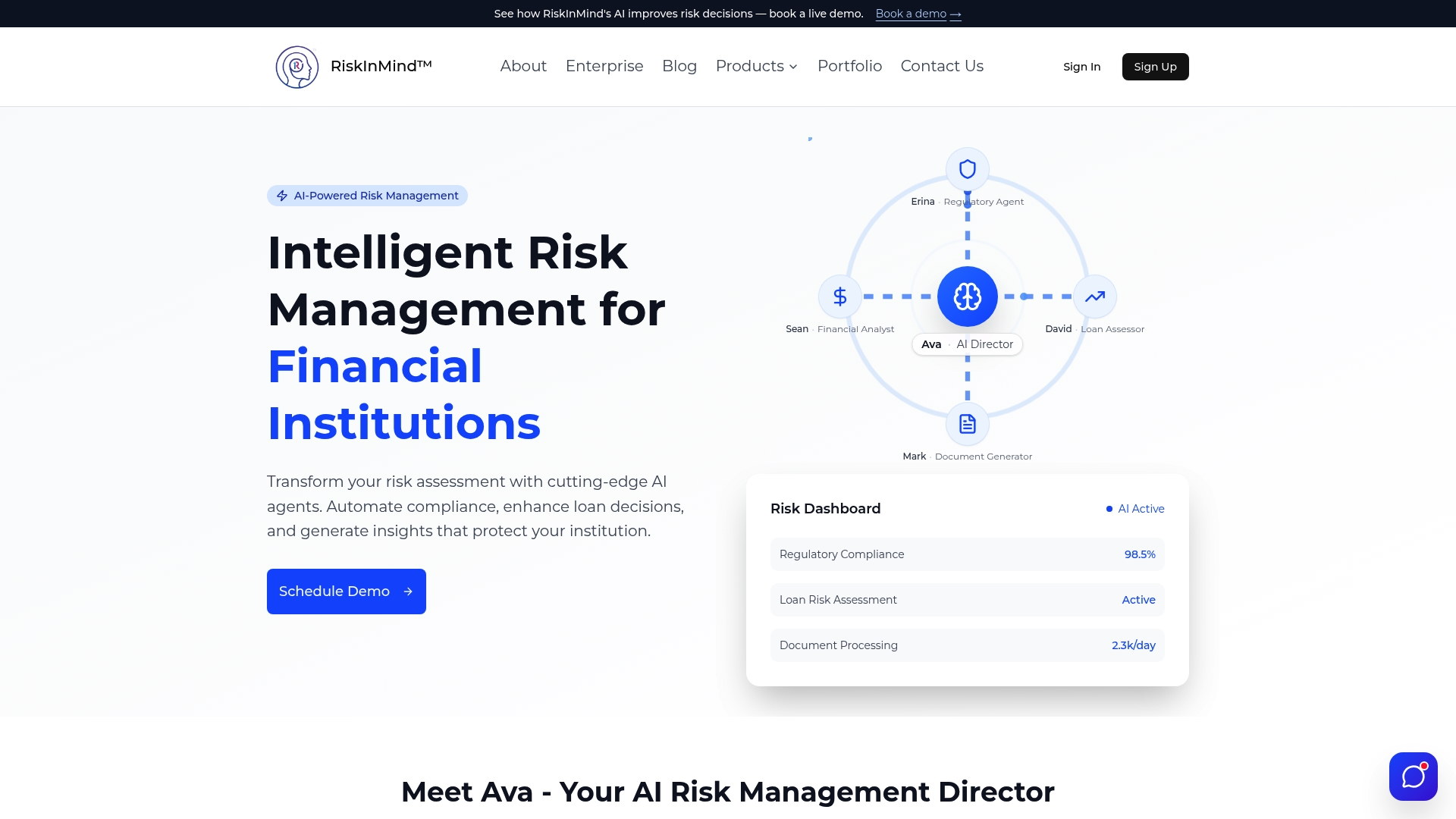
Riskinmind's AI agents, coordinated by a central director named Ava, handle portfolio segmentation, concentration reporting, and stress-test scenario generation automatically, reducing the manual preparation time that typically precedes board meetings. The platform's loan risk modeling capabilities are designed specifically for the credit union and community bank workflow.
Your board-ready checklist and KPIs for this quarter
Bring these fields to your next governance meeting:
Board pack template fields:
- Portfolio summary: total loans, segment balances, quarter-over-quarter change
- Top 5 concentrations by segment as % of net worth and % of total loans
- Current HHI score and trend over four quarters
- Stress-test loss estimate for the top two concentrated segments under a moderate adverse scenario
- ACL impact of concentration scenarios vs. base case
- Open action items with owners and target dates
KPIs with suggested thresholds:
- Any single segment > 100% of net worth: requires documented board rationale per NCUA guidance
- HHI > 2,500: signals high concentration; review sublimits
- CRE construction represents a substantial share of total loans: flag for stress-test priority
- Geographic concentration > 60% in one MSA: monitor local market indicators per 12 CFR Appendix C
- Vintage loss rate trending up two consecutive quarters: escalate to credit committee
Frame mitigation options for the board as a cost-benefit decision: participation sales reduce income but also reduce capital consumption; tighter underwriting preserves credit quality but may slow growth. Boards respond better to explicit trade-offs than to abstract risk language. A step-by-step risk assessment framework can help structure that presentation.
The case for acting before the examiner asks
The institutions that manage concentration risk well share one trait: they treat diversification as a capital efficiency question, not just a compliance checkbox. A concentrated portfolio doesn't just carry more credit risk; it consumes more capital per dollar of earning assets, limits the institution's ability to grow in a downturn, and narrows the board's strategic options when conditions shift. The practical next step is straightforward: run your current HHI, map your top five segment exposures against net worth, run one stress scenario on your most concentrated segment, and bring those three numbers to the board this quarter. That single exercise usually reveals more about portfolio risk than a year of qualitative discussion.
Riskinmind gives you board-ready concentration analytics from day one
Portfolio managers at credit unions and community banks spend hours each quarter assembling the concentration data their boards need. Riskinmind eliminates that manual work. The platform delivers real-time HHI calculations, automated segment concentration reports, and stress-test scenarios built directly into board-ready dashboards, all backed by SOC 2® certification and bank-grade security. Ava, Riskinmind's central AI director, coordinates specialized agents for credit risk, regulatory compliance, and portfolio monitoring, so your team gets current numbers in under half a second rather than end-of-week batch files.
For institutions managing CRE exposure, the CRE Loan Risk Predictor provides segment-level risk scoring and concentration monitoring designed for examiner-ready documentation. Request a demo to see a live HHI recalculation and a sample board concentration report built from your portfolio data.
Sources
The sources below are cited throughout this article. They are organized by primary use case.
Exam preparation and regulatory alignment:
- Managing Concentration Risk in Credit Unions
- Interagency Guidance on Concentrations in Commercial Real Estate Lending; Sound Risk-Management Practices
- Concentrations of Credit, Comptroller's Handbook
- 12 CFR Appendix C to Part 208 - Interagency Guidelines for Real Estate Lending Policies
- Documenting lender specialization
- Asset diversification and bank lending (conference paper)
Empirical evidence for board briefings:
This article is general information, not a substitute for advice from a qualified financial advisor. Consult a qualified financial professional about your own circumstances before acting on anything here.
Recommended
- Finding the Lending Diamonds in the Rough: How RiskinMind.ai Helps Lenders Win in a Down Market | RiskInMind
- Loan risk modeling explained: Strategies for better credit decisions | RiskInMind
- Loan Underwriting Checklist for Loan Officers in 2026 | RiskInMind
- How Smarter Risk Management Can Help Prevent the Domino Effect of Loan Defaults | RiskInMind