
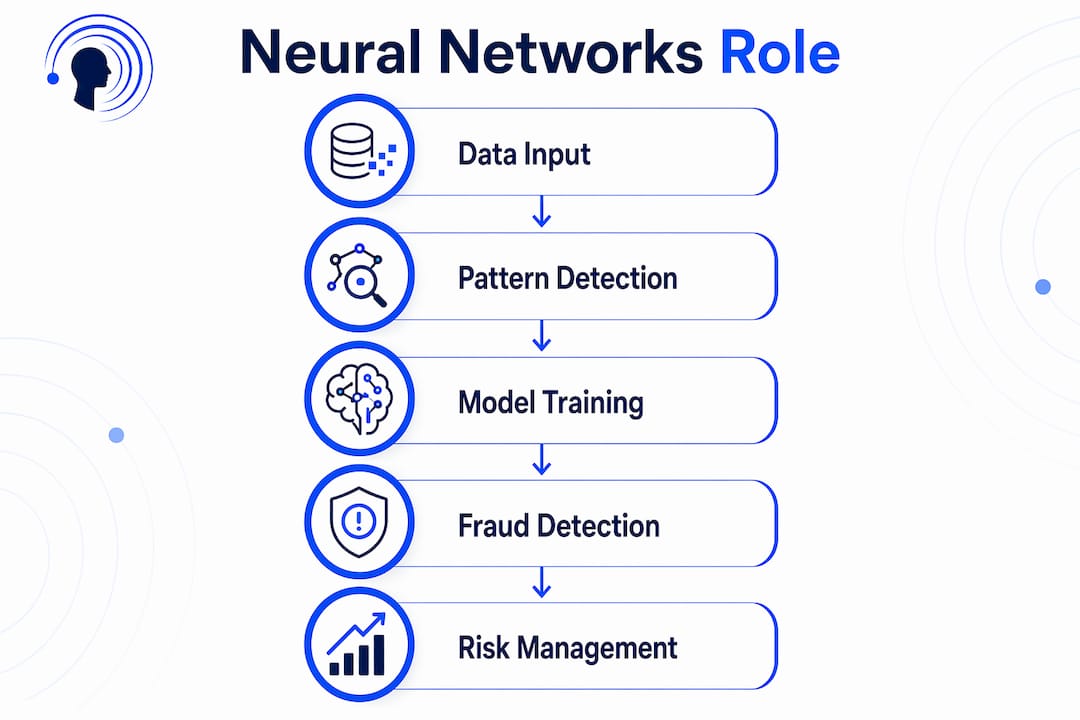
Neural networks are computational models that identify complex, nonlinear patterns in large datasets, and their role of neural networks in finance is to improve predictive accuracy in risk assessment, fraud detection, and portfolio management. Where traditional statistical models assume linear relationships, neural networks learn from raw transaction sequences, price histories, and credit profiles without requiring manual feature engineering. Research published in 2026 confirms that hybrid architectures combining neural layers with tree-based or transformer components now deliver measurably superior risk-adjusted returns and fraud recall rates. For portfolio managers and analysts, these advances translate directly into better credit decisions, lower trading costs, and more defensible compliance documentation.
What is the role of neural networks in finance?
Neural networks serve as the core engine behind modern predictive analytics in finance, processing thousands of variables simultaneously to surface risk signals that rule-based systems miss entirely. A traditional logistic regression model for credit scoring uses perhaps a dozen hand-selected features. A deep neural network trained on the same loan portfolio can process payment timing, transaction velocity, behavioral sequences, and macroeconomic indicators in a single forward pass.
Automate Regulatory Model Risk Governance
Examine models against 32 qualitative criteria and resolve risk Tiers with pre-deployment checklists per OCC 2011-12 guidelines.
The practical output is measurable. Analysts using neural network models report sharper separation between performing and non-performing loans, tighter confidence intervals on default probability estimates, and faster model refresh cycles when market conditions shift. Portfolio managers benefit from improved Sharpe ratios on quantitative strategies because the models capture regime-dependent return patterns that moving-average signals cannot.

The standard industry term for this class of methods is deep learning, a subset of machine learning in finance that uses multi-layer architectures. Neural networks and deep learning are often used interchangeably in financial contexts, though deep learning technically refers to architectures with three or more hidden layers. Both terms apply throughout this article.
How do hybrid neural network architectures improve fraud detection?
Hybrid neural network architectures combine the pattern-recognition strength of deep learning with the structured decision logic of tree-based models, and the results in fraud detection are striking. A hybrid neural-tree framework tested on Lending Club and payment datasets achieved an F1-score of 0.93 and a recall of 0.96 on minority fraud cases, outperforming both Random Forest and XGBoost on the same data. That recall figure matters most: it means the model correctly flags 96 out of every 100 fraudulent transactions, a standard that pure tree-based classifiers consistently fail to reach.
The architecture works by using neural layers to generate dense embeddings from raw transaction sequences, then passing those embeddings into a tree-based decision layer that applies interpretable thresholds. This design preserves the fraud-catching sensitivity of deep learning while maintaining the explainability needed for compliance audits. Regulators reviewing a credit decision can trace the tree path that triggered a flag, even when the upstream embedding is complex.
Key use cases where hybrid models outperform conventional algorithms include:
- Payment fraud detection: Sequence embeddings capture velocity patterns and merchant-category anomalies that static feature tables miss.
- Credit risk identification: Neural layers encode borrower behavioral signals across time, while tree thresholds enforce interpretable credit policy rules.
- Authorization scoring: Real-time inference on transaction streams requires both speed and recall, a combination hybrid architectures handle well.
- Regulatory reporting: Tree-based decision layers produce audit trails that satisfy model risk management requirements under SR 11-7 guidance.
Pro Tip: Before deploying a hybrid fraud model in production, generate SHAP values for the neural embedding layer and confirm that the top contributing features align with your institution's known fraud indicators. Regulators increasingly expect this documentation at model validation.
What neural network architectures deliver the best risk-adjusted returns?
Time-series forecasting is where the choice of neural architecture has the most direct impact on portfolio performance. VLSTM models, which combine a variable selection network with a standard LSTM, achieved a Sharpe ratio of 2.40 versus 1.48 for a standard LSTM across a 15-year backtest spanning 2010–2025. That gap of nearly one full Sharpe unit represents a substantial improvement in risk-adjusted return per unit of volatility.
The reason VLSTM outperforms standard LSTM is architectural. Standard LSTM scales parameters to handle longer sequences but does not explicitly select which input variables carry predictive signal at each time step. The variable selection network solves this by learning input weights dynamically, so the model focuses on the most informative features during each market regime. Stable temporal dependencies, not raw model size, drive robustness across changing market conditions.
Transformer-based architectures also show strong results in financial time-series tasks, particularly for multi-asset forecasting where cross-asset attention mechanisms capture correlation shifts. However, transformers require substantially more training data and compute than VLSTM models, making them better suited to large institutional desks than to community banks or credit unions running leaner infrastructure.
| Architecture | Sharpe Ratio | Best Use Case |
|---|---|---|
| VLSTM | 2.40 | Multi-asset time-series forecasting |
| Standard LSTM | 1.48 | Single-asset sequential prediction |
| Transformer | Not publicly listed | Large-scale multi-asset correlation modeling |
| Random Forest | Baseline | Feature importance benchmarking |
Pro Tip: When backtesting VLSTM or transformer models, always include at least one full market stress period (such as 2020 or 2022) in your training window. Models that have never seen a volatility spike will underestimate tail risk in live trading.
How do hybrid LSTM-MLP models improve portfolio management?
Portfolio management benefits from a specific architectural combination: LSTM layers that capture sequential return patterns over time, paired with multilayer perceptron (MLP) layers that process cross-sectional signals across many stocks simultaneously. Hybrid LSTM-MLP models applied to US stock intraday Trade and Quote data produced a turnover ratio of 43.7%, compared to 77.5% for Random Forest and 72.2% for XGBoost on the same dataset. Lower turnover means fewer trades, which directly reduces transaction costs and slippage in live portfolios.
The mechanism behind this efficiency is the LSTM component's ability to encode momentum and mean-reversion signals across multiple time horizons, while the MLP component ranks stocks cross-sectionally using contemporaneous features like relative volume and sector momentum. The two components train jointly, so the model learns which temporal signals matter most for cross-sectional ranking rather than treating the two tasks independently.
For portfolio managers, the practical implications are clear:
- Lower transaction costs: A 43.7% turnover ratio versus 72–77% for tree-based alternatives translates to meaningful cost savings at scale.
- Improved signal stability: LSTM memory cells smooth out noise in high-frequency data, reducing whipsaw trades triggered by short-term price artifacts.
- Better regime adaptation: Joint training on sequential and cross-sectional data means the model adjusts its stock rankings when market-wide momentum shifts, rather than lagging by a full rebalancing cycle.
- Applicability to real data: Results were validated on actual US equity Trade and Quote data, not synthetic simulations, which strengthens confidence in live deployment.
The machine learning in finance literature consistently shows that models combining temporal and cross-sectional processing outperform single-architecture approaches on equity return prediction tasks.
What are the challenges of adopting neural networks in financial risk management?
Neural networks create a genuine paradox for financial institutions: they improve predictive accuracy while simultaneously introducing model opacity and governance risk. A model that cannot explain its decisions to a regulator or a credit committee is a liability, regardless of its F1-score. This tension between performance and interpretability is the central challenge of AI adoption in regulated finance.
Overfitting is the most common technical failure mode. Financial datasets are noisy and often limited in size relative to the number of model parameters. Regularization techniques including dropout, batch normalization, and early stopping are mandatory practices for any production neural network in financial services. Without them, a model that performs well in backtesting will degrade rapidly when deployed against live market data.
Best practices for responsible adoption follow a clear sequence:
- Apply regularization from the start. Dropout rates of 0.2–0.5 and batch normalization between hidden layers reduce overfitting without sacrificing model capacity.
- Integrate explainable AI tools. SHAP and LIME generate feature-level attribution scores that satisfy model risk management documentation requirements.
- Combine neural models with rule-based systems. Hybrid architectures that pair neural embeddings with interpretable decision trees preserve auditability while retaining predictive power.
- Establish human review checkpoints. Automated model outputs for high-stakes credit or fraud decisions should route to human analysts when confidence scores fall below a defined threshold.
- Monitor for model drift continuously. Financial data distributions shift with interest rate cycles, credit conditions, and regulatory changes. Monthly performance reviews against holdout data catch drift before it affects decisions.
Pro Tip: Build a model governance log that records every retraining event, data version, and performance metric. Regulators under SR 11-7 and CECL frameworks expect this documentation, and it also helps your team diagnose performance degradation faster.
Key Takeaways
Neural networks deliver the strongest results in finance when hybrid architectures combine deep learning with interpretable decision logic, validated regularization, and continuous governance monitoring.
| Point | Details |
|---|---|
| Hybrid models lead in fraud detection | Neural-tree frameworks achieve F1-scores of 0.93 and recall of 0.96, outperforming Random Forest and XGBoost. |
| VLSTM improves risk-adjusted returns | VLSTM models produce a Sharpe ratio of 2.40 versus 1.48 for standard LSTM across 15-year backtests. |
| LSTM-MLP reduces portfolio turnover | Hybrid LSTM-MLP models cut turnover to 43.7%, well below the 72–77% range for tree-based alternatives. |
| Explainability is non-negotiable | SHAP and LIME attribution tools are required for regulatory compliance and model risk management audits. |
| Governance prevents model drift | Monthly retraining reviews and documented performance logs protect against distribution shift in live deployments. |
Why I think most finance teams are still underusing neural networks
The performance data is clear, yet most community banks and credit unions still rely on logistic regression for credit scoring and rule-based systems for fraud detection. The gap is not technical. It is organizational. Teams that have not built internal model validation capacity default to familiar tools because they can explain them to their board, not because those tools perform better.
The insight I keep returning to is the concept of Transaction Foundation Models. Rather than building a separate neural network for fraud, another for credit, and another for authorization, institutions can train a single reusable embedding model on their full transaction history, then attach lightweight specialized heads for each downstream task. This approach dramatically reduces the total modeling burden and creates a shared intelligence layer that improves every decision simultaneously.
The hybrid architecture argument is equally compelling. Combining neural embeddings with tree-based decision logic is not a compromise. It is the correct design for regulated finance. You get the predictive power of deep learning and the audit trail that compliance requires. Institutions that treat interpretability as an afterthought will face model validation rejections and regulatory scrutiny. Those that build it in from the start will move faster.
The future belongs to teams that view neural networks as augmenting analyst judgment, not replacing it. The model surfaces the signal. The analyst applies the context. That division of labor is where the real performance gains live.
— Raj
How Riskinmind applies neural networks to financial risk
Riskinmind's AI platform brings the neural network architectures described in this article directly into the workflows of credit unions, community banks, and lenders. Its AI-powered loan application tool uses neural network models to evaluate credit risk with real-time processing, delivering decisions in under half a second. For analysts who need portfolio-level context, the peer benchmarking tool applies predictive models to surface risk-adjusted comparisons against peer institutions.

Riskinmind's platform is SOC 2® certified and built specifically for regulated financial institutions, so the governance and explainability requirements discussed throughout this article are addressed by design, not as an add-on. Finance professionals who want to see the platform in action can request a demo directly at riskinmind.ai.
FAQ
What is the role of neural networks in finance?
Neural networks identify complex, nonlinear patterns in financial data to improve credit risk scoring, fraud detection, and portfolio return forecasting. They process raw transaction sequences and price histories without requiring manual feature engineering.
How do neural networks improve fraud detection in banking?
Hybrid neural-tree frameworks achieve recall rates of 0.96 on minority fraud cases, meaning they correctly flag 96 out of 100 fraudulent transactions while maintaining interpretable decision paths for compliance audits.
What is the best neural network architecture for financial time-series forecasting?
VLSTM models, which combine a variable selection network with LSTM layers, produce a Sharpe ratio of 2.40 versus 1.48 for standard LSTM across 15-year backtests, making them the strongest documented architecture for risk-adjusted return forecasting.
How do analysts address model opacity in neural network deployments?
SHAP and LIME explainable AI tools generate feature-level attribution scores that satisfy model risk management documentation requirements under frameworks like SR 11-7, making neural network decisions auditable for regulators and credit committees.
What regularization techniques prevent overfitting in financial neural networks?
Dropout, batch normalization, and early stopping are the three mandatory regularization methods for financial deep learning models, reducing overfitting on noisy and limited financial datasets without sacrificing predictive capacity.