
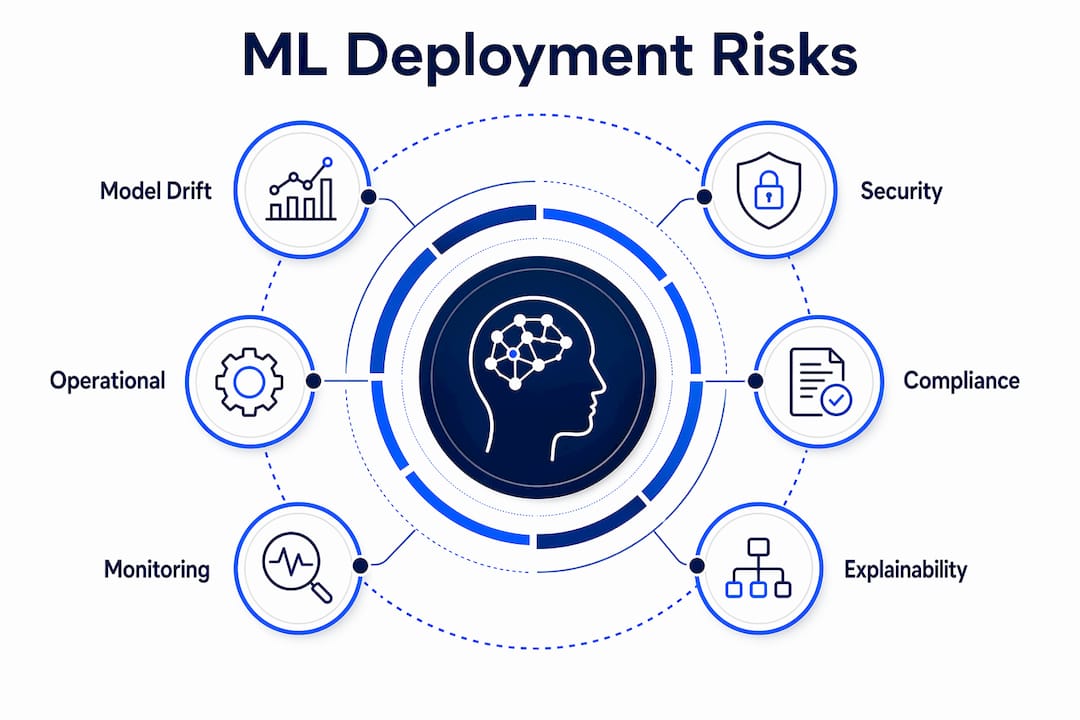
Deploying a trained model to a production environment is where machine learning risk becomes real. Machine learning model deployment risk encompasses model degradation, data drift, security vulnerabilities, operational failures, and compliance exposure, all of which can surface the moment a model moves from a controlled experiment to live inference. Research on ML deployment projects found that 46% of identified vulnerabilities in ML deployment projects were critically or highly severe, a figure that underscores why governance, monitoring, and rollback plans cannot be afterthoughts. The risks extend well beyond the model itself: pipeline integrity, infrastructure architecture, skills alignment, and regulatory readiness each carry their own failure modes.
Key risk categories to account for before any production release:
- Model degradation and drift: Performance erodes as real-world data distributions shift away from training data.
- Security vulnerabilities: Artifact tampering, model inversion attacks, and data leakage threaten both the model and the underlying infrastructure.
- Operational failures: Pipeline breaks, integration gaps, and monitoring blind spots cause silent, undetected errors.
- Compliance and regulatory exposure: GDPR, the EU AI Act, and sector-specific frameworks such as FDIC model risk guidance impose obligations that survive the initial release.
- Organizational risk: Skills mismatches between data science and engineering teams slow incident response and delay retraining cycles.
Automate Regulatory Model Risk Governance
Examine models against 32 qualitative criteria and resolve risk Tiers with pre-deployment checklists per OCC 2011-12 guidelines.
Continuous risk assessment, automated retraining pipelines, and documented incident response protocols are not optional add-ons. They are the structural requirements for any production ML system that needs to remain reliable over time.
What are the main types of ML model deployment?
How a model is deployed determines its risk profile as much as how it was trained. Each deployment type carries distinct trade-offs across latency, security surface, and monitoring complexity.
Batch deployment runs inference on accumulated data at scheduled intervals, making it well-suited for credit scoring, fraud report generation, and portfolio risk summaries. The lower operational complexity is an advantage, but delayed inference means that model degradation can go undetected between batch runs.
Real-time deployment serves predictions on demand, typically via a REST API or gRPC endpoint. Fraud detection, live underwriting decisions, and recommendation engines depend on this pattern. The attack surface is larger because the model endpoint is continuously exposed, and latency SLAs, often under 100ms for financial applications, add infrastructure pressure.
Serverless deployment abstracts infrastructure management and scales automatically with request volume. Cold-start latency and limited control over the execution environment introduce risks that are harder to monitor than in a dedicated serving setup.
Edge deployment moves inference to the device or network edge, keeping data local and reducing round-trip latency. For use cases with strict data residency requirements, edge is often the only compliant path. The trade-off is that model updates require a coordinated rollout across distributed hardware, and security patching becomes operationally complex.
Embedded models are compiled directly into an application binary or service. This approach minimizes network overhead but tightly couples the model lifecycle to the application release cycle, making rapid rollback difficult.
-
Batch: lower operational risk, slower feedback loop on degradation.
-
Real-time API: high availability requirements, continuous security exposure.
-
Serverless: managed scaling, limited observability.
-
Edge: strong data privacy posture, complex update and patching logistics.
-
Embedded: tight coupling to application releases, limited rollback flexibility.
Understanding which deployment type fits your latency SLA, data privacy requirements, and inference volume is the first decision in any machine learning risk assessment.
Which deployment strategies reduce risk during production rollouts?
No deployment strategy eliminates risk entirely. The goal is to limit blast radius, create reversibility, and generate enough signal to detect problems before they affect the full user base.
Canary releases route a small percentage of live traffic to the new model version while the previous version continues serving the majority. If error rates or prediction distributions shift outside acceptable bounds, traffic is redirected back without a full rollout. This is the most practical starting point for teams moving from pilot to production.
Blue-green deployment maintains two identical production environments, one active and one idle. The new model version is deployed to the idle environment, validated under production conditions, and then traffic is switched over in a single step. Rollback is immediate: flip the traffic back. The cost is running duplicate infrastructure during the transition window.
Shadow deployment runs the new model in parallel with the current production model, receiving the same inputs but with its outputs suppressed from end users. This allows direct comparison of prediction distributions without any user-facing risk, making it particularly valuable before deploying models that inform high-stakes decisions such as loan approvals or credit limit changes.
A/B testing splits live traffic between two model versions to measure performance differences on real user interactions. Unlike shadow deployment, both versions produce live outputs, so the test carries real business risk if one version underperforms.
Each strategy benefits from automated governance integrated into the CI/CD pipeline. Manual approval gates on every update bottleneck deployments; automated policy-based guardrails scale safer at production by enforcing checks programmatically rather than relying on individual reviewers to catch every issue.
How does the ML model deployment pipeline work?
The deployment pipeline is the sequence of automated and human-reviewed steps that carry a model from a validated artifact to a monitored production service. Each stage introduces its own risk controls, and gaps between stages are where the most costly failures originate.
- Model validation: Offline evaluation against held-out test sets, fairness checks, and performance benchmarking against the current production model. This stage should also include adversarial testing for high-risk applications.
- Containerization: Packaging the model, its dependencies, and serving code into a reproducible container image. Pinning dependency versions and signing container images reduces the risk of supply chain attacks.
- Artifact registry: Storing versioned model artifacts in a controlled registry with access controls and audit logging. Silent pipeline failures due to unversioned feature engineering artifacts are a common and hard-to-detect failure mode.
- Infrastructure provisioning: Allocating compute, configuring autoscaling, and establishing network security controls before traffic reaches the model endpoint.
- Security hardening: Applying least-privilege access policies, encrypting model artifacts at rest and in transit, and scanning container images for known vulnerabilities.
- Phased rollout: Executing the canary, blue-green, or shadow strategy chosen for the release, with automated traffic management tied to monitoring thresholds.
- Monitoring and alerting: Tracking inference latency, error rates, prediction distribution, and input feature statistics from the first request. Retrofitting monitoring after the first incident is one of the most common and avoidable deployment mistakes.
- Rollback procedure: A documented, tested mechanism to revert to the previous model version. A rollback plan written for the first time during an active incident is not a plan.
The PoC-to-production gap that practitioners consistently report centers on infrastructure and integration, not on model quality. A model that performs well in a notebook can fail in production because the serving infrastructure cannot replicate the feature engineering environment used during training.
1. Model performance degradation and drift
Model drift is the most underestimated long-term risk in ML deployment. Production data distributions change continuously, and a model trained on historical patterns will degrade silently unless monitoring systems detect distributional shift and trigger retraining. Two distinct mechanisms drive this: data drift, where input feature distributions shift, and concept drift, where the relationship between inputs and the target variable changes.

The operational reality is stark: 70.9% of practitioners reported no automated model retraining processes in production. Without automated retraining, degradation accumulates undetected until prediction errors become visible in downstream business metrics, by which point the damage is already done.
Effective drift detection requires monitoring both input distributions and output distributions in real time, using statistical tests such as the Kolmogorov-Smirnov test or Population Stability Index for continuous features. Alerting thresholds should trigger retraining workflows automatically, not just notify a human to investigate.
2. Security vulnerabilities in ML deployment infrastructure
Security risk in ML deployment extends well beyond the model weights. 46% of vulnerabilities identified across ML deployment projects were critically or highly severe, with consequences including unauthorized access to trigger deployments and infrastructure compromise.
Specific attack vectors include model inversion attacks, where adversaries reconstruct training data from model outputs; membership inference attacks, which determine whether a specific record was in the training set; and adversarial inputs designed to manipulate predictions at inference time. Data leakage through cloud API endpoints is a persistent risk for any deployment that routes personal data outside the organization's infrastructure perimeter.

Artifact integrity is a frequently overlooked control. Unsigned model artifacts stored in uncontrolled registries can be tampered with between training and serving, introducing backdoors that are invisible to standard performance monitoring. Signing artifacts, enforcing registry access controls, and scanning container images for vulnerabilities are baseline controls, not advanced practices.
3. Operational and organizational risks
The biggest deployment risks often lie in underlying infrastructure and integration, not in the model itself. Practitioners consistently identify infrastructure architecture design, legacy application integration, and scalability planning as the top sources of production failures, and the skills gap between data scientists and production engineers compounds every one of these challenges.
Data scientists optimize for model accuracy; production engineers optimize for reliability, latency, and cost. When these teams operate without shared ownership of the deployment pipeline, incidents escalate slowly and retraining cycles stall. Defining clear accountability, specifically which team owns model performance monitoring versus infrastructure health, is as important as any technical control.
Cost modeling is another operational risk that teams consistently underestimate. Neglecting inference cost forecasting before deployment routinely results in exceeded budgets within the first quarter of production, particularly for cloud API deployments where inference spend can compound quickly at scale.
Pro Tip: Assign explicit RACI ownership for model performance, infrastructure health, and retraining triggers before the first production release. Ambiguous ownership is the single most common reason incidents escalate from detectable anomalies to business-impacting failures.
4. Compliance and regulatory risks
Regulatory obligations do not pause at the model boundary. For financial institutions, FDIC model risk guidance requires documented validation, ongoing monitoring, and governance frameworks for any model used in credit decisions. The EU AI Act introduces risk-tiered classification requirements that affect deployment architecture directly, particularly for high-risk applications in lending, credit scoring, and fraud detection.
GDPR creates specific constraints for cloud-hosted deployments. Any model endpoint that routes personal data to a third-party cloud provider requires Data Processing Agreements and, in some cases, Standard Contractual Clauses for international transfers. On-premise and edge deployments are inherently more GDPR-compatible because data stays within the organization's infrastructure perimeter.
Compliance requirements should be resolved before infrastructure selection, not retrofitted afterward. Retrofitting compliance into an existing deployment architecture is significantly more expensive than designing for it from the start, and in regulated sectors, it may not be technically feasible without a full redeployment.
5. Monitoring gaps and silent failures
Many models in production are not monitored at all. When monitoring does exist, it typically covers only outputs and decisions, leaving input feature distributions, data pipeline health, and model confidence scores unobserved. This creates the conditions for silent failures: prediction errors that accumulate without triggering any alert.
Failure to version feature engineering artifacts and tie them to specific model versions is a leading cause of silent degradation. If the feature engineering logic applied at inference time diverges from what was used during training, predictions become unreliable in ways that output monitoring alone cannot detect. Lineage tracking, which links every model version to the exact data pipeline and feature code used to produce it, is the control that closes this gap.
Post-deployment monitoring must cover six categories: functionality (is the model producing valid outputs?), operational health (is the infrastructure stable?), input distribution (are features drifting?), output distribution (are predictions shifting?), human-AI feedback loops (are users overriding the model at unusual rates?), and security events (are there anomalous access patterns?). NIST's Center for AI Standards and Innovation has identified post-deployment monitoring as a critical and underdeveloped area, with best practices and validated methodologies still nascent across the industry.
6. Human-AI interface and explainability risks
A technically correct model can still fail operationally if its outputs are misinterpreted at the human interface. When model confidence scores, uncertainty estimates, and known limitations are not clearly communicated to the end user, correct predictions get blamed for human errors that occur downstream. This is especially acute in financial services, where loan officers or risk analysts may override model recommendations without understanding the model's confidence or the conditions under which it is unreliable.
Presenting information carefully at every human-AI boundary, whether that is a risk dashboard, an underwriting recommendation, or a fraud alert, is a deployment control, not a UX nicety. The investment in clear interface design directly reduces the probability that model outputs are misused or misattributed.
7. Risk assessment and mitigation frameworks for ML deployment
A structured risk assessment framework for ML deployment starts with threat modeling before infrastructure selection. For each deployment type and use case, teams should enumerate what can go wrong, assess the severity and likelihood of each failure mode, and document a mitigation plan. Microsoft's approach, as described by its Deputy CISO for AI, frames safe deployment not as eliminating failure but as building resilience: understanding failure modes thoroughly enough that no single failure becomes a major incident.
A practical framework for ML deployment risk assessment covers five layers:
- Model risk: Drift detection thresholds, retraining triggers, performance benchmarks against the production baseline, and adversarial robustness testing.
- Infrastructure risk: Vulnerability scanning, artifact signing, access controls, and network segmentation for model endpoints.
- Data pipeline risk: Feature versioning, lineage tracking, and automated data quality checks upstream of the serving layer.
- Compliance risk: Data residency mapping, regulatory classification under applicable frameworks, and documented validation evidence.
- Organizational risk: RACI ownership matrix, incident response runbooks, and cross-functional escalation paths between data science, engineering, and compliance teams.
The NIST AI Risk Management Framework (AI RMF) provides a governance structure that maps directly onto these layers, covering the Govern, Map, Measure, and Manage functions. For financial institutions, aligning the ML deployment risk assessment with FDIC model risk guidance and the NIST AI RMF simultaneously satisfies both regulatory and operational requirements. Teams building AI risk management practices for production environments will find that the two frameworks reinforce rather than duplicate each other.
Rollback and incident response deserve their own documented procedures, tested before go-live. A rollback procedure that has never been executed in a non-production environment will fail under the time pressure of a live incident. Incident response protocols should define detection thresholds, escalation paths, communication templates, and post-incident review requirements, covering not just security breaches but also privacy failures, model performance degradation, and unexpected user behavior patterns.
Key Takeaways
Safe ML model deployment requires continuous monitoring, automated guardrails, and documented rollback procedures, because production failures are inevitable and the goal is resilience, not elimination of risk.
| Point | Details |
|---|---|
| Security vulnerabilities are severe | 46% of vulnerabilities in ML deployment projects were critically or highly severe, requiring artifact signing and access controls as baseline practices. |
| Automated retraining is rare | 70.9% of practitioners reported no automated retraining pipeline, leaving most production models exposed to silent drift degradation. |
| Infrastructure risk dominates | The PoC-to-production gap centers on infrastructure and integration, not model quality, making pipeline design the highest-leverage risk control. |
| Compliance must come first | Data residency, GDPR obligations, and regulatory classification should be resolved before infrastructure selection, not retrofitted afterward. |
| Rollback plans must be tested | A rollback procedure written for the first time during a live incident is not a plan; test it in a non-production environment before go-live. |
How Riskinmind supports production ML risk management
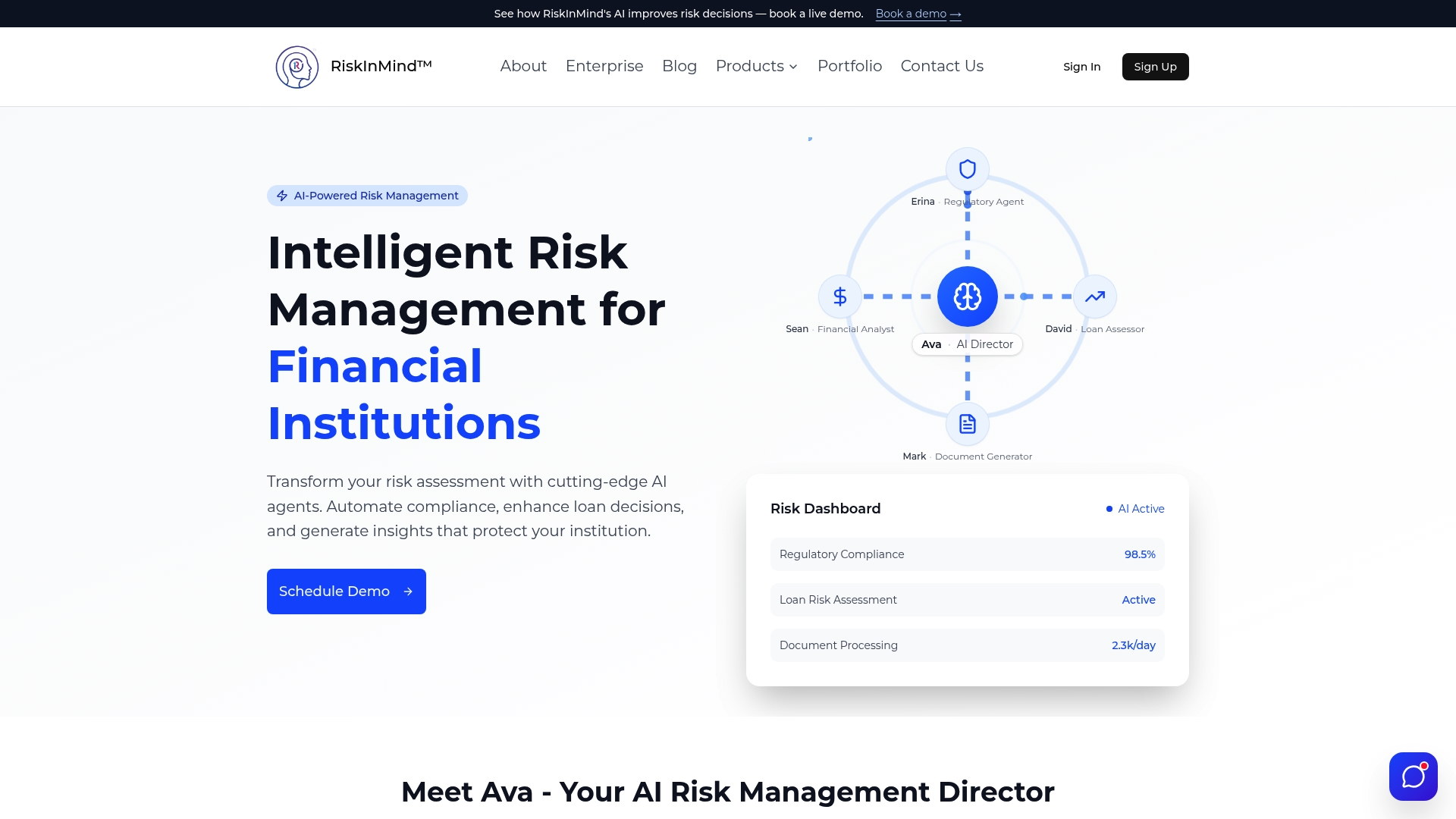
For financial institutions deploying ML models in credit risk, underwriting, and portfolio monitoring, the gap between a working prototype and a compliant, monitored production system is where most risk accumulates. Riskinmind's AI-powered platform is built specifically for this environment, combining real-time monitoring, SOC 2® certified infrastructure, and specialized AI agents for regulatory compliance and credit risk assessment. The platform's peer benchmarking and risk analytics capabilities give risk teams the continuous performance visibility that manual review cycles cannot provide. For organizations managing advanced AI risk strategies across multiple deployed models, Riskinmind provides the governance layer that keeps production systems reliable, auditable, and compliant.