
Mobile access for risk platforms is defined as the capability that allows risk managers to securely interact with risk management systems from any location, at any time, using mobile devices. This is not a convenience feature. It is a fundamental shift in how financial institutions manage credit risk, regulatory compliance, and portfolio monitoring. 38% of global organizations now use mobile treasury tools, and 68% of finance professionals identify mobile-enabled workflows as essential for talent retention. For credit union executives, community bank CROs, and lenders, understanding mobile access for risk platforms is now a baseline operational requirement.
What is mobile access for risk platforms?
Mobile access for risk platforms refers to secure, role-based interaction with enterprise risk management systems through native mobile applications or mobile-optimized interfaces. The industry term for the broader category is mobile governance, risk, and compliance, commonly abbreviated as mobile GRC. Risk professionals use both terms. Mobile GRC covers everything from real-time portfolio monitoring and regulatory reporting to loan approval workflows and audit trail generation, all executed from a smartphone or tablet.
Maintain 100% NCUA & OCC Audit Readiness
Monitor regulatory updates 24/7, check internal credit policies, and generate compliance trails with Erina (AI Regulatory Agent).
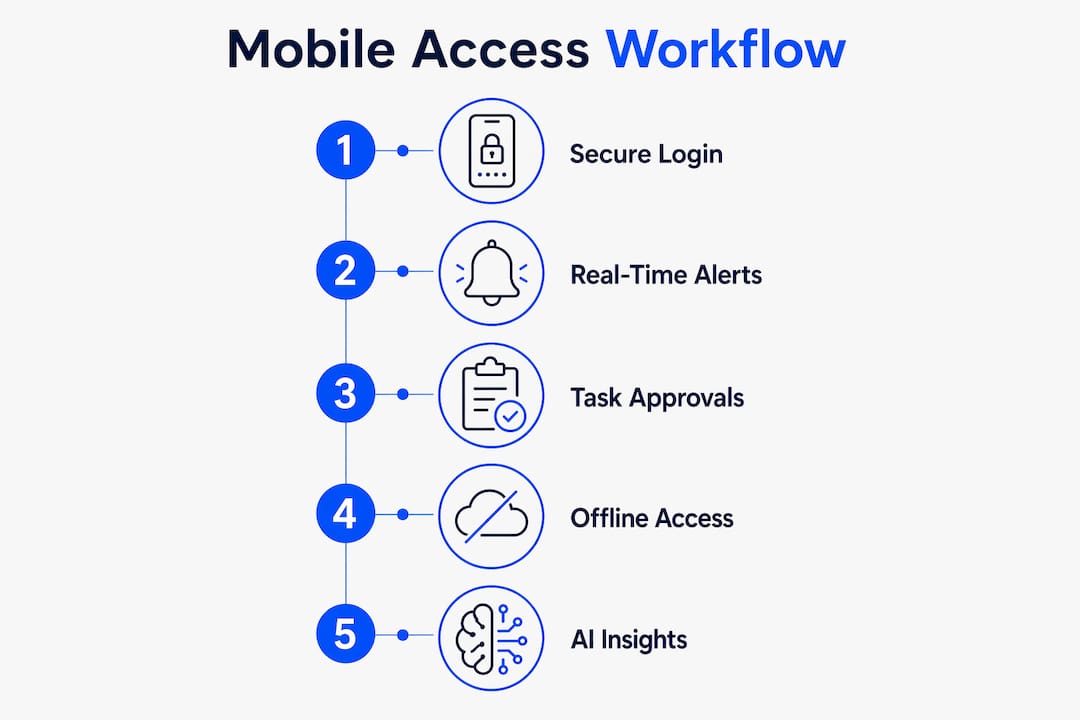
The distinction between mobile GRC and simply "checking email on a phone" is critical. Mobile access for risk platforms means the full risk workflow runs on the device. Risk managers can approve flagged transactions, review credit risk dashboards, respond to compliance alerts, and generate audit logs without returning to a desktop. That capability changes the speed and quality of risk decisions in ways that desktop-bound systems cannot match.

Riskinmind builds this capability directly into its AI-powered platform, designed specifically for credit unions, community banks, and lenders. Its mobile access features connect to a central AI director named Ava, who coordinates specialized AI agents covering credit risk, regulatory compliance, and market analysis. The result is a mobile experience that delivers real-time risk intelligence, not just a data display.
What operational benefits does mobile access provide?
Mobile access removes the desktop bottleneck from urgent risk decisions. When a credit officer needs to approve a time-sensitive loan modification or a compliance officer must respond to a regulatory alert at 7 PM, waiting until the next morning is not a neutral choice. Delayed decisions carry real credit risk and regulatory exposure. Mobile-enabled workflows reduce average time-to-completion for urgent risk tasks and create immutable audit trails that improve both compliance and operational reliability.
The operational benefits extend across several dimensions:
- Faster task completion. Risk managers close urgent approvals and compliance reviews without waiting for desktop access. That speed directly reduces exposure windows.
- Immutable audit trails. Every mobile action is logged with a timestamp, user identity, and device context. This creates audit-ready records that satisfy regulatory examiners without additional manual documentation.
- Point-of-work control execution. Mobile apps close the control execution gap by enabling mitigation actions to be completed and verified at the actual location of work, not entered retroactively into a desktop database.
- Crisis responsiveness. Mobile access supports rapid decision-making in crises by eliminating delays caused by desktop-bound processes, which is critical for multi-site financial operations.
- Staff flexibility. Risk professionals can maintain oversight during travel, remote work, or off-hours without compromising security or compliance posture.
Pro Tip: Build mobile approval workflows for your top five highest-frequency risk tasks first. Targeting the highest-volume actions delivers measurable time savings within the first quarter of deployment.
The mobile risk management workflow for financial institutions is most effective when it mirrors the desktop workflow exactly. Any gap between mobile and desktop functionality creates shadow processes, where staff work around the mobile tool rather than through it.
What governance and compliance challenges arise with mobile access?
Mobile access introduces governance complexity that desktop-only environments do not face. The core challenge is that risk data now travels across devices the institution may not own, operating systems it may not control, and networks it definitely does not manage. Mobile compliance requires governing access to sensitive data based on user role, device, and application, with continuous monitoring to meet regulations like GDPR and HIPAA.
The most common governance pitfalls in mobile risk environments include:
- Mixed device ownership. Bring-your-own-device policies create visibility gaps. Personal devices may lack the security configurations required for handling regulated financial data.
- Diverse operating systems. Android and iOS update cycles differ. A security patch on one platform may not exist on another for weeks, creating uneven compliance posture across the team.
- Audit readiness gaps. Without automatic logging at the mobile layer, compliance teams cannot reconstruct decision sequences for regulatory examiners.
- Policy enforcement inconsistency. Policies written for desktop environments often fail to account for mobile session behaviors, such as background app refresh or screen capture.
Sustainable mobile compliance requires clear cross-device policies, continuous enforcement, and governance focused on data access behavior rather than device security alone. That framing matters. Institutions that focus only on device-level controls miss the more dangerous risk: what data is accessed, by whom, and under what conditions.
Pro Tip: Treat mobile access governance as a data behavior problem, not a device security problem. Map every sensitive data type to a role-based access rule before you deploy any mobile risk tool.
The role of automation in financial compliance becomes especially important in mobile environments, where manual policy enforcement is impractical at scale.
How do technology choices impact mobile access effectiveness?
The technology architecture of a mobile risk platform determines whether it actually works under real operating conditions. Traditional mobile workarounds like VPN access and mobile browser sessions often fail during critical operations, causing delays and authentication issues. A risk manager locked out of a VPN session during a credit committee review is not just inconvenienced. The institution has a control failure on record.
Native mobile applications set the correct standard. They handle authentication through biometrics, maintain session integrity without VPN dependency, and support offline workflows with automatic syncing when connectivity returns. Cached offline access and automatic syncing enable continuous workflows without disruption, which matters for risk managers operating across multiple sites or in areas with unreliable connectivity.
The table below contrasts the two primary implementation approaches:
| Capability | VPN or browser-based access | Native mobile app |
|---|---|---|
| Session stability | Frequent timeouts and failures | Persistent, managed sessions |
| Offline functionality | None | Cached data with auto-sync |
| Biometric authentication | Rarely supported | Standard feature |
| Audit trail generation | Incomplete or manual | Automatic and immutable |
| Regulatory compliance posture | Difficult to enforce | Policy-enforced by design |
AI integration is the second critical technology decision. Embedding AI into mobile GRC apps enables real-time risk detection and predictive analytics, giving risk managers context-aware alerts rather than raw data feeds. Riskinmind's platform processes risk signals with response times under half a second, which means a mobile alert reaches the risk manager before the exposure window widens.
Pro Tip: Require any mobile risk platform vendor to demonstrate offline workflow continuity during your evaluation. If the app cannot function without a live connection, it will fail you at the worst possible moment.
What strategic implications should risk leaders consider?
Mobile access is a talent retention variable, not just an operational tool. 68% of finance professionals in 2026 surveys identified mobile-enabled workflows as essential for flexible work. Risk departments that cannot offer mobile access will lose experienced professionals to institutions that can. That is a direct credit risk and compliance risk, because institutional knowledge walks out with departing staff.
Risk leaders evaluating mobile access adoption should work through the following strategic priorities:
- Align mobile policy with enterprise risk culture. A mobile risk tool that bypasses your existing approval hierarchies creates more risk than it solves. Map mobile workflows to your existing governance structure before deployment.
- Treat mobile access as a crisis management asset. Governance leaders rely on mobile access to make rapid decisions in crises, avoiding errors and delays inherent in traditional methods. Build this into your business continuity plan explicitly.
- Plan for continuous governance, not a one-time deployment. Mobile operating systems, device types, and regulatory requirements change constantly. Mobile access governance requires the same ongoing attention as your credit risk models.
- Evaluate AI-powered mobile platforms for predictive capability. AI in mobile GRC shifts risk management from reactive to predictive by analyzing location, user actions, and logs in real time. That shift changes the value proposition from "faster access" to "earlier warning."
- Measure mobile access as a competitive differentiator. Institutions with mature mobile risk workflows respond faster to regulatory changes, close credit decisions more quickly, and retain experienced risk staff at higher rates.
The risk technology roadmap for financial institutions increasingly places mobile-first risk access at the center of digital transformation planning, not at the periphery.
Key Takeaways
Mobile access for risk platforms is a governance and operational requirement for financial institutions, not a supplementary feature, and institutions that treat it as optional accept measurable credit, compliance, and talent risk.
| Point | Details |
|---|---|
| Core definition | Mobile GRC gives risk managers full workflow access from any device, not just data visibility. |
| Operational impact | Native mobile apps close the control execution gap and generate immutable audit trails automatically. |
| Governance priority | Govern data access behavior by role and context, not device security alone. |
| Technology standard | Native apps with offline sync and biometric authentication outperform VPN or browser-based workarounds. |
| Strategic value | Mobile access retains experienced risk staff and enables faster crisis response across multi-site operations. |
Why mobile access is the foundation of operational resilience
I have spent years watching financial institutions treat mobile risk access as a bolt-on feature, something to add after the "real" platform work is done. That framing is wrong, and it costs institutions in ways that are hard to see until a crisis makes them visible.
The most common misconception I encounter is that mobile access is primarily a convenience play for remote workers. The actual value is structural. When a risk manager can execute a mitigation control at the point of work and generate a verified audit trail in the same action, you have closed a gap that desktop systems leave open by design. That gap is where regulatory findings live.
The second misconception is that AI and mobile access are separate conversations. They are not. The real power of mobile risk platforms comes from AI that analyzes what is happening on the device in real time and surfaces the right alert to the right person before the exposure becomes a loss. Riskinmind's approach, with Ava coordinating specialized AI agents across credit risk, compliance, and market analysis, reflects this architecture correctly.
My honest view is that institutions delaying mobile risk platform adoption are not saving money. They are accumulating a governance debt that will surface in the next regulatory examination or the next credit event that required a decision at 9 PM on a Friday.
— Raj
Riskinmind's mobile-native risk platform for financial institutions
Riskinmind builds AI-powered risk management specifically for credit unions, community banks, and lenders. Its mobile access capabilities are native to the platform, not added later. Risk managers get real-time dashboards, AI-generated compliance alerts, and full audit trail generation from any device, all backed by SOC 2® certification and bank-grade security.
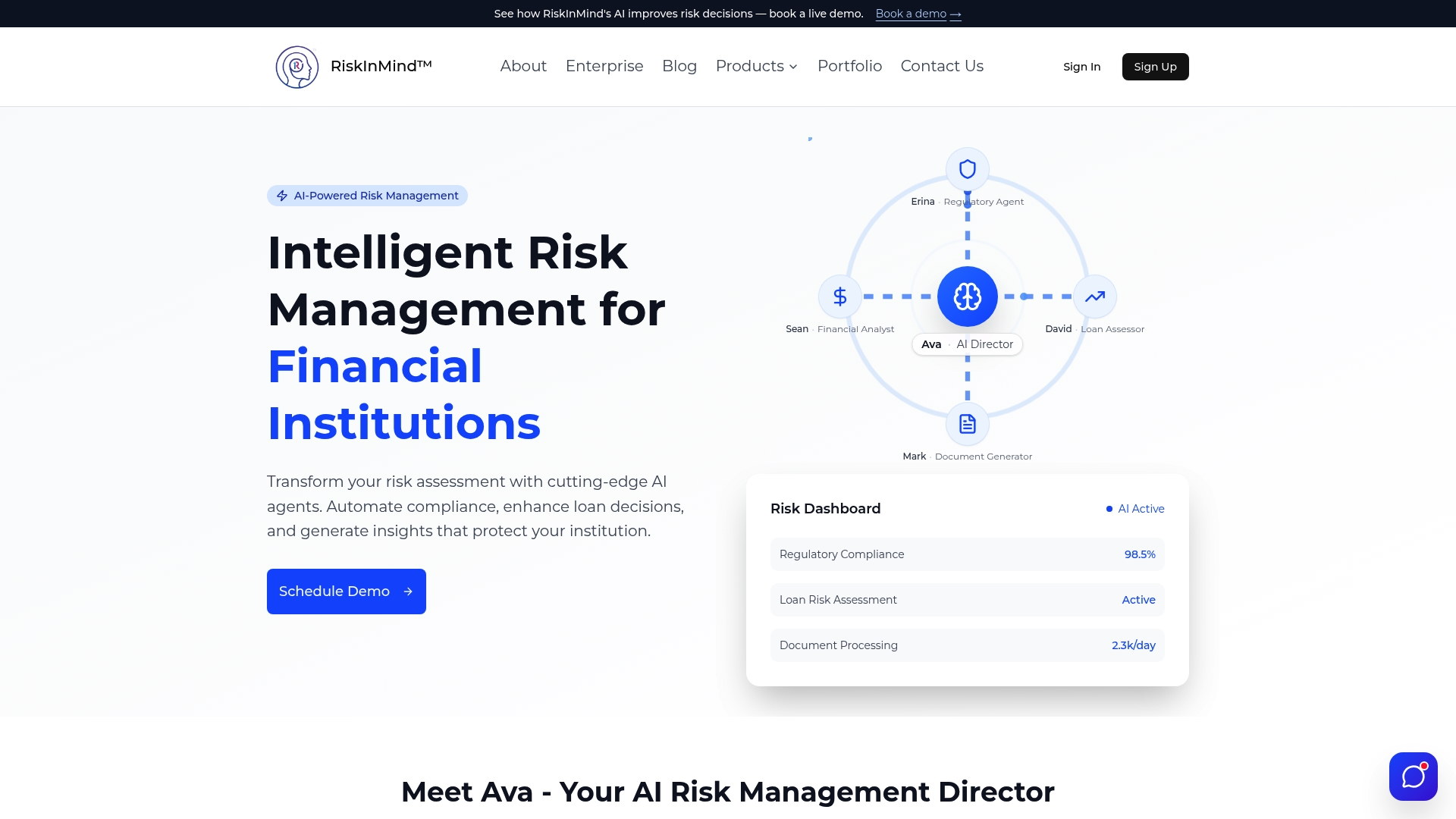
The platform's AI director, Ava, coordinates specialized agents covering credit risk assessment, regulatory compliance, and market analysis, delivering context-aware risk intelligence in under half a second. For institutions ready to move beyond desktop-bound workflows, Riskinmind's AI-powered risk management platform offers a practical starting point. Risk professionals can also review the step-by-step risk assessment workflows that mobile access supports across the full credit and compliance lifecycle.
FAQ
What is mobile access for risk platforms?
Mobile access for risk platforms is the capability that allows risk managers to securely interact with enterprise risk management systems from any location using mobile devices. It covers full workflow execution, including approvals, compliance monitoring, and audit trail generation, not just data viewing.
Why does mobile access matter for risk managers?
Mobile access eliminates desktop bottlenecks from urgent risk decisions, reduces time-to-completion for critical tasks, and generates immutable audit trails that satisfy regulatory requirements. It also supports talent retention, with 68% of finance professionals identifying mobile-enabled workflows as essential.
What are the main compliance risks of mobile access?
The primary compliance risks include mixed device ownership, inconsistent policy enforcement across operating systems, and audit readiness gaps when mobile actions are not automatically logged. Governing data access behavior by user role and context, rather than focusing only on device security, addresses these risks most effectively.
How does AI improve mobile risk management?
AI embedded in mobile GRC platforms enables real-time anomaly detection and predictive alerts, shifting risk management from reactive to proactive. Platforms like Riskinmind process risk signals in under half a second, delivering context-aware intelligence directly to the risk manager's device.
What technology standard should financial institutions require for mobile risk access?
Financial institutions should require native mobile applications with biometric authentication, offline workflow support with automatic syncing, and automatic audit trail generation. VPN-based or browser-based mobile access fails under real operating conditions and does not meet enterprise compliance requirements.