
Regulatory deadlines are compressing, AI capabilities are expanding faster than most governance structures can absorb, and the financial institutions that fall behind on both fronts face compounding exposure. The U.S. Treasury's FS AI RMF, released in February 2026 with 230 control objectives, has reset the baseline for what compliant AI adoption looks like in financial services. At the same time, advanced AI tools are reshaping credit assessment, portfolio monitoring, and regulatory reporting in ways that create both competitive advantage and new risk vectors. This guide walks you through the full implementation journey, from foundational prerequisites to operationalizing controls and deploying purpose-built AI across core risk functions.
Automate Regulatory Model Risk Governance
Examine models against 32 qualitative criteria and resolve risk Tiers with pre-deployment checklists per OCC 2011-12 guidelines.
Table of Contents
- Critical prerequisites for advanced AI risk management
- Integrating FS AI RMF: Mapping, embedding, validating controls
- AI for credit assessment: Empowering compliance and explainability
- Portfolio risk management: AI-driven stress testing and dynamic allocation
- Why most risk management strategies fail: Gaps, governance, and the path forward
- Put advanced AI risk management into practice today
- Frequently asked questions
Key Takeaways
| Point | Details |
|---|---|
| Embed, don’t document | Operationalizing controls within infrastructure is essential for true AI risk management, not just writing policies. |
| Prioritize governance gaps | Bridging governance and risk ownership silos is more game-changing than new tools alone. |
| Leverage AI for compliance | Modern AI frameworks boost efficiency and transparency, particularly in credit and portfolio risk. |
| Continuous improvement is key | AI-powered systems must be monitored and updated to ensure resilience in a fast-moving regulatory environment. |
Critical prerequisites for advanced AI risk management
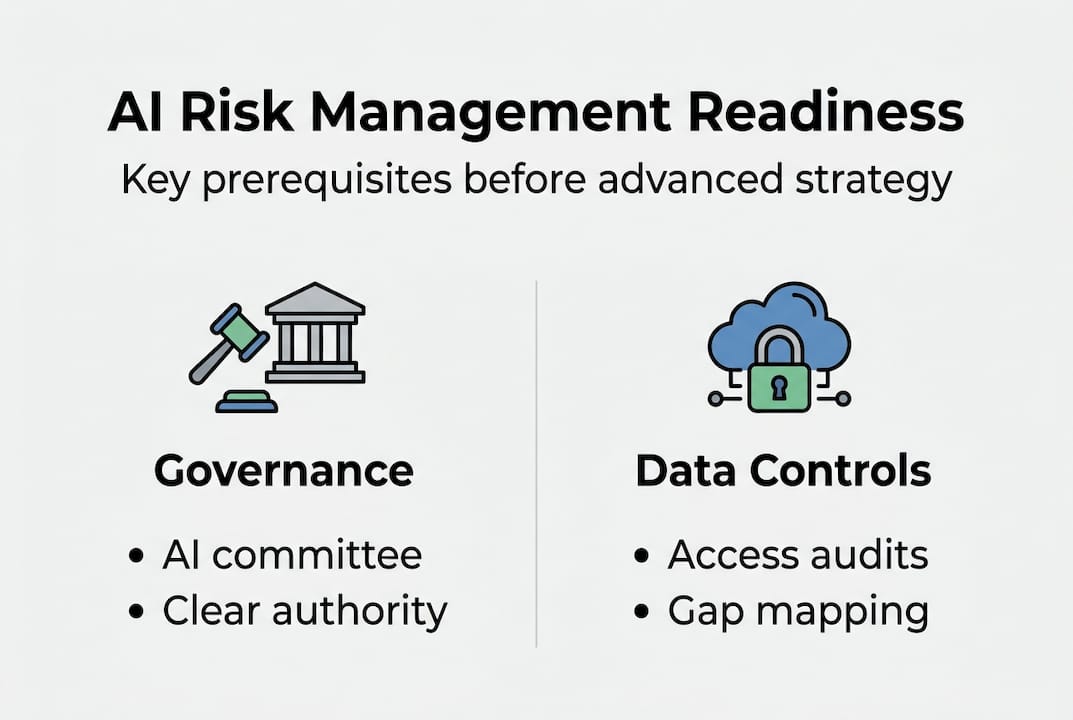
Before operationalizing any advanced AI strategy, you need to conduct an honest assessment of your institution's readiness across four domains: governance, policy, technology infrastructure, and workforce capability. Skipping this audit phase is one of the most common and costly mistakes risk leaders make, often discovering mid-implementation that they lack the committee structures or data pipelines to support their ambitions.
The readiness picture across the industry is sobering. Only 35.8% of financial institutions have ethical AI policies in place, 33.8% have governance committees, and just 12.2% have well-defined generative AI strategies. If your institution falls into the majority on any of these dimensions, those gaps need to close before you layer on advanced capabilities.
Here is a baseline readiness checklist your team should work through:
- Governance committee: A named body with authority to approve, pause, or retire AI models
- Ethical AI policy: Written standards covering fairness, bias testing, and prohibited use cases
- Centralized model inventory: A living catalog of all AI and ML models in production
- Data quality controls: Documented pipelines with validation, lineage tracking, and access logging
- AI literacy programs: Role-specific training for risk officers, compliance staff, and front-line users
- Baseline infrastructure: API-ready data architecture and MLOps tooling capable of supporting model monitoring
Start by auditing your existing committee structures and data access controls, then map gaps against these criteria. Investing in streamlining risk analysis early pays dividends throughout later implementation phases. You can also review AI risk management insights for practical frameworks that connect governance readiness to execution.
Pro Tip: Engage legal, compliance, IT, and business line leaders in the readiness audit simultaneously. Misalignment discovered at the governance stage costs far less to fix than misalignment discovered during model validation.
| Prerequisite domain | Key readiness criteria |
|---|---|
| Governance | Named AI risk committee with documented authority |
| Ethical policy | Bias testing, fairness standards, prohibited use definitions |
| Model inventory | Centralized catalog updated in real time |
| Data infrastructure | Validated pipelines, lineage tracking, role-based access |
| AI literacy | Training programs for risk, compliance, and operations staff |
Integrating FS AI RMF: Mapping, embedding, validating controls
With the foundation in place, you are ready to bring the AI risk management framework to life through practical integration. The distinction that separates successful implementations from failed ones is architectural depth: policy documents that describe controls are not the same as controls that are actually enforced at the infrastructure layer.
Operationalizing the FS AI RMF means embedding its 230 controls across four infrastructure layers: data, model, identity and access management, and monitoring. Each layer requires specific technical integration, not just written acknowledgment.
Follow this sequence for structured integration:
- Map controls to infrastructure layers: Assign each of the 230 controls to its primary enforcement point, whether that is a data pipeline, model registry, identity provider, or monitoring dashboard.
- Integrate data controls: Implement automated data quality checks, retention schedules, and encryption standards directly within your data pipelines.
- Embed model controls: Enforce version control, validation gates, and bias testing within your MLOps workflows so no model reaches production without documented review.
- Apply identity and access controls: Restrict model access by role, log all queries, and enforce multi-factor authentication for systems handling sensitive decisioning.
- Activate monitoring pipelines: Configure real-time drift detection, performance degradation alerts, and anomaly flags tied directly to your governance dashboard.
- Validate through automated testing: Run continuous integration pipelines that verify control adherence before any model update goes live.
"Institutions that treat FS AI RMF compliance as an architectural challenge rather than a documentation exercise will be positioned to respond faster when regulators increase scrutiny." Mindforge on FS AI RMF operationalization
The FS AI RMF was adapted from the NIST AI Risk Management Framework specifically for financial services, meaning its control categories align with existing regulatory expectations around model risk management. That alignment is a structural advantage you can leverage by cross-referencing existing SR 11-7 documentation with the new control objectives.
Pro Tip: Use MLOps platforms to automate real-time monitoring and rapid validation cycles. Manual review at the cadence regulators now expect is not operationally sustainable, and security controls in practice demand continuous, not periodic, enforcement.
| Approach | Outcomes | Regulatory effectiveness |
|---|---|---|
| Policy-only controls | Documentation exists, enforcement is manual | Low: gaps emerge under audit |
| Operationalized controls | Automated enforcement at infrastructure layer | High: evidence is system-generated |
AI for credit assessment: Empowering compliance and explainability
Once your broader controls are embedded, focus turns to AI applications that directly impact lending and risk. Credit assessment is where advanced AI delivers some of its most measurable returns, and where regulatory scrutiny around fairness and transparency is most intense.
AI-powered credit decisioning now incorporates real-time alternative data, agentic AI actions, and explainable AI (XAI) to improve both accuracy and auditability. The practical effect is faster decisions with stronger compliance documentation, provided the system is configured correctly from the start.
Here is a structured approach for embedding AI in credit workflows:
- Define compliant data inputs: Identify which alternative data sources your institution will use, document their permissibility under fair lending law, and establish refresh cycles.
- Configure XAI outputs: Require that every automated credit decision produce a human-readable explanation log tied to specific input factors.
- Establish audit trails: Integrate decision logs directly with your compliance management system so examiners can access records without manual retrieval.
- Test for disparate impact: Run regular bias analyses across demographic proxies before models go live and on a quarterly basis thereafter.
- Deploy agentic monitoring: Allow AI agents to flag anomalous decision patterns in real time, triggering review queues before violations accumulate.
The types of alternative data now in active use include:
- Cash flow patterns from bank account transaction data
- Rent and utility payment histories
- Employment verification through payroll APIs
- Small business revenue trends from accounting software integrations
- Supply chain indicators for commercial borrowers
Tools like RiskInMind's credit memo generator and AI loan assessor bring these capabilities into a single workflow, reducing decision times while maintaining the explainability documentation regulators require. AI in credit assessment using XAI reduces decision times while preserving complete auditability, a combination that manual processes simply cannot match at scale.
Statistic callout: Institutions using XAI-enabled credit models report audit preparation time reductions of over 30%, because decision rationale is generated automatically at the point of each decision rather than reconstructed after the fact.
Portfolio risk management: AI-driven stress testing and dynamic allocation
Beyond credit, optimization of overall portfolio risk requires robust, ongoing AI-driven processes that respond to macroeconomic signals in near real time. Traditional stress testing cycles, typically quarterly or annual, leave institutions exposed to shifts that materialize in weeks, not months.

Portfolio AI now performs macroeconomic stress simulations, detects subtle correlations across asset classes, executes dynamic risk-weight adjustments, and maintains continuous intelligence loops that alert risk officers before concentration risk becomes acute. The practical implication is a shift from reactive to anticipatory risk posture.
Executing a continuous intelligence loop in your portfolio function requires these steps:
- Ingest macroeconomic feeds: Connect real-time economic indicators, rate curves, and sector performance data directly to your portfolio analytics engine.
- Run scenario simulations continuously: Replace periodic stress tests with rolling simulations that update as new data arrives.
- Apply dynamic risk weighting: Allow the AI system to recalibrate risk weights based on correlation shifts, not just static category rules.
- Trigger intelligent provisioning: Configure automated alerts when concentration thresholds are approached, linking directly to reserve adjustment workflows.
- Generate CRO dashboards: Synthesize simulation outputs into executive-ready summaries with actionable signals, not raw model outputs.
For institutions earlier in their AI maturity journey, the AI-driven portfolio risk response case study illustrates how earlier signal detection could have changed outcomes in a recent bank failure scenario. Those already operating advanced systems should prioritize integration with portfolio AI alerts to close the gap between model outputs and decision-maker action.
| Capability | Traditional approach | AI-augmented approach |
|---|---|---|
| Stress testing frequency | Quarterly or annual | Continuous, real-time |
| Correlation detection | Manual, category-based | Automated, cross-asset |
| Risk-weight adjustment | Static rule sets | Dynamic, data-driven |
| Provisioning triggers | Threshold-based, lagged | Predictive, early-warning |
Why most risk management strategies fail: Gaps, governance, and the path forward
Having covered how to build and execute advanced strategies, it is worth being direct about why so many of these efforts fall short, because the answer is rarely the technology.
The most common failure mode is underestimating governance complexity and change management. Banks are split on whether AI risk ownership belongs to model risk teams or enterprise risk overseen by senior leadership, and that ambiguity creates accountability gaps that regulators will probe. Divided responsibility models produce coverage blind spots, inconsistent control enforcement, and delayed escalation when anomalies appear.
Most institutions also still operate with siloed risk teams, where credit, market, and operational risk functions each maintain separate data environments and model inventories. That fragmentation makes holistic oversight nearly impossible and directly undermines the continuous intelligence loop that advanced portfolio AI requires.
The practical lesson: success depends on cross-functional alignment and architectural integration, not just policy alignment. Institutions that treat overcoming compliance gaps as an IT problem rather than an organizational one will keep rebuilding the same infrastructure without closing the governance gaps that defeat it.
Pro Tip: Develop ongoing AI literacy programs for risk officers at all levels. When your people understand how the models work and where they can fail, they become the most effective layer of oversight you have.
Put advanced AI risk management into practice today
Building a rigorous AI risk management strategy takes deliberate architecture, cross-functional commitment, and the right technology layer to bring it all together.
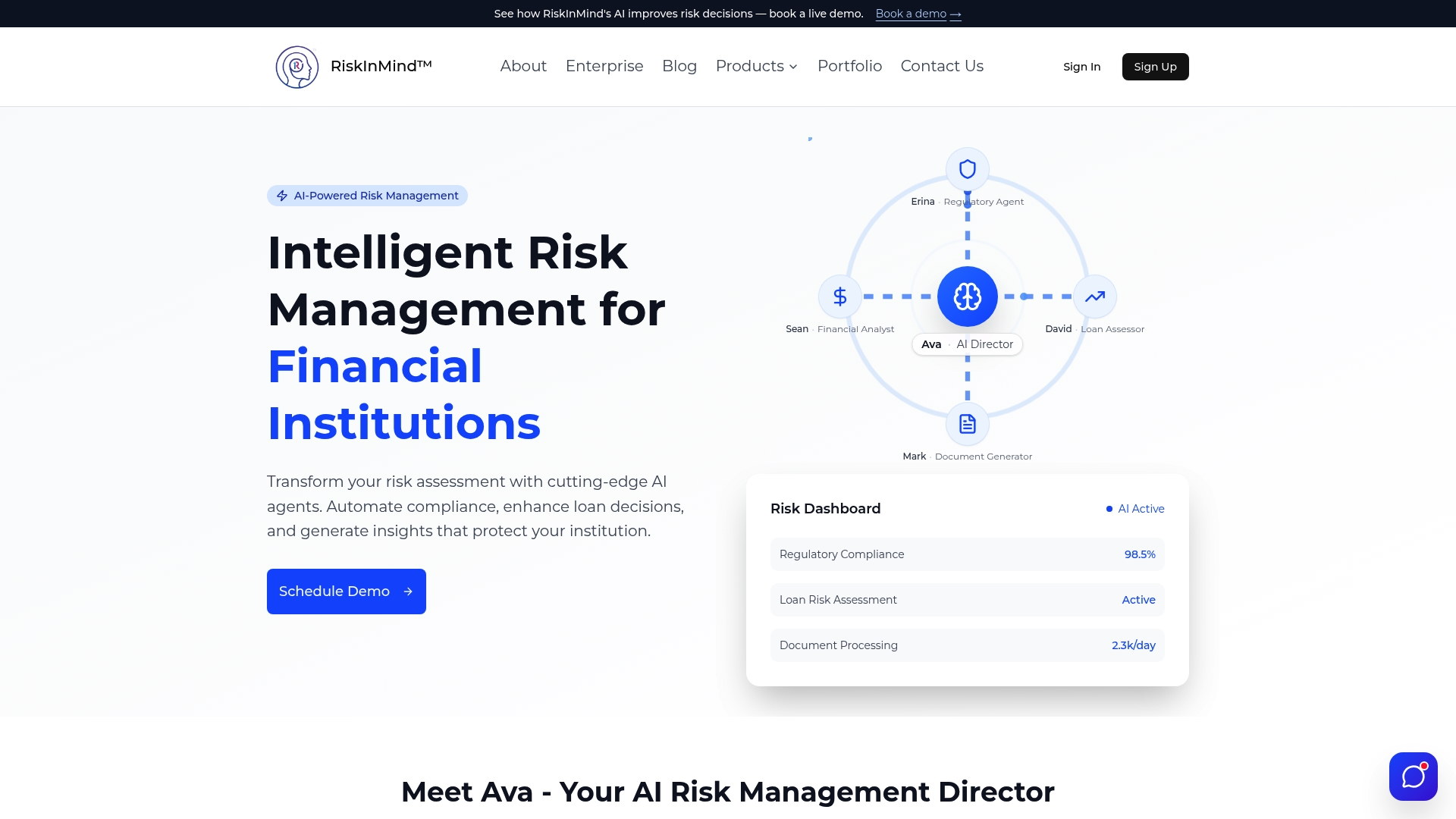
RiskInMind's AI-powered risk management platform is purpose-built for financial institutions navigating exactly this challenge, with specialized AI agents for credit risk, automating compliance, and portfolio monitoring operating under a unified governance framework. From CRE loan AI analysis to real-time regulatory reporting, the platform embeds the controls and explainability your examiners expect. SOC 2® certified and capable of sub-half-second response times, RiskInMind is designed to scale with your risk function as regulatory demands increase. Request a demo and see how quickly implementation can begin.
Frequently asked questions
What is the FS AI RMF and why is it important for 2026?
The FS AI RMF is the U.S. Treasury's 230-control framework released in February 2026, providing financial institutions with a structured compliance architecture for AI adoption across data, model, and monitoring layers.
How do AI risk management strategies improve compliance and efficiency?
Advanced AI automates control monitoring and surfaces compliance risks earlier in the cycle, with portfolio AI benchmarks showing over 20% efficiency gains when paired with XAI for fair lending auditability.
What are common challenges in operationalizing advanced AI risk management?
The primary barriers are insufficient governance structures, unclear AI risk ownership, and embedding controls only in policy documents rather than enforcing them at the infrastructure layer.
How can XAI help meet regulatory requirements in credit decisions?
Explainable AI in credit assessment automatically generates decision rationale logs that document the specific factors driving each outcome, giving regulators auditable evidence of fair lending compliance without manual reconstruction.
Recommended
- RiskInMind - AI-Powered Risk Management Solutions
- Turning the First Bank Failure of 2026 Into a Warning Signal: How AI‑Driven Risk Management Could Have Saved Metropolitan Capital Bank & Trust | RiskInMind
- Transforming Credit Union Growth with AI-Powered Risk Intelligence | RiskInMind
- Streamline your risk analysis process for better compliance | RiskInMind
- Cryptocurrency Trading Strategies 2025: AI’s Role in Volatile Markets