
A credit early warning system (EWS) is a trigger-driven monitoring layer that detects borrower stress earlier than traditional periodic reviews allow. For most risk teams, the immediate next step is not a full platform overhaul but a focused pilot: internal portfolio data paired with at least one external feed, scoped tightly enough to prove detection lead time within a quarter.
TL;DR:
- Set tiered triggers that route alerts to named owners with response windows, then report watchlist movement and performance to senior leaders and the board.
- Pair payment changes and utilization spikes with sector conditions, then add rare signals like management turnover only when their lead time outweighs false positive risk.
- Blend internal transaction records with specialty and macro feeds, using peer comparisons and combined models rather than relying on raw balances or one score.
- Choose a pilot segment with enough volume to validate triggers yet small enough for manual review, and track detection lead time and false positive rates.
- Require explainability documentation, backtesting, bias monitoring, and documented model changes, while tracking Gini and F1 alongside lead time to assess model revisions.
Automate Regulatory Model Risk Governance
Examine models against 32 qualitative criteria and resolve risk Tiers with pre-deployment checklists per OCC 2011-12 guidelines.
Table of Contents
- What an early warning system is and where it sits in risk operations
- Key early-warning indicators and signals to monitor
- Data, analytics and model design for effective early warning
- Implementing EWS: pilot steps, triggers, workflows and governance
- How an enterprise AI risk platform maps to EWS requirements
- Author perspective: near-term priorities and what risk committees should watch
- Practical next step: request a RiskInMind demo or pilot
- FAQ
- Sources
What an early warning system is and where it sits in risk operations
An EWS exists to flag deteriorating credit quality between formal review cycles, catching stress while remediation options are still wide open. It does not replace internal risk ratings; it feeds them. A well-built EWS pushes triggered accounts onto a watchlist, prompts a credit officer review, and documents the outcome, closing the loop between detection and action rather than leaving alerts to sit in a dashboard.

Supervisory guidance from the BCBS on credit risk management expects banks to maintain systems for early remedial action, with internal risk ratings and monitoring tied directly to governance and board reporting. That expectation shapes how an EWS should be designed from the start, not bolted on afterward.
Three things distinguish a working EWS from a dashboard that looks busy but changes nothing:
- It operates on a defined trigger hierarchy, not a single composite score.
- It routes alerts to a named owner with a required response window.
- It reports outcomes to senior management and the board on a fixed cadence, tying detection to provisioning decisions.
Key early-warning indicators and signals to monitor
Indicator selection determines whether an EWS earns its keep or generates noise that credit officers learn to ignore. The strongest frameworks layer several signal types so that no single data gap blinds the system.
- Behavioral signals: payment pattern shifts, rising NSF frequency, and early-stage delinquency trends that precede a formal past-due status.
- Account and transaction metrics: balance volatility, sudden utilization spikes on revolving lines, and declining average account balances relative to history.
- Commercial and management signals: executive or ownership turnover, deferred capital expenditure, and increased use of payment-in-kind (PIK) structures, which the Federal Reserve Bank of Boston has linked to rising stress in business development company portfolios since 2022.
- Macro and peer signals: sector-level deterioration and spread compression that place an otherwise stable borrower inside a weakening industry cohort.
Prioritization matters as much as coverage. A signal with a long detection lead time but a high false-positive rate will burn credit officer attention faster than it builds confidence in the system, so calibration should weigh both dimensions before a trigger goes live.
Pro Tip: Low-frequency signals like management turnover or deferred capex rarely fire, but when they do, they tend to precede measurable delinquency by a meaningful margin, so weight them accordingly rather than discounting them for being rare.
Data, analytics and model design for effective early warning
Reliable early warning depends on blending internal records with specialty and macro data, then running that mix through models built for explainability rather than raw predictive power alone. Internal accounting and transactional data form the base layer; specialty feeds such as Early Warning Services add deposit-account screening data that institutions can use to evaluate account-opening and payment risk alongside their own history.
An EY briefing on EWS frameworks frames successful implementations around three pillars: data, analytics and technology, and process and governance. That structure holds up in practice.
- Feature engineering should include balance-to-limit ratios, volatility measures, and sector-adjusted peer comparisons rather than raw balances alone.
- Ensemble or meta-models tend to outperform single-score approaches because they combine behavioral, transactional, and macro inputs without forcing one signal type to carry the whole model.
- Natural language processing can extract industry-level stress signals from news and filings that structured data misses entirely.
- Model governance, including backtesting, bias monitoring, and documented change control, keeps the system audit-ready when examiners ask how a trigger was calibrated.
Validation metrics like Gini and F1 scores, tracked alongside detection lead time, give model risk teams a consistent way to judge whether a rebuilt model is actually improving on the version it replaces. Our own view, explored further in why dynamic risk assessment matters for lenders now, is that static annual scoring simply cannot keep pace with how fast these signals move.
Implementing EWS: pilot steps, triggers, workflows and governance
A phased rollout protects credibility with both front-line staff and the board. Starting too broad invites alert fatigue before the model has proven itself.
- Select a pilot segment with enough volume to validate triggers but small enough to review manually, such as one commercial vertical or a defined consumer product line.
- Define trigger tiers, mapping each to a specific remediation action: a tier-one alert might prompt a relationship manager call, while a tier-three alert escalates straight to credit review and a formal watchlist placement.
- Assign ownership so relationship managers, credit officers, and credit review each know which alerts they act on and within what window.
- Set success metrics before launch, including detection lead time versus the prior review cycle and false-positive rate on triggered accounts.
- Report to senior management and the board on a fixed cadence, feeding watchlist movement and trigger performance directly into CECL reserve discussions.
Our guide on the role of risk committees in banks covers board review cadence in more depth, which matters here because an EWS without a reporting line to governance is just a model running in isolation.
How an enterprise AI risk platform maps to EWS requirements
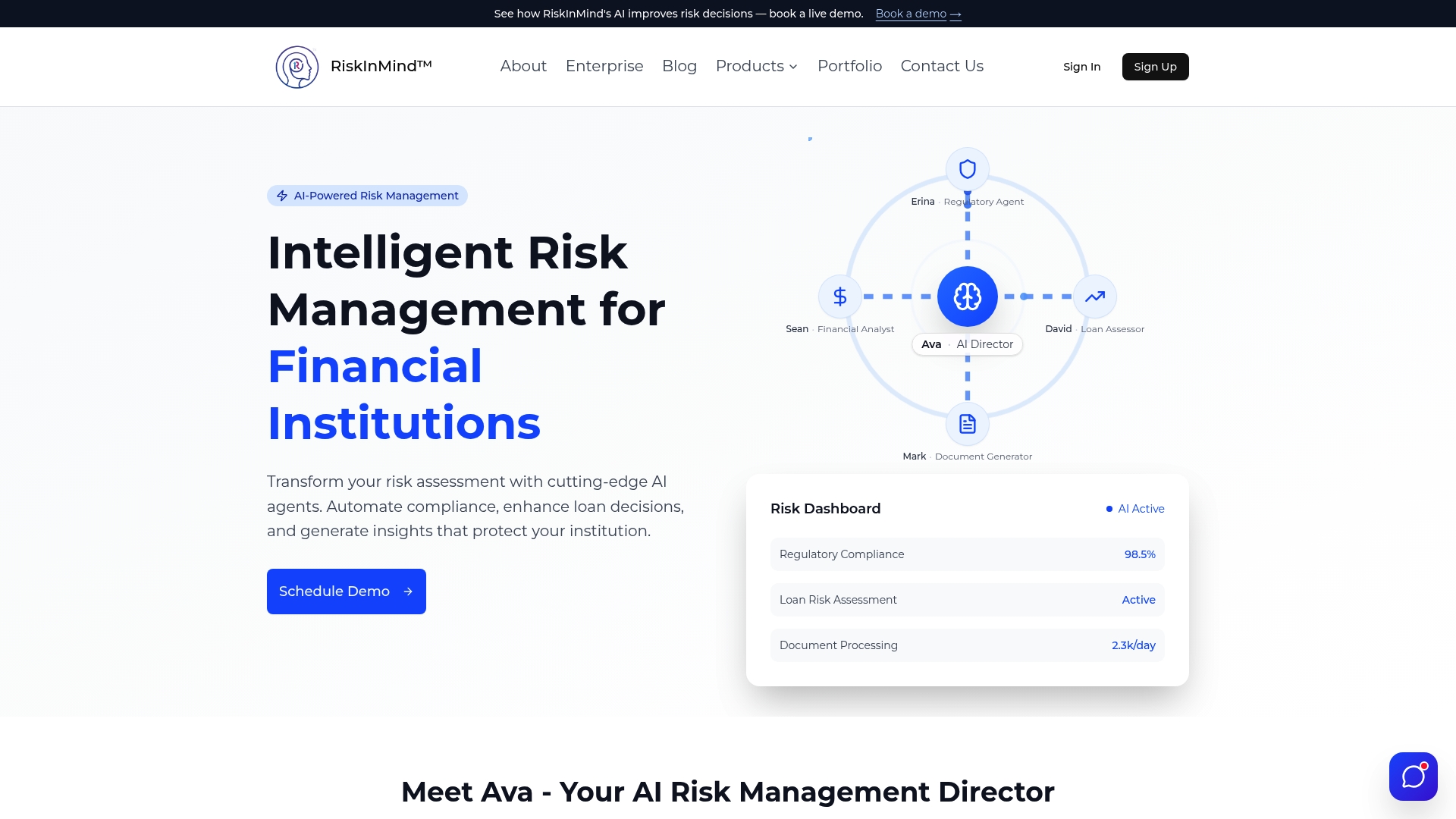
The data, model, and governance needs described above point toward a specific kind of platform: one built for real-time processing, auditable decisions, and workflow automation rather than periodic batch scoring. We built RiskInMind around that requirement set.
- Sub-second processing supports real-time trigger evaluation instead of overnight batch runs that delay detection by a full cycle.
- A coordinated suite of AI agents, overseen by a central AI director, handles credit risk assessment, regulatory compliance, and portfolio monitoring as connected workflows rather than separate tools.
- SOC 2® aligned controls and bank-grade security give audit trails the granularity that examiners expect when reviewing how a trigger fired and who acted on it.
- Packaged use cases, including CRE portfolio monitoring through our CRE loan risk predictor, give teams a starting point rather than a blank model-building exercise.
Regulatory guidance consistently emphasizes early remedial action and governed monitoring systems, per the BCBS prudential framework, which is the same standard we designed our watchlist automation and audit trail features to meet.
A pilot built on our platform typically centers on portfolio monitoring, CRE exposure, or CECL readiness, each scoped to prove detection lead time and governance fit before a wider rollout.
Author perspective: near-term priorities and what risk committees should watch
Private credit's opacity is catching up with it. Rising PIK usage and spread compression are detectable well before default, yet many portfolios still treat these as footnotes rather than triggers. Procurement teams are also starting to demand explainability from AI models, not just accuracy scores. Our recommendation for this quarter: have the risk committee formally request model explainability documentation alongside detection metrics for any EWS vendor under evaluation.
— Raj
Practical next step: request a RiskInMind demo or pilot
We created an AI risk management platform to turn governance and data requirements into a working system rather than a planning document. A demo request is the fastest way to see whether our platform fits your portfolio's specific trigger logic and reporting needs.
When you request a demo, ask us to show:
- How our data connectors ingest internal portfolio data alongside external feeds.
- How watchlist automation routes tier-based alerts to the right owner.
- How our audit trails document trigger history for examiner review.
Pricing details across our Starter, Professional, and Enterprise plans are available on our pricing page, where you can also schedule a pilot scoped to your portfolio.
FAQ
How can someone get removed from an Early Warning record?
Consumers can dispute inaccurate information in writing, and Early Warning generally has up to 30 calendar days to complete a reinvestigation under FCRA procedures. Outcomes may include removal, correction, or retention of the disputed item, depending on what the furnishing institution confirms.
Is Early Warning Services a legitimate company?
Yes. Early Warning Services, LLC is a consumer reporting company listed by the CFPB that provides deposit-account screening data to financial institutions evaluating account-opening and payment risk.
How long does information stay on an Early Warning record?
Retention periods depend on the type of record and applicable FCRA rules, and Early Warning does not publish a single universal duration. Consumers who want specifics on their own file should request a disclosure directly and review the reinvestigation outcome for any disputed item.
Which banks use Early Warning Services for screening?
Early Warning Services works with financial institutions broadly that need deposit-account screening data, rather than a published list of specific bank names. Institutions typically use this data as one input among several when evaluating new account risk.
What early-warning indicators should credit risk teams prioritize first?
Behavioral signals like NSF frequency and early delinquency trends, combined with account-level utilization spikes, tend to offer the clearest early read with manageable false-positive rates. Teams should layer in slower-moving commercial signals, such as management turnover, once the behavioral triggers are calibrated.
Sources
- The future of early warning systems in banking | EY
- BCBS prudential guidance on credit risk management (Basel/BCBS)
- Early warning signals in private credit — Federal Reserve Bank of Boston
- Early Warning Services, LLC (CFPB company listing)
- Dispute your Early Warning® file disclosure information | Early Warning